
Buy the policy for where you operate, not for the game you run. Most GellyBall operators do it the other way around. They spend the call explaining the game to an agent, the agent writes down something close enough, and the operator ends up with a policy that describes a game reasonably well and describes their business wrong.
The game is the easy part. GellyBall is a lower-impact shooting game played with battery-powered blasters that fire hydrated gel orbs, and the manufacturer describes the ammunition as ninety percent water, biodegradable and non-toxic, containing no paint or stain. None of that is what an underwriter is deciding. The underwriter is deciding where you operate, who is standing in front of the blasters, and whose property you are standing on when it happens.
That question has two different answers, and most GellyBall businesses are one of them without ever saying so out loud.
GellyBall is two businesses, and they do not buy the same policy
GellyBall is based in Tyler, Texas, and launched its dealer network in early 2020. The company says over 1,000 businesses in 42 countries now use its equipment. The kit is sold outright: the Starter Dealer Kit lists at $5,495 for twelve blasters, eighteen batteries, eighteen hoppers, 500,000 gellets, twelve masks and ten bunkers, and checks out at $5,545 once the first month of the required warranty and ammunition program is added. There is no franchise royalty. What there is instead is an ongoing warranty and ammunition subscription, which matters for insurance only in that it tells you the operator owns the equipment and carries the exposure themselves.
From there the business forks.
The mobile dealer loads a van and goes to the customer. Birthday parties in back gardens, church halls, school field days, corporate away days, county fairs. A regional dealership network tells prospective dealers that most dealers run six parties a weekend, each two to three hours long. The mobile dealer's insurance problem is not the game. It is that every booking happens on somebody else's property, under somebody else's rules, and a good share of those somebodies will not let the van through the gate until a document is in their hands.
The arena operator runs a fixed site: a leased unit, a soft-barrier course, open play sessions and party packages. The arena operator's insurance problem is a premises problem. Fire, theft, a lease with an indemnity clause, tenant improvements, business income if the roof fails in July, and a landlord who has an opinion about the certificate. If you are weighing the two models against each other, our comparison of GellyBall and paintball on cost, safety and insurance sets out how the risk profiles differ.
Plenty of operators are both, and a large number arrive at GellyBall as an add-on: bounce house companies, laser tag operators, foam party services and family entertainment centers bolting a second activity onto an existing book. If that is you, the question is not what a GellyBall policy costs. It is whether your current policy picked up the new activity at all, and whether anyone told the carrier. It usually needs to be added, and it is not automatic.
The seven coverages a GellyBall business buys
Seven lines do the work. Not all seven apply to every operator, and the two business models weight them differently.
General liability with participant injury is the foundation, and the participant part is the whole argument. A standard commercial general liability form can carry an athletic or sports participants exclusion, ISO form CG 21 01, which removes bodily injury to anyone practising for or taking part in the sports or athletic contest the policy covers. Buy general liability without checking that line and you have bought coverage for the spectator, the car park and the caterer, and nothing for the eleven year old who took a gellet to the eye. That is the single most expensive misunderstanding in this vertical, and it is why participant injury sits alongside general liability rather than inside it.
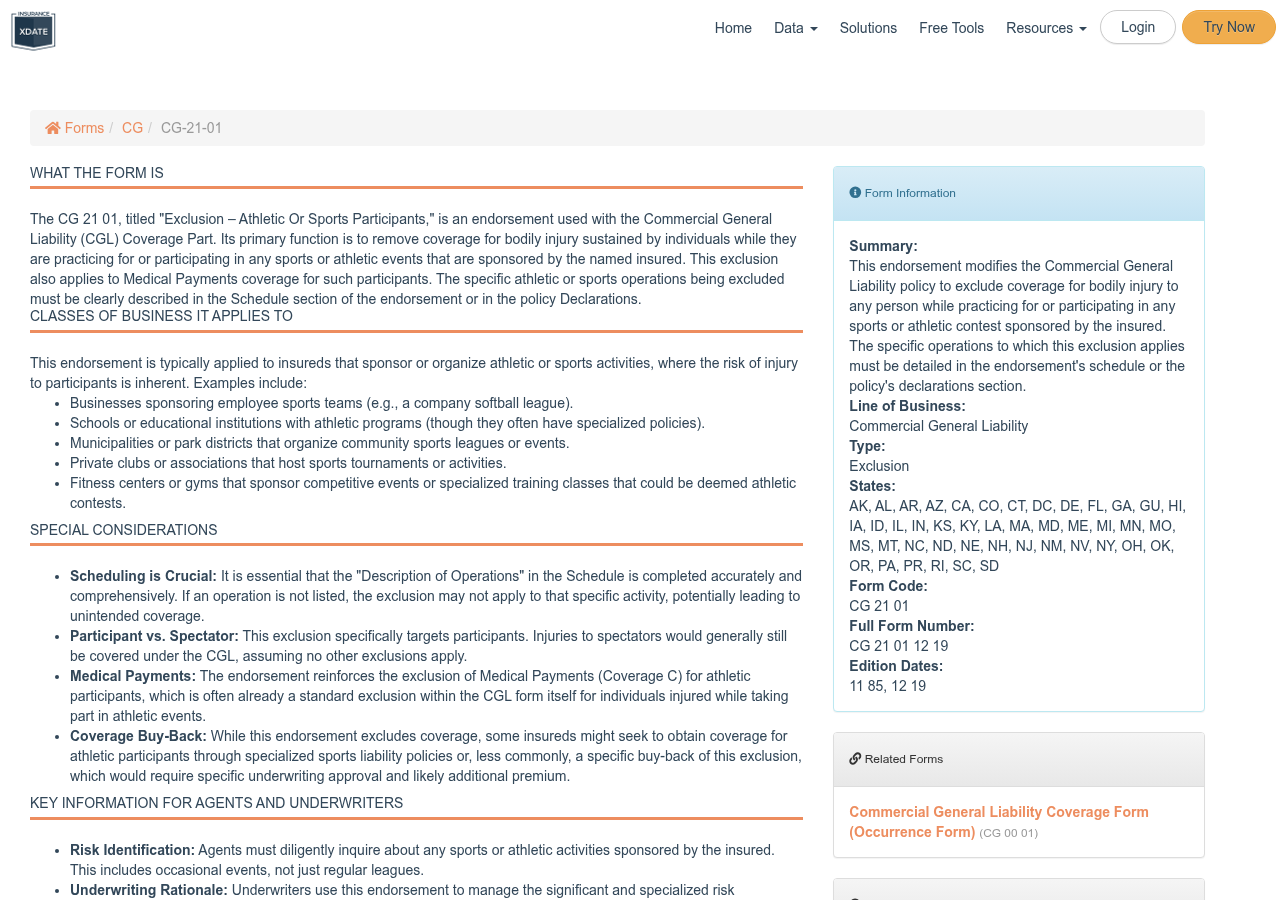
Source 1 of 4 · Standard ISO exclusion form
ISO form CG 21 01 is the endorsement that removes bodily injury to participants from a general liability policy. It is the line that decides whether the players at a GellyBall party are insured or merely present.
Participant accident is not the same product, even though the names sit next to each other. Venues treat them as separate line items and ask for them separately. The School District of Palm Beach County, for activities its own vendor liability program excludes as athletic or high hazard, requires the sponsoring organization to buy "the additional commercial general liability and participant liability insurance for that activity". If you are quoting a school, expect to be asked for both, and expect a generalist agent to supply one and call it done. The distinction between participant accident and participant injury liability is worth having straight before that call.
Products liability is the line nobody expects to need and the one GellyBall's own commercial model builds in. Dealers are encouraged into retail: gellet pods resold at the party table, take-home packs, blasters sold at fairs. The moment ammunition or a blaster leaves in a customer's hand, the exposure continues after teardown. Venues already price this. Albuquerque's special event schedule requires $1,000,000 of products and completed operations. Pinal County, Arizona requires a $6,000,000 products and completed operations aggregate from carnival and amusement ride operators.
Inland marine covers the kit while it moves. A fixed-location property policy stops at the property line, and a mobile dealer's entire asset base spends its working life in a vehicle, a car park or somebody's garden. Kit values run from $5,495 for a twelve-blaster starter package upward, before the trailer and the bunkers, which is why inland marine is not optional for a traveling operation.
Commercial auto and hired and non-owned auto decide whether the drive is covered. This is the quiet failure point for a new mobile dealer, because the vehicle is usually a personal one and personal auto policies exclude business use. The van is not incidental to a mobile GellyBall business. It is the business. Our piece on gel blaster party rental insurance walks through the same problem from the party-rental side.
Abuse and molestation is written by endorsement, not granted in a base liability form, and youth-serving venues have started policing it directly. Beaverton School District in Oregon requires that for any facility use during the school's normal operating hours the insurance "must not specifically exclude coverage for sexual abuse and molestation", and if it does, separate proof at no less than $1,000,000 per occurrence and $2,000,000 aggregate.
Property and business income belong to the arena operator, and the second half gets forgotten. A leased unit with published trading hours and a booked party diary has an income stream that stops when the site does.
Two more are worth naming because of what they prevent. A business owner's policy is what a generalist agent reaches for when a small mobile operator calls, and it is the form most likely to carry the participant exclusion described above. And excess or umbrella cover is not a luxury in this vertical: the venue limits below run to $5,000,000, and an operator sitting at $1,000,000 per occurrence is not underinsured so much as ineligible.
Operators ask me what GellyBall insurance covers. The more useful question is what their policy says they do. I have read general liability policies written for a GellyBall business that describe it as a party equipment rental, and the day a player gets hurt, that description is the whole argument.
Bobby Sharp, Action Sports Practice Lead, Specialty Insurance
What the venue demands before it lets you set up
Here is the part that decides whether a mobile GellyBall business gets paid, and almost nobody writes about it. The booking is not gated by a coverage grant. It is gated by a document, and the document has rules of its own.
Start with the distinction that costs operators the most bookings. Being listed as certificate holder is not the same as the venue being an additional insured, and venues have stopped being polite about it. The City of Albuquerque puts it in plain terms: "Showing the City as a certificate holder is not the same as naming the City as an additional insured and is not an acceptable substitute." The same page tells applicants that the additional insured box must be ticked and that the endorsement page itself has to be attached. Beaverton School District asks for the same thing in the same order: named as additional insured on the general liability policy, "and shall be provided a copy of the additional insured endorsement".
An agent who emails a certificate and considers the job finished has done about half of it.
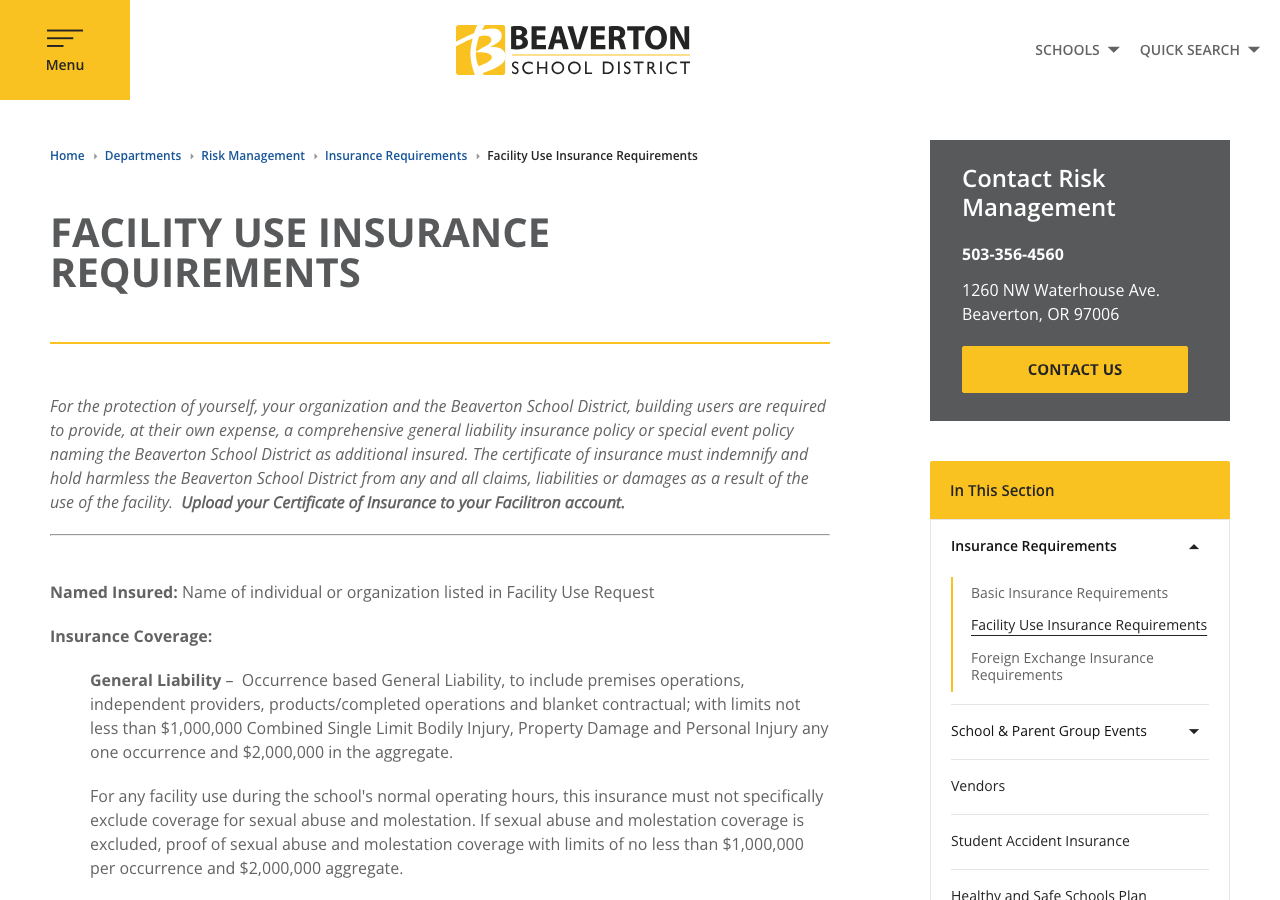
Source 2 of 4 · Public school district facility requirement
Beaverton School District sets $1,000,000 combined single limit and $2,000,000 aggregate for facility users, and separately requires that the policy not exclude sexual abuse and molestation during the school's normal operating hours.
Source: beaverton.k12.or.us/departments/risk-management/insurance/facility-use-requirements
Then the limits, which are not standard and are not close to standard.
| Venue | Published general liability requirement | The detail that catches operators |
|---|---|---|
| California State Parks, San Diego Coast District | $500,000 minimum, rising to $1,000,000 combined single limit for a greater-hazard event | $25.00 per business day late fee if the certificate lands later than 30 calendar days before the event |
| Beaverton School District, Oregon | $1,000,000 combined single limit, $2,000,000 aggregate | Policy must not exclude sexual abuse and molestation during school operating hours |
| City of Ventura, California | $1,000,000 per occurrence and $2,000,000 aggregate, doubling to $2,000,000 per occurrence when alcohol is present or the policy covers multiple rentals | Inflatables permitted only from an approved vendor list, and the vendor's own certificate is due 30 days ahead |
| City of Albuquerque, New Mexico | $2,000,000 per occurrence and $2,000,000 aggregate, rising to a $3,000,000 aggregate for amusement rides and inflatables | Additional insured wording required in the description of operations box even on a blanket policy |
| Pinal County, Arizona | $3,000,000 per occurrence with $6,000,000 general aggregate for carnival and amusement rides, up to $5,000,000 per occurrence for very large events | Original certificates and the endorsements must reach Risk Management 15 working days ahead |
Four of those venues also set a carrier quality floor, at A.M. Best ratings of A-VII, A:VII, A VII and A- VII respectively, and four set none at all. There is no national standard here, which is the finding: the operator has to read each one.
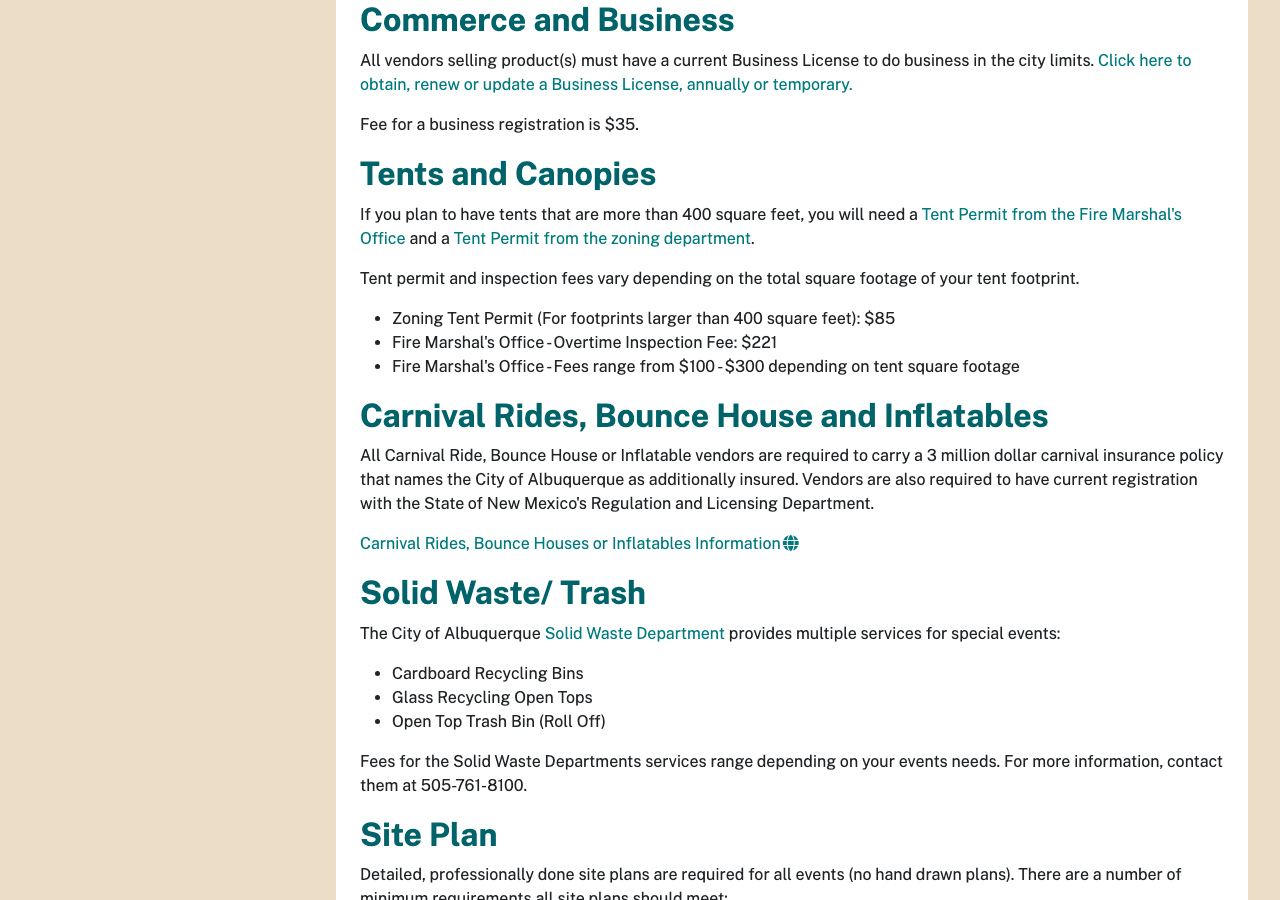
Source 3 of 4 · Municipal special event permitting
Albuquerque requires carnival ride, bounce house and inflatable vendors to carry a three million dollar policy naming the City as additionally insured, above the schedule that applies to ordinary special event applicants.
A few more things the paperwork does that a coverage summary will not tell you. Pinal County states outright that its own minimums are not a coverage recommendation, warning that the county "does not represent that the minimum required insurance is adequate to protect the interests of any Special Event Owner/Sponsor, producer, vendor". Palm Beach County's schools, in the guide they published for the 2019 financial year, asked amusement vendors for three years of school, municipal or commercial experience and stated that residential work does not qualify, which means a new operator cannot buy their way onto a school campus with a certificate alone. That same district uses its own participant waiver forms rather than the vendor's. And California State Parks' San Diego Coast District does not permit inflatables or bounce houses at all, which is a gate a GellyBall operator running on soft barriers can walk through and a bounce house operator cannot.
Gering, Nebraska goes further than most and writes the sentence for you. Its municipal code devotes a section to bounce houses and requires the rental company, not the party host, to file insurance with the city at $1,000,000 per occurrence and aggregate, written as primary and not contributing, from an insurer rated no less than A-VII by A.M. Best, with an endorsement containing the city's prescribed wording naming its officers, employees, agents and volunteers. That is the level of prescription a mobile operator should expect to meet, and it is not something an agent improvises on a Friday afternoon.
"Bobby Sharp and the team at Specialty Insurance had a fast turnaround, professional service, and answered every question I had as a brand-new operator. They wrote the policy I'd want defending me if a player ever filed a claim."
Grimnir Tactical LLC
Verified customer review
Turnaround is the reason that review sits here rather than in a section about price. A venue that wants an endorsement 30 days out has effectively set a deadline for your broker, and a party booked on a Tuesday for the following Saturday is a test of whether anyone answers the phone.
For a mobile operator, the certificate is the product. The coverage matters when something goes wrong, which is rare. The paperwork matters every single week, because it is what stands between the booking and the invoice, and it is the thing a generalist agent has never had to produce on a Thursday for a Saturday.
Bobby Sharp, Action Sports Practice Lead, Specialty Insurance
What GellyBall business insurance costs
Specialty Insurance publishes the band for the full-time mobile party business at roughly $850 to $1,850 a year at $1,000,000 per occurrence and $2,000,000 aggregate limits, once general liability with participant injury is on the program, with inland marine on the traveling kit and hired and non-owned auto quoted on top. The full breakdown of what moves that number in each direction, weekend scale below the band and multi-activity sites above it, lives in our dedicated GellyBall pricing guide.
The number most prospective dealers arrive with does not come from an insurer at all. It comes from a dealership network's own recruitment page, which tells prospects to budget $900 to $1,100 a year for liability insurance. That is in the right area for general liability standing alone, which Specialty Insurance writes at $500 to $1,500 for a GellyBall operator, but it does not buy the program above, which also carries participant injury, inland marine on the traveling kit and hired and non-owned auto. Treat the number as what dealers are told rather than as an underwriting benchmark: it names no carrier, no limits and no coverage form, and it carries no date.
2026-2027 premium benchmark
What GellyBall business insurance costs by operation size
General Liability with Participant Injury, Inland Marine on the traveling kit, and Hired and Non-Owned Auto, for a United States GellyBall business.
- Limits assumed
- $1M occurrence / $2M aggregate
- Coverage priced
- GL with Participant Injury + Inland Marine + Hired and Non-Owned Auto
- Basis
- Annual premium, United States
| Operation size | What it looks like | Arenas and parties a month | Typical annual premium |
|---|---|---|---|
| Small | Weekend dealer working birthdays, church halls and school field days out of one vehicle | No arena, up to 4 parties a month | Under $500 |
| MediumMost operators | Full-time mobile party business booking year round, kit traveling every weekend | No arena, 12 to 24 parties a month | $500 to $3,500 |
| Large | Fixed soft-barrier arena running open play and parties, plus mobile bookings | 1 arena, 25 or more parties a month | $3,500 to $9,000 |
What pushes an operator off this grid: alcohol at adult and corporate events, reselling blasters rather than ammunition alone, a second activity such as bounce houses or laser tag on the same policy, a venue demanding a $3,000,000 aggregate, and any program carrying its own owned vehicles rather than hired and non-owned auto.
Premium ranges per the Specialty Insurance book. Updated . Ranges are an indication for budgeting, not a quote or a bindable offer.
Get a 24-hour quoteRating GellyBall on arena count and parties a month rather than on revenue is deliberate. Two operators turning over the same money look nothing alike to an underwriter if one runs a fixed site with open play and the other runs four birthday parties a month out of a van. If your quote came back priced as paintball, the reason and the fix are set out in why GellyBall should not be priced like paintball.
The rules that reach a GellyBall operation in 2026
Three regulatory questions come up, and two of them are usually answered wrong.
The water bead rule is real, and it is narrower than the panic around it. The Consumer Product Safety Commission's final rule, "Safety Standard for Toys: Requirements for Water Beads", was published on 12 December 2025 and took effect on 12 March 2026. It reaches toys, and the Commission drew the boundary itself: "Water bead guns that are designed, manufactured, and marketed to adults (i.e., marketed for ages 14+ years old) for use in activities similar to paintball or air soft are outside the scope of this rule because they are not toys as defined by ASTM F963."
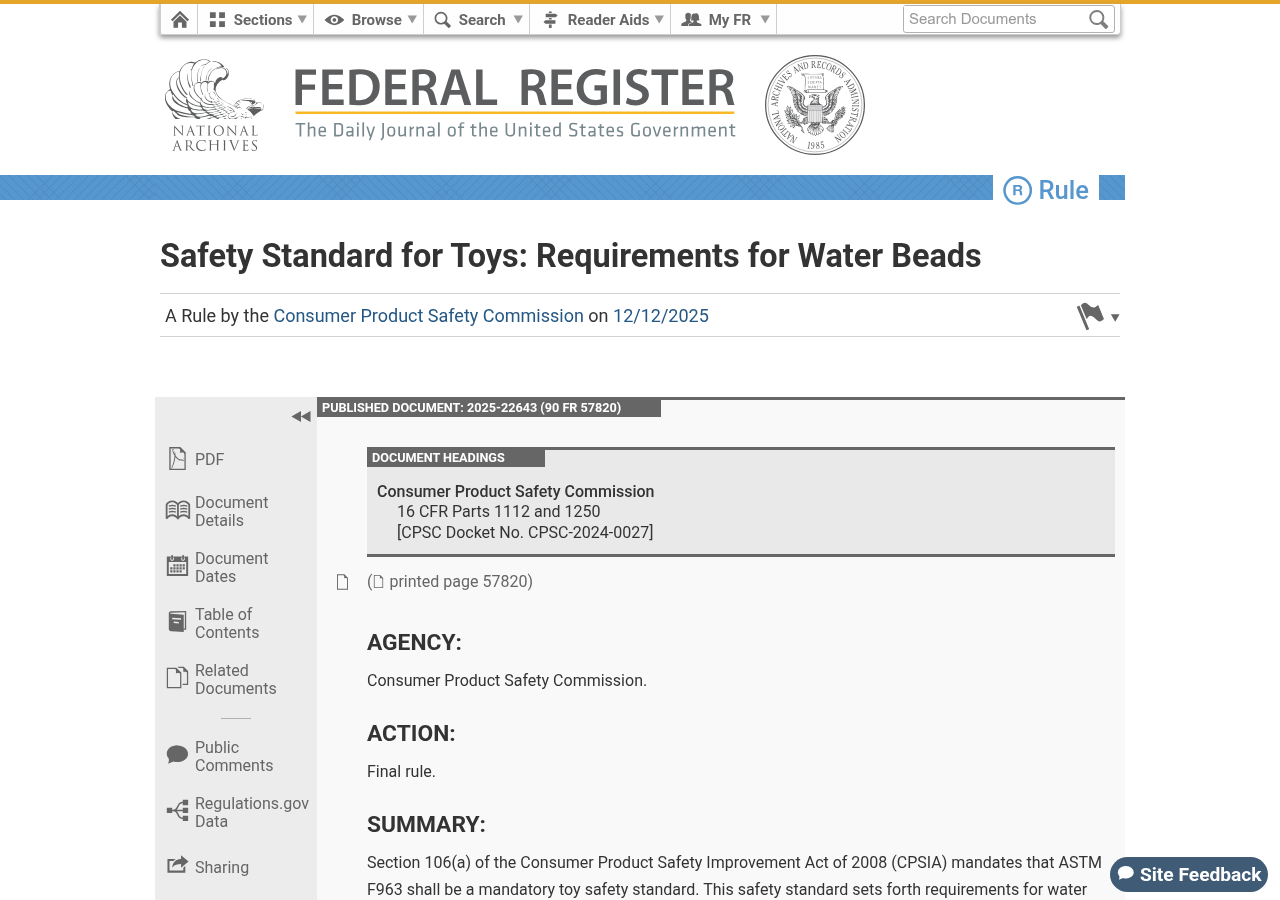
Source 4 of 4 · Federal final rule
The Consumer Product Safety Commission's water bead rule, published 12 December 2025 at 90 FR 57820 under docket CPSC-2024-0027, amends 16 CFR parts 1112 and 1250 and took effect on 12 March 2026.
That boundary turns on marketing, not on the product, and the Commission said it polices exactly that, warning that where it finds water bead products carrying images of children and other descriptive language aimed at them, it "may determine those water bead products are toys within scope of the rule". A dealer whose entire marketing is children's birthday parties, and who resells ammunition at the party table, is the operator for whom that sentence was written. Confirm the status of what you resell with your supplier in writing, and keep the answer.
The orange tip is a myth in the form most operators repeat it. Federal marking of toy, look-alike and imitation firearms sits at 16 CFR part 1272, and enforcement moved from the Department of Commerce to the Consumer Product Safety Commission under Public Law 117-167 in August 2022. The regulation approves four different markings, not one, and a device colored entirely in bright red, orange, yellow, green, blue, pink, purple or white complies with no muzzle plug at all. The part also carves out traditional B-B, paint-ball and pellet-firing air guns. Where a given gel blaster falls is a product question for the manufacturer to answer, not something to guess at from a blog. If the terminology itself is the confusion, start with what a gel blaster is and how it differs from the neighbouring categories.
No state statute we could find names gel blasters or GellyBall. That gap is real and it is worth understanding correctly: it does not mean the devices are unregulated, it means the regulation that reaches them arrives through general non-powder gun, air gun and imitation weapon language written before these products existed, and through municipal ordinance. The check is a local one, and it is a check worth doing before signing an arena lease rather than after.
How to buy it, in the right order
- Decide which business you are. Mobile, fixed, or both. Write it down before you call anyone, because every other answer follows from it.
- Get general liability quoted as GellyBall, not as paintball. Read the activity description on the quote. If it says paintball-type activity, the carrier is rating a different risk and putting your name on it.
- Confirm participant injury sits on the policy in writing, and read the exclusions before the coverages. This is the line a generalist agent skips.
- Ask for the additional insured endorsement, not just the certificate. Ask now, before a school asks, and ask what your program issues: a blanket endorsement, or a per-event one.
- Schedule the kit on inland marine before it travels, not after the first booking.
- Settle the vehicle question before the first drive. If the van is personal, assume the personal policy excludes the business use and fix it.
- Set limits against the largest venue you want, not the smallest. If a $3,000,000 aggregate is the price of a county fair, a $1,000,000 policy is a decision to not do county fairs.
New operators and add-on operators should also read our guide to starting a GellyBall party business. If you already run paintball, the question of whether your existing policy stretches is answered in is GellyBall insurance the same as paintball coverage. And if an underwriter has asked you about injury history, the published figures for the class sit in our GellyBall safety and injury data and in the wider paintball, airsoft and GellyBall injury rate comparison. One-off bookings and festival activations are a different purchase again, covered under event insurance.
Frequently Asked Questions
Does a GellyBall business need its own insurance policy, or does a general business policy cover it?
A general business policy rarely covers it as sold. The recurring failure is the athletic or sports participants exclusion, ISO form CG 21 01, which strips out injury to the people taking part in the activity. That leaves the spectator and the car park covered and the players uncovered. A GellyBall business needs general liability with participant injury written for the activity, and a mobile operator needs inland marine and an auto answer alongside it.
What is the difference between being a certificate holder and being an additional insured?
A certificate is evidence of a policy; an additional insured endorsement extends the policy's protection to another party. Venues know the difference and increasingly say so. The City of Albuquerque states that showing the City as a certificate holder is not the same as naming the City as an additional insured and is not an acceptable substitute, and requires the endorsement page itself to be attached. Beaverton School District also asks for a copy of the endorsement rather than the certificate alone.
How much does GellyBall business insurance cost?
Specialty Insurance puts general liability with participant injury for a GellyBall party business at roughly $850 to $1,850 a year at one million per occurrence and two million aggregate limits. A mobile operator adds inland marine on the traveling kit and a hired and non-owned auto endorsement on top of that, each rated separately. Our GellyBall pricing guide breaks down what moves the number in each direction. Weekend-scale operators sit below that band and fixed arenas sit above it. Our GellyBall pricing guide breaks down what moves the number in each direction.
Does the 2026 CPSC water bead rule apply to GellyBall ammunition?
The rule, effective 12 March 2026, applies to toys. The Commission stated that water bead guns designed, manufactured and marketed to adults for paintball-like or airsoft-like activities fall outside its scope because they are not toys under ASTM F963. Because the boundary turns on how a product is marketed rather than on what it is, an operator who resells ammunition into children's parties should get the compliance position of the specific product confirmed by their supplier in writing.
Do GellyBall blasters need an orange tip?
Not necessarily. Federal marking rules at 16 CFR part 1272 approve four different markings, and a device colored entirely in bright red, orange, yellow, green, blue, pink, purple or white complies without any muzzle plug. The part also excludes traditional B-B, paint-ball and pellet-firing air guns. Whether a specific blaster is covered is a question for the manufacturer.
What insurance limits do parks and schools ask a mobile GellyBall operator for?
There is no single standard, which is the practical problem. Published requirements in the sample above run from $500,000 at one California State Parks district to $3,000,000 per occurrence for amusement operators in Pinal County, Arizona, with a $5,000,000 tier for very large events. Several venues also set a minimum A.M. Best rating and require the endorsement to arrive 15 to 30 days before the event.
Sources
- Consumer Product Safety Commission, Safety Standard for Toys: Requirements for Water Beads, final rule, 90 FR 57820, published 12 December 2025, effective 12 March 2026, CPSC Docket No. CPSC-2024-0027.
- City of Albuquerque, Special Event Permitting, insurance requirements and carnival, bounce house and inflatable vendor requirements.
- Beaverton School District, Facility Use Insurance Requirements, Risk Management.
- Pinal County, Arizona, Large Special Event Application, Section 11 Insurance Requirements, revised April 2021.
- City of Ventura, Application and Guidelines for Park Rental Permit, insurance requirements tiers I and II.
- California State Parks, Special Event Terms and Conditions, San Diego Coast District.
- The School District of Palm Beach County, Special Event Risk Planning Guide, FY2019, Risk and Benefits Management.
- ISO form CG 21 01, Exclusion: Athletic Or Sports Participants.
- Gering, Nebraska Code of Ordinances § 90.28 (bounce houses), Ord. 1990, passed 13 April 2015. Cited in prose only.
- GellyBall, About Us and published dealer kit listings.