

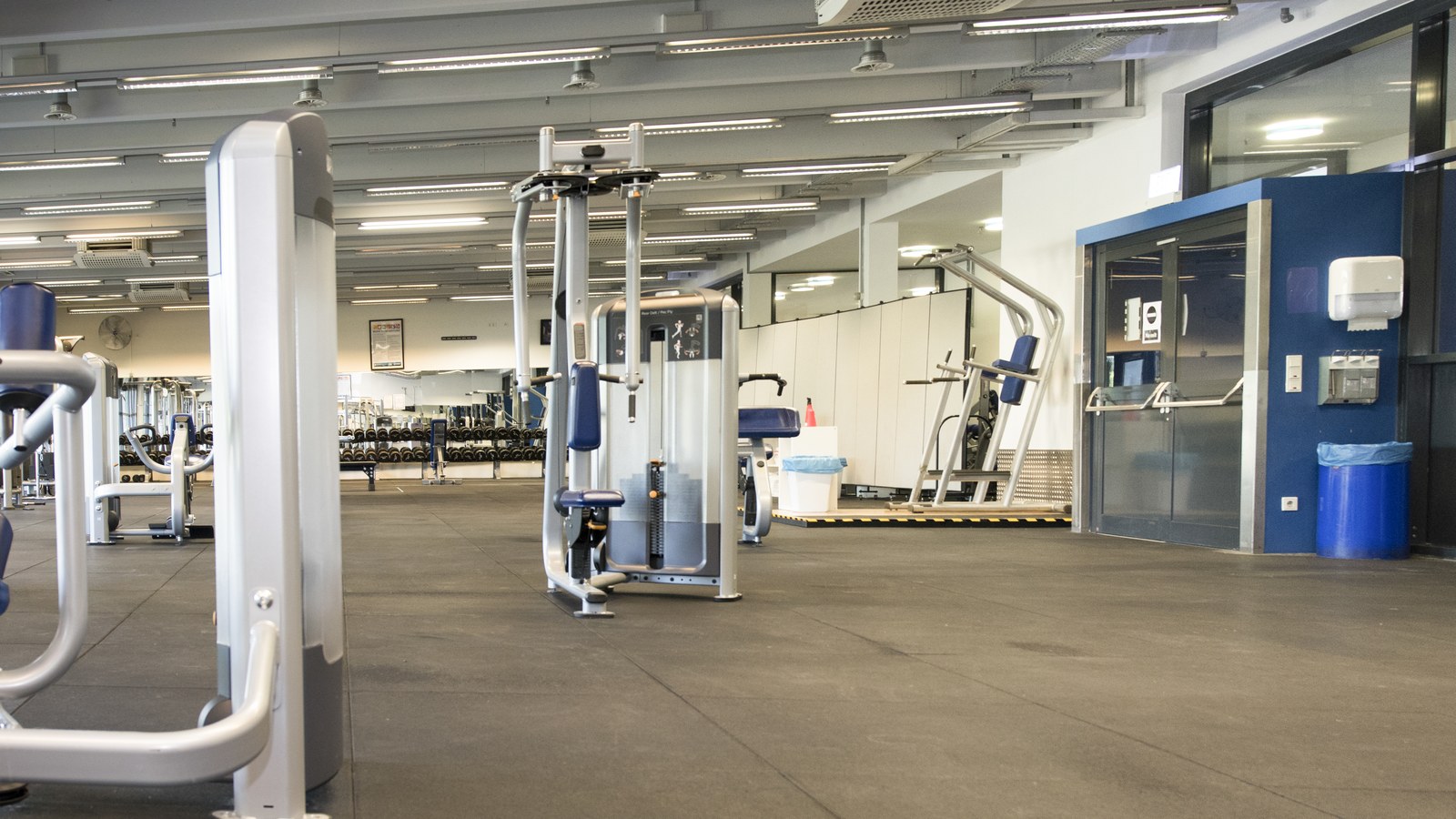
A gym that lets members in with a key card when nobody is on staff pays twice the liability rate of the same gym with staffed hours, on a national health club program that prints its rates in public. K&K Insurance's 2026 Basic Service Health Club enrollment form charges $7.10 per $1,000 of annual sales for a club "staffed with defined hours" and $14.20 for a "24-hour Key card/pad/code Health Club," both for $1,000,000 per occurrence, with a $1,650 minimum premium. On those rates a club with $500,000 of membership sales pays $3,550 a year with staff on the floor and $7,100 with unstaffed access, before any optional cover.
That is a far larger step than the one most owners find online. The insurance platform that ranked first for 24-hour gym insurance when we searched in October 2026 prices after-hours access as "a 15% addition" to the general liability premium. California law shows why an underwriter treats unstaffed hours as a different risk. A health studio there must keep a defibrillator and staff trained to use it, and one that admits members when no trained employee is on the premises waives "the affirmative defense of primary assumption of the risk, whether express or implied, as to a claim arising out of the absence of trained staff." Above 6,000 square feet, it may not admit members without an employee present at all.
The prices that rank for gym insurance cost hide a second gap. Most are liability figures or bundles that are never defined: a $69 a month median for general liability on one insurance marketplace, $1,000 to $5,000 a year for a small gym in a local agency's guide. Franchisors, who must disclose their costs in documents filed with state regulators, print something else. Planet Fitness's 2026 franchise disclosure document tells a new franchisee to budget $25,000 to $45,000 as the "Lump sum payment of first year premium for one location." At the other end of the market, four boutique studio brands state annual premiums of $3,196 to $21,172 for their minimum required insurance, and Anytime Fitness prints $3,200 a year of insurance for each of its company-owned centers, a figure it says its insurer supplied.
This guide prices the full program one coverage line at a time, for independent gyms, fitness centers and health clubs, franchise and boutique studios, CrossFit boxes and 24-hour key-card gyms, with a separate price column for unstaffed access. Two kinds of facility sit outside it because they are rated on programs of their own. Climbing walls belong in our ropes course, zipline and climbing gym cost guide, and martial arts and boxing gyms are excluded by both of the published fitness forms this guide reads.
How much gym and fitness center insurance costs for 2026-2027
The table prices one operation: an independent gym of about 5,000 square feet in leased space, with roughly $500,000 a year in membership sales, employed staff and personal trainers, and no pool, childcare or spa services. The first price column is that gym with staffed hours. The second is the same gym with key-card access when nobody is on site. Read both as budgeting indications rather than quotes. A 1,500-square-foot personal training studio and a 40,000-square-foot club with a pool and a nursery land at opposite ends of these ranges, and a franchise agreement can add lines an independent owner would not otherwise buy.
2026-2027 premium benchmark
What gym and fitness center insurance costs, line by line
Typical annual premiums for a single independent US gym or fitness center, by coverage line, with staffed hours and with 24-hour key-card access when no staff are on site.
- Priced for
- A single independent gym of about 5,000 square feet in leased space, roughly $500,000 a year in membership sales, employed staff and personal trainers, no pool, childcare or spa services. The 24-hour column is the same gym with key-card access when nobody is on site
- Basis
- Annual premium, United States
- Updated
- October 2026
| Coverage | Staffed gym, annual | 24-hour key-card gym, annual | Typical limits |
|---|---|---|---|
| General Liability InsuranceFoundation Injury and property damage claims from members and guests: a slip in the locker room, a cable that snaps on a machine, a member hurt on the gym floor who says the equipment was not maintained. For a gym it should include participant liability, the cover for injuries members suffer while exercising. | $2,500 to $8,000$210 to $670per month | $3,500 to $14,000$295 to $1,170per month | $1,000,000 per occurrence / $2,000,000 to $5,000,000 aggregate |
| Professional Liability InsuranceFoundation Claims that a trainer's programming, spotting, fitness assessment or nutrition advice caused an injury, for employed trainers and, when the extension is bought, independent contractor trainers. | $500 to $2,500$45 to $210per month | $500 to $2,500$45 to $210per month | $1,000,000 per claim |
| Commercial Property InsuranceFoundation Treadmills, racks, flooring, lockers and the build-out after a fire, a burst pipe or a break-in, usually with business income cover for the months the gym is closed. Often bought with general liability as a Business Owners Policy. | $1,500 to $5,000$125 to $420per month | $1,750 to $6,000$150 to $500per month | Replacement cost of equipment, contents and improvements |
| Workers' Compensation InsuranceFoundation Injuries to trainers, instructors, front-desk and cleaning staff, such as a back injury moving plates or a fall while cleaning, required by state law once the gym has employees. Includes employer's liability. | $1,000 to $5,000$85 to $420per month | $750 to $4,000$65 to $335per month | Statutory state limits; employer's liability $500,000 to $1,000,000 |
| Sexual Abuse and Molestation InsuranceFoundation Allegations arising from one-on-one training, youth programs, childcare and locker rooms. The published health club form excludes it unless it is reported, approved and paid for as its own line. | $500 to $2,500$45 to $210per month | $750 to $3,500$65 to $295per month | $1,000,000 per occurrence / $1,000,000 to $2,000,000 aggregate |
| Employment Practices Liability InsuranceSituational Harassment, discrimination, wrongful termination and retaliation claims from employees. Most franchisors require it, and the published health club and fitness studio forms exclude employment-related practices. | $1,500 to $5,000$125 to $420per month | $1,500 to $5,000$125 to $420per month | $250,000 to $1,000,000 per claim |
| Cyber Liability InsuranceSituational A breach of member card data, the recurring billing platform or the key-card access system: notification costs, forensic work and claims from members whose data was exposed. | $750 to $3,500$65 to $295per month | $1,000 to $4,000$85 to $335per month | $100,000 to $1,000,000 per claim |
| Excess / Umbrella InsuranceSituational Limits above the general liability, employer's liability and auto policies, for a catastrophic injury or a member's death, or for a lease or franchise agreement that requires $2,000,000 or more. | $1,500 to $8,000$125 to $670per month | $2,500 to $12,000$210 to $1,000per month | $1,000,000 to $5,000,000 per occurrence |
No gym buys every line. The first five are the foundation for a gym with employees, trainers and members under 18; the rest switch on with a franchise agreement or lease, a larger staff or a stored member database. General Liability Insurance should include participant liability and, on many forms, hired and non-owned auto liability. A gym that qualifies for a Business Owners Policy buys general liability and property together rather than separately. Commercial Auto Insurance, Liquor Liability Insurance and cover for pools, childcare and medical or spa services are quoted separately.
Specialty Insurance book. Updated . Ranges are an indication for budgeting, not a quote or a bindable offer.
Request a quoteIn Specialty Insurance's book, general liability with participant liability at $1,000,000 per occurrence runs $2,500 to $8,000 a year for the staffed gym and $3,500 to $14,000 for the same gym with 24-hour key-card access. The published health club program's $3,550 and $7,100 for a club of this size, set out below, both fall inside those ranges. Unstaffed hours raise five of the eight lines and leave professional liability and employment practices liability where they are. Workers' compensation is the one line that falls, to $750 to $4,000 for the 24-hour gym against $1,000 to $5,000 staffed, which fits a line priced on payroll.
The lines follow the order in which a gym usually buys them. General Liability Insurance is the base, and the part that decides most gym claims is participant liability, the cover for a member who is hurt while exercising and says the gym is to blame: a cable that snapped, a machine that was not maintained, a bench that collapsed. Some forms write it in, as the K&K health club form does with "Bodily Injury to Participants Liability," and some exclude it, which is the split our guide to participant injury versus general liability explains. Professional Liability Insurance answers a different allegation: that a trainer's programming, spotting or nutrition advice caused the injury. On the published health club form it covers the club and its employees, and it reaches independent contractor trainers only if the club buys that extension, which matters in a gym where most trainers rent floor time.
Commercial Property Insurance covers the equipment and the build-out, and most gyms buy it with business income cover for the months a fire or a flood keeps the doors shut. A gym that qualifies can buy general liability and property together as a Business Owners Policy, and our page on commercial property insurance explains how replacement cost and coinsurance work. Sexual Abuse and Molestation Insurance is marked as foundation for two reasons: the health club form lists abuse and molestation among its exclusions unless the line is reported, approved and paid for, and one-on-one training, youth programs and locker rooms create the exposure in most gyms. A gym that admits only adults and runs no private training can treat it as situational.
The last three lines switch on with a franchise agreement, a lease or a growing staff. Employment Practices Liability Insurance matters more in a gym than in many small businesses, because both published K&K fitness forms exclude employment-related practices and most of the franchisors in our sample require it. Cyber Liability Insurance follows the member database, the card-on-file billing and the access-control system. Excess / Umbrella Insurance sits on top of the rest for the claim no primary limit was written for, such as a wrongful death claim after a member's cardiac arrest on the gym floor.
What the whole program costs, by gym type
The table above prices one line at a time, but a gym buys a program. For budgeting a complete gym, Specialty Insurance prices four common setups as a whole.
| Gym profile | What the underwriter is rating | Typical annual program |
|---|---|---|
| Boutique or personal training studio under 3,000 square feet | A small floor, scheduled classes or one-on-one sessions, and an instructor with members for most of the time they train. | $2,500 to $10,000 |
| Independent gym of about 5,000 square feet, staffed hours | The gym in the line table: open-floor training on machines and free weights, employed staff and trainers, and someone on the floor whenever it is open. | $7,500 to $30,000 |
| The same gym with 24-hour key-card access | The same floor and staff, plus hours when members train alone, which raise the liability and abuse exposures and bring the security and emergency questions set out below. | $10,000 to $45,000 |
| Large club of 20,000 square feet or more, with a pool or childcare | A bigger floor, payroll and property schedule, and a pool or a nursery, two exposures the published health club form will not insure at all. | $40,000 to $200,000 |
Do not add up the line table to get a program. Few gyms buy every line, and fewer sit at the top of every range at once, so start from the row here that looks most like yours. A studio that opens a free-weight floor to its members moves from the first row toward the second, and a staffed gym that hands out key fobs for unstaffed hours moves from the second row to the third.
What the published health club rate buys, and what it leaves out
Most gym insurance programs do not print a price. K&K's Basic Service Health Club program does, in a 20-page enrollment form, number 1804, revised in September 2026 and valid for policies effective from January 1 to December 31, 2026. It is a rating formula rather than a quote. The club chooses a liability option, adds up its annual sales (membership fees, daily use fees, the juice bar, the pro shop and any other revenue, leaving out initiation fees), and multiplies the total by the rate for its type of facility, subject to a minimum premium.
| Published health club rate, all states except Hawaii | $1,000,000 per occurrence (Option 1) | $2,000,000 per occurrence (Option 2) |
|---|---|---|
| Staffed club with defined hours, per $1,000 of annual sales | $7.10 | $10.65 |
| CrossFit affiliate, staffed with defined hours, per $1,000 | $9.46 | $14.19 |
| 24-hour key card, pad or code club, per $1,000 | $14.20 | $21.30 |
| Minimum premium | $1,650 | $2,750 |
| Staffed club, $250,000 of sales | $1,775 | $2,750 (the minimum applies) |
| Staffed club, $500,000 of sales | $3,550 | $5,325 |
| Staffed club, $1,000,000 of sales (the program's ceiling) | $7,100 | $10,650 |
| 24-hour club, $250,000 of sales | $3,550 | $5,325 |
| 24-hour club, $500,000 of sales | $7,100 | $10,650 |
| 24-hour club, $1,000,000 of sales | $14,200 | $21,300 |
The rates and minimums in the first four rows are printed on the form for applicants in every state except Hawaii, which has its own column. The six example rows are our arithmetic on those rates. At $1,000,000 per occurrence the minimum premium binds for a staffed club with less than about $232,000 of annual sales and for a 24-hour club with less than about $116,000. At $2,000,000 it binds below about $258,000 and $129,000.
For that rate the program includes more than most of the figures on the first page of search results. At Option 1 the form lists $1,000,000 each occurrence of commercial general liability with a $5,000,000 general aggregate per location, $1,000,000 of "Bodily Injury to Participants Liability," $1,000,000 of professional liability, $1,000,000 for damage to premises rented to the club, $1,000,000 of hired and non-owned auto liability (not available in Illinois, Louisiana, Utah, Vermont or Wisconsin) and $5,000 of medical expense for people other than exercising participants. A staffed club with $500,000 of sales pays $3,550 for all of it.
The optional lines are priced on the same form. Sexual Abuse or Sexual Molestation Liability at $1,000,000 for each perpetrator costs $1.42 per $1,000 of sales for a staffed club and $2.84 for a 24-hour club, with a $150 minimum, and the form notes that this limit "is part of, and not in addition to, the General Aggregate Limit of Insurance." Liability for independent contractor trainers costs $300 a year at the $1,000,000 option and $450 at $2,000,000, and a club with more than ten contractors "may be subject to additional underwriting and premium." Equipment and contents cover, written as inland marine, is rated at 3.3 cents per dollar of value for a location with up to $10,000 of equipment and 2.86 cents above that, with a $100 minimum, and the form tells clubs to insure "the full replacement cost of all of your equipment and contents to avoid a coinsurance penalty at the time of loss." Every enrollment adds a $20 purchasing group administration fee.
The form is just as clear about what it will not insure. A club is eligible only if its annual sales are "$1,000,000 or less per location," leaving out initiation fees. The ineligible list names martial arts facilities, climbing walls, swimming pools, full-size trampolines, drop-off child care, dance, gymnastics and cheer facilities, and Anytime Fitness facilities. The liability exclusions name "The sport of boxing (contact/sparring)," "Employment-related practices," and events, competitions, tournaments and camps the club runs, "unless reported to and approved by us." A club over the sales ceiling is outside the program and needs a policy underwritten on its own figures.
Smaller studios have a second published route. K&K's Fitness Studio form, number 1019, covers exercise, circuit and personal training studios with 3,000 square feet or less per location, valid for the same calendar year, and it prices liability by floor area instead of sales.
| Studio floor area per location | $1,000,000 limit | $2,000,000 limit | $5,000,000 limit |
|---|---|---|---|
| 1 to 1,000 square feet | $500 | $750 | $1,500 |
| 1,001 to 2,000 square feet | $1,000 | $1,500 | $2,250 |
| 2,001 to 3,000 square feet | $1,500 | $2,250 | $3,125 |
A 1,800-square-foot personal training studio pays $1,000 a year for $1,000,000 of liability on this form, with participant, professional and hired and non-owned auto liability built in at the same limit. The catch is in the eligibility list. The studio form excludes CrossFit affiliates, childcare, climbing walls, Anytime Fitness facilities and "Open access to members to utilize facility on a self directed basis outside of a structured program," and its liability exclusions include boxing with contact or sparring and employment-related practices. A studio that hands members a key fob for open gym hours has left the studio program, whatever its size.
When an owner sends me a health club certificate, I read two things before the limits: the facility type the premium was rated on, and the ineligible list. A gym rated as staffed that starts handing out key fobs, or a studio that adds an open gym, has changed the risk the premium was built on, and nothing on the renewal notice will say so.
Bobby Sharp, Action Sports Practice Lead, Specialty Insurance
What 24-hour unstaffed access does to the price
Unstaffed access is the largest single rating step on the published health club form. The 24-hour key card rate is exactly twice the staffed rate at both limit options, $14.20 against $7.10 at $1,000,000 and $21.30 against $10.65 at $2,000,000, and the abuse and molestation rate doubles with it, from $1.42 to $2.84 per $1,000 of sales.
The online figure most owners see is far smaller. That platform says its after-hours cover is "calculated as a 15% addition to the cost of your general liability policy," about $15 to $20 a month on its own policy. On a $3,550 staffed premium, a 15 percent loading would add about $530 a year, by our arithmetic; the published program's 24-hour rate adds $3,550. The platform's figure loads a liability policy, while the published rate reprices a program that includes participant and professional liability, so the two cannot be swapped for each other on a budget.
Specialty Insurance's ranges sit between the two. By our arithmetic on the table above, 24-hour access adds 40 percent at the bottom of the general liability range, $3,500 against $2,500, and 75 percent at the top, $14,000 against $8,000: less than the published program's doubling, and well above a 15 percent loading. For the whole program, the 24-hour band of $10,000 to $45,000 starts a third higher than the staffed band of $7,500 to $30,000 and ends 50 percent higher.
The form's 24-hour supplement shows what the underwriter is pricing. Every location that allows members "24-hour access-code entry to the premises" must answer questions a staffed club never sees:
- whether the location is staffed during peak attendance hours, and which hours;
- whether minors are allowed in at any time without a parent or guardian, and the minimum age for a membership;
- whether the entry system has "a tailgate detection feature that detects more than one person entering at a time," whether the entry is on video, whether an alarm sounds and whether the owner is notified of a tailgate;
- whether the exit has a free-exit mechanism such as a paddle or crash bar, and whether it is mechanical, so that a power failure will not stop a member leaving;
- how the cameras are monitored, how long recordings are kept and how often they are reviewed;
- whether members have wireless personal emergency devices to wear, whether emergency pull stations are placed around the facility, and how emergency responders will get into the building when nobody is on staff;
- whether tanning, saunas, steam rooms and hot tubs can be used during unstaffed hours, and how they are monitored or locked.
Each of those questions is about a member who is hurt or taken ill with nobody there to help, or a stranger who walks in behind a member. They are also the questions to settle before the first quote, because the answer to each one changes what the gym can buy.
California has written the same concern into its Health and Safety Code. Section 104113 requires every health studio to acquire and maintain an automatic external defibrillator and to train staff in its use. Subdivision (e)(3) then sets four duties for a studio that lets members in when no employee is on the premises: every employee must complete a CPR and defibrillator course within 30 days of starting, a trained employee must be on the premises for no fewer than 50 hours a week, members must be told when they sign up that trained staff will not always be there, and a studio in a space larger than 6,000 square feet must deny access whenever no employee is present. Subdivision (g) puts the cost of unstaffed hours in liability terms.
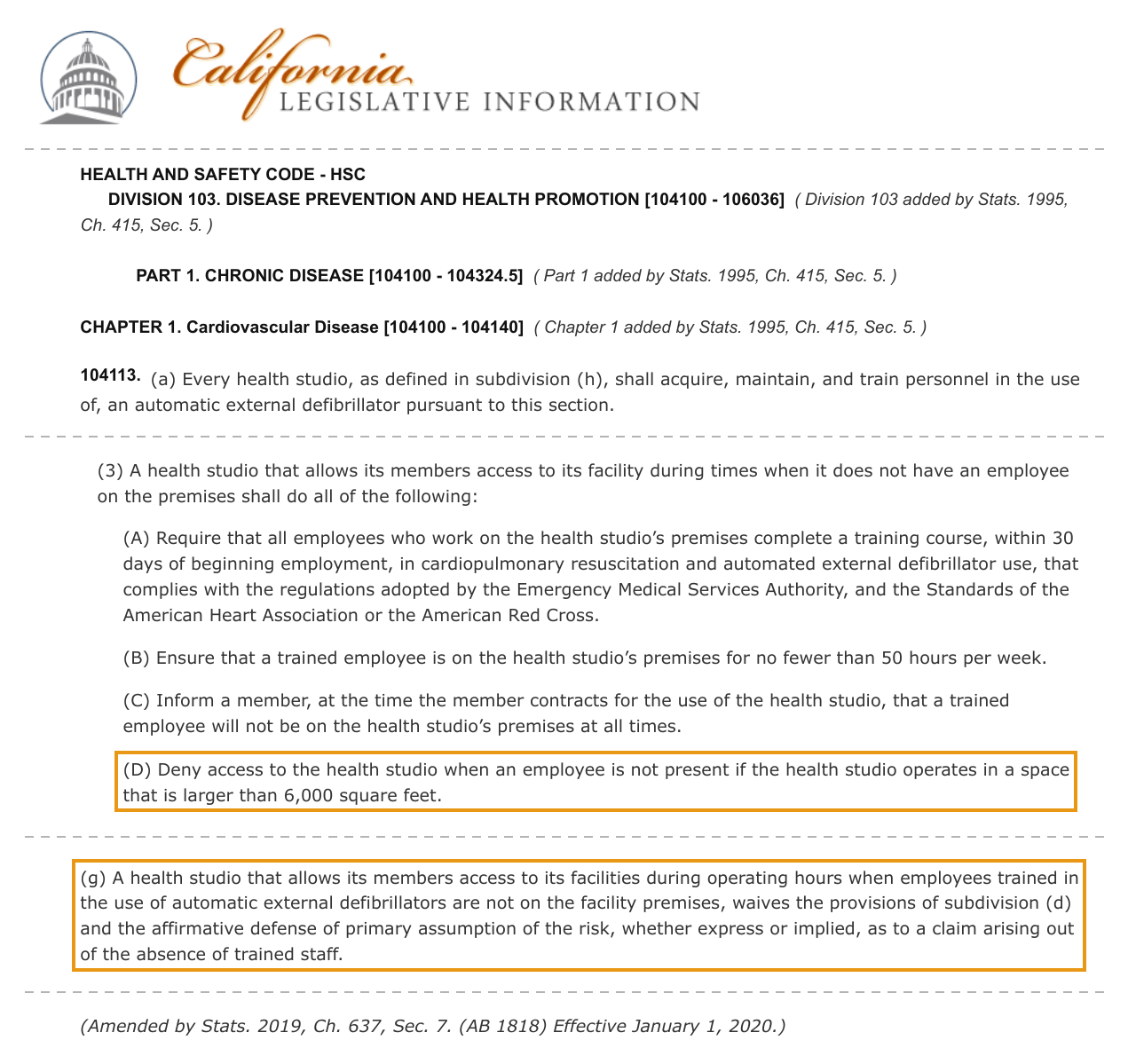
Source 1 of 3 · A state prices unstaffed hours in liability
California Health and Safety Code section 104113: subdivision (a) requires every health studio to keep a defibrillator and train staff to use it; (e)(3) sets four duties for a studio that lets members in when no employee is on the premises, including "Deny access to the health studio when an employee is not present if the health studio operates in a space that is larger than 6,000 square feet"; and (g) says such a studio "waives the provisions of subdivision (d) and the affirmative defense of primary assumption of the risk, whether express or implied, as to a claim arising out of the absence of trained staff."
Source: leginfo.legislature.ca.gov, Health and Safety Code section 104113
Primary assumption of the risk is one of the main defenses a California gym has against a member who is hurt in an activity with risks built into it. A gym that runs hours without trained staff gives that defense up for any claim arising out of their absence, which is the claim an unstaffed gym is most likely to face, and because the statute removes it "whether express or implied," a membership waiver does not bring it back. The section was last amended effective January 1, 2020. New York takes a narrower route. Since May 2023, General Business Law section 627-a has required every health club with 50 or more members, down from 500, to keep at least one defibrillator on the premises and a certified attendant present "at all times during staffed business hours," and it sets no staffing minimum for the hours in between. Our guide to waivers versus insurance explains why a signed waiver and a policy do different jobs.
Franchisors who build their brands on 24-hour access give their own buyers the same warning. Anytime Fitness requires its franchisees to staff each center for a minimum amount of hours a week and gives members 24-hour access the rest of the time, and its 2026 franchise disclosure document tells a prospective owner to confirm, before buying, that insurance is available "given that you will not staff the premises all of the time."
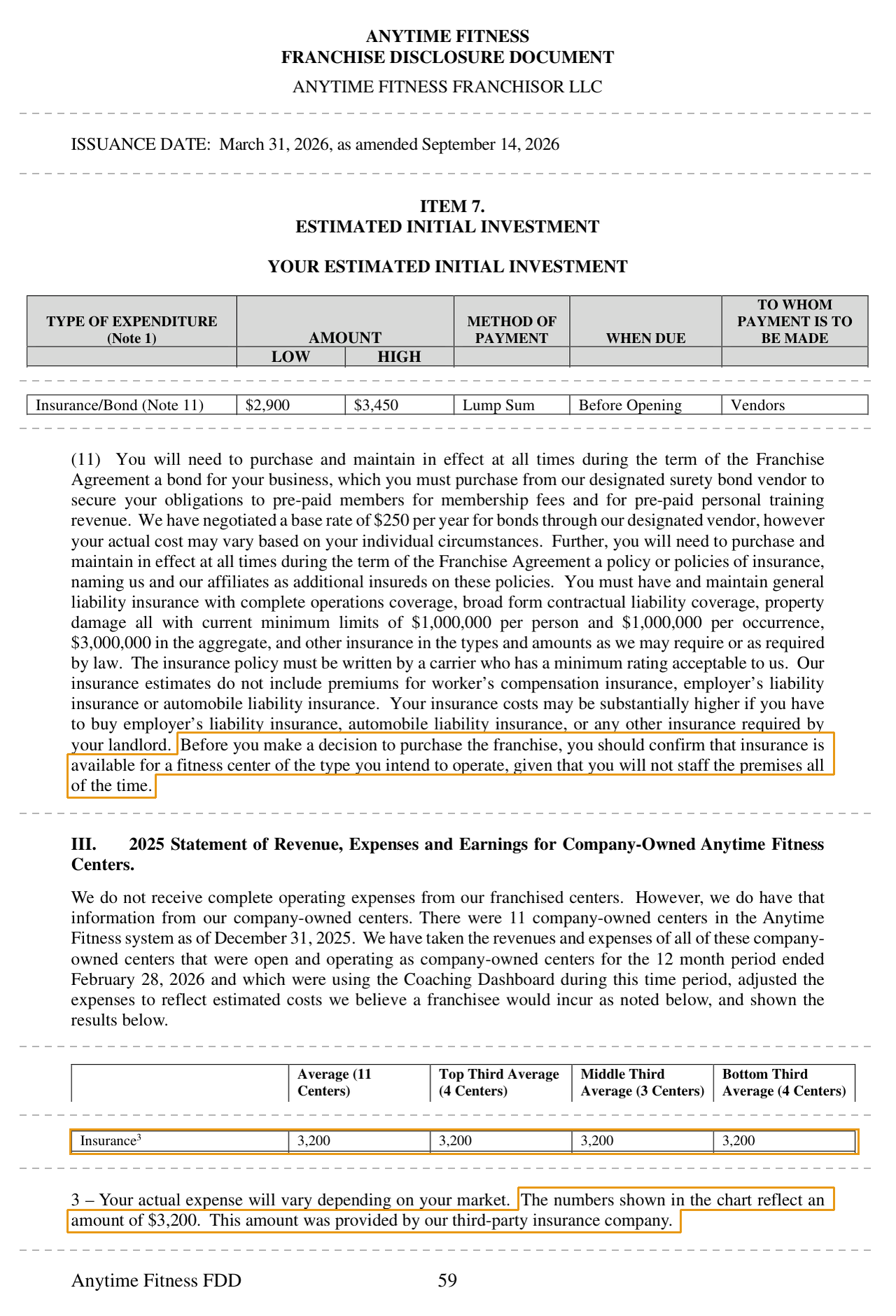
Source 2 of 3 · A 24-hour franchisor's own warning
Anytime Fitness Franchise Disclosure Document, issuance date March 31, 2026, as amended September 14, 2026: the Item 7 "Insurance/Bond" row ($2,900 to $3,450 before opening); note 11, which says the estimates exclude workers' compensation, employer's liability and automobile liability insurance and tells a buyer to "confirm that insurance is available for a fitness center of the type you intend to operate, given that you will not staff the premises all of the time"; and the Item 19 statement for 11 company-owned centers, where note 3 says the $3,200 insurance figure "was provided by our third-party insurance company."
Source: Anytime Fitness 2026 Franchise Disclosure Document, filed with the Minnesota Department of Commerce
The same document shows what a small 24-hour club pays inside a program built for the format. Its start-up estimate puts insurance and the membership bond at $2,900 to $3,450 before opening, excluding workers' compensation, employer's liability and auto cover, and its statement for the 11 company-owned centers shows $3,200 of insurance for each, a single figure the document says "was provided by our third-party insurance company." Snap Fitness, another 24-hour franchisor, requires every club to join its own insurance program at $576.85 a month, and each of its eight company-owned clubs shows $6,569 of insurance for 2025. Those are prices inside franchise programs. An independent 24-hour gym is underwritten on its own staffing and security controls, which is what the supplement above asks about. For a gym of the size in our table, Specialty Insurance's whole-program band with 24-hour access is $10,000 to $45,000 a year.
Unstaffed hours are an underwriting question before they are a price. I want to see the staffed schedule, the tailgate setting, how long the cameras keep footage and how the doors open in a power cut before I ask a carrier for a number. An application that says 24-hour access and nothing else gets priced as if none of those controls exist.
Bobby Sharp, Action Sports Practice Lead, Specialty Insurance
Why the gym insurance prices online disagree
The rest of the first page offers bands rather than formulas, and they rarely describe the same purchase. The page that ranked first for gym insurance cost in October 2026 asks "How much does gym insurance cost?" and answers without a dollar figure, while selling its lowest-priced plan with $500,000 of general liability per occurrence, half the limit every franchisor in our sample requires. A national carrier's gym page prints $810 a year for standalone general liability, $1,687 for a business owner's policy and $1,032 for workers' compensation as the average costs its customers pay, and the same three figures appear on its martial arts page, so they are averages across its small business customers rather than gym data. An online marketplace prints $69 a month for general liability, $86 for a business owner's policy, $42 for professional liability and $102 for workers' compensation, drawn from gyms and studios that applied for quotes through it. Its method sentence calls them medians and its headings call them averages, and its cyber and commercial auto figures are for small businesses in general.
The others are wider still. A gym insurance platform says most gym owners pay under $150 a month for gym liability insurance, and in the same comparison table puts the national carrier's gym liability at $1,500 to $3,500 a year, against the $810 average that carrier prints itself. A gym software company says individual policies run $15 to $200 a month each and a full package for a small gym $200 to $500 a month. A local agency puts small gyms at $1,000 to $5,000 a year.
None of these is wrong for every gym. The difficulty is that each is a liability figure, or a bundle it does not define, and none says what kind of gym it assumes. A 1,500-square-foot yoga studio and a 24-hour club with a free-weight floor and 2,000 members are not the same risk, and one band that covers both describes neither. That is why the table above is built line by line, with staffed and unstaffed hours priced apart, and why the next section turns to the public numbers that say what they include.
What franchise gyms budget for insurance
Franchisors must estimate a new owner's start-up costs, insurance included, in Item 7 of a franchise disclosure document, list recurring fees in Item 6, and set out the insurance they require in Item 8; some also show what their own clubs spend in Item 19. The documents are filed with state regulators, and Minnesota publishes them. In October 2026 we read the current documents of 13 big-box, 24-hour, boutique and bootcamp brands. Several were amended during 2026, and four brands print insurance figures that differ from their previous documents, so the date on a disclosure document matters. All are estimates prepared for a franchisee's budget, not quotes, and several cover a period shorter than a year or do not say what period they cover, so the table shows each figure as printed and annualizes it only where the document states the period.
| Brand and document | Insurance figure as printed | What the figure covers | Annual equivalent |
|---|---|---|---|
| Planet Fitness, 2026 FDD (May 22, 2026) | $25,000 to $45,000 (Item 7) | Lump sum payment of the first year premium for one location | $25,000 to $45,000, stated |
| Crunch Fitness, 2026 FDD (April 29, 2026) | $15,000 to $35,000 (Item 7) | Period not stated; property and business interruption premiums may exceed the estimate after catastrophic natural disasters | Not stated |
| Gold's Gym, 2026 FDD (May 13, 2026, amended August 14, 2026) | $5,000 to $25,000 (Item 7, note 10) | Workers' compensation, public liability and other insurance, depending on gross membership sales and the number of employees | Not stated |
| Workout Anytime, 2026 FDD (April 30, 2026) | $6,000 to $18,000 (Item 7) | Period not stated | Not stated |
| Snap Fitness, 2026 FDD (May 7, 2026) | $576.85 a month (Item 6); $6,569 for each company club in 2025 (Item 19) | The franchisor's required insurance program | $6,922.20 at the current monthly charge, our arithmetic |
| Anytime Fitness, 2026 FDD (March 31, 2026, amended September 14, 2026) | $2,900 to $3,450 (Item 7); $3,200 for each company-owned center (Item 19) | Insurance and bond before opening, excluding workers' compensation, employer's liability and auto; the Item 19 figure was supplied by the franchisor's insurer | $3,200 in the Item 19 annual statement |
| Orangetheory Fitness, 2026 FDD (March 31, 2026, amended September 14, 2026) | $4,000 to $5,000 (Item 7) | Period not stated | Not stated |
| F45 Training, 2026 FDD (April 1, 2026) | $1,000 to $4,000 (Item 7) | Estimated cost of the initial premiums | Not stated |
| Burn Boot Camp, 2026 FDD (April 20, 2026, amended June 26, 2026) | $910 to $950 (Item 7) | Three months of prepaid premium, excluding workers' compensation | $3,640 to $3,800, our arithmetic |
| Club Pilates, 2026 FDD (April 17, 2026, amended August 7, 2026) | $3,823 to $21,172 (Item 7) | Annual premium of the minimum required insurance | $3,823 to $21,172, stated |
| Pure Barre, 2026 FDD (April 17, 2026, amended August 7, 2026) | $3,196 to $15,256 (Item 7) | Annual premium of the minimum required insurance | $3,196 to $15,256, stated |
| StretchLab, 2026 FDD (April 17, 2026, amended August 7, 2026) | $3,300 to $15,035 (Item 7) | Annual premium of the minimum required insurance | $3,300 to $15,035, stated |
| YogaSix, 2026 FDD (April 17, 2026, amended August 7, 2026) | $3,936 to $14,632 (Item 7) | Annual premium of the minimum required insurance | $3,936 to $14,632, stated |
Planet Fitness's document is the plainest of the 13, because it says exactly what its figure buys: a full year's premium for one club, paid before opening.
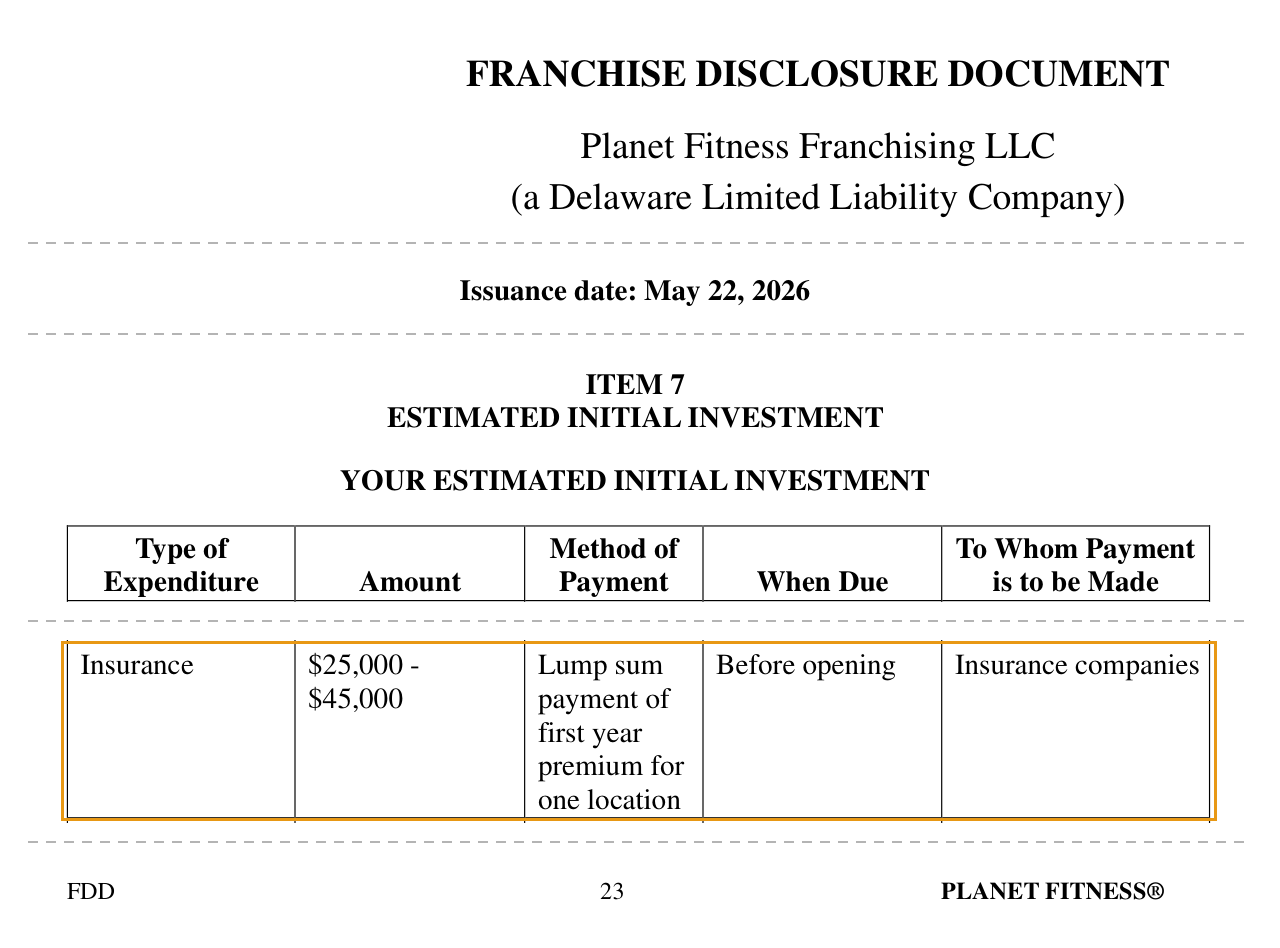
Source 3 of 3 · A big-box franchisor's first-year premium
Planet Fitness Franchise Disclosure Document, issuance date May 22, 2026, Item 7: "Insurance", $25,000 to $45,000, "Lump sum payment of first year premium for one location", due before opening and paid to insurance companies.
Source: Planet Fitness 2026 Franchise Disclosure Document, filed with the Minnesota Department of Commerce
Three things stand out. The first is size. Planet Fitness and Crunch, which run large clubs with big memberships, budget $25,000 to $45,000 and $15,000 to $35,000, several times the $1,000 to $5,000 bands on the first page of search results. The second is format. The four boutique studio brands state annual premiums from $3,196 at the low end to $21,172 at the high end for their minimum required insurance, and the two small 24-hour brands print program figures of $3,200 and $6,569 a club. The third is buying power. Planet Fitness notes that the insurance costs in its Item 19 statement "are based on bulk buy pricing for multiple clubs," and Snap Fitness runs its required program through a captive insurer, charging every company club the same $6,569, below the $576.85 a month, or $6,922.20 a year by our arithmetic, that its Item 6 now lists. A single independent club should not expect to buy at either brand's price.
Item 8 explains most of the gap with the search-result bands, because the franchisors require far more than liability. Every one of the 13 requires general liability of at least $1,000,000 per occurrence. Planet Fitness adds $1,000,000 each of abuse and molestation cover and tanning cover, both on "silent/non-exclusionary language," business income cover at 50 percent of annual gross revenue, cyber and employment practices cover of $1,000,000 per claim for an owner of one to five clubs, and an umbrella of $2,000,000 for one or two clubs, $5,000,000 for three to ten and $10,000,000 for 11 to 50. Orangetheory requires $100,000 each occurrence for sexual misconduct within its professional liability, employment practices cover of $250,000 a year, business interruption cover of not less than 75 percent of annual revenue and $250,000 of cyber cover. Club Pilates requires participant legal liability of $1,000,000, sexual abuse and molestation cover included rather than excluded, and employment practices cover of $1,000,000 with a retention no larger than $25,000. F45 requires an umbrella of at least $3,000,000 and professional liability of at least $3,000,000, including abuse and molestation cover of at least $300,000.
Set against Specialty Insurance's whole-program bands, the boutique figures straddle ours. The low estimate of each of the four boutique brands, $3,196 to $3,936, falls inside our $2,500 to $10,000 band for a studio under 3,000 square feet, and each high estimate, $14,632 to $21,172, sits above it. Planet Fitness's $25,000 to $45,000 for one club's first year meets only the bottom of our band for a large club of 20,000 square feet or more with a pool or childcare, $40,000 to $200,000.
An independent gym is not bound by any franchisor's list. It is a fair guide to what a landlord, a lender or a buyer of the business will eventually ask about, and to the lines a gym is going without when its only policy is a liability certificate. An owner who runs several clubs, or who is opening a second, can read our guide to multi-location coverage for how per-location aggregates and umbrella tiers work.
Franchise documents are the most useful public prices in this industry, because a franchisor has to print what its own brand standards cost. They also show why a liability quote and a program quote are different documents. Before I compare two numbers for a gym owner, I ask which of the eight lines each one includes.
Bobby Sharp, Action Sports Practice Lead, Specialty Insurance
What the listed gym companies tell their investors
The largest operators insure differently again. Life Time's annual report on Form 10-K for 2025 says it uses restricted cash "for our self-insured workers' compensation and general liabilities," and it carried self-insurance accruals of $35.5 million at December 31, 2025, against $29.4 million a year earlier (Life Time 10-K). Its risk factors warn that more claims "against health and fitness center operators generally" may cause "the cost of insurance for the industry as a whole" to rise, and that its "level of insurance has decreased and the relative cost has increased" for parts of the business, including its medi-spa services. Planet Fitness tells investors that claims may be asserted "for injuries or death suffered by members or guests while exercising," and that it may not be able to maintain its general liability insurance "on acceptable terms in the future" (Planet Fitness 10-K). Xponential Fitness, which franchises boutique studio brands, lists claims for a customer's injury while exercising and "for harassment in connection with services offered at a studio," and says: "We maintain cyber risk insurance, but do not require franchisees to do so" (Xponential 10-K).
For an independent owner these filings are context rather than prices. They show that the companies with the most claims data expect the cost of cover to rise, and that the claims they worry about are member injuries, harassment and data, which are the lines in the table above.
State rules that change a gym's insurance bill
Most of a gym's premium is set by underwriting rather than by statute, but four kinds of state rule move the bill: defibrillator and staffing rules, health studio bonds, and the workers' compensation class a gym's payroll is rated in.
| State and rule | What it requires | What it does to the insurance bill |
|---|---|---|
| California, Health and Safety Code section 104113 | A defibrillator and trained staff at every health studio. A studio with unstaffed hours must also have every employee trained in CPR and defibrillator use within 30 days, keep a trained employee on site at least 50 hours a week, tell members at sign-up, and deny unstaffed access in a space over 6,000 square feet | Hours without trained staff waive the primary assumption of the risk defense, express or implied, for claims arising out of their absence |
| New York, General Business Law section 627-a | At least one defibrillator, and a certified attendant at all times during staffed business hours, at every health club with 50 or more members (the threshold was 500 until May 2023) | Sets the staffed-hours standard a member injury claim will be measured against |
| Florida, Statutes sections 501.015 and 501.016 | A health studio that sells contracts registers each location for $300 a year and posts a $25,000 bond, letter of credit or guaranty, reducible to at least $10,000 while outstanding contracts are under $5,000. Monthly billing at a reasonable and fair fee, or five years of compliant operation under the same ownership, exempts a studio | A surety bond is a separate purchase from the insurance program |
| Pennsylvania, workers' compensation class 884, Health or Exercise Club | Rating bureau loss cost of $0.433 per $100 of payroll from April 1, 2026. Boxing, gymnastics and martial arts training facilities and indoor climbing walls are rated in a different class, 968 | Sets the base of the workers' compensation line before the insurer's own multiplier |
| California, workers' compensation class 9053, Health Clubs or Gyms | Advisory pure premium rate of $1.889 per $100 of payroll from September 1, 2026, up from $1.500. Studios built on scheduled classes are rated in class 8870 at $0.975 | The same payroll costs nearly twice as much in an at-will gym as in a class-based studio |
Workers' compensation is the one line priced on payroll rather than on sales or members, and the class a gym's payroll lands in sets the rate. In Pennsylvania, health and exercise clubs are rated in class 884, and the rating bureau's loss cost from April 1, 2026 is $0.433 per $100 of payroll. On $250,000 of payroll that is $1,082.50 of loss cost before the insurer applies its own multiplier and any experience modification, by our arithmetic. The same bureau rates indoor climbing walls in a different class, which our climbing gym cost guide sets out. In California, class 9053, Health Clubs or Gyms, covers facilities where cardiovascular equipment, weight machines and free weights are "available for use by clients on an at-will basis for the majority of operating hours," at an advisory pure premium rate of $1.889 per $100 of payroll from September 1, 2026. A studio built on scheduled classes, where equipment is not open for at-will use most of the time, is rated in class 8870 at $0.975, so the same payroll can cost nearly twice as much in a gym as in a studio.
What drives a gym insurance premium up
Sales are the base. The published health club program rates a club on its annual sales, so a gym that doubles its membership doubles its liability premium on that form. Everything else on this list either moves the rate or adds a line.
| Factor | Why it moves the premium |
|---|---|
| Annual sales | The published health club program prices liability per $1,000 of annual sales, so a club that grows from $250,000 to $1,000,000 of sales quadruples its staffed premium on that form, and a club above $1,000,000 a location leaves the program. |
| Unstaffed 24-hour access | Doubles the published liability and abuse and molestation rates, brings a supplement of security and emergency questions, and in California removes a key defense for claims arising from the absence of trained staff. |
| A higher limit demanded by a lease or a franchisor | Moving from $1,000,000 to $2,000,000 per occurrence on the published form takes the staffed rate from $7.10 to $10.65 per $1,000 of sales, 50 percent more, and the minimum from $1,650 to $2,750. Franchisors then add umbrella limits that climb with the number of clubs. |
| High-intensity and contact programs | A CrossFit affiliate rates at $9.46 per $1,000 of sales against $7.10 for a staffed club, about a third more. Boxing with contact or sparring is excluded from both published fitness forms, and martial arts facilities are ineligible. |
| Amenities | Swimming pools, drop-off child care, full-size trampolines and climbing walls are ineligible on the published health club form, and saunas, steam rooms, tanning, a nursery and massage each bring their own questions. |
| Independent contractor trainers | Are not covered by the club's policy unless the extension is bought, at $300 a year for $1,000,000 on the published form, and more than ten contractors brings extra underwriting. |
| Youth members and one-on-one training | Bring Sexual Abuse and Molestation Insurance into the program and put the minimum membership age and the rule for unaccompanied minors on the application. |
| Employees | Workers' Compensation Insurance is required by state law once the gym has employees and is priced on payroll, and franchisors add Employment Practices Liability Insurance, which both published fitness forms exclude. |
| Property values and location | Equipment and build-out must be insured at full replacement cost to avoid a coinsurance penalty, and one franchisor warns that property and business interruption premiums may exceed its estimate because of catastrophic natural disasters. |
| The industry's claims | One of the largest listed club operators warns that more claims against health and fitness center operators could raise the cost of insurance for the whole industry. |
Specialty Insurance builds coverage programs one exposure at a time for action sports and entertainment businesses. Here is how one client, a brand-new operator rather than a gym owner, described working with us.
"Bobby Sharp and the team at Specialty Insurance had a fast turnaround, professional service, and answered every question I had as a brand-new operator. They wrote the policy I'd want defending me if a player ever filed a claim."
Grimnir Tactical LLC
Verified customer review
What brings it down
Most of this list costs little more than paperwork and a few settings on the access system, which is the useful part for an owner reading it before renewal.
| Factor | What it proves to an underwriter |
|---|---|
| Staffed peak hours on a written schedule | That someone is on the floor when the gym is busiest. The published 24-hour supplement asks for the staffed hours by name. |
| Tailgate detection, alarms and owner alerts on the door | That only members get in during unstaffed hours, and that the owner hears about it when someone follows a member through. |
| Cameras with footage kept and reviewed | That the gym can show what happened when a claim arrives months later. The supplement asks how long recordings are kept and how often they are reviewed. |
| Mechanical free-exit hardware, pull stations and wearable emergency devices | That a member can leave in a power cut and can summon help when nobody is on staff, and that responders have a way into the building. |
| A defibrillator on site and staff trained to use it | That the gym meets the state rule where one applies, as it does in California and New York, and can respond to a cardiac arrest in the minutes that matter. |
| Saunas, steam rooms, tanning and hot tubs locked during unstaffed hours | That the exposures most likely to hurt a member who is alone are closed when nobody is there. |
| A minimum membership age and no unaccompanied minors | That the abuse and supervision exposure is managed, which the supplement asks about directly. |
| Monthly equipment inspections and a maintenance log | That the gym inspects and services its equipment, which the published application asks about, and can prove it after a cable or a bench fails. |
| Certificates from contract trainers and renters | That anyone else training members on the floor carries their own liability cover, with the gym named as an additional insured. |
| A schedule of equipment values at replacement cost | That the equipment and build-out are insured to value, which avoids the coinsurance penalty the published form warns about. |
The incident report deserves a place in the daily routine. A claim over an equipment injury can arrive months after the fall, when the camera footage has been overwritten and nobody remembers who was on the floor; our guide to how to handle a claim covers what to record on the day.
What to have ready before you ask for a quote
A quote for a gym turns on documents rather than adjectives. Have these to hand and the quote comes back faster and closer to the bottom of the range.
- The facility. Square footage, the lease, a floor plan, and every amenity: pool, sauna, steam room, tanning, nursery, juice bar, pro shop.
- Sales. Last year's membership fees and other revenue by category, this year's projection, and initiation fees shown separately.
- Hours. Staffed hours by day, unstaffed hours, and how members get in when nobody is on site.
- Security. Tailgate detection, camera coverage and how long footage is kept, alarms, exit hardware, emergency devices and pull stations.
- Members. The current count, the minimum membership age, and the rule for minors.
- Staff and trainers. Who is an employee and who is an independent contractor, payroll, certifications, and CPR and defibrillator training.
- Programs. Group classes, CrossFit or other high-intensity programs, youth programs, and any events open to the public.
- Equipment. A schedule of values at replacement cost and the maintenance log.
- Contracts. The franchise agreement's insurance requirements, the lease's insurance clause, and any additional insured wording you have agreed to.
- Three to five years of loss runs, even if there have been no claims.
Line up the renewal dates while you are at it. Both published K&K fitness forms are valid for policies effective from January 1 to December 31, 2026, so a gym on either program will see the 2027 rates at its next renewal, and a franchisee's insurance requirements can change with each year's disclosure document.
Frequently asked questions
How much does a gym pay for insurance?
In Specialty Insurance's book, an independent gym of about 5,000 square feet with roughly $500,000 of membership sales pays $2,500 to $8,000 a year for general liability with participant liability at $1,000,000 per occurrence, or $3,500 to $14,000 with 24-hour key-card access. Priced as a whole program, the same gym runs $7,500 to $30,000 a year with staffed hours and $10,000 to $45,000 with 24-hour access, a boutique or personal training studio under 3,000 square feet $2,500 to $10,000, and a large club with a pool or childcare $40,000 to $200,000. On a national health club program that prints its rates, a staffed club with $500,000 of sales pays $3,550 a year for $1,000,000 of liability and a 24-hour key-card club twice that. Franchise disclosure documents show boutique studio brands stating $3,196 to $21,172 a year for their minimum required insurance and Planet Fitness telling a franchisee to budget $25,000 to $45,000 for one club's first-year premium.
How much is liability insurance for a gym?
Published liability figures run from a median of $69 a month on one insurance marketplace to an average of $810 a year across one national carrier's small business customers, and one gym insurance platform says most owners pay under $150 a month. The national health club program that prints its rates charges $7.10 per $1,000 of annual sales for $1,000,000 per occurrence, with a $1,650 minimum, and that premium includes participant liability, professional liability and hired and non-owned auto liability. A studio of 3,000 square feet or less can buy a similar package by floor area, from $500 a year for up to 1,000 square feet to $1,500 for 2,001 to 3,000 square feet at $1,000,000. Specialty Insurance's range for general liability with participant liability, for the 5,000-square-foot gym in the table, is $2,500 to $8,000 a year with staffed hours and $3,500 to $14,000 with 24-hour key-card access.
What insurance does a gym need?
Most gyms build their program from general liability that includes participant liability, professional liability for trainers, commercial property with business income cover (or a business owners policy that combines liability and property), workers' compensation once they have employees, and sexual abuse and molestation cover where there are youth programs, childcare or one-on-one training. Employment practices liability, cyber liability and an umbrella are usually added when a franchise agreement or a lease requires them. Planet Fitness's 2026 disclosure document, for example, requires employment practices and cyber cover of $1,000,000 per claim for an owner of one to five clubs, and an umbrella of $2,000,000 for one or two clubs.
Does gym insurance cover member injuries?
Only if the general liability policy includes participant liability, the cover for a member hurt while exercising who says the gym was at fault. The published national health club program includes $1,000,000 of bodily injury to participants liability, but its $5,000 medical expense cover does not pay for exercising participants, and it does not extend to independent contractor trainers unless the club buys that option. Some general liability forms exclude participants altogether. A signed waiver helps in some states, but in California a gym that admits members without trained staff on site loses the primary assumption of the risk defense, express or implied, for claims arising out of that absence.
How much does 24-hour gym insurance cost?
In Specialty Insurance's book, a 24-hour key-card gym of about 5,000 square feet with roughly $500,000 of membership sales pays $3,500 to $14,000 a year for general liability with participant liability at $1,000,000 per occurrence, against $2,500 to $8,000 for the same gym with staffed hours, and $10,000 to $45,000 for its whole program, against $7,500 to $30,000 staffed. On the published national health club program, a 24-hour key card, pad or code club pays $14.20 per $1,000 of annual sales for $1,000,000 of liability, exactly twice the $7.10 a staffed club pays, so a club with $500,000 of sales pays $7,100 instead of $3,550. One online platform prices after-hours access far lower, as a 15 percent addition to its general liability premium. Among 24-hour franchises, Snap Fitness requires its own insurance program at $576.85 a month, and Anytime Fitness prints $3,200 a year for each company-owned center, a figure its insurer supplied.
How much does insurance cost for a small gym?
A studio of 3,000 square feet or less can buy liability on a published program by floor area: $500 a year up to 1,000 square feet, $1,000 up to 2,000 and $1,500 up to 3,000, all at $1,000,000 of liability, though that program excludes self-directed open access outside structured classes. A small staffed gym on the published health club program pays the $1,650 minimum until its annual sales pass about $232,000. A local agency puts small gyms at $1,000 to $5,000 a year, and boutique studio franchises state annual premiums for their minimum required insurance of $3,196 to $21,172. Specialty Insurance prices the whole program for a boutique or personal training studio under 3,000 square feet at $2,500 to $10,000 a year.
Sources
- K&K Insurance, Basic Service Health Club Insurance Program and Enrollment Form 1804 (9/2026) and Fitness Studio Insurance Program and Enrollment Form 1019 (1/2026), both valid for effective dates January 1 to December 31, 2026, read October 2026.
- California Health and Safety Code section 104113; New York General Business Law section 627-a; Florida Statutes sections 501.015 and 501.016.
- Pennsylvania Compensation Rating Bureau, loss costs effective April 1, 2026 (class 884); Workers' Compensation Insurance Rating Bureau of California, advisory pure premium rates effective September 1, 2026 (classes 9053 and 8870).
- Franchise disclosure documents filed with the Minnesota Department of Commerce, current 2026 versions read in October 2026: Planet Fitness, Crunch Fitness, Gold's Gym, Workout Anytime, Snap Fitness, Anytime Fitness, Orangetheory Fitness, F45 Training, Burn Boot Camp, Club Pilates, Pure Barre, StretchLab and YogaSix.
- Annual reports on Form 10-K for the year ended December 31, 2025, filed with the US Securities and Exchange Commission by Life Time Group Holdings, Planet Fitness and Xponential Fitness.
- Gym insurance cost pages published by ERGO NEXT, The Hartford, Insureon, Gym Insurance by PushPress, Gymdesk and the Oliver L.E. Soden Agency, all read October 2026.
- Premium ranges in the coverage-line and whole-program tables are Specialty Insurance's own indication for a single US gym, fitness center or studio, October 2026, supplied for budgeting purposes only and not constituting an offer of cover.