

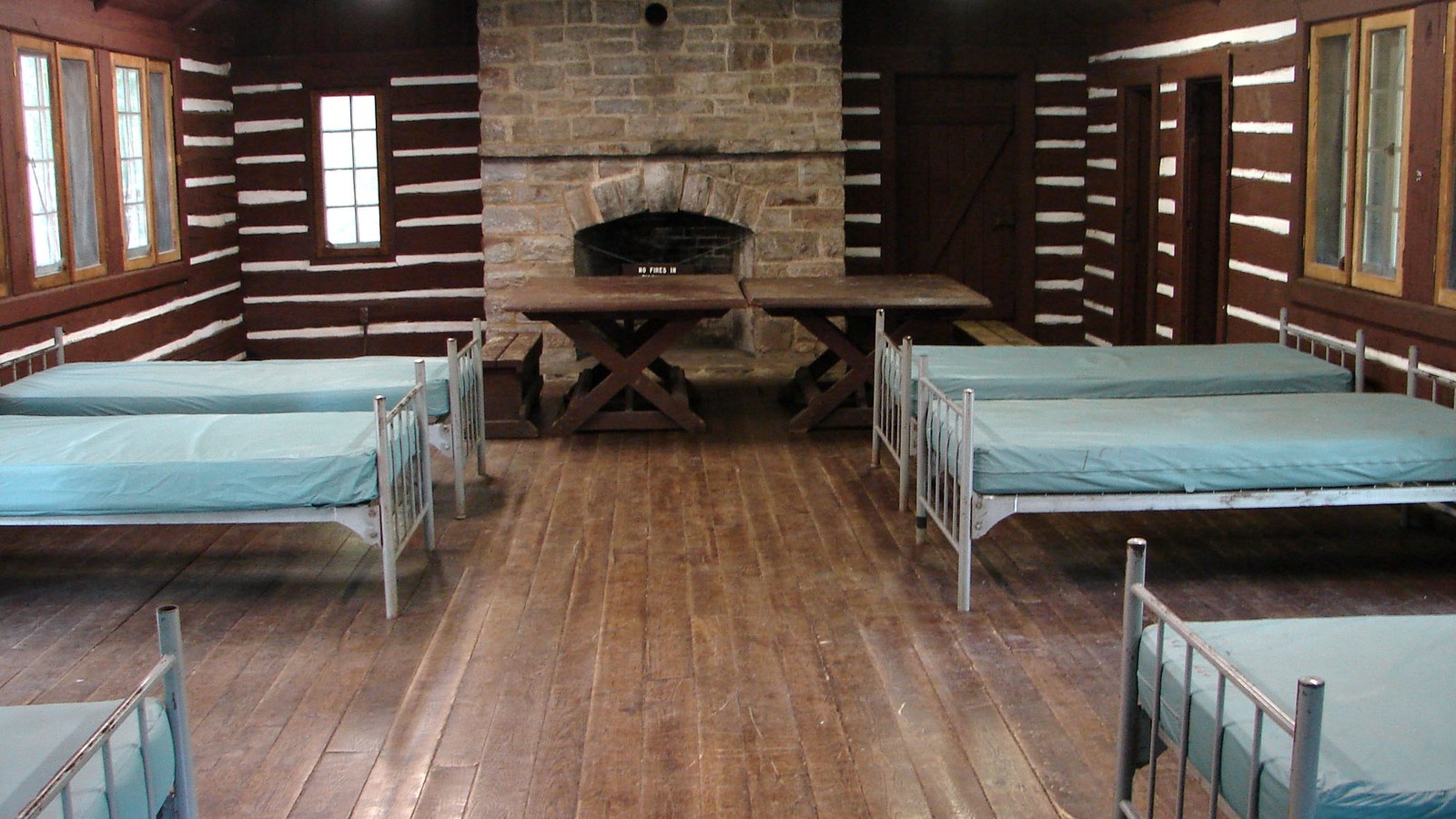
Camp Mystic carried $1,000,000 of general liability insurance and $5,000,000 of excess liability, both issued by AIG, when the Guadalupe River flooded the camp on July 4, 2025, killing 25 campers and two counselors. The camp disclosed the two policies in its answers to the parents' lawsuits, the San Antonio Express-News reported in July 2026. Parents of 24 of the 27 victims have sued, and the paper worked out that the two limits, shared among them, come to $250,000 per child. The camp filed for Chapter 11 bankruptcy in June 2026, and in October a federal bankruptcy judge ruled that the wrongful death suits may resume on November 9.
Texas rewrote its youth camp law after the flood. Since September 5, 2025, the state may not license or renew a camp that operates a cabin in a floodplain unless the cabin meets one of two narrow exceptions, and every camp must submit an emergency plan for approval each year. The statute still does not require a camp to carry insurance of any kind. Texas's licensed after-school and school-age programs answer to different rules: they must carry $300,000 of liability insurance for each occurrence, or tell every parent in writing that they do not.
Most of the prices that rank for the cost question start somewhere else. When we searched in October 2026, the first result for summer camp insurance cost printed a per-camper rate for $1,000,000 of liability. The third was a national carrier's page that lists the average premiums its small business customers pay and says, in the same sentence, that the carrier does not offer coverage for summer camps. Two others repeated a $37 to $59 a month band for general liability that traces back to one insurance comparison site. None of them set a price against the limits a camp is asked to carry, and none mentioned what Camp Mystic carried, although Google completes the search "how much insurance does camp mystic have."
This guide prices a camp one coverage line at a time, for day camps, sports camps and clinics, specialty camps and overnight camps, with a separate price column for a camp that sleeps campers on its own land, because that is where the published per-camper programs stop. Two kinds of activity sit outside it because they are rated on their own exposure. Climbing walls, ropes courses and ziplines are priced in our ropes course, zipline and climbing gym cost guide, and archery has an archery range guide of its own. Dance schools that run summer dance camps will find them priced in our dance studio cost guide.
How much summer camp insurance costs for 2026-2027
The table prices two operations. The day camp column is a general summer day camp for children aged 5 to 14 at a rented school or park, about 100 campers a week for eight weeks, or 800 camper-weeks, with 15 seasonal staff, swimming at a lifeguarded pool and field trips by chartered bus. The overnight camp column is a resident camp on its own land, about 150 campers a session for six one-week sessions, or 900 camper-weeks, with cabins, a dining hall, a lakefront used for swimming and canoeing, about 50 seasonal staff and two camp-owned vans. Read both as budgeting indications rather than quotes. A two-day basketball clinic in a rented gym and a resident camp with horses, a ropes course and a waterfront land at opposite ends of these ranges.
2026-2027 premium benchmark
What summer camp insurance costs, line by line
Typical annual premiums for a single US summer camp, by coverage line, for a day camp on rented premises and for an overnight camp on its own land.
- Priced for
- A day camp for children aged 5 to 14 at a rented school or park, about 800 camper-weeks a summer, 15 seasonal staff, swimming at a lifeguarded pool and field trips by chartered bus. The overnight column is a resident camp on its own land, about 900 camper-weeks in six one-week sessions, with cabins, a dining hall, a lakefront used for swimming and canoeing, about 50 seasonal staff and two camp-owned vans
- Basis
- Annual premium, United States
- Updated
- October 2026
| Coverage | Day camp, annual | Overnight camp, annual | Typical limits |
|---|---|---|---|
| General Liability InsuranceFoundation Injury and property damage claims from campers, parents and visitors: a fall on the playing field, a missed head count, a drill run in the heat. For a camp it should include participant liability, the cover for a camper hurt during an activity whose family says the camp was at fault. | $2,500 to $7,500$210 to $625per month | $8,000 to $25,000$670 to $2,085per month | $1,000,000 per occurrence / $2,000,000 to $5,000,000 aggregate |
| Participant Accident InsuranceFoundation A camper's medical bills after an injury at camp, paid whoever was at fault, usually after the family's own health insurance. Many universities and some cities require it of camps on their grounds. | $500 to $2,000$45 to $170per month | $1,500 to $5,000$125 to $420per month | $25,000 to $250,000 per camper |
| Sexual Abuse and Molestation InsuranceFoundation Allegations of abuse by staff, volunteers or another camper, and the negligent hiring and supervision claims that come with them. Most general liability forms exclude it unless it is added and paid for. | $400 to $2,000$35 to $170per month | $1,500 to $6,000$125 to $500per month | $1,000,000 per occurrence / $2,000,000 to $3,000,000 aggregate |
| Workers' Compensation InsuranceFoundation Injuries to counselors, coaches, lifeguards, kitchen and maintenance staff, required by state law once the camp has employees and priced on the season's payroll. Includes employer's liability. | $1,500 to $4,000$125 to $335per month | $7,500 to $20,000$625 to $1,670per month | Statutory state limits; employer's liability $500,000 to $1,000,000 |
| Commercial Auto InsuranceSituational Camp-owned vans and buses, plus hired and non-owned auto liability for chartered buses, rented vans and counselors who drive campers in their own cars on field trips. | $300 to $1,000$25 to $85per month | $3,000 to $8,000$250 to $670per month | $1,000,000 combined single limit |
| Commercial Property InsuranceSituational Cabins, the dining hall, docks, boats and program equipment at a camp that owns its site, with business income cover for a season lost to a fire or a flood. A day camp on rented premises insures only its equipment. | $250 to $1,000$25 to $85per month | $8,000 to $30,000$670 to $2,500per month | Replacement cost of buildings, equipment and contents |
| Professional Liability InsuranceSituational Claims that the camp's instruction, supervision plan or health care decisions, such as how a camper's medication was handled, caused an injury, for staff and contracted instructors. | $300 to $1,500$25 to $125per month | $750 to $3,000$65 to $250per month | $1,000,000 per claim |
| Excess / Umbrella InsuranceSituational Limits above the general liability, auto and employer's liability policies, for one event that hurts several campers at once, or for a host that requires $5,000,000. | $1,000 to $4,000$85 to $335per month | $5,000 to $25,000$420 to $2,085per month | $1,000,000 to $10,000,000 per occurrence |
No camp buys every line. The first four are the foundation for any camp with employees and campers under 18; the rest switch on with vehicles, an owned site, a host's insurance clause or the size of the program. General Liability Insurance should include participant liability, and Professional Liability Insurance is often included in a camp's general liability package. The day camp's Commercial Auto Insurance is hired and non-owned auto only, because the charter bus company insures the bus. Directors and Officers Insurance for a nonprofit camp's board, Cyber Liability Insurance for camper records and online registration, Special Event Insurance for a one-off clinic, and cover for horseback riding, climbing walls, ropes courses and ziplines are quoted separately.
Specialty Insurance book. Updated . Ranges are an indication for budgeting, not a quote or a bindable offer.
Request a quoteIn Specialty Insurance's book, general liability with participant liability at $1,000,000 per occurrence runs $2,500 to $7,500 a year for the day camp and $8,000 to $25,000 for the overnight camp. The overnight camp costs more on every line, and the gap is widest for property: $8,000 to $30,000 for cabins, a dining hall, docks and boats, against $250 to $1,000 for a day camp that insures only its equipment. Workers' compensation runs $7,500 to $20,000 overnight against $1,500 to $4,000 for the day camp, which fits a line priced on the payroll of about 50 seasonal staff rather than 15. Professional liability, at $300 to $1,500 for the day camp and $750 to $3,000 overnight, is often included in a camp's general liability package.
The lines follow the order in which a camp usually buys them. General Liability Insurance is the base, and the part that decides most camp claims is participant liability, the cover for a camper who is hurt during an activity and whose family says the camp is to blame: a missed head count, a drill run in the heat, a fall a counselor should have prevented. Some forms write it in, as the published per-camper programs do with "Legal Liability to Participants," and some exclude it, which is the split our guide to participant injury versus general liability explains. Participant Accident Insurance pays a camper's medical bills whoever was at fault, and it is the line hosts ask for most often after liability: Cornell University requires at least $5,000 per accident per attendee for athletic programs, and the University of California requires $25,000 for sports participants at third-party camps on its campuses. Our page on participant accident insurance explains how that cover works.
Sexual Abuse and Molestation Insurance is marked as foundation because every camp is built around children, and most general liability forms leave the exposure out unless it is added and paid for. The published day camp form, for example, excludes sexual abuse "unless reported to, approved by us, and the appropriate premium paid." Workers' Compensation Insurance covers counselors, coaches, lifeguards and kitchen staff, is required by state law once a camp has employees, and is priced on the season's payroll. New York City requires workers' compensation and disability insurance for camp staff before the season opens.
The last four lines depend on the camp. Commercial Auto Insurance covers camp-owned vans and buses, and its hired and non-owned auto liability covers chartered buses, rented vans and counselors who drive campers in their own cars. In the day camp column the line is hired and non-owned auto only, at $300 to $1,000 a year, because the charter bus company insures the bus; the overnight column, $3,000 to $8,000, adds the camp's two vans. The published per-camper programs include hired and non-owned auto liability but exclude injury to participants riding in those vehicles and the use of multi-passenger vehicles. Commercial Property Insurance matters to a camp that owns its cabins, dining hall, docks and boats; a day camp on rented premises insures little more than its equipment. Professional Liability Insurance answers the allegation that the camp's instruction, supervision plan or health care decisions caused an injury. Excess / Umbrella Insurance sits above the rest, and for a camp it is sized to the one event that hurts several campers at once, which is the subject of the Camp Mystic section below and of our page on excess and umbrella insurance.
What the whole program costs, by camp type
The table above prices one line at a time, but a camp buys a program. For budgeting a complete camp, Specialty Insurance prices four common setups as a whole.
| Camp profile | What the underwriter is rating | Typical annual program |
|---|---|---|
| Small specialty day camp (arts or STEM) at a rented site, about 100 camper-weeks | Arts, science or technology sessions on premises the camp does not own, with an eighth of the day camp's camper-weeks. | $750 to $2,500 |
| Sports camp or clinic at a rented school or university field, about 300 camper-weeks of soccer | Skill sessions in soccer, a Class 2 sport on the published per-camper forms, at a field the camp does not own, usually under the host's insurance clause. | $1,000 to $4,000 |
| Day camp for children aged 5 to 14 at a rented school or park, about 800 camper-weeks | The day camp in the line table: eight weeks of general activities, 15 seasonal staff, swimming at a lifeguarded pool and field trips by chartered bus. | $6,000 to $20,000 |
| Overnight camp on its own land, about 900 camper-weeks | The overnight camp in the line table: campers sleeping on site in cabins, a lakefront used for swimming and canoeing, a dining hall, about 50 seasonal staff and two camp-owned vans. | $35,000 to $100,000 |
Adding up the eight lines does not give you a program. Few camps buy all of them, and fewer sit at the top of every range at once, so start from the row that looks most like yours. A day camp that begins sleeping campers on land it owns moves from the third row, $6,000 to $20,000, to the fourth, $35,000 to $100,000, and off the published per-camper programs.
The published figures set out below sit lower for a reason. On our arithmetic, the per-camper program's $3,464 for the day camp, or $3,824 with its abuse option, buys the liability side of the program only, which is why it falls short of the whole-program band of $6,000 to $20,000: that band is the budget once workers' compensation, auto, property, an umbrella and the $1,000,000 abuse limit hosts ask for are added. At the other end, Specialty Insurance's book treats the same carrier's $10,000 minimum account premium as a realistic floor for a small resident camp, and it mostly matters to camps with fewer than about 50 campers a session. The overnight camp in the table lands well above it: its general liability, participant accident and abuse lines alone come to $11,000 to $36,000 a year by our arithmetic, and the whole program to $35,000 to $100,000.
What the published per-camper rates buy, and what they leave out
Most camp insurance programs do not print a price. K&K Insurance's youth camp programs do, in two enrollment forms sold through a risk purchasing group: form 1040 for youth day camps built on activities other than sports, and form 1032 for youth sports camps and clinics, both valid for policies effective from March 1, 2026 to February 28, 2027. Each is a rating formula rather than a quote. The camp counts its campers by session, multiplies by the rate for a daily session, a weekly session of three to seven consecutive days or an overnight session, and pays the higher of the result and a minimum premium. The policy runs for a year but applies only to the sessions the camp reports.
| Published rate per camper | $1,000,000 liability, $25,000 participant medical | $2,000,000 liability, $250,000 participant medical |
|---|---|---|
| Non-sport day camp or Class 1 sport, daily session | $1.45 | $1.97 |
| Non-sport day camp or Class 1 sport, weekly session (3 to 7 days) | $4.33 | $5.99 |
| Non-sport day camp or Class 1 sport, per resident camper (1 to 7 days) | $5.75 | $7.95 |
| Class 2 sport, daily session | $1.60 | $2.20 |
| Class 2 sport, weekly session (3 to 7 days) | $4.78 | $6.66 |
| Class 2 sport, per resident camper (1 to 7 days) | $6.34 | $8.83 |
| Minimum premium | $240 | $360 |
| Sexual misconduct option ($250,000 each event, $1,000,000 aggregate) | $0.15 daily, $0.45 weekly, $0.59 per resident camper, $150 minimum | Same rates |
The rates are printed on both forms, and the non-sport day camp rates match the Class 1 sports rates exactly. On those rates, by our arithmetic, the day camp in our table, at 800 camper-weeks, would pay $3,464 at the $1,000,000 option or $4,792 at the $2,000,000 option, plus $360 if it adds the sexual misconduct option and the $20 purchasing group fee, before surplus lines taxes. A two-day clinic for 50 campers calculates to $145 and pays the $240 minimum, the example both forms print. A soccer camp that hosts 150 resident campers a week for four weeks on a university campus would pay $3,804 at the $1,000,000 option.
That $3,464, the $4.33 weekly rate applied to all 800 camper-weeks, lands in the lower half of Specialty Insurance's general liability range for the same camp, $2,500 to $7,500, where a clean camp at a rented site should sit. Camps land higher with swimming, frequent field trips, prior claims or a site in a higher cost state, and open-market carriers also charge minimum premiums that a large per-camper program does not.
For that rate the program includes more than most figures on the first page of search results. At the $1,000,000 option the forms list $1,000,000 each occurrence of commercial general liability with a $5,000,000 general aggregate per event or camp, $1,000,000 of legal liability to participants, $1,000,000 of professional liability, $1,000,000 each of hired and non-owned auto liability, $1,000,000 for damage to premises rented to the camp, and $25,000 of medical payments for participants with a $100 deductible. The $2,000,000 option raises the occurrence, participant, professional and auto limits to $2,000,000 and participant medical payments to $250,000.
The forms are just as clear about what they leave out. The day camp form will not cover "Camps held at premises owned or maintained by the insured that provide overnight accommodations," sports camps, camps involving animals, or hunting and nature programs. The sports camp form will not cover "Sports camp/clinic operators who own or maintain their own facility," or camps in boxing, martial arts, equestrian, open water, diving and skiing. Both forms exclude amusement devices, a category that includes climbing walls, and the day camp form also excludes boating, equestrian and open water activities, and activities away from the main location that were not reported and approved in advance. Neither program is available to camps in Alaska or Rhode Island.
The first exclusion is the one that matters to a traditional summer camp. A camp that sleeps campers in cabins on its own land is outside both per-camper programs, whatever its size, and its insurance is underwritten on its own buildings, waterfront and staff. The same carrier's program for camps, retreats and conference centers prints no rate. It requires "a system for personnel screening, written sexual abuse and molestation procedures, and criminal background checks to qualify," prefers camps accredited by the American Camp Association, the Christian Camp and Conference Association or an equivalent body, and carries a "$10,000 minimum account premium."
Sport matters too. The sports camp form puts cheerleading, football, gymnastics, soccer, lacrosse, wrestling and the hockeys in Class 2, which costs 10 to 12 percent more per camper than Class 1 sports such as basketball, baseball, swimming and tennis, and it caps neurodegenerative injury claims in Class 2 sports at $1,000,000 at either limit option. A soccer camp that buys the $2,000,000 option for a host still has $1,000,000 for a claim of that kind.
When a camp sends me a certificate from a per-camper program, I check two things before the limits: whether the camp sleeps campers on ground it owns, and whether every session on its calendar was reported. The program covers the sessions on the form. A week added in July and never reported is a week the camp ran without cover.
Bobby Sharp, Action Sports Practice Lead, Specialty Insurance
Why the camp insurance prices online disagree
The first page of search results offers several kinds of figure, and they rarely describe the same purchase. The first result was an agency page that prints the per-camper rates set out above. The second was the carrier's own camp page, which gives only its $10,000 minimum account premium for resident camps. The third, from a national carrier, is titled as a summer camp insurance page and lists $1,687 a year for a business owner's policy, $810 for standalone general liability, $1,032 for workers' compensation and $744 for professional liability as "the average costs our small business customers pay," in a sentence that opens by saying the carrier does not offer coverage for summer camps. Those figures describe the carrier's small business customers in general.
The fourth and fifth results repeat a general liability band of $37 to $59 a month for a policy of $1,000,000 per occurrence and $2,000,000 aggregate. It comes from an insurance comparison site that describes it as the average for small camps; one of the two pages credits it and the other does not. The page that does not credit it also prints $3 to $8 per camper for camp accident insurance and $1,000 to $3,000 a year for "a comprehensive package" for a small to mid-sized day camp. The top of that accident band, $8 per camper, is nearly twice the published weekly rate of $4.33, which buys liability, participant liability and participant medical payments together. Further down the page, a sports camp specialist says its price "starts at $230," just under the $240 minimum on the published forms.
The carrier's own pages are not always current either. Its youth day camp page still works an example at "$1.33," an older daily rate, while the 2026-2027 form linked from the same page uses $1.45. None of these figures is wrong for every camp. Each is a liability figure, a single program's rate or a bundle it does not define, and none says which limits it assumes or whether the camp owns the ground it sleeps on. That is why the table above is built line by line, with day and overnight camps priced apart.
The limits universities and cities require of a camp
For a camp that runs on someone else's campus or field, the limits are set by the host, and many hosts publish them. A sports camp on a university campus, a day camp in a city park or a clinic on a school field will be asked for a certificate showing at least these limits before the first session.
| Host | General liability | Abuse and molestation | Also required |
|---|---|---|---|
| University of Alabama, third-party youth programs | $1,000,000 each occurrence, $2,000,000 aggregate | $1,000,000 each occurrence | Fire damage liability of $100,000 |
| UC Santa Cruz, third-party youth programs | $1,000,000 per occurrence, $2,000,000 aggregate | $1,000,000 per occurrence, $3,000,000 aggregate | Not stated on the published page |
| Cornell University, third-party youth programs | $1,000,000 each occurrence, $2,000,000 aggregate | $1,000,000 per occurrence, $2,000,000 aggregate, as separate limits | Auto liability of $1,000,000 ($5,000,000 for charter bus companies), workers' compensation with $1,000,000 employer's liability, a $5,000,000 umbrella and $5,000 accident cover per attendee |
| University of California campuses, third-party camps and clinics | Participant general liability naming the Regents as additional insured | $1,000,000 for camps with an overnight stay or that run several days | Accident medical of $25,000 for sports participants; some campuses require higher limits |
| City of Los Angeles golf courses, groups and camps | $1,000,000, with the City as additional insured | $1,000,000 sexual assault and misconduct cover | Workers' compensation |
Cornell's list is the fullest of the five, and it shows how far a host's requirements reach beyond general liability.
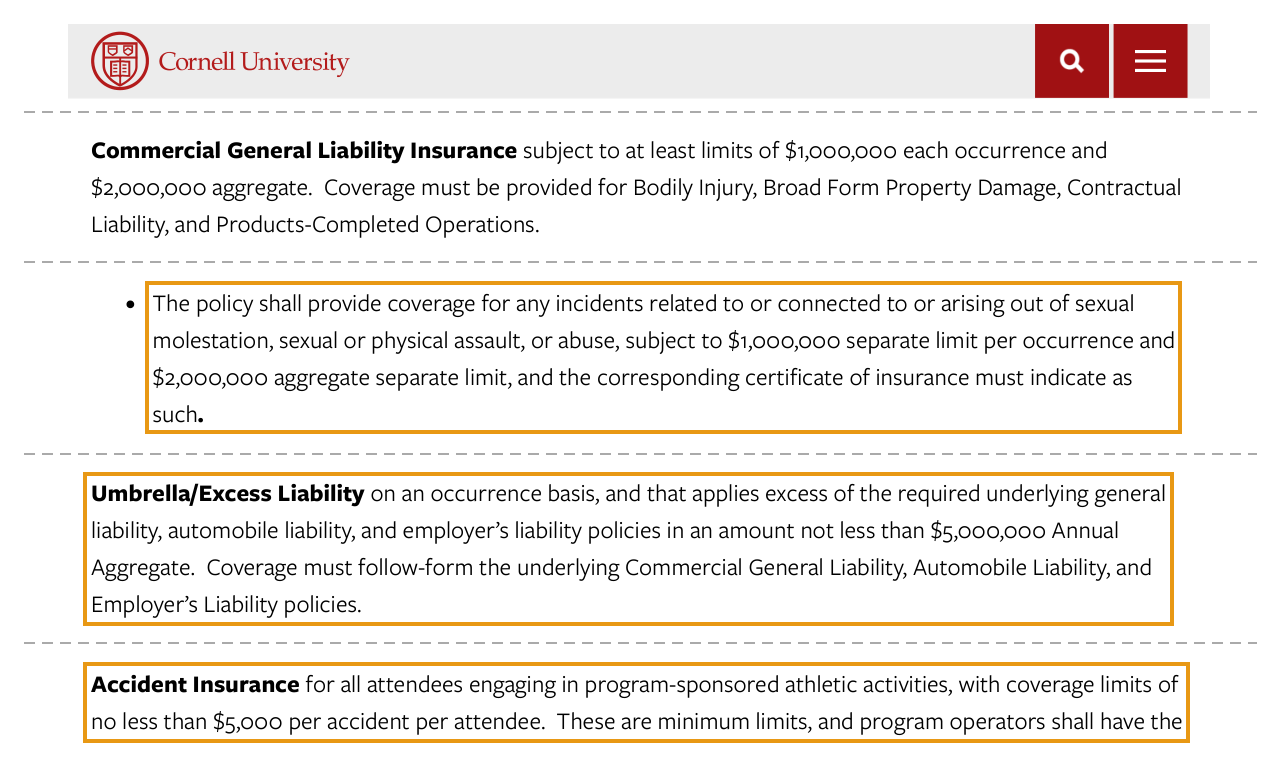
Source 1 of 3 · What one university requires of a youth camp
Cornell University, Office of Risk Management and Insurance, "Events Involving Children and Youth," insurance requirements for third-party operators: commercial general liability of at least $1,000,000 each occurrence and $2,000,000 aggregate, which "shall provide coverage for any incidents related to or connected to or arising out of sexual molestation, sexual or physical assault, or abuse, subject to $1,000,000 separate limit per occurrence and $2,000,000 aggregate separate limit"; umbrella or excess liability of "not less than $5,000,000 Annual Aggregate"; and accident insurance "with coverage limits of no less than $5,000 per accident per attendee."
Source: risk.cornell.edu, Events Involving Children and Youth
Set against these requirements, the published per-camper program meets every host's general liability limit at its $1,000,000 option, and its $25,000 of participant medical payments meets the accident requirements of Cornell and the University of California. Its abuse option meets none of them. That option pays $250,000 for each insured event, within a $1,000,000 aggregate that is part of the general aggregate, while every host in the table asks for $1,000,000 per occurrence, and Cornell asks for it as a separate limit. A camp that relies on the per-camper program for a university booking will need its abuse cover written separately, and an umbrella as well if the host is Cornell.
Two association programs show what cover built for those requirements looks like. The Southern California Municipal Athletic Federation's day camp program charges $7.50 per participant per week for a non-sport camp and $8.00 for a sports camp in 2026, for $1,000,000 per occurrence and a $5,000,000 aggregate of general liability, $15,000 of excess accident medical cover with a $100 deductible, and $1,000,000 per occurrence and $2,000,000 aggregate of abuse cover for instructors who have passed a background check and put abuse prevention training in place. A camps program offered through the University Risk Management and Insurance Association, for camps on college campuses, lists $2,000,000 per occurrence and $3,000,000 aggregate of liability, abuse cover of $1,000,000 per occurrence and $2,000,000 aggregate as a separate limit, a $0 liability deductible, and up to $100,000 of accident medical expense with a $250 deductible per injury. Its marketing calls the abuse cover "a generous $2 million" limit; the program's limits page shows that $2,000,000 is the aggregate.
How much liability is enough: what Camp Mystic carried
A per-occurrence limit is shared by everyone hurt in the same occurrence. For most camp claims, a camper hurt in a game or a fall from a bunk, $1,000,000 is the limit a host asks for. The claims that break a camp's insurance program are the ones in which one event hurts many campers at once: a flood, a fire in a cabin, a bus crash on a field trip. Those claims share one occurrence limit and whatever umbrella sits above it.
Camp Mystic's two AIG policies, $1,000,000 of commercial general liability and $5,000,000 of excess liability, are the clearest public example. Parents of 24 of the 27 victims have sued, and divided among them the two limits come to $250,000 per child. A Texas lawyer quoted by the Express-News, who is not involved in the cases, said "A more appropriate amount of insurance coverage for Camp Mystic would have been $15 million to $25 million." The paper reported that the camp's bankruptcy filing estimates more than 1,000 creditors and debts of up to $50 million, and that the county appraisal district valued its 725 acres at about $15 million. The bankruptcy judge has said that no money can be paid out without the court's permission. The camp did not open for the 2026 season.
Texas answered the flood with siting and planning rules rather than an insurance requirement. The floodplain ban took effect on September 5, 2025.
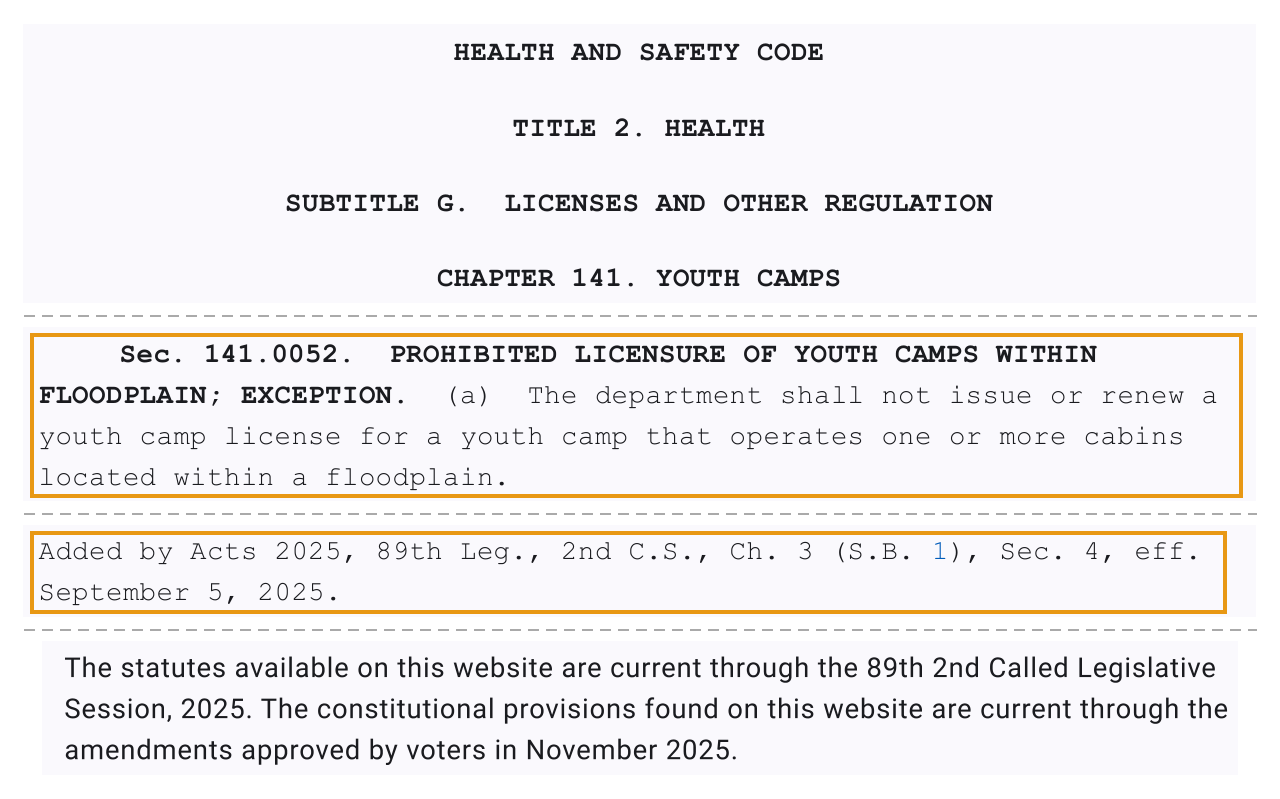
Source 2 of 3 · The rule Texas wrote after the flood
Texas Health and Safety Code chapter 141, the Texas Youth Camp Safety and Health Act, as published by the Texas Legislature ("current through the 89th 2nd Called Legislative Session, 2025"): section 141.0052(a), "The department shall not issue or renew a youth camp license for a youth camp that operates one or more cabins located within a floodplain," with the exceptions in (b) for cabins near still water that is not connected to a watercourse or is dammed, or at least 1,000 feet from a floodway; added by S.B. 1, effective September 5, 2025. The chapter contains no insurance requirement.
Source: statutes.capitol.texas.gov, Health and Safety Code chapter 141
For a camp's insurance, the new rule is a property question and a liability question at the same time. A cabin in a floodplain now has to meet one of the exceptions before the camp can be licensed at all, and the flood map that decides it is the same map a property underwriter reads. The American Camp Association's insurance committee warned in 2020 that, after wildfire, flood and wind losses felt primarily in the West, camps there "can expect to see a 200-percent or higher increase in premium" on the property cover they can still buy, and that awards to plaintiffs "can be staggeringly high."
The question I ask every overnight camp is how many campers sleep on site on the busiest night, and what one event would cost if it reached all of them. Everyone hurt in that event shares one occurrence limit, so the umbrella should be sized to the camp's worst night rather than its average day.
Bobby Sharp, Action Sports Practice Lead, Specialty Insurance
Abuse claims: the line behind the largest camp verdicts
On June 29, 2026, a Cook County, Illinois jury returned $49 million in compensatory damages and $1 million in punitive damages against First Ascent, a Chicago climbing gym operator, over its kids climbing camp in Peoria (John Doe v. First Ascent LLC, Case No. 2024 L 7938). An eight-year-old camper was sexually assaulted in a bathroom by a 13-year-old fellow camper on July 18, 2022, and according to the plaintiff's lawyers the evidence showed the two boys had been unsupervised for 50 minutes. Two points matter for a camp's insurance. The abuser was another camper, so the wording that decides coverage is whether the abuse form reaches camper-on-camper abuse and the negligent supervision claim that comes with it. And the verdict is many times the $250,000 per event that the published per-camper program's abuse option pays. Our climbing gym cost guide covers what the verdict means for climbing operators.
Abuse claims also arrive late. In March 2024 a Pierce County, Washington jury awarded $7.5 million to a man who was abused by two counselors at the YMCA's Camp Seymour from 1976 to 1979, starting when he was eight. The YMCA admitted legal responsibility at trial, and the defense had suggested $500,000. A claim like that is usually tested against the occurrence policies in force when the abuse happened, nearly 50 years earlier, which is why a camp should keep every old policy where it can find it. The American Camp Association's insurance committee noted in 2020 that "Survivor statutes are being passed by states and being opened up."
The abuse limits on offer to camps vary more than any other line. The published per-camper program offers $250,000 for each insured event within a $1,000,000 aggregate that is part of the general aggregate, at $0.15 per camper per day, $0.45 per camper per week or $0.59 per resident camper, with a $150 minimum, or defense cost reimbursement only, up to $100,000, for a flat $100. The association programs above write $1,000,000 per occurrence with a separate aggregate, and every host in our table asks for $1,000,000 per occurrence. Underwriters price the controls as much as the limit: the resident camp program will not quote without screening, written procedures and background checks, and the municipal program offers its abuse cover only to instructors with background checks and training.
California has written some of those controls into law. Business and Professions Code section 18975 requires every administrator, employee and regular volunteer of a youth service organization, a definition that reaches youth recreation programs, to complete child abuse training and a background check, and requires policies that put at least two mandated reporters with children wherever possible. It also lets an insurer "request information demonstrating compliance with this section" before writing liability insurance for the organization. Texas requires a youth camp operator to notify the state immediately, and keep the records, when law enforcement reports that a camp employee is under investigation for or convicted of sexual abuse at the camp.
The abuse questions on a camp application take longer than any other part of the file, because the answers decide which limit the camp can buy. Background checks on every adult, a written rule that no adult is alone with a camper, and a record of who completed the training are what an underwriter asks to see before quoting the $1,000,000 a host requires.
Bobby Sharp, Action Sports Practice Lead, Specialty Insurance
State rules that set a camp's insurance floor
Most states license youth camps without naming an amount of insurance, and several require only that a camp carry some. A few set dollar floors, and the floors are low.
| State and rule | What it requires | Dollar floor |
|---|---|---|
| New York City, Health Code section 48.21 | Workers' compensation and disability insurance for staff, comprehensive liability and motor vehicle insurance before the season; a non-owner policy for vehicles the camp uses but does not own; accident and health cover for every camper and staff member | $100,000 per person and $500,000 for two or more on camp vehicles; $1,000 accident and $300 illness cover per camper; $5,000 and $1,000 plus $100,000 of liability for traveling day camps |
| Wisconsin, DCF 252.41(1)(e), licensed day camps | General liability, vehicle liability when the camp transports children, non-owned vehicle cover, and a certificate on file before the license is issued | $25,000 each person and $75,000 each occurrence of general liability |
| Texas, Health and Safety Code chapter 141, youth camps | A license, an emergency plan submitted for approval each year, and since September 5, 2025 no cabins in a floodplain unless an exception applies | None: the statute does not require insurance |
| Texas, 26 Administrative Code sections 744.203 to 744.207, licensed school-age programs | Liability cover for injury to a child on the premises or in the program's care, with proof each year; a program may go without it for financial reasons, if no underwriter will write it or if it has exhausted its limits, but must tell Licensing and every parent in writing | $300,000 for each occurrence |
| New Jersey, N.J.A.C. 8:25-2.5, youth camps | "Liability insurance in an amount consistent with the expected risks" | None stated |
| Colorado, 8 CCR 1402-1 section 2.408, children's resident camps | Public liability insurance, with the amount and the agency reported to the state and the details kept at the campsite | None stated |
| Delaware, DELACARE regulations for youth camps | Documentation of comprehensive general liability insurance, and motor vehicle insurance when campers ride in a vehicle the camp owns or leases | None stated |
New York City's rule is the most specific in the table, and it is a useful checklist even for a camp elsewhere.
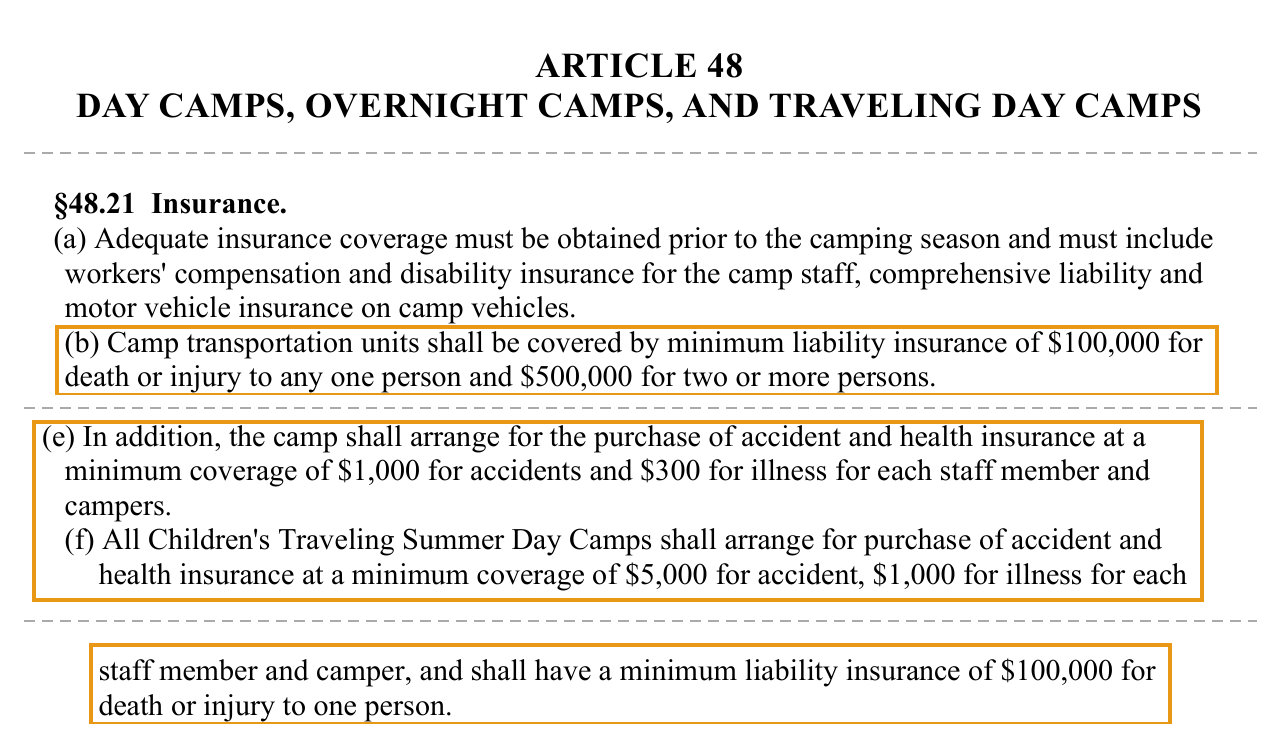
Source 3 of 3 · A city that sets dollar floors
New York City Health Code Article 48, section 48.21 Insurance: (a) workers' compensation and disability insurance for staff, comprehensive liability and motor vehicle insurance before the season; (b) camp transportation "minimum liability insurance of $100,000 for death or injury to any one person and $500,000 for two or more persons"; (e) accident and health cover of "$1,000 for accidents and $300 for illness for each staff member and campers"; and (f) for traveling summer day camps, $5,000 for accident, $1,000 for illness and "a minimum liability insurance of $100,000 for death or injury to one person."
Source: nyc.gov, Health Code Article 48
A state floor is the least a camp may carry. New York City's $1,000 of accident cover per camper sits well below the $5,000 Cornell requires and the $25,000 the University of California requires, and its vehicle floor of $100,000 per person is a tenth of the $1,000,000 combined single limit Cornell asks for. New York State sets its own $1,000,000 requirement for children's camps that run ziplines, high ropes courses or climbing walls with mechanical belays, which our ropes course and climbing gym guide covers.
What drives a camp insurance premium up
Camper exposure is the base. The published programs rate a camp per camper per day, per week or per resident camper, so a camp that doubles its sessions doubles its liability premium on those forms. Everything else on this list either moves the rate or adds a line.
| Factor | Why it moves the premium |
|---|---|
| Camper exposure | The published programs charge per camper per day, per week or per resident camper, so more sessions and more campers raise the premium in step, above a $240 minimum. |
| Overnight stays | A resident camper costs $5.75 a session against $4.33 for a day camper's week on the published program, and a camp that sleeps campers on its own land leaves the per-camper programs for an underwritten program with a $10,000 minimum account premium. |
| Higher limits | Moving from $1,000,000 to $2,000,000 on the published forms takes the weekly rate from $4.33 to $5.99, 38 percent more, and the minimum from $240 to $360. |
| Contact and collision sports | Class 2 sports such as soccer, football, cheerleading, lacrosse, wrestling and hockey cost 10 to 12 percent more per camper and carry a $1,000,000 limit on neurodegenerative injury claims. |
| A host's insurance clause | A separate $1,000,000 abuse limit, a $5,000,000 umbrella or $1,000,000 of auto liability adds lines that a per-camper rate does not include. |
| Waterfront, boats, horses and climbing | Boating, open water and equestrian activities and amusement devices including climbing walls are excluded from the published per-camper programs and are underwritten on their own. |
| Camp vehicles | Owned vans and buses bring commercial auto cover, and the published programs exclude injury to participants in hired or non-owned autos and the use of multi-passenger vehicles. |
| Owned buildings in a flood or wildfire zone | Bring property and business income cover into the program; western camps were warned of property increases of 200 percent or more after wildfire, flood and wind losses, and Texas now refuses a license for cabins in a floodplain unless an exception applies. |
| Abuse controls that cannot be shown | The resident camp program will not quote without personnel screening, written abuse procedures and background checks, and every host in our table asks for a $1,000,000 abuse limit. |
| Claims history | Includes abuse claims that surface decades later and are tested against the policies in force at the time. |
Specialty Insurance builds coverage programs one exposure at a time for action sports and entertainment businesses. Here is how one client, an airsoft field owner rather than a camp director, describes working with us.
"Specialty Insurance has been an incredible foundation for our business. They are personal, professional, and easy to work with."
Ballahack Airsoft LLC
Verified customer review
What brings it down
Most of this list is paperwork and supervision practice, which is the useful part for a camp director reading it before the season's applications go out.
| Factor | What it proves to an underwriter |
|---|---|
| Background checks on every adult, renewed on a schedule | That the camp screens the people with access to campers. California requires them for youth service organizations, and the published abuse programs ask for them. |
| A written two-adult rule and abuse prevention training | That no adult is alone with a camper and staff know how to report, which is the control abuse underwriters ask about first. |
| Accurate camper counts reported before each session | That every session is on the policy. The published forms cover only the sessions the camp reports. |
| Accreditation by the American Camp Association or the Christian Camp and Conference Association | That the camp meets a published standard, which the resident camp program says it prefers. |
| A written emergency and evacuation plan, and the flood map for every cabin | That the camp has planned for the event that would hurt the most campers at once. Texas now requires an approved plan every year. |
| Lifeguarded swimming with swim tests, and no unplanned open water | That the aquatic exposure is controlled; open water is excluded from the published day camp program. |
| Chartered buses carrying their own auto cover | That transport risk sits largely with a carrier that insures it. Cornell requires $5,000,000 of auto liability from charter bus companies. |
| Certificates from contracted instructors and vendors | That anyone else running an activity with campers carries their own liability cover, with the camp named as an additional insured. |
| Incident reports written on the day, and every old policy kept | That the camp can answer a claim made months or decades later. |
Camps are seasonal, and our guide to seasonal operations explains how a seasonal business can stop paying for year-round cover it does not use. Our guide to how to handle a claim covers what to record on the day a camper is hurt.
What to have ready before you ask for a quote
A quote for a camp turns on counts and documents. Have these to hand and the quote comes back faster and closer to the bottom of the range.
- The program. Day, overnight or both; every session with its dates; campers' ages; campers per session; and total camper-days, camper-weeks or resident campers for the year.
- The site. Whether you own or rent it, the host's insurance requirements, a schedule of buildings and their values if you own them, and the flood map for any cabin near water.
- Activities. Every sport by name, swimming and where it happens, boating, horses, climbing, ropes courses, archery and field trips.
- Staff. Counselors, coaches and lifeguards by number, seasonal payroll by state, counselors under 18, volunteers and contracted instructors.
- Abuse prevention. Background checks, training records, the written supervision and two-adult policies, and staff-to-camper ratios.
- Health care. Who holds the camp's medications, the nurse or health officer's credentials, and the written health care plan.
- Transportation. Camp-owned vehicles, chartered buses and their certificates, and any staff who drive campers in their own cars.
- Licenses and accreditation. The state camp license, the emergency plan where your state requires one, and any American Camp Association or Christian Camp and Conference Association accreditation.
- Three to five years of loss runs, even if there have been no claims, and the details of every policy the camp has ever carried.
Line up the dates while you are at it. The published per-camper forms are valid for policies effective from March 1, 2026 to February 28, 2027, so a camp that enrolls in the spring will see new rates for the 2027 season, and most hosts want the certificate before they confirm a booking.
Frequently asked questions
How much does summer camp insurance cost?
In Specialty Insurance's book, a day camp of about 800 camper-weeks at a rented school or park pays $2,500 to $7,500 a year for general liability with participant liability at $1,000,000 per occurrence, and an overnight camp of about 900 camper-weeks on its own land pays $8,000 to $25,000. Priced as a whole program, the day camp runs $6,000 to $20,000 a year and the overnight camp $35,000 to $100,000, a soccer camp or clinic of about 300 camper-weeks at a rented field $1,000 to $4,000, and a small arts or STEM day camp of about 100 camper-weeks $750 to $2,500. The per-camper program that prints its rates charges $4.33 per camper per week for a non-sport day camp or a Class 1 sports camp, for $1,000,000 of liability that includes participant liability and $25,000 of participant medical payments, or $5.99 for $2,000,000 and $250,000, with minimum premiums of $240 and $360. By our arithmetic, the same day camp pays $3,464 at the lower option, plus $360 for the program's abuse option, before workers' compensation, commercial auto, property or an umbrella. A camp that sleeps campers on its own land is not eligible for those rates at all: the same carrier's resident camp program carries a $10,000 minimum account premium.
Is summer camp insurance legally required?
Most states license youth camps without naming an amount of insurance. New York City requires workers' compensation, liability and motor vehicle insurance, $100,000 per person on camp vehicles and accident cover of $1,000 per camper; Wisconsin requires licensed day camps to carry at least $25,000 each person and $75,000 each occurrence of general liability; and New Jersey, Colorado and Delaware require liability cover without a dollar floor. Texas's youth camp statute, rewritten after the 2025 flood, requires none. In practice the requirement comes from the host: universities and cities that let camps use their grounds ask for $1,000,000 per occurrence of general liability and $1,000,000 of abuse cover, and some ask for much more.
How much insurance did Camp Mystic have?
According to its answers to the parents' lawsuits, reported by the San Antonio Express-News in July 2026, Camp Mystic had a commercial general liability policy with a $1,000,000 limit and an excess liability policy with a $5,000,000 limit, both issued by AIG, when the July 4, 2025 flood killed 25 campers and two counselors. Divided among the parents of the 24 victims who sued, the two limits come to $250,000 per child. The camp filed for Chapter 11 bankruptcy in June 2026, and a federal bankruptcy judge ruled in October 2026 that the wrongful death suits may resume on November 9.
How much is insurance for a sports camp?
In Specialty Insurance's book, a soccer camp or clinic of about 300 camper-weeks at a rented school or university field runs $1,000 to $4,000 a year as a whole program. On the published per-camper sports camp program, a camp in a Class 1 sport such as basketball, baseball, swimming or tennis pays $1.45 per camper per day, $4.33 per week or $5.75 per resident camper for $1,000,000 of liability, and a Class 2 sport such as soccer, football, cheerleading, lacrosse or wrestling pays $1.60, $4.78 or $6.34, with a $240 minimum. Class 2 sports carry a $1,000,000 limit on neurodegenerative injury claims. The program is for operators who run camps on premises they do not own or maintain; boxing, martial arts, equestrian, open water, diving and skiing camps are ineligible. Universities that host sports camps usually add requirements, such as a separate $1,000,000 abuse limit, that the per-camper rate does not include.
What is the difference between sports camp insurance and regular camp insurance?
The published programs split the two. A sports camp or clinic built on skill development in a listed sport is rated by sport class, Class 1 or Class 2, and must run on premises the operator does not own or maintain. A day camp built on activities other than sports, such as arts, science, music or academics, is rated on a separate form at the same rates as a Class 1 sport, and it may hold overnight sessions only at premises it does not own or maintain. A traditional resident camp on its own land is outside both and is underwritten on its own buildings, staff and activities.
Does camp insurance cover abuse claims?
Only if abuse cover is added and paid for. Most general liability forms exclude sexual abuse and molestation, and the per-camper program that prints its rates offers either $250,000 for each insured event within a $1,000,000 aggregate that is part of the general aggregate, or defense cost reimbursement only, up to $100,000. Universities and cities that host camps ask for $1,000,000 per occurrence, and some for a separate limit. The stakes show in recent verdicts: $50 million against a climbing gym's kids camp in Illinois in June 2026 after a camper was assaulted by an older camper, and $7.5 million in Washington in 2024 for abuse by camp counselors in the 1970s.
Sources
- K&K Insurance, Youth Day Camps Insurance Program and Enrollment Form 1040 (3/2026) and Youth Sports Camps and Sports Clinics Insurance Program and Enrollment Form 1032 (2/2026), both valid for effective dates March 1, 2026 to February 28, 2027; K&K Camp Insurance and Youth Day Camp Insurance program pages; all read October 2026.
- San Antonio Express-News, "Camp Mystic victims' parents shocked by 'paltry' insurance," updated July 10, 2026; KUT, Camp Mystic Chapter 11 filing, June 24, 2026; Houston Public Media and KUT, "Bankruptcy judge lifts pause on wrongful death lawsuits against Camp Mystic," October 12, 2026.
- Cook County Circuit Court, John Doe v. First Ascent LLC, Case No. 2024 L 7938, verdict of June 29, 2026, as reported by WCBU and ABC7 Chicago and by the plaintiff's counsel; Pierce County, Washington jury verdict of March 2024 concerning the YMCA's Camp Seymour, as reported by the plaintiff's counsel.
- Texas Health and Safety Code chapter 141 (sections 141.0052, 141.0085 and 141.0091); 26 Texas Administrative Code sections 744.203 to 744.207; Texas Register, January 30, 2026, adopted youth camp rules (25 TAC chapter 265).
- New York City Health Code Article 48, section 48.21; Wisconsin DCF 252.41; N.J.A.C. 8:25; Colorado 8 CCR 1402-1, section 2.408; Delaware DELACARE Regulations for Youth Camps; California Business and Professions Code section 18975.
- Third-party program insurance requirements published by the University of Alabama, UC Santa Cruz, Cornell University, the University of California third-party camps and clinics program and the City of Los Angeles golf division, read October 2026.
- Southern California Municipal Athletic Federation, 2026 day camp insurance; University Risk Management and Insurance Association camps program limits; American Camp Association, Standards at a Glance (November 2025) and CampLine, "Camp Insurance Trends" roundtable (May 21, 2020).
- Summer camp insurance cost pages published by Sadler Sports, The Hartford, Pembee, Sawyer, GeneralLiabilityInsurance.com and American Specialty Express, all read October 2026.
- Premium ranges in the coverage-line and whole-program tables are Specialty Insurance's own indication for a single US summer camp, supplied for budgeting purposes only and not constituting an offer of cover.