

The usual answer to what dance studio insurance costs is small and confident. An insurance marketplace that ranks for the question says dance studios pay a median of $55 a month, or $654 a year, for general liability. A dance insurance agency says the policies a studio needs start at around $475 to $500. A national carrier's dance page says its customers paid $1,687 a year, about $141 a month, for a business owner's policy. Taken together, they suggest that insuring a dance school takes a few hundred dollars and an online form.
The companies that sell dance school franchises print a different answer, because federal franchise rules make them estimate a new owner's costs in writing. Tutu School, a ballet franchise for young children, budgets $2,500 to $5,000 for one year of liability insurance in its 2026 disclosure document. Tippi Toes budgets $1,040 to $1,560 for the first quarterly premium alone, about $4,160 to $6,240 a year on our arithmetic. Fred Astaire Dance Studios budgets $3,000 to $5,500 for insurance that meets its minimums, then charges $200 to $800 a month for captive insurance that pays refunds of prepaid lessons. And the one studio whose real insurance bill appears in any of these documents, a dance fitness studio in Sarasota run by an affiliate of the Fly Dance Fitness franchisor, spent $3,691 on insurance in 2025.
Even the clearest published price is misquoted where many owners would find it. The best-known dance school program, sold by K&K Insurance, charges $11.86 a year per enrolled student for $1,000,000 of liability in every state except Hawaii. A broker that resells the same program advertises $11.40 a student on its web page, which is the Hawaii rate printed beside it on the same form.
This guide prices a dance school the way the published programs rate it: per enrolled student, with separate charges for camps, birthday parties, equipment and abuse cover, and with each line a landlord, a recital venue or a franchisor will ask about set out on its own. It is written for ballet, jazz, tap, hip hop and contemporary schools that teach children and teens, for competition studios, and for adult ballroom and social dance studios. The table below is the studio program. Recitals, camps and parties have their own section, and so does abuse cover, the line that costs least to add and the most to get wrong.
How much dance studio insurance costs for 2026-2027
The table prices one operation: a single-location dance school in leased space with about 150 enrolled students, mostly children and teens, four to eight instructors, one recital a year at a rented theater, a few weeks of summer camp and some birthday parties. Read it as a budgeting indication rather than a quote. A 40-student ballet school in a church hall and a 400-student competition studio with three rooms, a travel team and an adult ballroom program land at opposite ends of these ranges.
2026-2027 premium benchmark
What dance studio insurance costs, line by line
Typical annual premiums for a single US dance studio or dance school, by coverage line, including its classes, its recital, its summer camps and its birthday parties.
- Priced for
- A single-location dance school in leased space with about 150 enrolled students, mostly children and teens, four to eight instructors, one recital a year at a rented theater, a few weeks of summer camp and birthday parties
- Basis
- Annual premium, United States
- Updated
- October 2026
| Coverage | Studio program, annual | Typical limits |
|---|---|---|
| General Liability InsuranceFoundation Injury and property damage claims from students, parents and visitors: a parent who slips on a wet lobby floor, a sibling who pulls over a speaker, damage to the theater the studio rents for its recital. For a dance school it should include participant liability, the cover for a student hurt in class whose family sues the studio. | $1,000 to $3,500$85 to $295per month | $1,000,000 per occurrence / $2,000,000 to $5,000,000 aggregate |
| Participant Accident InsuranceFoundation A student's emergency room, imaging and physical therapy bills after a fall or a bad landing in class, paid without anyone proving fault and usually after the family's own health plan, which keeps a sprained ankle from becoming a claim. | $400 to $1,500$35 to $125per month | Excess medical, $25,000 to $100,000 per student |
| Professional Liability InsuranceFoundation Claims that the teaching itself caused the injury: a progression pushed too fast, a lift or a stretch taught before the student was ready, or a hands-on correction that went wrong. | $300 to $1,500$25 to $125per month | $1,000,000 per claim |
| Sexual Abuse and Molestation InsuranceFoundation Allegations against an instructor, an employee, a volunteer or another student, including the claim that the studio hired or supervised carelessly. Private lessons, changing rooms and travel to competitions are where these claims start. | $500 to $2,500$45 to $210per month | $100,000 to $1,000,000 per occurrence |
| Commercial Property InsuranceFoundation The sprung or vinyl floor, wall mirrors, barres, the sound system, costumes and props in storage, and the improvements a studio paid for in leased space, after a fire, a burst pipe or a break-in. | $500 to $2,500$45 to $210per month | Replacement cost of floors, equipment, costumes and improvements |
| Workers' Compensation InsuranceFoundation Injuries to instructors who demonstrate, spot and partner students every day, and to front-desk staff, required by state law once the studio has employees. Includes employer's liability. | $750 to $3,000$65 to $250per month | Statutory state limits; employer's liability $500,000 to $1,000,000 |
| Employment Practices Liability InsuranceSituational Wrongful termination, harassment, discrimination and wage claims from instructors and staff, the line a franchise agreement or a growing staff brings in. | $750 to $2,500$65 to $210per month | $100,000 to $500,000 per claim |
| Excess / Umbrella InsuranceSituational Limits above the general liability, auto and employer's liability policies, when a landlord, a recital venue or a franchisor asks for more than the primary limit. | $750 to $4,000$65 to $335per month | $1,000,000 to $5,000,000 per occurrence |
No studio buys every line. The first six are the foundation for a school with instructors and youth classes; the last two switch on with a lease, a franchise agreement or a larger staff. General Liability Insurance should include participant liability and, on many forms, hired and non-owned auto liability and damage to a rented recital venue. Professional Liability Insurance is often included in a dance studio's general liability package at no extra charge. Special Event Insurance for a show open to performers who are not your students, Commercial Auto Insurance for a van that takes students to competitions, Cyber Liability Insurance and Business Interruption Insurance are quoted separately.
Specialty Insurance book. Updated . Ranges are an indication for budgeting, not a quote or a bindable offer.
Request a quoteIn Specialty Insurance's book, general liability with participant liability at $1,000,000 per occurrence runs $1,000 to $3,500 a year for the studio in the table, and the published per-student program's $1,779 for 150 students, set out below, falls inside that range. Professional liability is priced at $300 to $1,500 on its own, but dance studio general liability packages often include it at no extra charge, as the published program does. The umbrella has the widest range of the eight lines, $750 to $4,000, across limits from $1,000,000 to $5,000,000, and workers' compensation, at $750 to $3,000, follows payroll more than enrollment.
The lines follow the order in which a studio usually buys them. General Liability Insurance is the base, and for a dance school the part that matters most is participant liability: the cover for a student hurt in class whose family sues the studio over the floor, the choreography or the supervision. Some forms build it into the general liability policy, as the K&K dance program does with "Bodily Injury to Participants," and some exclude it, which is the split our guide to participant injury versus general liability explains. The exposure is real at studio scale: a 2025 New York jury verdict report describes a $662,000 judgment against a Suffolk County dance studio after an 11-year-old in a hip hop class was hurt on a trampoline; the studio stopped defending the case and was found in default on liability. Participant Accident Insurance pays a student's medical bills without anyone having to prove fault, usually after the family's own health plan, and our page on participant accident insurance sets out how that excess cover works. Professional Liability Insurance answers the claim that the teaching itself caused the injury, which is a different allegation from a fall in the lobby.
Two lines need a word about limits. Sexual Abuse and Molestation Insurance is marked as foundation because almost every dance school teaches minors, and the limits sold to studios run from $100,000 that shrinks as defense costs are paid to $1,000,000 that sits inside the general liability limit. The abuse section below explains why that difference matters more than the premium. Workers' Compensation Insurance limits are set by each state, and the employer's liability part that sits alongside it is where franchisors and landlords set their own floors. Its price follows payroll rather than students: California rates dance instruction under class 8870, fitness instruction programs or studios, at an advisory $0.975 per $100 of payroll from September 1, 2026, and Pennsylvania lists dance studios under code 965 at an advisory loss cost of $0.27 per $100 from April 1, 2026. Insurers add their own expenses to both figures. Employment Practices Liability Insurance and Excess / Umbrella Insurance are situational: a franchise agreement, a growing staff or a theater that wants $2,000,000 brings them in.
What the whole program costs, by studio type
The table above prices one line at a time, but a studio buys a program. For budgeting a complete studio, Specialty Insurance prices three common setups as a whole.
| Studio profile | What the underwriter is rating | Typical annual program |
|---|---|---|
| Children's dance school, about 150 students, one recital a year | The studio in the line table: weekly classes for children and teens, four to eight instructors, a recital at a rented theater, summer camp and birthday parties. | $3,000 to $10,000 |
| Competition studio, about 300 students, with a travel team | Twice the enrollment of the first row, and a competitive team that travels to perform away from the studio. Add hired and non-owned auto liability if staff or parents drive students to competitions. | $10,000 to $50,000 |
| Adult ballroom or social dance studio selling prepaid lesson packages | Adult students in private and group lessons, partnered dancing, and tuition paid in advance for lesson packages, the refund exposure Fred Astaire insures through a separate captive program. | $2,000 to $7,500 |
Adding up the eight lines does not give you a program. Few studios buy all of them, and fewer sit at the top of every range at once, so start from the row that looks most like yours. A children's school that starts a competition team moves from the first row, $3,000 to $10,000, toward the second, $10,000 to $50,000.
The published figures elsewhere in this guide land in the same bands. On our arithmetic, the worked example below, about $3,231 a year on the per-student program for the studio in the table, sits just above the bottom of the children's dance school band, and it leaves out workers' compensation, employment practices liability and an umbrella, lines a full program adds on top of it. Tutu School's $2,500 to $5,000 for a year of liability insurance runs from just below that band into its lower half, and the $3,691 one Sarasota dance fitness studio spent in 2025 falls inside both the children's band and the $2,000 to $7,500 band for an adult ballroom or social dance studio. Fred Astaire's $3,000 to $5,500 insurance budget also falls inside the adult ballroom band, although its disclosure document does not say what period that covers.
A recital is the one event a studio may insure on its own. At a rented theater, Specialty Insurance's book puts it at $150 to $750 per event, but most studios cover the recital under their annual general liability and send the theater a certificate. The recitals section below sets out what that certificate has to say.
What the per-student rate buys, and what it leaves out
K&K's dance school page ranked first when we searched for dance studio insurance cost in October 2026, and it prints no price. The price is in the 20-page enrollment form linked from that page, form 1017, which is valid for policies taking effect from January 1, 2026 through February 28, 2027. It is a rating formula rather than a quote. The studio picks a liability option, and the premium is that option's rate multiplied by "the greatest number of member/students that your program could have during the year," subject to a minimum premium. The rate is set by the studio's mailing address.
| Published program rate | $1,000,000 per occurrence (Option 1) | $2,000,000 per occurrence (Option 2) |
|---|---|---|
| Rate per enrolled student, all states except Hawaii | $11.86 | $14.68 |
| Rate per enrolled student, Hawaii | $11.40 | $14.11 |
| Minimum premium | $870 | $1,305 |
| Camps, clinics and separately charged classes, per participant, all states except Hawaii | $14.04 | $18.88 |
| Birthday parties and special events, per party, all states except Hawaii | $15.60 | $21.58 |
| School of 50 students (the minimum applies) | $870 | $1,305 |
| School of 100 students | $1,186 | $1,468 |
| School of 150 students | $1,779 | $2,202 |
| School of 300 students | $3,558 | $4,404 |
The rates and minimums are printed on the form. The four school-size rows are our arithmetic on those rates, before the program's required $20 risk purchasing group fee. At $1,000,000 per occurrence the minimum premium applies to any school of 73 students or fewer, and at $2,000,000 to any school of 88 or fewer. Because the count is the most students the school could have at any point in the year, a studio whose enrollment peaks in September is rated on September.
For that rate the program includes more than the figures on the first page of search results suggest. Both options carry a $5,000,000 general aggregate per location. Each occurrence, products and completed operations, personal and advertising injury, professional liability and "Bodily Injury to Participants" are written at the option limit. The program adds $1,000,000 for damage to rented premises, $25,000 of excess medical payments for participants with a $250 deductible per claim, $5,000 of medical expense for people who are not participants, and hired and non-owned auto liability at the option limit, which is not available in Illinois, Louisiana, Utah, Vermont or Wisconsin. A 150-student school pays $1,779 for all of it at the $1,000,000 option.
The optional lines are priced on the same form. Non-members, classes charged separately, camps and clinics cost $14.04 a participant at the $1,000,000 option and $18.88 at $2,000,000. Birthday parties and special events cost $15.60 and $21.58 a party. Sexual Abuse or Sexual Molestation Liability at $1,000,000 costs $1.13 per dance student, $1.93 per participant in those additional operations and $2.39 per party or event, with a $150 minimum; the alternative is $100,000 of defense-cost reimbursement only, for a flat $100. Equipment and contents cover is the rate times the total replacement value: 3.3 cents per dollar of value for a studio with up to $10,000 of equipment and contents, with a $250 deductible, and 2.86 cents per dollar for one with more, with a $1,000 deductible that rises to $2,500 above $100,000, subject to a $100 minimum. The form tells studios to insure the full replacement cost "to avoid a coinsurance penalty at the time of loss." Our guide to inland marine insurance for gear that leaves the building explains how that kind of cover follows costumes, portable floors and sound equipment to a competition or a theater.
Put the add-ons together for the studio in our price table and the published program gives a useful floor. A 150-student school at the $1,000,000 option, with 40 summer camp participants, 20 birthday parties a year, the $1,000,000 abuse option on all of them and $8,000 of equipment and contents, pays $1,779 for the students, $561.60 for the camp, $312 for the parties, $294.50 for abuse cover, $264 for the equipment and the $20 fee: about $3,231 a year in all, on our arithmetic. That buys liability, participant medical, abuse and contents cover. It leaves out workers' compensation, employment practices, property cover for the build-out and any umbrella. The program is also written through a risk purchasing group formed under the federal Liability Risk Retention Act of 1986, so the studio receives a certificate of insurance under a master policy rather than a policy of its own, although its limits apply to it alone.
One trap sits in the way the program is resold. A broker that sells the same program prints $11.40 a participant, $13.50 per participant for non-registered activity and $15.00 a party on its web page, and all three are the Hawaii column of the brochure it links. Its page also prints the Hawaii equipment rates as its rates. Studios in every other state pay $11.86, $14.04 and $15.60, about 4 percent more than the Hawaii student rate on our arithmetic, and a budget built on the web page comes out short.
The form is just as clear about what it will not cover. Its ineligible list names acrobatic and circus skills training, ballroom rental facilities, banquet and reception halls, cabarets, dance halls, discotheques, nightclubs, production companies, professional dance companies, professional touring companies and trampoline parks. Independent contractors are "not covered under this program," child care is excluded, and the program "does not provide coverage for the transportation of members/students/participants." A style of dance that is not on the online list sends the studio to the phone, and so do higher limits, inflatables, special events and parkour, ninja or extreme tumbling. The broker that resells the program asks for a paper application from any school with floor tumbling. Those studios are underwritten one by one.
Before I compare a studio's renewal with anything else, I ask three questions: how the student count was set, whether the teachers are employees or contractors, and whether the recital is on the certificate. A per-student program can be exactly right for a school that teaches its own students in its own rooms. It needs a second look once the recital moves to a rented theater with guest performers in the program.
Bobby Sharp, Action Sports Practice Lead, Specialty Insurance
Why the prices online disagree
The rest of the first page offers single figures rather than formulas. The insurance marketplace that ranks fifth says studios that buy through it pay a median of $55 a month, or $654 a year, for general liability with $1,000,000 and $2,000,000 limits, and $121 a month, or $1,447 a year, for a business owner's policy, with professional liability at $42 a month. The dance insurance agency that ranks third and eighth says studio policies start at around $475 to $500. The national carrier that ranks second says its customers paid $1,687 a year for a business owner's policy. An instructor policy sold online for $159 a year ranks tenth.
Read closely, each has a problem. The marketplace contradicts itself on workers' compensation for the same class. Its studio page says fitness trainers and instructors, "including those who work at dance studios," pay an average of $42 a month, or $500 a year; its dance instructor page says sports and fitness businesses, "including dance companies," pay $64 a month, or $768 a year. Both pages carry the same update date, May 19, 2025. The carrier's $1,687 is the same figure, to the dollar and the month, that its summer camp page gives as what "our small business customers pay," on a page that also says the carrier does not offer coverage for summer camps, so it is an average across small businesses rather than a dance figure. The agency's starting price has moved: a studio owners' trade site still credits it with "$450* a year" for $1,000,000 of liability and a $100,000 medical benefit, in an article first published in 2021, with a footnote sending readers to the agency for current pricing. And the $159 policy insures one teacher's own liability, not a school with students, rooms and a recital.
None of these figures is wrong for every studio. The difficulty is that each is a liability figure, or a bundle it does not define, and none says how many students it assumes, whether it covers a student who sues, or whether abuse cover is inside it. A 30-student tap school in a community room and a 300-student competition studio are not the same risk, and the per-student program prices them four times apart before a single add-on. That is why the table above is built line by line, and why the next section turns to the published numbers that say what they include.
What dance franchisors budget for insurance
Franchisors must estimate a new franchisee's start-up costs, insurance included, in Item 7 of a franchise disclosure document, list recurring fees in Item 6, and set out the insurance they require in Item 8. Those documents are filed with state regulators, and Minnesota publishes them. We searched its registry, and a public mirror of filed documents, for every dance franchisor we could find, and read eight: three children's dance franchises (Tutu School, Tippi Toes and Twinkle Star Dance), Fancy Feet, a studio franchise from the Bronx that teaches children and adults, two adult brands (DivaDance's hip hop and cardio classes and Fly Dance Fitness), and the two ballroom chains, Fred Astaire and Arthur Murray. Six are current Minnesota filings. Twinkle Star's 2026 document and Fancy Feet's 2025 document come from the mirror, and Fancy Feet's may since have been replaced. All are estimates prepared for a franchisee's budget, not quotes, and several cover less than a year, so the table shows each figure as printed and annualizes it only where the document says what period it covers.
| Brand and document | Insurance figure as printed | What the figure covers | Annual equivalent |
|---|---|---|---|
| Tutu School, children's ballet, 2026 FDD | $2,500 to $5,000 (Item 7) | One year of liability insurance | $2,500 to $5,000, stated |
| Tippi Toes, children's dance, 2026 FDD | $1,040 to $1,560 (Item 7) | The first quarterly premium for the required cover | $4,160 to $6,240, our arithmetic |
| Twinkle Star Dance, children's dance, 2026 FDD | $1,350 to $2,000 (Item 7) | The first three months of the required policies | $5,400 to $8,000, our arithmetic |
| Fancy Feet Dance Studio, children and adults, 2025 FDD | $500 to $2,000 (Item 7) | The first year's premium, with the franchisor's designated insurer | $500 to $2,000, stated |
| Fly Dance Fitness, dance fitness, 2026 FDD | $3,500 to $7,000 (Item 7) | The first annual premium | $3,500 to $7,000, stated |
| Fly Dance Fitness, affiliate studio in Sarasota, 2026 FDD | $3,691 (Item 19) | Insurance spent in 2025, on $274,296 of adjusted sales | $3,691, an actual |
| DivaDance, adult dance classes, 2026 FDD | $700 to $1,300 at partner sites, $1,000 to $3,000 in a dedicated studio (Item 7) | A deposit equal to three months of premium | $2,800 to $5,200 and $4,000 to $12,000, our arithmetic |
| Fred Astaire Dance Studios, ballroom, 2026 FDD | $3,000 to $5,500 (Item 7) | Insurance that meets the minimum requirements; the period is not stated | Not stated |
| Fred Astaire Dance Studios, ballroom, 2026 FDD | $200 to $800 a month (Item 6), $25,600 at opening (Item 7) | Captive insurance for refunds of prepaid lessons | $2,400 to $9,600 for the monthly charge, our arithmetic |
| Arthur Murray, ballroom, 2026 FDD | $2,500 to $7,625 (Item 7) | Pre-opening insurance premium deposits together with music licenses, initial inventory and other opening costs | Not stated; insurance is not broken out |
Tutu School's figure is the cleanest public price for a children's dance school, because its note says exactly what it covers.
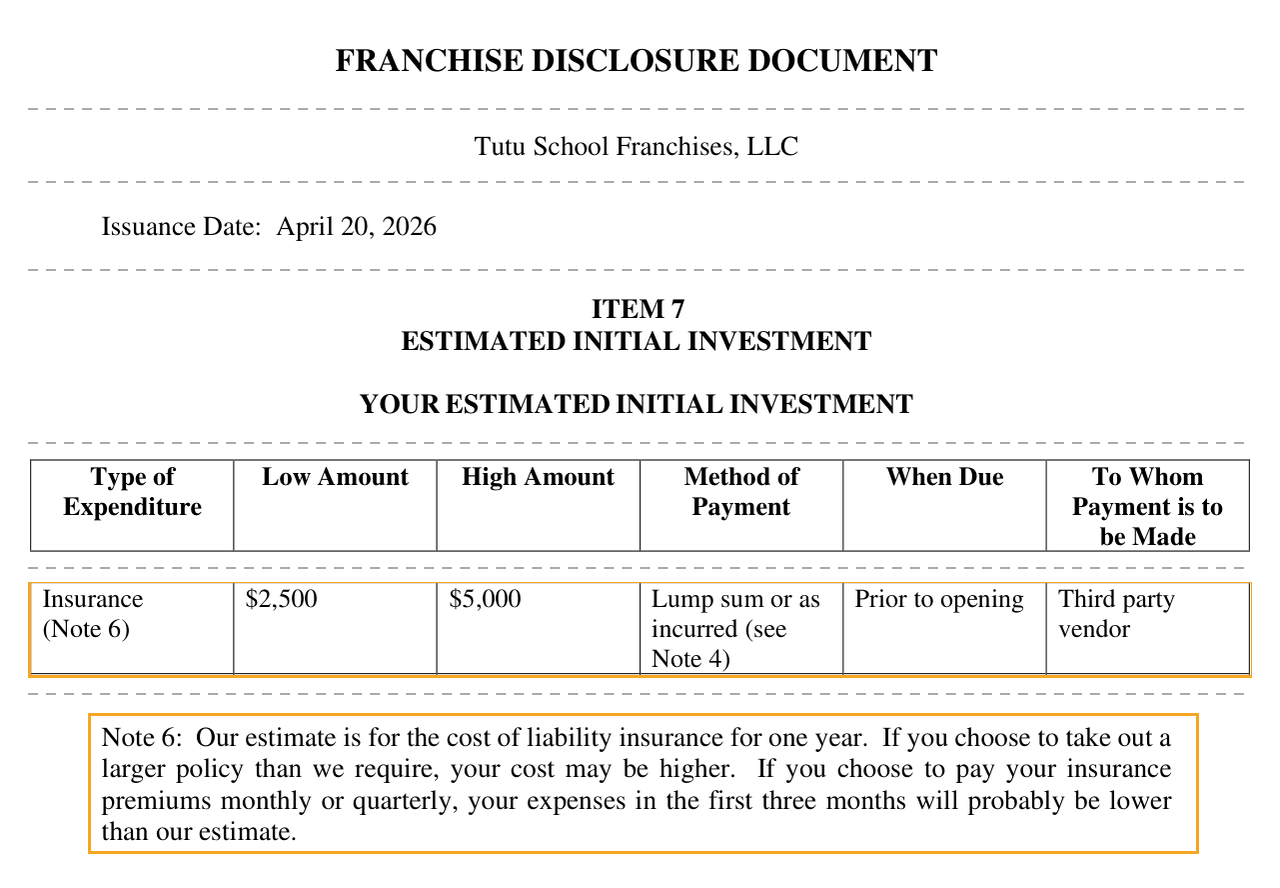
Source 1 of 3 · A franchisor's own one-year estimate
Tutu School Franchises, LLC, Franchise Disclosure Document issued April 20, 2026, Item 7: the insurance row ($2,500 low, $5,000 high, prior to opening) and note 6: "Our estimate is for the cost of liability insurance for one year."
Source: Tutu School 2026 Franchise Disclosure Document, filed with the Minnesota Department of Commerce
Tutu's 52 franchised schools that had been open three years or more averaged $283,159 of revenue in 2025, so its $2,500 to $5,000 line is 0.9 to 1.8 percent of revenue on our arithmetic. The Fly Dance Fitness figure is the only actual in the set. Its franchisor's affiliate runs a studio in Sarasota whose adjusted profit and loss statement, in Item 19, shows insurance of $3,691 in both 2024 and 2025, against adjusted sales of $274,296 in 2025, or 1.35 percent. The note under the statement says the line was adjusted to take out the owners' personal life insurance, so what remains is the studio's business insurance.
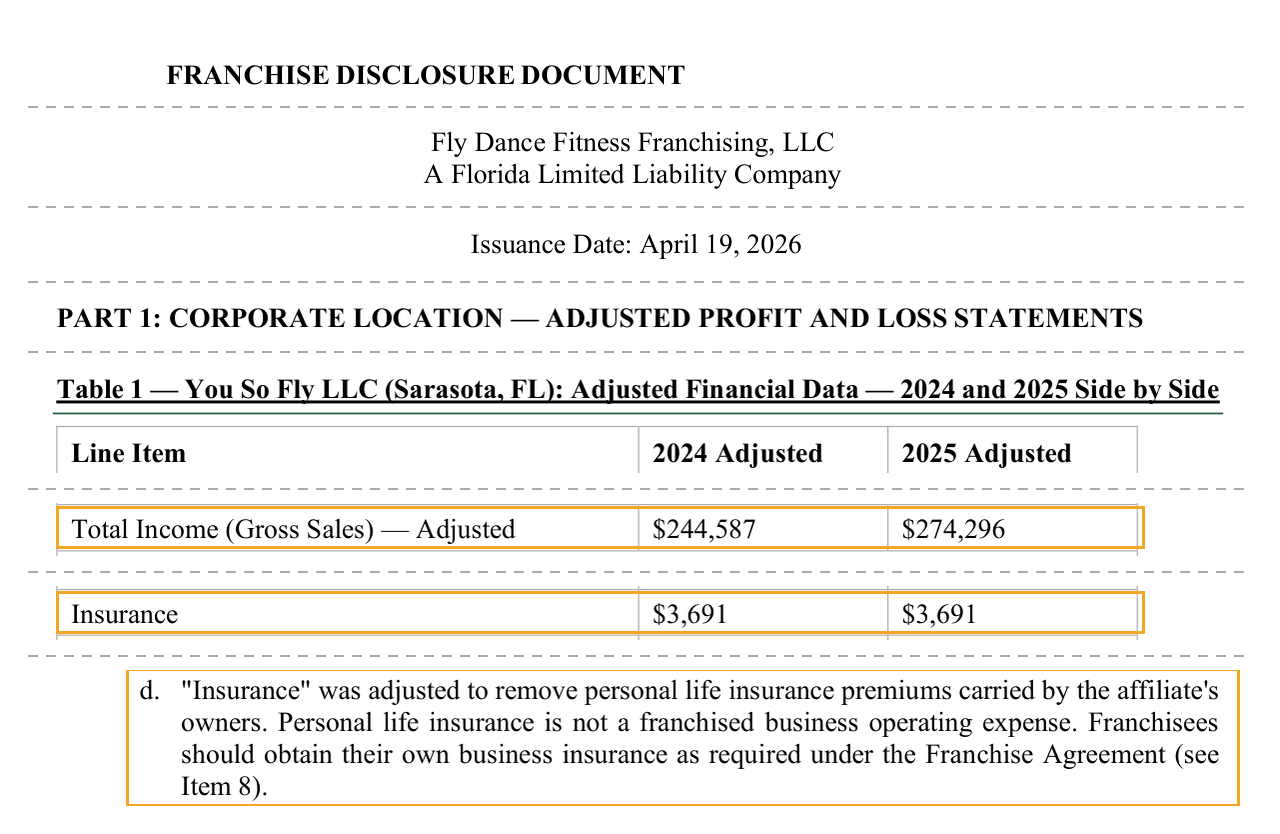
Source 2 of 3 · One studio's insurance bill, as filed
Fly Dance Fitness Franchising, LLC, Franchise Disclosure Document issued April 19, 2026, Item 19, Table 1: the affiliate-run studio in Sarasota reports adjusted gross sales of $274,296 in 2025 and insurance of $3,691 in both 2024 and 2025. Note d: the line "was adjusted to remove personal life insurance premiums carried by the affiliate's owners."
Source: Fly Dance Fitness 2026 Franchise Disclosure Document, filed with the Minnesota Department of Commerce
Three things stand out. First, the three children's dance franchises land at $2,500 to $8,000 a year once their figures are annualized, several times the $475 to $654 figures that rank for the question. Only Fancy Feet, which makes franchisees buy from one designated insurer, prints less: $500 to $2,000 for the first year. Second, the worked example above, about $3,231 on the published per-student program for a 150-student school, lands inside Tutu's band and a little under the Sarasota actual, which is a fair check that the per-student program and the franchise budgets describe the same kind of school. Third, the ballroom chains budget a far smaller share of revenue for their main insurance line. Fred Astaire's 242 qualifying studios averaged $819,695.96 of gross revenue in 2025, so $3,000 to $5,500 is 0.37 to 0.67 percent of it on our arithmetic, and Arthur Murray's 232 reporting studios averaged gross receipts of $728,934 in fiscal 2025, with insurance deposits folded into a $2,500 to $7,625 miscellaneous line alongside music licenses and initial inventory. Fred Astaire's extra insurance cost sits somewhere else, as the next paragraphs show.
Item 8 explains most of the gap with the figures that rank. The franchisors require far more than one liability policy. Tutu School requires $1,000,000 per occurrence and $2,000,000 aggregate of general liability per location, $300,000 for damage to rented premises, medical payments or a supplemental participant accident policy, $1,000,000 of hired and non-owned auto liability, an umbrella of $1,000,000 for one to four locations, property at full replacement cost with 12 months of business income, and workers' compensation with $1,000,000 of employer's liability; it recommends, without requiring, cover for sexual or physical misconduct, employment practices liability and $1,000,000 of cyber cover. DivaDance requires a $2,500,000 umbrella, $1,000,000 of cyber cover and $1,000,000 of employment practices liability with at least $100,000 for wage and hour disputes. Fred Astaire requires employment practices liability of $100,000 per occurrence and $300,000 aggregate, and Arthur Murray requires general liability of "not less than $2,000,000 combined single limit," or more if the landlord asks, the highest general liability floor in the set.
The ballroom chains also show a cost that most dance pages never mention: the liability for lessons paid in advance. Fred Astaire requires every franchisee to join a prepaid lesson liability program run by two affiliates. One holds an escrow account funded with $5,000 to $25,000 at opening and 3 percent of gross revenue a month until it reaches $25,000; the other charges $200 to $800 a month for captive insurance "to cover refunds for pre-paid lessons." The 2026 document reports that the two affiliates collected $1,061,665 and $289,800 under the program in fiscal 2025. An independent studio that sells a year of tuition up front carries the same exposure without the program, and it is worth knowing which of its policies, if any, would answer it. One state has written a rule for it. Illinois's Dance Studio Act requires a studio that takes advance payments of more than $50, or more often than once a month, to keep a bond of 10 percent of its gross income in the state over its last fiscal year, and never less than $10,000; government and not-for-profit studios are exempt.
No independent studio is bound by any franchisor's list. It is a fair guide to what a landlord, a school district renting space for an after-school class, or a buyer of the business will eventually ask about, and to the lines a studio is going without when its only cover is a per-student certificate.
A franchisor's insurance requirement is the most honest price list in this class, because the franchisor has to print what its own standards cost. Set a per-student certificate next to that list and the gaps are easy to see: workers' compensation, employment practices, and the umbrella a theater or a landlord may ask for.
Bobby Sharp, Action Sports Practice Lead, Specialty Insurance
Recitals, camps and parties: what the class program covers
For most dance schools the recital is the biggest event of the year and the one most likely to fall between policies. The per-student program covers it only in part. Its form says: "Coverage is included for recitals and performances you host that only include students/members of your school." For an event that includes non-members, or students who pay a separate fee, the form tells the school to call the program to arrange cover "for your recital or performance." The same form lists recitals among the activities covered by its non-member option, and K&K's program page sends schools with non-member events to its separate tournament and event program, so a recital with guest performers is a phone call before it is a certificate.
Where the recital happens matters as much as who is on stage. The form covers off-site competitions, demonstrations, parades and fundraising activities automatically. Every other off-site activity "must be reported prior to occurring and approved by us," and recitals are not on the automatic list. A school that rents a high school auditorium or a city theater for its spring show therefore has to report it in advance. The form never uses the words spectator or audience; for people who are not participants it relies on the general liability itself and $5,000 of medical expense. The program page puts the risk plainly: if "a spectator is injured during a recital, your school can be named in a claim alongside the property owner."
The venue then sets its own terms, and they differ from one stage to the next.
| Venue and owner | General liability required | Additional insured and primary wording | Other conditions |
|---|---|---|---|
| School auditoriums, Montgomery County, Maryland (county and board of education) | $300,000 each occurrence and $300,000 aggregate | Both the county and the board of education named on the certificate | Any school auditorium booking counts as a large event; dance recitals are not named |
| Dougherty Arts Center theater, City of Austin, Texas | $500,000 per occurrence, with $500,000 for products and completed operations | City named as additional insured; the renter's cover is primary; waiver of subrogation | $50,000 for damage to rented premises; $100,000 of professional liability where the city asks for it, movement-based instruction among its examples |
| VPAC theater, De Anza College (Foothill-De Anza Community College District), California | $1,000,000 each occurrence | District named as additional insured on a separate endorsement | $1,000,000 of sexual abuse and molestation cover if the event involves minors |
| Edna Boykin Cultural Center, owned by the City of Wilson, North Carolina | $1,000,000 per occurrence, $2,000,000 aggregate | Primary and non-contributory language on the certificate | Certificate due two weeks before the event; $1,000,000 of liquor liability if alcohol is present, host liquor cover not accepted |
| New York State property managed by the Office of General Services | $1,000,000 each occurrence, $2,000,000 general aggregate | Primary and non-contributing; additional insured endorsement on ISO form CG 20 10 11 85 or its equivalent | Dance recitals named as a permitted use; proof of workers' compensation and disability cover |
| Sunnyvale Theatre, City of Sunnyvale, California | $2,000,000 | City named as additional insured, in wording the city sets | Recitals named as a use; dance groups lay their own floor with their own crew |
Two things follow. First, a studio's limit is set by the strictest venue on its calendar, not by its class program: a school that performs in a county school auditorium one year and a city theater the next can need anything from $300,000 to $2,000,000 without changing anything else about its business. The per-student program's $1,000,000 option meets most of these floors; the strictest needs the $2,000,000 option or an umbrella. Second, the wording matters as much as the limit. Several venues want primary and non-contributory language, a waiver of subrogation or an additional insured endorsement on a named form, and one college district asks for $1,000,000 of sexual abuse and molestation cover whenever an event involves minors, ten times the $100,000 options many studios carry.
The per-student program handles the paperwork side. Once the enrollment form is approved, a school can request a certificate naming a facility, a property owner or a sponsor, and the certificate holder "will automatically be an Additional Insured" for an owner, manager or lessor of the premises. The request form has boxes for primary and noncontributory wording and a waiver of subrogation, fields for the event's dates, hours and location, and a warning that "Additional insureds from the expiring policy term will not be automatically renewed." A school that rents the same theater every year has to ask again every year.
Camps and parties are priced the same way as the classes. A summer intensive, a weekend clinic or a class charged separately costs $14.04 a participant on the $1,000,000 option, and a birthday party $15.60, so a studio that runs 40 camp places and 20 parties adds about $874 a year before abuse cover, on our arithmetic. A show that is open to performers who are not your students, or a competition your studio hosts for other schools, is a different exposure again, and our page on event insurance sets out how cover for a single event works.
Abuse cover: the cheapest line to add and the most expensive to get wrong
Sexual Abuse and Molestation Insurance is the cheapest line on most dance school quotes and the one whose limit deserves the most attention. Studios are sold three very different things under the same name. The per-student program sells $1,000,000 "for each perpetrator with a $1,000,000 aggregate," and its form says the limit "is part of, and not in addition to, the general liability limit selected," so an abuse claim draws on the same limit that answers a broken wrist or a fall in the lobby. Its cheaper option is $100,000 of defense-cost reimbursement only. A dance insurance agency sells abuse and molestation cover with an available limit of $100,000 and warns that "judgment and defense costs reduce the available limit." Franchisors split the same way. Tippi Toes requires $1,000,000 per occurrence and $2,000,000 aggregate of sexual abuse and molestation cover. Fancy Feet's designated policy carries $500,000. Tutu School only recommends $100,000 each incident and $300,000 aggregate for sexual or physical misconduct, and DivaDance's list names no abuse limit at all.
The sums at stake are far larger than any of those limits. In September 2024 a now-closed private ballet school in Bergen County, New Jersey, agreed to a $30 million consent judgment with five former students who alleged that its founder had abused them for years, beginning when they were teenagers; he has admitted no wrongdoing and was not held personally liable under the judgment. Two months later the school's insurer filed a declaratory judgment action in federal court, arguing that its policies do not cover the abuse alleged and attaching abuse exclusions from the school's primary policies for 2010 to 2015 and 2015 to 2020 and from its umbrella policy. In October 2026 that case was still in discovery. In a separate case, a public school district in Cleveland paid $3.25 million in 2021 to settle with eight former students of a dance instructor who was later sentenced to life in prison. Against claims on that scale, $100,000 that shrinks with every legal bill pays for little more than the first stage of a defense, and an exclusion pays for nothing.
Some states write the safeguards into law. California's Business and Professions Code section 18975 requires every administrator, employee and regular volunteer of a youth service organization to complete child abuse training and undergo a background check, and requires the organization to adopt prevention policies, including, to the greatest extent possible, two mandated reporters present whenever staff are with children. The statute does not name dance, and whether a given studio counts as a youth recreation program under the Penal Code definition it relies on is a legal question, but it can reach a studio's youth classes. Its subdivision (d) speaks to insurance directly.
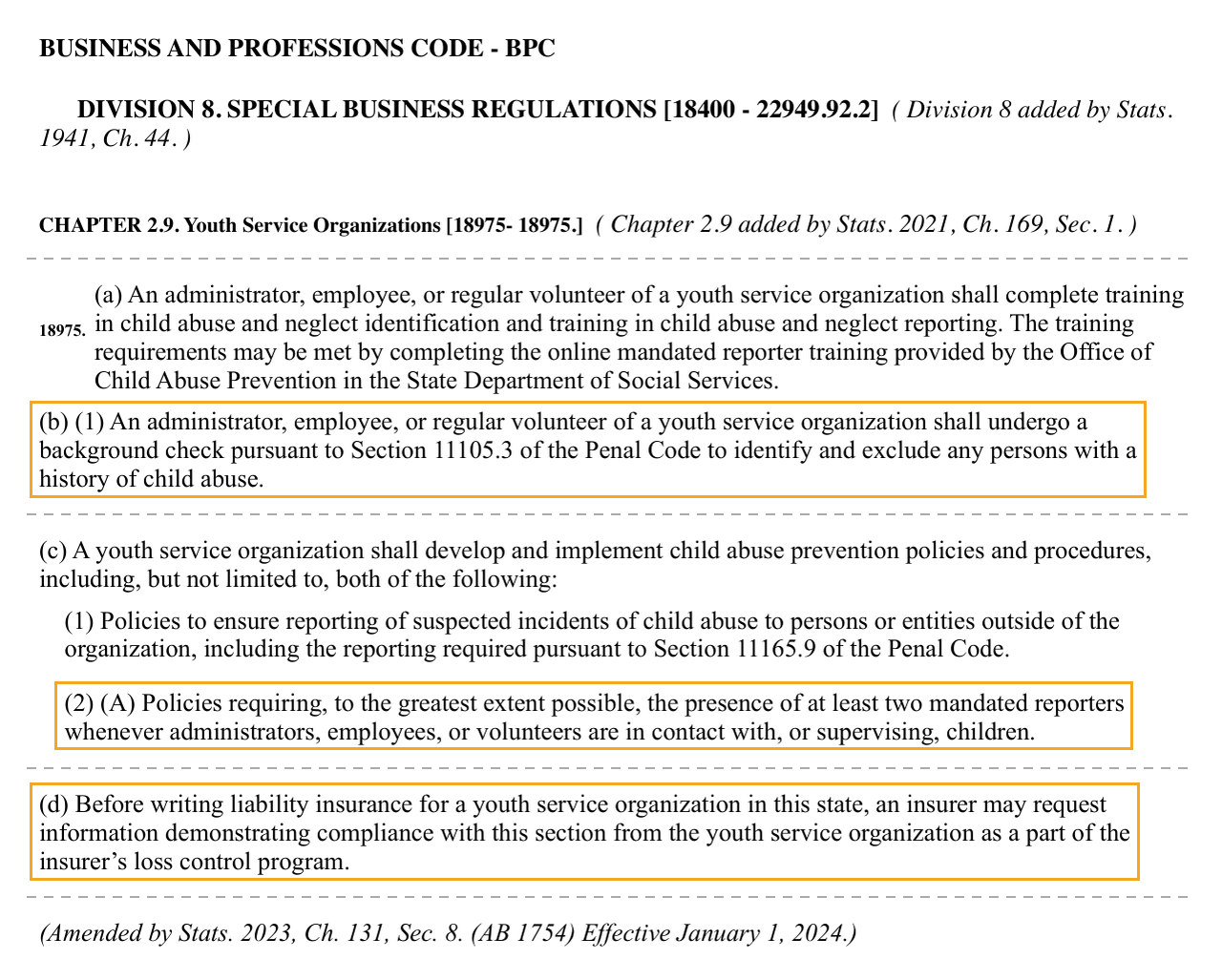
Source 3 of 3 · What an insurer may ask a youth program for
California Business and Professions Code section 18975: staff and regular volunteers of a youth service organization must undergo a background check (b)(1); the organization must adopt policies requiring, to the greatest extent possible, two mandated reporters present with children (c)(2)(A); and "before writing liability insurance for a youth service organization in this state, an insurer may request information demonstrating compliance with this section" (d). Last amended effective January 1, 2024.
Source: leginfo.legislature.ca.gov, Business and Professions Code section 18975
Pennsylvania takes a similar line through its child protective services law, which requires a paid employee aged 14 or older who has direct contact with children in a "recreational camp or program" or an "enrichment or educational program" to hold three clearances. The state prices them at $13.00, $22.00 and $27.95 and requires them every 60 months.
The premium follows the controls. The dance agency's lower-cost abuse option requires background checks on every employee and volunteer who works with young people, written procedures for dealing with abuse, employment applications that ask about criminal convictions, procedures that prevent a participant being alone with one staff member, and no prior allegation; without them, it says, "the cost is several times higher." The per-student program prices its $1,000,000 option at $1.13 a student, but only after an underwriter approves a questionnaire that asks, among other things, about background checks. A studio that can show its policy in writing qualifies for the cheaper cover and has a better answer when an allegation arrives.
The abuse line is where I spend the most time with a youth program, and it is rarely about the premium. Ask two questions of any quote: is the abuse limit inside the general liability limit or on top of it, and do defense costs come out of it. A $100,000 limit that shrinks with every legal bill is a very different thing from $1,000,000 standing on its own.
Bobby Sharp, Action Sports Practice Lead, Specialty Insurance
What drives a dance studio premium up
Enrollment is the base. The published program rates a school on the most students it could have at any point in the year, so a studio is priced on its busiest month, not its average. Everything else on this list either moves the rate per student or adds a line.
| Factor | Why it moves the premium |
|---|---|
| More students, counted at the peak | The published program multiplies its rate by the most students the school could have during the year, $11.86 each at $1,000,000 in every state except Hawaii, so a studio is rated on its busiest month. |
| A higher limit demanded by a lease, a venue or a franchisor | Moving from $1,000,000 to $2,000,000 per occurrence takes the published rate from $11.86 to $14.68 a student, about 24 percent more, and the minimum from $870 to $1,305. |
| Camps, clinics and classes charged separately | Each participant is rated at $14.04 on the published program, more than an enrolled student, and adds $1.93 to the abuse premium. |
| Birthday parties and special events | Each party costs $15.60 at the $1,000,000 option, plus $2.39 for abuse cover. |
| A recital at a rented theater, or with guest performers | Off-site activities other than competitions, demonstrations, parades and fundraisers must be reported and approved in advance, performers who are not students need their own option or event cover, and the venue may want more limit than the class program carries. |
| Acrobatics, tumbling, aerial and pole | Acrobatic and circus skills training is ineligible for the published program, floor tumbling needs a paper application at the broker that resells it, and the dance agency sends aerial and pole programs to separate cover or an added premium. |
| Instructors paid as independent contractors | The published program does not cover them, and the dance agency adds contractors only for an additional premium that starts at $50. |
| Employees | Workers' Compensation Insurance is required by state law from the first employee in California and Pennsylvania, the first regular employee in New York and the fourth in Florida, and is elective in Texas. It is priced on payroll, so every instructor moved from contract to employee adds to it. |
| Driving students to competitions | The published program does not cover transporting students, so a studio van brings Commercial Auto Insurance into the program. |
| Prepaid lessons and tuition | Fred Astaire requires a prepaid lesson liability program: an escrow funded with $5,000 to $25,000 at opening plus 3 percent of monthly gross revenue, and captive insurance at $200 to $800 a month to cover refunds. |
| More locations | Tutu School's franchise agreement sets the umbrella at $1,000,000 for one to four locations and raises it to $2,000,000, $3,000,000 and $5,000,000 as the count grows to 30 or more. |
| A claims record | The published form asks a new applicant that already carries cover whether it has had more than $5,000 in claims in the past five years. |
Specialty Insurance builds coverage programs one exposure at a time for action sports and entertainment businesses. Here is how one client, a gel tag operator rather than a dance studio, described working with us.
"Specialty Insurance is a great choice! I highly recommend this company for your business! They diligently take their time and work with you, making sure your business has all the correct and specific coverages you need. Cathy was a huge help, and gave me exactly what I needed, making it budget friendly and greatly affordable. Choose Specialty Insurance if you want the best service and fair treatment for your business!"
Gel Tag San Diego LLC
Verified customer review
What brings it down
Most of this list costs a studio little more than paperwork, which is the useful part for an owner reading it before renewal.
| Factor | What it proves to an underwriter |
|---|---|
| An enrollment count you can show | That the peak number on the application matches the school's own records, so the premium is right from the start rather than corrected later. |
| Every activity named on the application | That the camp, the parties, the adult evening classes and the recital are rated now rather than discovered after a claim. |
| Instructors on payroll, or contractors with their own certificates | That every teacher in the room is either covered by the studio's program or carries liability cover of their own, with the studio named as an additional insured. |
| Background checks and a written abuse prevention policy | That the abuse exposure is managed: checks on every employee and volunteer who works with minors, no one-to-one time behind closed doors, and a policy parents can read. It is the condition for the cheaper abuse option at the dance agency. |
| The recital contract read before it is signed | That the venue's limits, additional insured wording and damage to premises figure are met by the program, or that the gap is bought before the show. |
| A schedule of floor, equipment and costume values | That floors, mirrors, sound equipment and costumes are insured at full replacement cost, which avoids the coinsurance penalty the published form warns about. |
| Registration forms with a waiver and medical release | That the studio knows who is in each class, has emergency contacts, and can show the family accepted the ordinary risks of dance. |
| A clean, dry floor and a written cleaning log | That the most ordinary claim in any studio, a slip in the lobby or on a wet floor, has an answer on paper. |
| Same-day incident reports | That the studio can show what happened when a claim arrives months later. |
The waiver in that file has limits. How far it reaches depends on your state's courts, above all when the person signing is a parent and the student is a child, and it pays nothing toward defending a claim; our guide to waivers versus insurance explains why the two do different jobs. And when a student is hurt, write it up the same day: our guide to how to handle a claim covers what to record while everyone still remembers what happened.
What to have ready before you ask for a quote
A quote for a dance school turns on documents rather than adjectives. Have these to hand and the quote comes back faster and closer to the bottom of the range.
- Enrollment. The current count, the peak count over the past year, and how many students are under 18.
- The class list. Every style taught, with ages, including any tumbling, acro, aerial, pole or adult fitness classes.
- Camps, clinics and parties. How many participants and parties a year, and whether non-students attend.
- Recitals and competitions. Venues, dates, guest performers, and a copy of each venue's insurance requirements.
- Instructors. Who is an employee and who is a contractor, payroll, and any certificates contractors carry.
- Youth safeguards. Background checks, the written abuse prevention policy, rules for private lessons and changing rooms, and any training your state requires.
- The facility. The lease's insurance clause, square footage, the type of floor, and a schedule of floors, mirrors, sound equipment and costumes at replacement cost.
- Prepaid tuition. How much is paid in advance, by term or in lesson packages.
- Transport. Who drives students to competitions and in whose vehicle.
- Three to five years of loss runs, even if there have been no claims.
Line up the dates while you are at it. The published program's current form covers policies taking effect through February 28, 2027, recital venues are often booked months ahead, and a venue's certificate request is easier to meet in January than in the week of the show.
Frequently asked questions
How much is dance studio insurance?
In Specialty Insurance's book, a single-location dance school with about 150 students pays $1,000 to $3,500 a year for general liability with participant liability at $1,000,000 per occurrence. Priced as a whole program, that children's dance school runs $3,000 to $10,000 a year, a competition studio of about 300 students with a travel team $10,000 to $50,000, and an adult ballroom or social dance studio selling prepaid lesson packages $2,000 to $7,500. The most widely published rate is K&K's 2026 dance schools form: $11.86 per enrolled student a year for $1,000,000 of liability in every state except Hawaii, with an $870 minimum and a required $20 group fee, which works out to $1,779 for 150 students before the fee. That package includes participant liability, professional liability and $25,000 of excess medical cover for students, but not workers' compensation, employment practices or property cover for the build-out. Franchise disclosure documents put a children's dance school at $2,500 to $8,000 a year once their figures are annualized, and one franchisor's own studio in Sarasota spent $3,691 on insurance in 2025.
How much is dance studio insurance per month?
In Specialty Insurance's book, general liability for a 150-student dance school runs $1,000 to $3,500 a year, about $85 to $295 a month, and the whole program for that school $3,000 to $10,000 a year, about $250 to $835 a month. Monthly figures on the first page of search results run from $15 for a single instructor's policy to $121 for a business owner's policy, and one insurance marketplace puts the median for general liability alone at $55 a month. On the published per-student program, a 150-student school pays about $148 a month for liability at $1,000,000, and about $269 a month once camps, parties, abuse cover and equipment are added, on our arithmetic. Dance studio cover is priced as an annual premium; the monthly figures in the table above are the annual ranges divided by twelve.
What kind of insurance does a dance studio need?
General liability that includes participant liability, participant accident cover for students' medical bills, professional liability for the teaching, sexual abuse and molestation cover for any school that teaches minors, property cover for floors, mirrors, sound equipment and costumes, and workers' compensation once there are employees. Employment practices liability and an umbrella come in with a franchise agreement, a larger staff, or a landlord or recital venue that wants higher limits. Franchise agreements show the full list: Tutu School requires $1,000,000 per occurrence and $2,000,000 aggregate of general liability, $1,000,000 of hired and non-owned auto liability, an umbrella, property and business income cover and workers' compensation, and recommends abuse, employment practices and cyber cover.
Do dance teachers need their own insurance?
An instructor on the studio's payroll is usually insured under the studio's program; one dance agency's policy, for example, covers W-2 employees and volunteer staff. An instructor paid as an independent contractor may not be: the best-known dance program says independent contractors are not covered under it, and the same agency adds them only for an extra premium that starts at $50. A teacher who works for several studios, or teaches privately, can buy an instructor policy sold online for $159 a year, but that insures the teacher's own liability, not the studio, its students or its recital. Studios that use contractors should ask each one for a certificate naming the studio as an additional insured.
Does dance studio insurance cover recitals held off-site?
Not automatically on the best-known program. Its form covers off-site competitions, demonstrations, parades and fundraising activities, but any other off-site activity must be reported and approved in advance, and a recital that includes non-members or students who pay a separate fee needs a call to the program. The venue then sets its own terms: the public venues we checked ask for anything from $300,000 to $2,000,000 of general liability, often with additional insured and primary and non-contributory wording. Insured on its own, one recital at a rented theater runs $150 to $750 in Specialty Insurance's book, but most studios cover the recital under their annual general liability and send the theater a certificate. Read the rental contract before you sign it, and request the certificate early.
Is liability insurance required by law for a dance studio?
We found no state law that requires a dance studio to carry liability insurance. The requirement usually comes from a contract: the lease, a recital venue's rental agreement, a franchise agreement, or a school or city that rents space to the studio. Workers' compensation is different, because state law requires it once a studio has employees: from the first employee in California and Pennsylvania, the first regular employee in New York and the fourth in Florida. Illinois requires a studio that takes advance payments to keep a bond, and California requires youth service organizations to train and background-check staff and volunteers, a rule that can reach a studio's youth classes.
Sources
- K&K Insurance, Dance Schools and Programs enrollment form 1017 (11/2025 edition, valid for effective dates from January 1, 2026 through February 28, 2027), Facility Certificate of Insurance Request Form 2270, and K&K's dance school program page, read October 2026.
- Franchise disclosure documents filed with the Minnesota Department of Commerce: Tutu School (April 20, 2026), Tippi Toes (March 9, 2026), Fly Dance Fitness (April 19, 2026), DivaDance (April 30, 2026), Fred Astaire Dance Studios (June 5, 2026) and Arthur Murray (June 30, 2026); Twinkle Star Dance (March 20, 2026) and Fancy Feet Dance Studio (March 31, 2025), read from a public mirror of filed documents.
- California Business and Professions Code section 18975 and Penal Code section 11165.7; Pennsylvania Consolidated Statutes, title 23, sections 6303 and 6344, and the Pennsylvania Department of Human Services clearances FAQ; Illinois Dance Studio Act, 815 ILCS 610/2, 610/3 and 610/12.
- California Labor Code section 3700; New York Workers' Compensation Law section 3; Pennsylvania Workers' Compensation Act section 305; Florida Statutes section 440.02; Texas Labor Code sections 406.002 and 406.004; WCIRB, classification 8870 advisory pure premium rates (September 1, 2026); PCRB, code 965 loss costs (April 1, 2026).
- Venue insurance requirements: Montgomery County Community Use of Public Facilities; City of Austin, Dougherty Arts Center; Foothill-De Anza Community College District, VPAC rental policy; Edna Boykin Cultural Center rental contract (2026); New York State Office of General Services, events on state property (revised February 2026); City of Sunnyvale, Theatre use guidelines and fees policy (2026).
- The Philadelphia Inquirer, November 4, 2024; Markel Insurance Company v. Petrov Ballet School LLC, U.S. District Court for the District of New Jersey, No. 2:24-cv-10377; WOIO Cleveland 19, November 20, 2021; The Associated Press via NBC News, June 9, 2023; New York Jury Verdict Review & Analysis, August 22, 2025.
- Dance studio insurance cost and program pages published by Insureon, The Hartford, DanceStudioInsurance.com, Sadler Sports and Recreation Insurance, DanceStudioOwner.com and Insurance Canopy, all read October 2026.
- Premium ranges in the coverage-line and whole-program tables, and the per-recital figure, are Specialty Insurance's own indication for a single US dance studio, supplied for budgeting purposes only and not constituting an offer of cover.