

Most youth league boards settle their insurance once a year, on the charter form. The treasurer counts the teams, ticks the accident and liability boxes, pays the per-team rate and files the certificate the city asked for. That buys real cover for the players and coaches on the roster, and some programs print exactly what it costs: in 2026 Babe Ruth League charges $42 a team for accident insurance and $133 a team for $1,000,000 of general liability in its Cal Ripken Major division. What the charter form does not buy is cover for the board's own decisions, the concession stand at the home field, the invitational the league hosts in June, or the parent who drives four players to an away game.
The governing bodies say so themselves. USA Swimming lists six kinds of insurance its membership program does not include, from directors and officers cover to workers' compensation, and tells a club that owns its pool that it "must carry independent insurance at its own expense." The AAU says a member that hosts an event the AAU has not licensed "would not have any coverage for the event." USA Lacrosse tells member programs that its directors and officers policy covers individual certified coaches and officials only, so an organization named in a lawsuit needs a policy of its own. Little League sells its general liability, directors and officers, cyber, crime and equipment cover as one package that "cannot be purchased individually," which is a reminder that a league buys a program, not one line.
The prices that rank for the cost question do not show that gap. When we searched "youth sports insurance cost" in October 2026, the third result, a page titled "How Much Does Sports Insurance Cost?", told readers that "the average cost of sports insurance for a youth or amateur event is for coverage against third-party injuries and bodily damages," with the number missing from the sentence. Most of the others printed a per-player or per-team rate for one program, or a monthly figure for general liability alone.
This guide puts the governing bodies' own 2026 prices side by side, shows what each membership leaves uninsured, and prices a league one coverage line at a time, with one column for a volunteer recreation league and one for a travel club. Facilities sit outside it because they are rated on their own buildings: hockey associations that own or lease ice will find rinks priced in our roller and ice rink cost guide, court facilities in our pickleball facility cost guide, and leagues that run batting cages in our batting cage and mini golf cost guide.
How much youth sports league insurance costs for 2026-2027
The table prices two operations. The recreation league column is a volunteer-run baseball and softball league of about 30 teams and 400 players aged 5 to 16, playing on city fields under a permit, with a concession stand, a press box, a scoreboard and lights at its home field, one invitational tournament a year and no paid staff. The travel club column is a club of about 10 travel baseball teams and 130 players aged 9 to 17, with paid head coaches, about 12 tournaments a season including out-of-state events, and families driving players to them. Read both as budgeting indications rather than quotes. The first two rows are the open-market price for an independent league. Most chartered leagues get general liability and participant accident through their national program at the per-team rates in the next section, because it is the cheapest route and the charter often expects it, and go to the open market mainly for the other six lines or for limits above the program's own. Independent leagues and travel clubs with no charter buy all eight on the open market.
2026-2027 premium benchmark
What youth sports league insurance costs, line by line
Typical annual premiums for a US youth sports league, by coverage line, for a volunteer recreation league and for a travel club.
- Priced for
- A volunteer-run recreation baseball and softball league of about 30 teams and 400 players aged 5 to 16, playing on city fields under a permit, with a concession stand, press box, scoreboard and lights at its home field and one invitational tournament a year. The travel column is a club of about 10 travel baseball teams and 130 players aged 9 to 17, with paid head coaches, about 12 tournaments a season including out-of-state events, and families driving players
- Basis
- Annual premium, United States
- Updated
- October 2026
| Coverage | Recreation league, annual | Travel club, annual | Typical limits |
|---|---|---|---|
| General Liability InsuranceFoundation Injury and property damage claims from players, parents, spectators and opposing teams at games, practices, concessions and fundraisers. For a league it should include participant legal liability, the cover for a player hurt in play whose family says the league was at fault. | $1,500 to $6,000$125 to $500per month | $1,500 to $5,000$125 to $420per month | $1,000,000 per occurrence / $2,000,000 to $5,000,000 aggregate |
| Participant Accident InsuranceFoundation A player's medical bills after an injury in a game or practice, paid whoever was at fault, usually after the family's own health insurance. Most governing bodies require it for every rostered player and coach. | $1,000 to $4,000$85 to $335per month | $750 to $2,500$65 to $210per month | $50,000 to $250,000 per participant |
| Sexual Abuse and Molestation InsuranceFoundation Allegations of abuse by a coach, volunteer or another player, and the negligent hiring and supervision claims against the league that come with them. Most general liability forms exclude it unless it is added. | $500 to $2,500$45 to $210per month | $500 to $2,500$45 to $210per month | $1,000,000 per occurrence / $2,000,000 to $3,000,000 aggregate |
| Directors and Officers InsuranceFoundation Claims against the board and its officers over their decisions: tryouts and roster cuts, eligibility rulings, discipline, removing a coach, discrimination and the handling of registration money. Defense costs are most of what it pays. | $500 to $1,500$45 to $125per month | $500 to $2,000$45 to $170per month | $1,000,000 to $2,000,000 per claim and aggregate |
| Commercial Property InsuranceSituational Property the league owns at a field that equipment cover excludes: a concession stand, press box, scoreboard, lights, bleachers and dugouts, plus the equipment kept in them. A club that owns no buildings insures its equipment, such as pitching machines and nets. | $750 to $3,000$65 to $250per month | $250 to $1,000$25 to $85per month | Replacement cost of buildings, fixed field property and equipment |
| Event InsuranceSituational A tournament or showcase the league hosts that its governing body does not sanction, or that brings in teams from outside its membership. | $300 to $1,500$25 to $125per month | Not typically bought per month | $1,000,000 per occurrence for each event |
| Commercial Auto InsuranceSituational Hired and non-owned auto liability for vans the league rents and for coaches, volunteers and parents who drive players on league business, a use most membership programs exclude. | $250 to $750$25 to $65per month | $750 to $2,500$65 to $210per month | $1,000,000 combined single limit |
| Excess / Umbrella InsuranceSituational Limits above the general liability and auto policies, for a venue or city contract that demands $3,000,000 or more, or for one event that hurts several people at once. | $1,000 to $4,000$85 to $335per month | $1,000 to $4,000$85 to $335per month | $1,000,000 to $5,000,000 per occurrence |
The first two rows are the open-market price for an independent league; a chartered league usually gets this cover through its national program and buys the other six lines, or limits above the program's own, on the open market. No league buys every line. The first four lines are the foundation for any league with players under 18 and a board; the rest switch on with owned field property, hosted tournaments, travel and a venue's insurance clause. A travel club that hosts its own tournament pays the recreation league's price for event cover. Workers' Compensation Insurance for a travel club's paid head coaches runs about $500 to $2,500 a year, depending on the state and the payroll; Crime Insurance for registration money and Cyber Liability Insurance for player records are quoted separately.
Specialty Insurance book. Updated . Ranges are an indication for budgeting, not a quote or a bindable offer.
Request a quoteSpecialty Insurance's 2026-2027 ranges put general liability, with participant legal liability at $1,000,000 per occurrence, at $1,500 to $6,000 a year for the recreation league and $1,500 to $5,000 for the travel club. The two columns part most on the lines that follow the operation rather than the sport. The league rosters about 400 players and the club about 130, and participant accident follows that count: $1,000 to $4,000 for the league against $750 to $2,500 for the club. Property runs $750 to $3,000 for the league, which owns a concession stand, a press box, a scoreboard and lights, and $250 to $1,000 for the club, which insures its equipment. Hired and non-owned auto turns the other way, $250 to $750 for the league and $750 to $2,500 for the club whose families drive to a dozen tournaments a season. A travel club that hosts no tournament of its own has no event line to buy, and one that does pays what the league pays, $300 to $1,500. Workers' compensation for the club's paid head coaches, quoted outside the table, adds about $500 to $2,500 a year depending on the state and the payroll.
The lines follow the order in which a league usually buys them. General Liability Insurance is the base, and the part that matters most for a league is participant legal liability, the cover for a player hurt in play whose family says the league was at fault: a field left in poor repair, a dugout without a screen, a coach who sent a concussed player back in. Babe Ruth League will accept a league's own policy only if it carries "no athletic participant exclusion," and our guide to participant injury versus general liability explains why that wording matters. Participant Accident Insurance pays a player's medical bills whoever was at fault, usually after the family's health plan. The governing bodies set its limit anywhere from $50,000 (USA Hockey, USA Swimming, USA Gymnastics) to $250,000 (Little League, Babe Ruth League and Diamond Youth Baseball in 2026), and our page on participant accident insurance explains how that cover works.
Sexual Abuse and Molestation Insurance and Directors and Officers Insurance are marked as foundation because every league is built around children and run by a board. They are separate lines for a reason: Babe Ruth League's directors and officers policy lists "Sexual Misconduct, Child Abuse & Child Neglect" and "Bodily Injury" among its exclusions, so an abuse allegation against a coach falls to the abuse cover and a dispute over a roster cut falls to the directors and officers policy. Defending a claim over a board decision costs money even when the board wins, and that defense is a large part of what a directors and officers policy pays.
The last four lines depend on what the league owns and where it travels. Commercial Property Insurance covers the fixed property that equipment cover leaves out: Little League's equipment policy excludes "light poles, scoreboards, bleachers, dugouts and other fixed property usual to a baseball/softball field," and Babe Ruth League's cannot be extended to "concession stands, bathrooms, storage units that are permanent or press boxes." Event Insurance covers a tournament the league hosts that its governing body does not sanction or that brings in teams from outside its membership, which our page on event insurance covers in more detail. Commercial Auto Insurance, through its hired and non-owned auto liability, answers for rented vans and for coaches and parents who drive players on league business, a use most membership programs exclude. Excess / Umbrella Insurance sits above general liability and auto for the venue contract that demands $3,000,000 or the one event that hurts several people at once; our page on excess and umbrella insurance explains how the layers stack.
What the whole program costs, by league type
The table above prices one line at a time, but a league buys a program, and few leagues buy all eight lines or sit at the top of every range at once. For budgeting a complete league, Specialty Insurance prices four common setups as a whole.
| League profile | What the underwriter is rating | Typical annual program |
|---|---|---|
| Volunteer recreation baseball and softball league, about 30 teams | The league in the first column of the line table: about 400 players aged 5 to 16 on city fields, a concession stand, press box, scoreboard and lights at its home field, one invitational tournament a year and no paid staff. | $5,000 to $15,000 |
| Travel baseball club, about 10 teams | The club in the second column: about 130 players aged 9 to 17, paid head coaches, about 12 tournaments a season including out-of-state events, and families driving players. | $6,000 to $18,000 |
| Recreation soccer league, about 40 teams | Games on city fields, with no property of its own and no tournaments it hosts. | $4,000 to $12,000 |
| Youth tackle football association, eight teams | Six tackle teams and two flag teams, playing their games on a school field. | $6,000 to $20,000 |
Start from the row that looks most like your league rather than adding up the lines. Bought as a whole, the recreation league in the line table runs $5,000 to $15,000 a year and the travel club $6,000 to $18,000. A soccer league with no stand, no press box and no tournament of its own has no property or event line to buy, and its band starts lower, at $4,000 to $12,000, even with ten more teams than the baseball league. Tackle football has the widest band of the four, $6,000 to $20,000, in line with the per-team rates in the next section, where Pop Warner charges $706 to $1,020 a tackle team against $262 a flag team.
A tournament can also be insured as a single event. A league or club that hosts a weekend invitational for 32 youth baseball teams and insures it on its own pays $500 to $2,500 for that event; the $300 to $1,500 in the event line above is the recreation league's one invitational a year.
The governing bodies' own prices sit near the bottom of these bands. By our arithmetic in the next section, a 30-team Cal Ripken league pays $4,551 a year through Babe Ruth League for accident, $1,000,000 of liability, directors and officers and crime cover, about $152 a team. Bought on the open market, three of those lines, general liability, participant accident and directors and officers, add up to $3,000 to $11,500 a year for the recreation league in the table, so the program's price sits near the low end even with crime cover in it. A national program buys as one large group, spreads its losses across thousands of leagues and requires its own safety and background check rules, so its per-team rate beats what a single league pays on its own. Open-market carriers also charge a minimum premium for each policy, which weighs most on a small league. Pop Warner's rates come to $5,292 for accident and liability cover alone for the eight-team association in the next section, by our arithmetic, against $6,000 to $20,000 for a whole tackle football program bought on the open market.
What the national programs charge, sport by sport
Most youth leagues buy their first two lines through a governing body, and several of those programs print their rates. The prices below are per team or per person, for the program's own limits, read from each body's 2026 documents in October 2026. Where a program publishes limits but no price, the table says so.
| Sport and program | What the program includes | Published price |
|---|---|---|
| Baseball and softball: Babe Ruth League and Cal Ripken, 2026 | Accident $250,000 per participant with a $100 deductible; general liability $1,000,000 or $2,000,000 per occurrence, $5,000,000 aggregate per league; abuse $1,000,000 per perpetrator, $3,000,000 aggregate | $33 to $209 a team for accident and $63 to $192 a team for liability, plus a $20 to $100 charter fee |
| Baseball and softball: Diamond Youth Baseball and Softball endorsed program, 2026 | Accident $250,000; general liability $2,000,000 | $12.70 to $59.55 a team for accident and $45.35 to $47.61 a team for liability |
| Baseball and softball: Little League, 2026 | Excess accident up to $250,000 per injury with a $50 deductible; general liability, directors and officers, cyber, crime and equipment cover sold only as one package | Not published outside the league portal |
| Softball: USA Softball of Kansas, 2026 | Team insurance and the team sanction fee; the program's FAQ lists $2,000,000 of liability and $250,000 of accident medical | $19 a player or coach |
| Tackle and flag football: Pop Warner, 2026-2027 | Excess accident $100,000 per participant; general liability $1,000,000 per occurrence, $3,000,000 aggregate; abuse $1,000,000 per occurrence, $2,000,000 aggregate | $706 to $1,020 a tackle team and $262 a flag team; $114 or $38 more for $2,000,000 of liability |
| Flag football: NFL FLAG | Requires the league to hold at least $1,000,000 of general liability; participant accident cover offered free to approved leagues that opt in | Accident free; liability bought by the league |
| Basketball and multi-sport: AAU, 2026 | Excess medical $100,000 with a $300 deductible; general liability up to $1,000,000 per licensed event, excess up to $5,000,000; abuse cover included | $22 a youth athlete ($24 extended), $55 a non-athlete |
| Ice hockey: USA Hockey, 2026-2027 | General liability $1,000,000 per occurrence, $5,000,000 aggregate; excess accident up to $50,000 after the member pays $1,000; no abuse coverage described in the insurance handbook | $17 to $81 a player by birth year and $54 a coach (membership fee) |
| Soccer: US Club Soccer, 2026-2027 | Accident $200,000 per injury with a $500 deductible; liability $6,000,000 per occurrence ($2,000,000 plus $4,000,000 excess); abuse $2,000,000 each occurrence | Part of membership; no separate insurance price published |
| Swimming: USA Swimming | General liability $2,000,000 per occurrence, $4,000,000 per event; abuse $2,000,000 and $4,000,000; accident $50,000 | Part of membership; no separate insurance price published |
| Gymnastics: USA Gymnastics, 2026-2027 | General liability $2,000,000 per occurrence, $4,000,000 aggregate, for events sanctioned in writing; accident $50,000 with a $500 deductible | Tied to membership; no separate insurance price published |
| Lacrosse: USA Lacrosse, 2026 | General liability, secondary accident, directors and officers cover for individual certified coaches and officials only, and game fee reimbursement; no dollar limits published | Part of membership; no separate insurance price published |
The per-team rates add up quickly at league scale. By our arithmetic, a Cal Ripken league of 30 teams, 10 in the Major division and 20 in Minor, Rookie and T-Ball, pays $1,080 for accident insurance and $2,590 for $1,000,000 of general liability, plus $620 for the board's directors and officers cover and $261 for crime, a total of $4,551 before $650 in charter fees. A Pop Warner association with two teams at each of the $706, $785 and $893 tackle rates and two flag teams pays $5,292 for combined accident and liability cover, plus a $12 processing fee for each of its eight teams and $388 if it adds $1,000,000 of directors and officers cover. A travel basketball club with 130 AAU athletes and 20 coaches pays $2,860 for the athletes and $1,100 for the coaches at the regular rates.
Babe Ruth League's guide shows how such a program is priced: a charter fee, an accident rate and a liability rate for each division, with board-level cover sold at a flat rate.
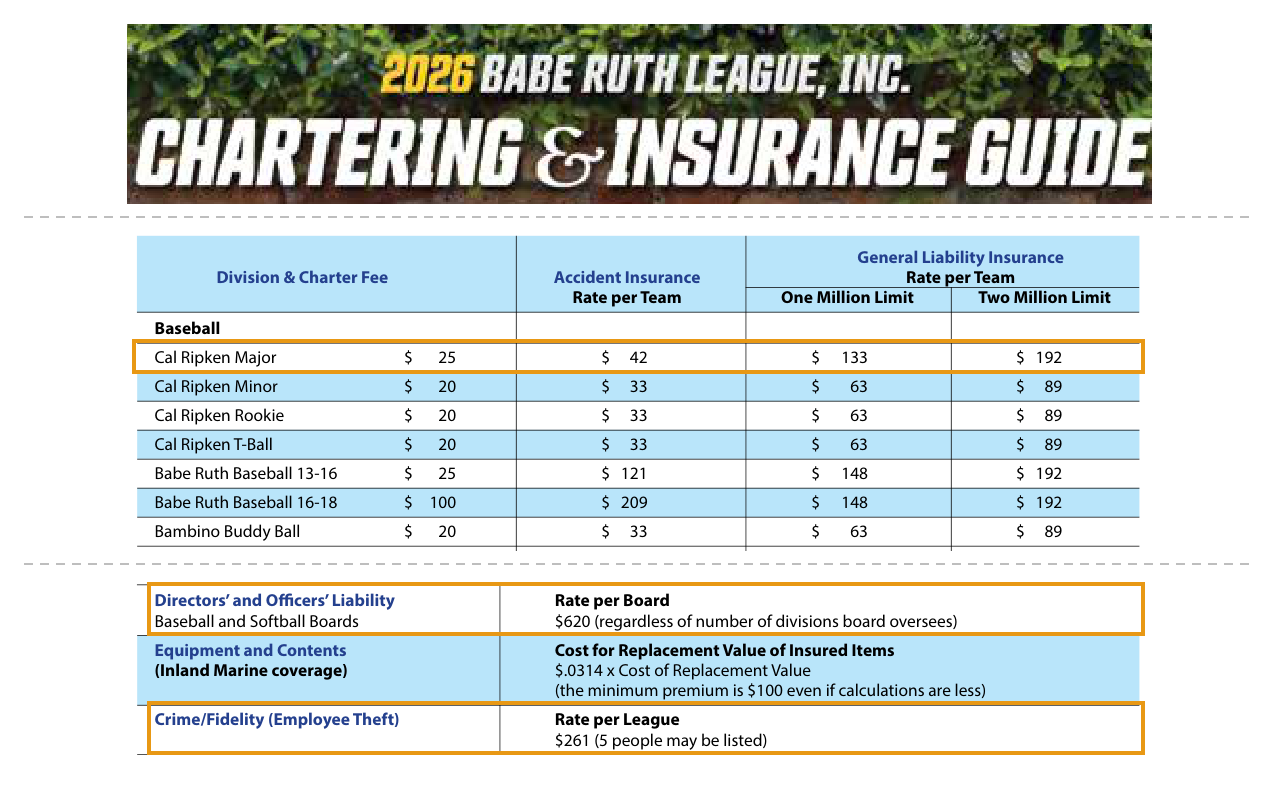
Source 1 of 3 · What one governing body charges per team
Babe Ruth League, 2026 Chartering & Insurance Guide, "Cost of Coverage": for each baseball division, the charter fee, the accident insurance rate per team and the general liability rate per team at a one million and a two million dollar limit, with Cal Ripken Major at $25, $42, $133 and $192. Below it, directors' and officers' liability at "$620 (regardless of number of divisions board oversees)", equipment and contents at "$.0314 x Cost of Replacement Value" with a $100 minimum premium, and crime and fidelity at "$261 (5 people may be listed)". The softball divisions, priced the same way, are omitted.
Source: baberuthleague.org, 2026 Chartering & Insurance Guide
Three things about these prices matter more than the figures. They are group rates, written for a whole national program rather than for one league. They cover the program's own activity, so a game outside the governing body's schedule may fall outside the policy. And they come with the program's limits: $1,000,000 per occurrence is the most common general liability limit, $2,000,000 usually costs extra, and Babe Ruth League says its $3,000,000 limit "is only available for purchase when required by contract." Little League publishes no premium outside its league portal, but its 2026 program raised the accident maximum from $100,000 to $250,000 and requires a league that buys elsewhere to carry "comparable limits and scope of coverage."
When a league sends me its charter certificate, I read it as proof of the games, then ask about everything else the league does: the stand it owns, the tournament it hosts in the summer, the decisions its board makes and who drives the players. The per-team rate was built for the first of those. The rest is where a league finds out what it bought.
Bobby Sharp, Action Sports Practice Lead, Specialty Insurance
What membership leaves uninsured
The clearest statement of the gap comes from the governing bodies. USA Swimming's insurance page opens by saying it offers its members "two forms of insurance: liability and accident insurance," and closes with a list of the insurance its program does not include.
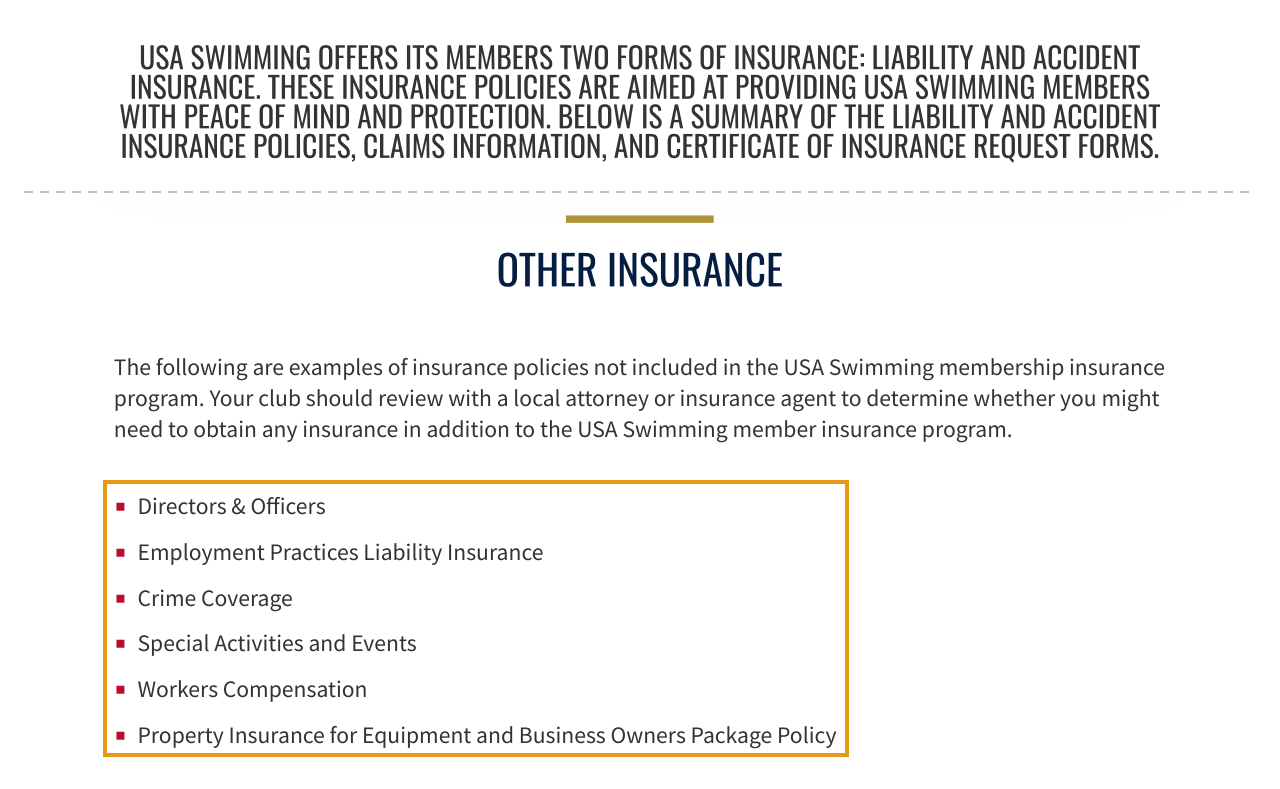
Source 2 of 3 · What one membership program leaves out
USA Swimming, insurance page: the program offers its members "two forms of insurance: liability and accident insurance". Under "Other Insurance", the "examples of insurance policies not included in the USA Swimming membership insurance program": directors and officers, employment practices liability insurance, crime coverage, special activities and events, workers compensation, and property insurance for equipment and a business owners package policy.
Source: usaswimming.org, USA Swimming Insurance
The other programs draw the same line in their own words. US Club Soccer, whose 2026-27 program carries $6,000,000 of liability per occurrence, "strongly recommends" that member organizations buy management liability, including directors and officers and employment practices cover, workers' compensation and liability cover for activities outside US Club Soccer, and it says a camp open to players who are not registered with it "falls outside" its coverage. USA Gymnastics insures member clubs "only while performing operations in connection with an event sanctioned in writing." USA Hockey tells associations that if a rink requires higher limits than its policy, they "may need to purchase additional excess liability on their own." Babe Ruth League asks leagues to report non-sanctioned tournaments so that coverage can be extended, and tells a league with "24/7 premises exposure" at a field it owns or leases to call about additional insurance.
Transport is the gap that appears in program after program. USA Football's insurance partner includes $1,000,000 of hired and non-owned auto liability that "Excludes bodily injury and property damage arising out of the transportation of participants." US Club Soccer's summary says "No coverage is provided for parents, coaches or volunteers using any automobile to transport team members." USA Softball's program FAQ says transporting participants is "specifically excluded," and USA Swimming's includes neither travel liability nor automobile liability. The federal Volunteer Protection Act does not help here either: its protection for volunteers does not apply to harm caused while driving a vehicle for which the state requires a license or insurance. For a travel club whose families drive to a dozen tournaments a season, that is the line most likely to be missing.
A travel club meets one more gap at the gate. Tournament hosts and field owners ask for a certificate naming them as additional insured, and the programs charge for it: the AAU's fee for a third-party certificate is $50 when it is requested at least 31 days ahead and $150 inside 15 days. A club with its own general liability policy requests those certificates from its own agent, and the general liability line in the travel club column is priced for that.
Why the youth sports insurance prices online disagree
The first page of results for "youth sports insurance cost" offered at least six kinds of figure in October 2026, and they rarely describe the same purchase. The first result, a broker's program for teams outside any governing body, prints per-player rates from $6.04 a year for swimming or track to $58.91 for tackle football at ages 16 to 19, with a $300 minimum premium and a $20 purchasing group fee; its search snippet quotes "1% to 2% of registration fees" with a $500 minimum, which belongs to a registration refund product on the same page. The second was a carrier's amateur sports page with no price on it. The third was the page with the missing number. The fourth put general liability for youth teams at "between $27 and $59 a month."
Further down, a broker sells youth basketball at $103 a team with the note "All costs below include a fee," while its own league rate table lists $105 plus a 3 percent administration fee for the same team. Another broker prices directors and officers cover from $400 a year for a defense-only policy, and another says its "Prices start at $105." The eighth result was a municipal athletic federation that charges $90 a team in 2026 for youth medical and liability cover, with excess medical capped at $15,000. Each of these figures is right for what it prices, and each prices one program's per-player or per-team cover for sanctioned play, often with an accident limit between $15,000 and $100,000. None of them prices the lines a board buys for itself, which is why the table above is built line by line.
How much liability a youth league needs
A per-occurrence limit is shared by everyone hurt in the same occurrence, and for most league claims, a player hurt by a pitch or a spectator who falls on the bleachers, the $1,000,000 that most programs write is the common floor. The pressure on limits comes from venues. One youth sports broker notes that facilities "for many years ... required a $1,000,000 liability policy, but most are now requiring $2,000,000." NFL FLAG requires every league to hold at least $1,000,000 of general liability and to name NFL FLAG's operator and the National Football League as additional insureds. Babe Ruth League sells a $3,000,000 limit only when a venue's contract requires it, and USA Hockey tells associations to buy excess cover themselves when a rink asks for more than its program provides.
The size of a single youth sports verdict shows why. In February 2018 an Allegheny County, Pennsylvania jury awarded $1.7 million to the family of an 11-year-old who suffered a traumatic brain injury when a line drive struck him "as he waited in the first-base dugout" during a Little League game in 2015. According to the family's lawyer there was "an 11-foot opening in the fencing from where the back stop ended, and the dugout began," against Little League's rule that dugouts be fenced and screened. The jury put 50 percent of the award on one local athletic association, 10 percent on another and 40 percent on the borough, and the court later denied a defendant's post-trial motion. One association had argued that it was immune from damages "because it was a volunteer, non-profit sports program." By our arithmetic the largest share, $850,000, fits inside a $1,000,000 limit; the whole verdict would not.
Abuse claims: the line that reaches the board
The largest figures in this guide come from abuse claims, and those claims reach the organizations as well as the abuser. USA Gymnastics and its insurers agreed a $380 million settlement with nearly 500 survivors of its former team doctor in December 2021, after the organization filed for bankruptcy. In November 2025 a Hennepin County, Minnesota jury awarded $12.5 million to a woman who was abused as a child by her figure skating coach. Her lawsuit had also named U.S. Figure Skating and two local skating clubs; a judge dismissed the claims against them in June 2025, finding that the coach was an independent contractor hired by her family, and the Minnesota Court of Appeals heard her appeal of that dismissal on September 17, 2026, with a decision expected within 90 days. Whatever the appeals court decides, the two clubs have been parties to the case since 2023, and the cost of defending a claim like that is what an abuse policy or a directors and officers policy pays first.
The abuse limits that come with membership vary more than any other line. Pop Warner's program carries $1,000,000 per occurrence with a $2,000,000 aggregate; Babe Ruth League's, $1,000,000 per perpetrator with a $3,000,000 aggregate; US Club Soccer's, $2,000,000 each occurrence; and USA Swimming's, $2,000,000 and $4,000,000. The AAU lists abuse cover as included without stating a separate limit, and USA Hockey's 2026-27 insurance handbook describes no abuse coverage at all. A league with its own policy has to show Babe Ruth League abuse cover of at least $1,000,000, and USA Football's insurance page lists $1,000,000 per occurrence and $2,000,000 aggregate among its required coverages.
Underwriters look as hard at the controls as at the limit. Diamond Youth Baseball's endorsed program says that unless a team or league runs a criminal background check and keeps a written prevention plan and an incident response plan that requires notifying law enforcement, "your coverage for sex abuse/molestation will not apply." Federal law adds a reporting duty: under 34 U.S.C. 20341, an adult authorized by a national governing body or an amateur sports organization to interact with minors must report suspected child abuse "as soon as possible," which the statute defines as within 24 hours. Florida has gone further. From July 1, 2026, Florida Statutes section 943.0438 requires an independent sanctioning authority to run a level 2 background screening on every coach, manager and referee, and it may not hand that job to an individual team. A sanctioning authority that complied is presumed, subject to rebuttal, not to have been negligent in authorizing a coach later accused of sexual misconduct.
The abuse questions on a league application take longer than the rest of the file put together. Background checks on every adult with access to players, a written rule that no adult is alone with a child, training records and a reporting procedure are what an underwriter asks to see before quoting a limit a venue or a governing body will accept.
Bobby Sharp, Action Sports Practice Lead, Specialty Insurance
Volunteers, the board and the limits of immunity
Volunteer immunity protects people, not leagues. The federal Volunteer Protection Act, 42 U.S.C. 14503, shields a volunteer of a nonprofit who acts within the scope of the role and without gross negligence, but says that "Nothing in this section shall be construed to affect the liability of any nonprofit organization." It lets states make that protection conditional on the organization providing "a financially secure source of recovery," which may be an insurance policy, and it does not protect a volunteer convicted of a sexual offense. Maryland is one state that ties the two together in dollar terms.
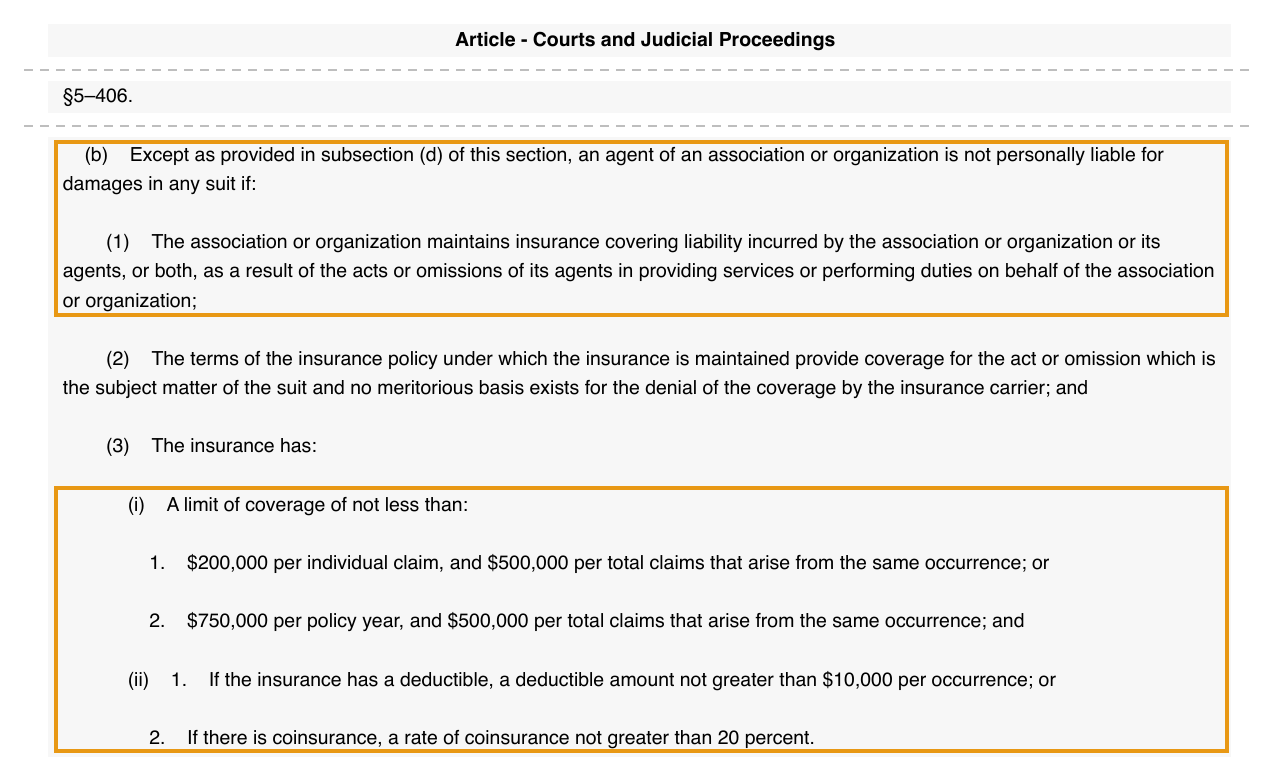
Source 3 of 3 · A state that ties volunteer immunity to insurance
Maryland Code, Courts and Judicial Proceedings section 5-406(b): an agent of an association or organization is not personally liable for damages if the organization "maintains insurance covering liability incurred by the association or organization or its agents", the policy covers the act in question, and the insurance has a limit of not less than "$200,000 per individual claim, and $500,000 per total claims that arise from the same occurrence" or "$750,000 per policy year", with a deductible of no more than $10,000 per occurrence.
Source: mgaleg.maryland.gov, Courts and Judicial Proceedings section 5-406
Under Maryland Courts and Judicial Proceedings section 5-406, a director, officer, trustee, employee or volunteer of a charitable organization is not personally liable if the organization carries liability insurance of at least $200,000 per claim and $500,000 per occurrence, or $750,000 a year, with a deductible of no more than $10,000, and a plaintiff's recovery from the organization is limited to that insurance. In Maryland, the league's liability policy is what keeps its volunteers personally out of reach of a damages award. Elsewhere, the board's protection is its directors and officers policy, which the programs sell for a few hundred dollars: $620 a board from Babe Ruth League, $388 for $1,000,000 or $687 for $2,000,000 from Pop Warner, and $382 or $490 from Diamond Youth Baseball. Crime cover for the treasurer's account costs $261 a league from Babe Ruth League, and $105 to $298 from Pop Warner for limits of $10,000 to $100,000.
The cheapest gap to close is the calendar. Little League's own example describes a league whose insurance expired on December 31 while it waited until February 15 to charter; a volunteer hurt on January 15 repairing the press box roof had the claim denied, and the league found itself responsible for medical expenses of more than $2,800. Little League's coverage runs with the calendar year, and a league that charters and pays before January 1 carries its program over without a break.
What drives a league premium up
Sport and age are the base. The published programs rate a league per team or per player, by sport and age bracket, so a league that adds a tackle division or an older age group pays more for every team in it. Everything else on this list either moves the rate or adds a line.
| Factor | Why it moves the premium |
|---|---|
| Contact and collision sports | Tackle football costs the most wherever rates are printed: Pop Warner charges $706 to $1,020 a tackle team against $262 for flag, and one broker's per-player rates run from $6.04 for swimming to $58.91 for tackle football at 16 to 19. |
| Older age brackets | Babe Ruth League's accident rate runs from $33 a team in its Cal Ripken Minor division to $209 in Babe Ruth Baseball 16-18. |
| Higher liability limits | $2,000,000 instead of $1,000,000 takes a Cal Ripken Major team's liability rate from $133 to $192, and adds $114 to a Pop Warner tackle team. |
| Owned or leased fields with buildings | Bring property cover and year-round premises liability; Babe Ruth League tells leagues with 24/7 premises exposure to call about additional insurance. |
| Hosted tournaments outside the program | Need event cover; the AAU says a member that hosts an unlicensed event has no coverage for it. |
| Travel and volunteer drivers | Add hired and non-owned auto liability, which most programs exclude for transporting players and which the Volunteer Protection Act does not cover. |
| Venue contracts above $1,000,000 | Add an excess or umbrella layer; Babe Ruth League sells $3,000,000 only when a contract requires it. |
| Paid coaches and staff | Bring workers' compensation and employment claims that volunteer programs do not carry; US Club Soccer recommends both lines to its member clubs. |
| Abuse controls that cannot be shown | Can void abuse cover outright: one endorsed program's abuse cover will not apply without background checks, a written plan and an incident response plan. |
| Claims history | Includes abuse claims that surface years after the season and are tested against the policies in force at the time. |
Specialty Insurance builds coverage programs one exposure at a time for action sports and entertainment businesses. Here is how one client, a brand-new operator rather than a league board, described working with us.
"Bobby Sharp and the team at Specialty Insurance had a fast turnaround, professional service, and answered every question I had as a brand-new operator. They wrote the policy I'd want defending me if a player ever filed a claim."
Grimnir Tactical LLC
Verified customer review
What brings it down
Most of this list is paperwork and supervision practice, which is the useful part for a board reading it before the charter deadline.
| Factor | What it proves to an underwriter |
|---|---|
| Background checks on every adult with access to players, renewed on a schedule | That the league screens its coaches and volunteers. Florida now requires level 2 screening by the sanctioning authority, and one endorsed program voids abuse cover without background checks. |
| A written two-adult rule, abuse prevention training and a reporting procedure | That no adult is alone with a player and that coaches know they must report suspected abuse within 24 hours under federal law. |
| Fenced and screened dugouts and a field check before every game | That the league controls the hazards behind its largest verdicts, such as the gap in the dugout fencing in the Pennsylvania case above. |
| Concussion education and a removal-from-play rule | That a hurt player does not go back in. Florida requires sanctioning authorities to adopt both. |
| Every team and player reported before the season | That everyone is on the policy. Pop Warner requires excess cover for all teams in an association, and Babe Ruth League for every chartered team. |
| Parent consent and waiver forms signed every season | That families were told the risks of the sport. A waiver supports the defense but does not replace insurance. |
| Certificates from tournament hosts, vendors and contracted instructors | That anyone else running an activity with the league's players carries their own cover, with the league named as additional insured. |
| A written driving policy, or rented vans with hired auto cover in place | That transport risk sits with a policy written for it rather than with a parent's personal auto limit. |
| Renewal before the program's expiry date | That there is no gap. Little League's cover ends on December 31, and its own example shows a league paying a volunteer's medical bills after chartering late. |
| Incident reports written on the day, and every old policy kept | That the league can answer a claim made months or years later. |
Waivers belong on this list but do less than most boards expect, as our guide to waivers versus insurance explains. Our guide to how to handle a claim covers what to record on the day a player is hurt.
What to have ready before you ask for a quote
A quote for a league turns on counts and documents. Have these to hand and the quote comes back faster and closer to the bottom of the range.
- The program. Every sport and division, teams and players in each, age brackets, the season dates and whether you charter with a national governing body.
- The current certificate. Your governing body's certificate or your own policy, with its limits, deductibles and renewal date.
- The fields. Who owns each field, your permits and leases, and their insurance clauses, plus anything the league owns at a field: a concession stand, press box, scoreboard, lights, bleachers or batting cages, with their values.
- Tournaments and travel. Every tournament you host and whether it is sanctioned, every tournament your teams attend, and how players get there.
- People. The board, paid coaches and staff with their payroll, volunteers, and anyone who drives players.
- Abuse prevention. Background checks, training records, the written supervision and reporting policies, and who keeps them.
- Money. Who handles registration fees and sponsorships, and the controls on the league's accounts.
- Three to five years of loss runs, even if there have been no claims, and the details of every policy the league has carried.
Line up the dates while you are at it. Babe Ruth League chartering for the 2026 season opened on October 1, 2025, Little League's cover runs with the calendar year, and Pop Warner's 2026 program runs from July 15, 2026 to July 15, 2027, so a league that mixes programs or buys gap cover on the open market should set every renewal to the same date.
Frequently asked questions
How much does youth sports league insurance cost?
Specialty Insurance's 2026-2027 ranges put the whole program for a volunteer recreation league of about 30 teams at $5,000 to $15,000 a year, and for a travel club of about 10 teams at $6,000 to $18,000, with general liability alone at $1,500 to $6,000 for the league and $1,500 to $5,000 for the club. The governing bodies that print their rates charge less, per team or per player, because they buy for thousands of leagues at once. In 2026 Babe Ruth League charges $33 to $209 a team for accident insurance and $63 to $192 a team for general liability, Pop Warner charges $706 to $1,020 a tackle football team and $262 a flag team for both together, and the AAU charges $22 a youth athlete. By our arithmetic, a 30-team Cal Ripken league pays $4,551 a year for accident, $1,000,000 of liability, directors and officers and crime cover through its program, before charter fees. Those rates leave out league-owned field property, tournaments outside the program, transport and limits above the program's own, which the table above prices line by line.
What does Little League insurance cover?
Little League's accident policy is excess cover that pays up to $250,000 for any one injury in 2026, up from $100,000, after a $50 deductible and after the family's own insurance. Its liability package combines general liability, directors and officers, cyber, crime and equipment cover, and a league cannot buy those policies separately. Accident and general liability cover is mandatory for every rostered player, manager, coach and volunteer umpire, and a league that buys elsewhere must carry comparable limits and scope. The equipment policy covers bats, helmets, pitching machines, fences and sheds but excludes light poles, scoreboards, bleachers, dugouts and other fixed field property.
Do travel baseball teams need insurance?
In practice, yes, because the people a travel team depends on ask for it. Tournament hosts and field owners require a certificate of general liability, often naming them as additional insured, and many now ask for $2,000,000 rather than $1,000,000. A team registered with a sanctioning body such as Babe Ruth League, Diamond Youth Baseball, USA Softball or the AAU has the cover that body's program provides, which may not extend to tournaments run by others. Travel adds a gap of its own: most programs exclude transporting players, so families driving to out-of-state tournaments need hired and non-owned auto cover behind them. Specialty Insurance's 2026-2027 ranges put the whole program for a travel club of about 10 teams at $6,000 to $18,000 a year, and hired and non-owned auto for the club at $750 to $2,500.
What does AAU insurance cover?
A youth AAU membership costs $22 in 2026, or $24 with extended coverage, and includes excess accident medical cover of $100,000 with a $300 deductible and $20,000 for accidental death and dismemberment. The AAU's general liability covers up to $1,000,000 per occurrence at each licensed event, with excess liability of up to $5,000,000, and sexual abuse and molestation cover is included. It applies only to events the AAU has licensed: a member that hosts an unlicensed event has no coverage for it. Third-party certificates cost $50, or up to $150 when requested within 15 days of the start date.
How much does youth football insurance cost?
Specialty Insurance's 2026-2027 ranges put the whole program for a youth tackle football association of six tackle teams and two flag teams, playing on a school field, at $6,000 to $20,000 a year on the open market. Pop Warner's 2026-2027 program charges $706 to $1,020 a tackle team and $262 a flag team for combined excess accident medical and general liability cover, with $1,000,000 of liability per occurrence, $100,000 of excess medical per participant and $1,000,000 of abuse cover per occurrence; $2,000,000 of liability costs $114 more a tackle team or $38 more a flag team. USA Football's insurance page lists general liability of $1,000,000 per occurrence and $3,000,000 aggregate, abuse cover of $1,000,000 and $2,000,000, and participant accident of at least $100,000 as required coverages. NFL FLAG offers approved leagues participant accident cover free and requires at least $1,000,000 of general liability.
Does a youth sports league need directors and officers insurance?
Most leagues with a board should carry it. The federal Volunteer Protection Act protects individual volunteers in many cases but does not affect the liability of the organization, and the claims a board faces, over roster cuts, eligibility rulings, discipline, removing a coach or registration money, are rarely covered by general liability. USA Lacrosse's policy covers individual coaches and officials only and tells member organizations they need their own directors and officers policy. The programs that print a price charge $620 a board (Babe Ruth League), $388 for $1,000,000 (Pop Warner) and $382 (Diamond Youth Baseball); on the open market, Specialty Insurance's 2026-2027 ranges put it at $500 to $1,500 a year for a recreation league and $500 to $2,000 for a travel club, for limits of $1,000,000 to $2,000,000. Babe Ruth League's policy excludes bodily injury and sexual misconduct, which is why those claims need their own lines.
Sources
- Babe Ruth League, Inc., 2026 Chartering & Insurance Guide; Pop Warner 2026 Insurance Plans Enrollment Forms (combined accident medical and general liability, $0 deductible; directors and officers and crime), policy period July 15, 2026 to July 15, 2027, and the Pop Warner program limits, both published by the program administrator, K&K Insurance; Diamond Youth Baseball and Softball endorsed insurance program rates for 2026, published by Sadler Sports & Recreation Insurance; all read October 2026.
- Little League International, "Little League Insurance Programs" (updated January 13, 2026), "Chartering and Insurance Enrollment Now Open for 2026 Season" and "Don't Let This Happen: Local League Insurance Lapse Breaks Budget".
- AAU membership fees and 2026 Insurance Brochure; USA Softball of Kansas insurance registration and the USA Softball individual registration program FAQ; NFL FLAG insurance requirements; USA Football insurance page and the Players Health 2026 general insurance program; all read October 2026.
- USA Hockey 2026-27 Insurance Handbook, insurance management page and 2026-27 membership fee structure; USA Lacrosse, Insurance 101 for Member Programs (2026); USA Swimming insurance page; USA Gymnastics insurance page (policy term August 1, 2026 to August 1, 2027); US Club Soccer Youth Summary (2026-27) and insurance page; all read October 2026.
- Pittsburgh Post-Gazette, "Kilbuck boy, severely injured by Little League foul ball, wins $1.7 million jury verdict," February 1, 2018; plaintiff's counsel, "Hoffman v. Borough of Sewickley judgement upheld."
- Courthouse News Service, "USA Gymnastics reaches $380 million deal with Nassar abuse survivors," December 2021; MPR News, "Jury awards $12.5M to woman abused as child by skating coach," November 14, 2025; Broken Ice, "Minnesota Appeals Court Weighs USFSA's Duty to Protect Young Skaters," September 30, 2026.
- 34 U.S.C. 20341; 42 U.S.C. 14503 (Volunteer Protection Act of 1997); Florida Statutes section 943.0438 (2026); Maryland Courts and Judicial Proceedings section 5-406.
- Southern California Municipal Athletic Federation, 2026 sports medical and liability insurance rates.
- Youth sports insurance cost and program pages published by Sadler Sports & Recreation Insurance, K&K Insurance, ESP Specialty, eSportsInsurance, Chappell Insurance, Mosaic Insurance Alliance, American Specialty Express and Bob McCloskey Insurance, all read October 2026.
- Premium ranges in the coverage-line and whole-program tables, and the per-event tournament figure, are Specialty Insurance's own indication for a US youth sports league or travel club, supplied for budgeting purposes only and not constituting an offer of cover.