

Charter the club, take the plan the sport offers, hang the certificate behind the counter, open the doors. That sequence is how a working archery business ends up thoroughly insured for the sport it plays and thinly insured for the business it runs.
It is not carelessness. The archery world hands a new operator two things that look like shelter. The first is an association plan, which is real insurance and does real work. The second is a general sense that ranges are protected in law, because the shooting range down the road talks about its statutory protection constantly. Both are genuine. Neither one is where an archery operator thinks it is, and the distance between the two is where the uninsured claims live.
Send us your current declarations page. Specialty Insurance reads archery range and pro shop policies every week and will tell you in one free review whether the archer on your line, and the bow on your bench, are covered or excluded. 24-hour turnaround, licensed in all 50 states.
Get a 24-hour quoteAn archery business is usually two businesses on one floor
Before any coverage question, settle what you are selling, because an archery operation almost never sells one thing.
The trade association's own dealer research puts the shape of it plainly. In its survey of archery retailers, average total revenue was $484,400, of which $453,000 was retail sales and only $31,400 was range time, lessons, video range and service combined. Retail was roughly 93 percent of the money. Yet the same research put average shop size at 4,000 square feet, with 1,600 square feet of retail space and 2,000 square feet committed to shooting ranges. Half the building earns six percent of the revenue. Those figures come from a 2003 dealer survey published in 2004, the most recent public breakdown the industry has, so read them as structure rather than as current dollars.
The trade association does not flinch from the conclusion. Its own research says range revenue of about $3 per square foot was a loss leader in shops that did not focus on leagues and lessons, while dealers who promoted the range with leagues and lessons earned over $10 per square foot, which covered the total cost of operating the range in nearly every dealer surveyed.
Sit with that for a second, because it sets up the entire insurance problem. The activities that make the range pay for itself are leagues and lessons. Leagues and lessons are also the activities that put the most people, and the youngest people, on your line under your supervision. The commercial fix and the liability exposure are the same decision.
Half the building is a shop and half is a range, and the operator insures it as one thing because it has one address. The underwriter sees two classes of business sharing a door. When those two get described properly on the submission, the price usually moves, and so does what the policy answers for.
Bobby Sharp, Action Sports Practice Lead, Specialty Insurance
The federal classification system makes this worse rather than better. Archery ranges sit in NAICS 713990, All Other Amusement and Recreation Industries, a bucket that also holds shooting ranges, golf driving ranges, miniature golf courses, billiard parlors, boating clubs and riding stables. There is no archery code. That means no Census Bureau or Bureau of Labor Statistics dataset can tell anyone how many archery businesses exist in the United States, and it means the default classification for your business is a bucket built to hold everything that did not fit anywhere else.
The customer on your line is not who the class assumes
The most useful description of the archery customer is federal, free and almost never cited by anyone selling insurance to this class.
The 2022 National Survey of Fishing, Hunting, and Wildlife-Associated Recreation, coordinated by the United States Fish and Wildlife Service, added archery target shooting as its own measured activity for the first time and found an estimated 19 million archery target shooters aged six and over. The survey asked specifically about archery "not including hunting", so bowhunters are counted elsewhere.
Four findings from that survey should change how a range describes itself on a submission:
- Participation rates are highest among those under 18, and roughly a quarter of archery target shooters are minors, a far higher share than firearm target shooting or hunting. The report attributes this partly to the growth of organised youth archery programs.
- A majority have never hunted. Fifty two percent of archery target shooters have never tried hunting, and only 34 percent were active hunters.
- They are urban. Sixty seven percent live in urban areas and 48 percent live in metropolitan areas of a million people or more.
- Women are 29 percent of archery target shooters, against 17 percent of hunters.
So the modal customer walking into a commercial archery range is an urban novice, often a child, who does not hunt. That is a supervision-heavy, instruction-heavy, waiver-heavy business, and it is a very different risk from the one the word "archery" tends to summon.
It also runs straight into the structural problem with a liability policy written for premises risk. The insurance industry's standard endorsement for removing this exposure is titled Exclusion: Athletic Or Sports Participants, and it modifies the Commercial General Liability Coverage Part rather than sitting inside the base form. Its operative sentence removes bodily injury to any person while practising for or participating in any sports or athletic contest or exhibition that the insured sponsors.
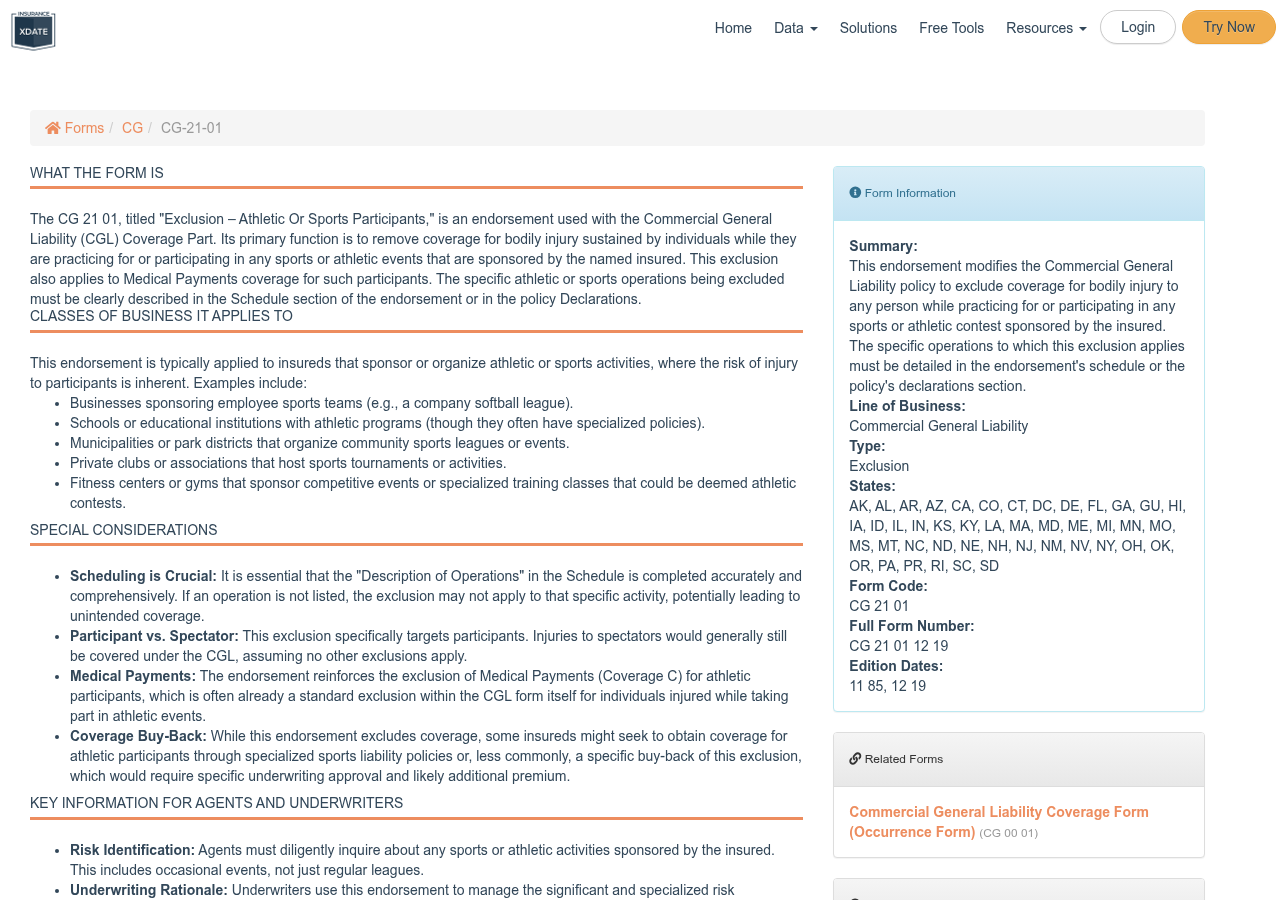
Source 1 of 4 · The endorsement that decides the class
The industry's standard participant exclusion is an endorsement to the liability coverage part, not a clause inside it. Where it is attached and nothing writes the exposure back in, the archer on the line is outside the policy while the spectator beside them is inside it.
Read that against your own floor. The person most likely to be hurt at your range is the person holding the bow. If the participant exclusion is attached and nothing writes the exposure back in, your liability limit is covering the lobby, the car park and the spectator, and not the archer. That is the same failure we broke down in detail in our piece on participant injury versus general liability, and it is the first thing to check on a quote rather than the last.
It is worth being concrete about what "check" means here, because this is the one exposure that does not show up as a tidy line item on an archery quote. Participant Injury Insurance is not something you can assume is inside a policy because the premium looks reasonable. Ask for it in writing: is injury to a person shooting on my line covered, and if so, which part of the policy does that. An answer you can put in a file is worth more than a limit you cannot trace.
Courts have not made this simpler. A United States Court of Appeals for the Sixth Circuit opinion shows two different carriers writing two differently worded participant exclusions on the same insured, with both applying, and with the exclusion overriding a separate endorsement that had broadened coverage elsewhere in the policy. An Illinois appellate court, on different facts, found the phrase "participating in" ambiguous and construed it in favour of coverage, because the policy never made clear whether a volunteer working inside the activity area was a participant or a bystander. The lesson from both is the same: the wording is not standard across carriers, so the answer for your policy is in your policy.
The good news is that archery earns a favourable number once it is described correctly, and we have set out the full injury record separately in what the federal and peer-reviewed data show about archery range injuries.
The sport's own plan is written for the club, not the counter
Here is the part that catches the most operators, and the proof of it sits on the governing body's own website.
The National Field Archery Association's page for clubs and shops lists insurance twice. Under benefits it says: "Liability insurance is available for affiliated clubs, pro shops and state associations." Three constituencies, named separately. Then in the Resources block on the same page it links two different insurance providers under two different labels: one described as insurance for pro shops, and a second, from a different administrator, described as insurance for clubs.
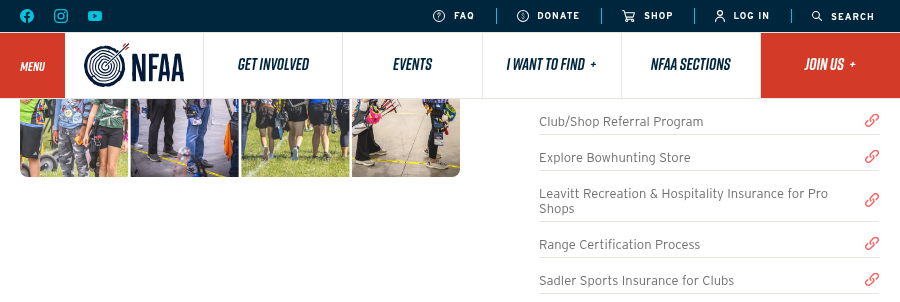
Source 2 of 4 · The governing body's own resource list
The Resources block on the association’s own club and shop page. Two different insurance providers, listed under two different labels: one for pro shops, one for clubs. The page that carries this list is the same page inviting an operator to charter as either.
The association also draws its own membership line at retail. Its page says a club charter suits "People who meet voluntarily to enjoy archery", while a shop license suits "Retail shops used to recruit business" with a "Sales tax license with a store front". An operator holding a club charter while running a retail counter is sitting on the wrong side of the association's own description of itself.
USA Archery is explicit in a different way. Its published insurance materials define the boundary in a sentence: "Only USA Archery club activities qualify for insurance coverage. A club activity is defined as any activity within a 24-hour period that is planned and hosted by the member club for members or direct membership recruitment. Any individual participating beyond these guidelines, or if the event is not planned and organized for members only, will not be covered under the individual member or club member insurance program."
Now hold that next to the limits on the same programme, because this is the trap. The USA Archery club summary shows a Products and Completed Operations Aggregate of $2,000,000, and it restricts covered activities to sanctioned and approved events. A limit is not a grant of coverage. The products limit is real. It does not follow your customer to the retail counter on an ordinary Tuesday afternoon, because an ordinary Tuesday afternoon is not a sanctioned event or a member-only club activity.
This is the single most misread page in the vertical. An operator reads a declarations summary, sees a products aggregate sitting there in seven figures, and concludes the shop is covered. The number is not the answer. The covered-activities definition is the answer, and it sits three paragraphs away.
To its considerable credit, USA Archery says so itself, in writing, in a note that every range owner should read twice: "If the Instructor, Club or Coach owns the premises or facilities, or if they are contractually responsible for the property on a 24-hour basis according to the terms of their lease, then they will need to purchase General Liability Insurance in addition to the coverage provided through USA Archery."
Three more scope limits are worth knowing before you rely on an association plan for anything commercial. Coverage is not included for independent contractors who are paid a fee for their services, which is exactly how most small ranges engage lesson instructors. Host liquor liability applies only where you do not sell alcohol as a business. And the coverage sits excess over any homeowners, tenants, personal liability or personal umbrella policy available to a coach or volunteer, so it is a backstop rather than a first-dollar answer. The full affiliation analysis is in our companion piece on USA Archery insurance requirements. What belongs here is narrower and more commercial: the plan is scoped to the sport, and your business is wider than the sport.
The trade body whose members are by definition pro shops offers nothing turnkey either. The Archery Trade Association runs no insurance program of its own and endorses no insurer. It operates a member service provider directory in which insurance sits beside legal services, accountancy and website development.
None of that means you have to choose between real coverage and your sanctioning, and this is the objection worth answering directly. The National Field Archery Association's own by laws set the condition for hosting national and sectional tournaments in one sentence: "The Host club must be covered by NFAA insurance or a policy of equal or greater coverage." Equal or greater coverage. A commercial policy written for the whole business satisfies that on its face, and it is the association itself saying so. Worth knowing alongside it: the by laws also provide that where a state association denies a charter application, the association will revoke the charter and notify the endorsed insurance carrier. Coverage that arrives as a membership benefit is coverage contingent on a membership somebody else administers.
An operator hands me an association summary with a seven figure products aggregate on it and asks why I want to talk about the pro shop. The limit is genuine. What it attaches to is a sanctioned event and a member activity. Read the covered activities before you read the numbers, because the numbers are describing a different afternoon than the one you are worried about.
Bobby Sharp, Action Sports Practice Lead, Specialty Insurance
What the bench work becomes the moment the bow leaves
If you tune bows, cut arrows, serve strings, time cams or fit draw length, you are performing work on other people's equipment. The standard liability form has a specific name for what that work turns into, and the definition is worth reading slowly because it splits your business along a line most operators have never noticed. It is also the exposure that Product Liability Insurance answers, which is worth naming now because it does not appear as its own row on the price table further down.
The Products and Completed Operations Hazard "Includes all 'bodily injury' and 'property damage' occurring away from premises you own or rent and arising out of 'your product' or 'your work' except: (1) Products that are still in your physical possession; or (2) Work that has not yet been completed or abandoned." The form then adds the sentence that closes the job: "Work that may need service, maintenance, correction, repair or replacement, but which is otherwise complete, will be treated as completed."
Two conditions have to be met together. The work has to be finished, and the injury has to happen away from premises you own or rent. That distinction matters more at an archery business than almost anywhere else, because a range with a shop attached runs the same customer through both buckets in a single visit. The bow is fitted and pressed at your counter, which is your work. It is then shot on lanes you own or rent, which is premises. Take the same bow home and shoot it in the garden six months later, and the claim has moved.
Three consequences an operator can check on a declarations page in about a minute:
- The Products and Completed Operations Aggregate is a separate limit. Money paid out of the general aggregate does not erode it, and money paid out of it does not erode the general aggregate.
- The form will not pay to redo the work or replace the product. Exclusion k removes property damage to your product arising out of it, and exclusion l removes property damage to your work included in the hazard, with an exception where the damaged work was performed on your behalf by a subcontractor. A shop that farms string building out to a contract technician sits inside that exception.
- Recall costs are excluded outright. Withdrawal, inspection, repair, replacement, removal and disposal expenses triggered by a known or suspected defect are not covered.
The failure modes are documented rather than hypothetical, and they are documented by the manufacturers themselves. Hoyt's published safety warnings tie dry fire directly to setup work the shop performs: "Never try drawing a bow that is too heavy for your strength or that does not fit your draw length as this could lead to an unintentional dry fire." The same page sets a numeric service interval that is a bench job, recommending that strings and cables be replaced "after 2,000 shots or after two years, whichever comes first". It restricts pressing to approved presses in unusually direct language: "STANDARD BOW PRESSES CANNOT BE USED and may result in bow failure and personal injury." It also sets a hard limit on the most common counter task there is, warning never to loosen limb weight adjustment bolts more than eight turns because the bow could violently disassemble.
The federal recall record fills in the rest, and it reaches the vertical bow as well as the crossbow. The BowTech compound bow recall covered about 8,000 bows on 255 reports of limb breakage with 11 reported injuries, on the stated hazard that "The ends of the bow's limbs can unexpectedly break during use and send fragments of the bow in the direction of the user or bystanders." Arrows have been recalled twice, about 20,700 Easton Axis arrows in 2013 and about 11,300 Beman arrows in 2010, on the hazard that they can break when launched and hit unintended targets, neither with a reported injury. The largest component recall by unit count is a white arrow nock recall of about 220,000 units, reporting 51 finger injuries including 21 serious ones when it was reannounced in 2021. A crossbow cocking aid, the sort of accessory a shop sells and fits at the counter, generated 538 breakage reports and one reported permanent eye injury. Two honest gaps belong beside that list: there is no recall on the federal record for a bow press, and none for a broadhead. Crossbow service is its own conversation, and we have written it up in our comparison of crossbow versus traditional bow operations.
The published court record is thin and heterogeneous, which is itself the finding. A Colorado appellate opinion records a customer injured while testing a hunting bow on an indoor range inside a retail store, after a salesperson adjusted his draw length and urged him to pull harder. A 1976 Illinois decision involved a man blinded in one eye when a bowstring silencer bought at the range's own shop shattered, and the range owner did not defend the case. A federal court in Georgia let a product case proceed where a salesperson fitted a youth compound bow and recommended incompatible arrows, one of which exploded on the second shot. Across every search route, the United States has produced roughly half a dozen published decisions touching a commercial or club archery range, and the mechanisms in them are a bow breaking during a fitting, a string accessory shattering, an excavation on a field course and a wobbly fence. An underwriter pricing this class is pricing the mechanism, because there is not enough record to price.
Then there is the tail, and this is the part worth acting on this week. The liability form is triggered by when the injury happens, not by when the work was done. In South Carolina, a personal injury action runs three years from when the person "knew or by the exercise of reasonable diligence should have known that he had a cause of action", not from the date of the tune. And under Section 15-3-40, the clock does not run against a minor at all, with infancy expressly carved out of the five year cap on tolling. A bow fitted for a ten year old can surface as a claim when that customer is nineteen. That is a nine year tail on one afternoon at the bench, and it needs a policy in force in year nine.
Run a bench as well as a range? Ask us for a free products and completed operations check. We will read your current form and tell you in writing whether the work you finished last season is still answered by the policy you hold today.
Get a free gap checkThe range statutes split, and only one of them answers an injury claim
Every operator in this class eventually hears about sport shooting range protection acts. Seventeen states were examined for this guide, at primary statutory text, and the received wisdom is wrong in both directions. Archery sits inside the defined term in more states than operators assume. In almost every one of them, what that buys is quiet enjoyment rather than a defence to an injury claim.
Start with what these acts do. In most states the protection runs to noise and nuisance, which is the complaint of the neighbour who moved in next door, not the claim of the customer who got hurt. Florida's version is typical and unusually explicit about its own limits. Section 823.16(1)(c) defines a sport shooting range as "an area designed and operated for the use of rifles, shotguns, pistols, silhouettes, skeet, trap, black powder, or any other similar type of sport shooting", which is a catch-all that has never been tested against a bow. Its immunity in subsection (2) covers "any matter relating to noise or noise pollution", and only where the range complies with local noise ordinances in force when it was built. And subsection (5) closes the door in terms: "This section does not prohibit actions for negligence or recklessness in the operation of a sport shooting range or by a person using the range."
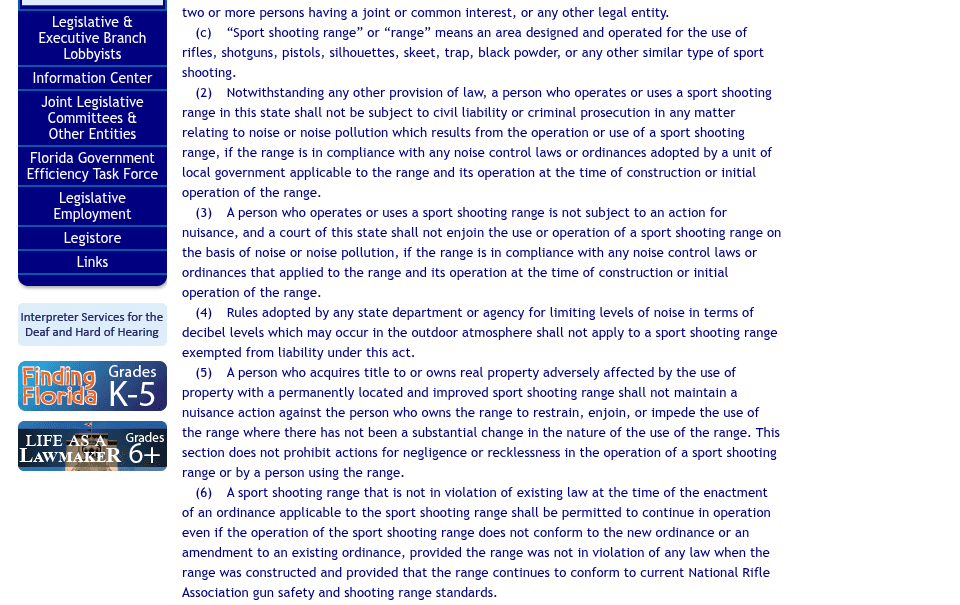
Source 3 of 4 · A neighbour statute, not a customer statute
Florida's catch-all definition never names archery, and subsection (5) states that the section does not prohibit actions for negligence or recklessness. Subsection (6) then conditions grandfathered operation on conforming to National Rifle Association range standards.
There is a textual hint that Florida was not thinking about archery. Subsection (6) lets a pre-existing range keep operating despite a later ordinance only "provided that the range continues to conform to current National Rifle Association gun safety and shooting range standards". A continuing-operation condition written in firearms terms is fair evidence about the drafters' subject matter. Florida also has a second and more discussed range statute, section 790.333, which does not reach private lawsuits at all: its immunity runs against the state and its subdivisions over projectiles in the environment, and it defines a projectile by reference to a firearm, BB gun, airgun or similar device. One live caveat, because it matters: in July 2025 the First District Court of Appeal held in Gartman v. Southern Tactical Range, LLC that section 823.16, as applied to those plaintiffs, violated their right of access to the courts under the Florida Constitution, stressing the as-applied nature of the ruling. The Supreme Court of Florida took the case on mandatory review, argued it in May 2026, and the docket was still open in August 2026. Nobody should treat the constitutional question as settled.
Wisconsin is the cleanest contrast in the survey, because Wisconsin is the one state examined where a range gets something an archery operator would genuinely want, and archery is locked out of it by a single sentence.
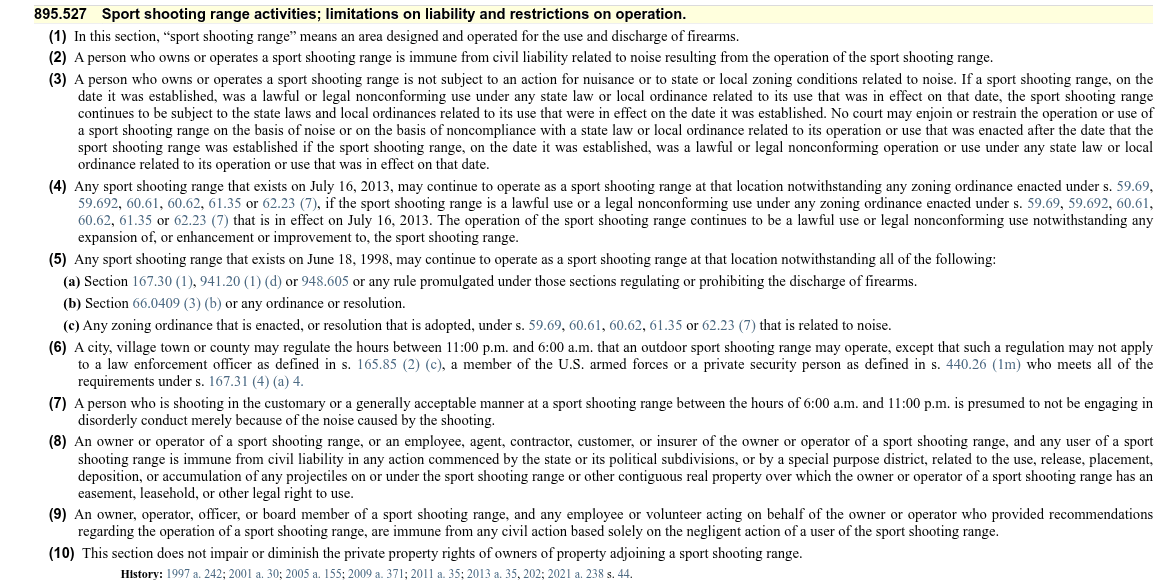
Source 4 of 4 · The definition that does the gating
Wisconsin defines a sport shooting range as an area designed and operated for the use and discharge of firearms, then grants immunities in subsections (8) and (9) that reach beyond noise. Archery, bows and arrows appear nowhere in the section.
Wisconsin Statute 895.527(1) reads: "In this section, 'sport shooting range' means an area designed and operated for the use and discharge of firearms." Archery, bows and arrows appear nowhere in the section. What that definition gates is not trivial. Subsection (9) makes an owner, operator, officer or board member immune from any civil action "based solely on the negligent action of a user of the sport shooting range". Subsection (8) adds immunity from actions brought by the state or its political subdivisions over the accumulation of projectiles on the range, which is the lead reclamation problem in statutory form. Note the words "based solely on" in subsection (9): the immunity evaporates the moment a plaintiff also pleads the range's own negligence. It is narrower than it sounds, and it is still more than an archery range gets.
Across the seventeen states examined, the pattern sorts into five groups:
| How the state's range statute treats archery | States examined |
|---|---|
| Archery named in, and the statute answers an injury claim | Idaho, alone |
| Archery named in, but the protection is noise, nuisance or zoning | Nevada, Tennessee, Michigan, Minnesota, Ohio, Indiana |
| Archery named out | Arizona, but only for an area in "exclusive" archery use |
| Firearms only, no catch-all to argue about | South Carolina, Wisconsin, Georgia, Texas, New York |
| Firearms anchored with an untested catch-all | Florida, North Carolina, Pennsylvania, California, Colorado |
Idaho is the real exception and an operator there should know it. The Idaho Sport Shooting Activities Immunity Act, at Idaho Code sections 6-2701 and 6-2702, is a personal injury immunity rather than a noise statute. It defines sport shooting activities as "the use of firearms, airguns and archery equipment for target practice, competition, training, instruction or other similar activities", and it defines a sport shooting range to include archery. It reaches commercial operations in its own words, covering an operator "whether or not operating for profit" and a participant "whether or not a fee is paid to participate". The operative section then says a range operator, sponsor, official or instructor "shall not be liable for any injury, including an injury causing death, to a participant engaged in sport shooting activities".
Read the exceptions before leaning on it. The immunity falls away for gross negligence, wilful and wanton disregard for a participant's safety, intentional injury, failure to exercise ordinary care in the operator's own use of archery equipment, handing a participant archery equipment without exercising ordinary care to confirm it is in safe operating condition, products liability, workers compensation claims, and injury from a dangerous latent condition the operator knew or should have known about and for which warning signs had not been conspicuously posted. That is where real claims live. A statute that narrows what can be pleaded still does not hire your lawyer or pay the settlement.
Everywhere else, being named in is worth less than it looks. Nevada puts archery first in its definition, then confines the protection to nuisance "with respect to any noise attributable to the shooting range". Tennessee names archery and then states expressly that nothing in the section limits civil liability for compensatory damage arising from physical injury to another human. Michigan names archery first, then conditions every protection on operating a range that conforms to "generally accepted operation practices", which the statute defines by reference to a national nonprofit that runs voluntary firearm safety programs. Minnesota and Ohio condition their benefits similarly, and Ohio's state shooting range standard names archery exactly once, to exempt it from the hours of operation rule, while every substantive safety provision in it concerns firearms.
Seventeen states is not fifty, so treat the table as a pattern rather than a census, and look up your own state's definition before assuming it either way.
South Carolina has the tightest definition in the set. The Shooting Range Protection Act of 2000 anchors to firearms three separate times inside one definition and has no catch-all at all. The even-handed reading matters here: no South Carolina range of any kind gets statutory help with a customer injury, because the act is about noise. That is not archery being treated worse. That is the whole class of range statutes doing a different job than operators believe.
Recreational use statutes are the other place operators expect shelter, and they usually will not help a business. Wisconsin shows why. Its recreational immunity statute defines recreational activity broadly enough to take in an outdoor archery range, expressly including "sport shooting and any other outdoor sport, game or educational activity" along with practice or instruction in any such activity, and it strips the landowner's duty to keep the property safe. Then it takes the protection straight back from anyone charging for it, withdrawing the immunity once a private owner's payments for recreational use pass two thousand dollars in the year of the injury, and withdrawing it again for injuries to the owner's own employees. A range selling lane time crosses that line in its first months. Tennessee is the friendlier version, naming archery and shooting range activities in its recreational use statute and expressly authorising a written waiver of the landowner's duty of care by a paying adult aged eighteen or over, provided the waiver does not limit liability for gross negligence or wilful conduct. California names archery as a hazardous recreational activity, but that immunity protects public entities and their employees rather than commercial operators, is removed where permission was granted for a "specific fee", and does not apply to indoor ranges at all.
So the honest statement is a narrow one. Archery is inside the statutory definition in more states than operators assume, and in nearly all of them that buys quiet enjoyment rather than a defence to an injury claim. Idaho is the genuine exception, and its carve-outs are wide enough that no operator should treat it as coverage. What stands between you and a claim is your policy, your documentation and your waiver, in that order.
The youth programs, and the number that is eighty to one
Because a quarter of archery target shooters are minors, the youth question is not a side issue for this class. It is the exposure most capable of exceeding every other limit on the schedule.
Start with where the legal obligations stop, because the answer is precise and counter-intuitive. The Ted Stevens Olympic and Amateur Sports Act defines an amateur sports organization as a "not-for-profit corporation, association, or other group", so a for-profit range is not one and the Act's abuse-prevention duties do not bind the business entity. The United States Center for SafeSport has jurisdiction over the Olympic and Paralympic Committee and each national governing body, not over a private venue. And yet federal law attaches a personal child abuse reporting duty to a "covered individual", meaning an adult authorized by a national governing body or a member of one to interact with a minor or amateur athlete at an amateur sports organization facility or a sanctioned event. The same section defines the deadline: "the term 'as soon as possible' means within a 24-hour period."
The statute stops at the entity and follows the person. A certified coach walks the reporting duty onto your floor even though the Act never reaches your company. Your written policy has to account for a duty your business does not itself owe.
Screening follows a similar sideways path at USA Archery. Its Level 1 Instructor certification lists exactly one prerequisite, a minimum age of 15, with no background screen and no SafeSport training attached to the certificate itself. The screening arrives one step later and by a different door: a Level 1 instructor assisting in a club must obtain a Range Pass, and the Range Pass requires membership, a background screen and SafeSport training. The coaches insurance summary confirms the gate from inside the policy, extending coverage to Level 1 instructors only where a Range Pass has been obtained. So the certificate on the wall is not the screening record. The current Range Pass is, and checking it is the range's job.
Scholastic 3D Archery is the youth program built to run through commercial archery businesses, and it says so: a team "can be affiliated with entities including but not limited to an archery shop, range, church, school, home school, etc. There are no school affiliation requirements." It also imposes hard conditions on the venue. Every team must have insurance covering the venue where it practises, with documented proof filed with the national office, and where the coverage comes from another organisation it must be a minimum of $1,000,000 in general and professional liability. It requires a certified coach physically present at every practice and team event, and states the reason plainly: "Due to insurance coverage requirements".
Now the number. USA Archery's coaches program summary of insurance shows abuse or molestation limits of $25,000 per person abused and $50,000 in the aggregate per policy, and shows Medical Expense as excluded outright. Its event and club programme carries $2,000,000 per abusive conduct and $4,000,000 aggregate, a coverage the current summary notes was previously referred to as Abuse and Molestation. Two programmes, one governing body, an eighty to one gap on the per-claim figure depending on which document your instructor is standing under.
Against that, look at what third parties demand in writing. Oxnard School District requires vendors and contractors working directly with students aged 18 and under to carry sexual abuse and molestation coverage of $2,000,000 per occurrence and $4,000,000 general aggregate, and requires the additional insured endorsement to be attached to that policy specifically, not only to the general liability policy. Tigard-Tualatin School District requires $2,000,000 per occurrence and in the aggregate from an after-school activity licensee, and requires background checks and fingerprinting for every instructor brought on site. The District of Columbia requires $1,000,000 per occurrence and $2,000,000 aggregate of "affirmative" abuse and molestation coverage and rejects silent or shared limits outright.
That is the gap in one line: the sport's coach programme may bring $25,000, and the school district down the road will not sign a booking for less than $2,000,000.
The market position is documented too. A procurement document published by the Arizona Supreme Court's administrative office tells vendors that coverage for abuse and molestation claims "is typically excluded from general liability policies, but some insurers offer a niche product with SAM coverage in their liability policy" for classes of business with the exposure, and requires a sublimit of no less than $500,000. And exclusions of this kind do what they say. In 2016 the Supreme Court of Ohio held unanimously that an abuse and molestation exclusion barred coverage for damages against an employer held liable for an employee's physical abuse of a child in its care, after the employer had settled for about $3.1 million. The abuse in that case was physical rather than sexual, and the exclusion still applied.
What archery range insurance covers, line by line
Archery behaves like a low frequency class, and most brokers who write it will tell you it is. Be honest about what that is worth, though, because it cannot be proved from public data. The federal injury surveillance system carries a single archery product code that swallows bowhunting, backyard shooting, school programs and commercial lanes together, and its coding manual instructs coders not to report hunting as an activity but to code the consumer product instead, so a bowhunting injury lands in the same number as a lesson on your line. No public dataset can isolate what happens on a supervised commercial range. We set out what the data does and does not support in our review of the archery injury record. What an underwriter can price on is the mechanism, the documentation and the loss history you personally hand over.
There is one structural advantage over the firearms range down the road, and it is measurable rather than assumed. It shows up in the environmental file rather than the injury file.
That advantage is lead. A peer-reviewed study used archery ranges as the control group for firearms ranges and found roughly 42 percent of shooters with elevated blood lead against under 6 percent of archers. The federal environmental guidance on range lead is scoped to rifle, pistol, trap, skeet and sporting clay ranges and does not mention archery at all, and there is no soil, groundwater or air contamination literature for archery ranges. A firearms range carries a chronic, regulated, employee-facing hazard with a federal permissible exposure limit of fifty micrograms per cubic metre averaged over eight hours. An archery range does not. Two caveats keep it honest: an archery range co-located inside a public shooting complex can inherit the neighbouring range's lead problem, and where a local code regulates archery, firearm and pneumatic ranges under one article, lead obligations can be drafted to catch all three.
What an archery operation does not get is one product at one price. It buys a set of lines, each with its own limit and its own job, and the mix is what separates a club range from a pro shop with lanes far more than size does.
Through Specialty Insurance, General Liability Insurance for an archery operation runs $400 to $1,200 a year. The rest of the foundation sits in the same territory: Participant Accident Insurance $300 to $1,200, Commercial Property Insurance $450 to $1,250, Workers' Compensation Insurance $250 to $1,500, and Sexual Abuse and Molestation Insurance $100 to $500. Read those as separate purchases rather than as a bill to add up, because almost nobody buys every line, and which ones you carry depends on whether you employ staff and coach children. Set against what this class is exposed to, those are small numbers, which is the practical argument for buying the line you are unsure about rather than leaving it off.
2026-2027 premium benchmark
What archery range insurance costs, line by line
Typical annual premiums for a commercial archery range, club, pro shop or lesson program in the United States.
- Priced for
- Commercial archery range, club or pro shop with a range
- Basis
- Annual premium, United States
- Updated
- August 2026
| Coverage | Typical annual range | Monthly estimate | Typical limits |
|---|---|---|---|
| General Liability InsuranceFoundation Third-party bodily injury, property damage and legal defense costs. | $400 to $1,200 | $35 to $100per month | $1,000,000 per occurrence / $2,000,000 aggregate |
| Participant Accident InsuranceFoundation No-fault medical payments for an injured archer, paid without proving negligence. | $300 to $1,200 | $25 to $100per month | Medical expense limit stated per participant |
| Commercial Property InsuranceFoundation Building, lanes, target butts, backstops, retail stock and the bench, plus business income. | $450 to $1,250 | $40 to $105per month | Based on total insurable value |
| Workers' Compensation InsuranceFoundation Employee injury. Statutory, and in South Carolina it bites at four or more regular employees. | $250 to $1,500 | $25 to $125per month | Statutory limits by state |
| Sexual Abuse and Molestation InsuranceSituational Written by endorsement, not granted in a base liability form. Expected wherever minors are coached. | $100 to $500 | $10 to $45per month | $1,000,000 per occurrence / $2,000,000 aggregate |
Most operators do not buy all five, so read the rows as separate purchases rather than as a total. A club range with no paid staff drops Workers' Compensation Insurance, and an operator who qualifies for a Business Owners Policy buys General Liability Insurance and Commercial Property Insurance together rather than separately. Two exposures this article treats at length are deliberately not priced as their own rows, because Specialty Insurance does not quote them as separate lines for this class: liability for the archer on your line, and the products and completed operations exposure your retail counter and service bench generate. Both are real, both are discussed above, and both are worth confirming in writing on whatever quote you are offered rather than assuming from a premium. Four further lines sit off this grid and belong on a quote when the facts call for them: Excess or Umbrella Insurance once a venue demands more than $1,000,000 per occurrence, Inland Marine Insurance and Commercial Auto Insurance for a mobile or event archery operation, and Liquor Liability Insurance for a range that sells alcohol rather than serving it at a hosted event.
Premium ranges supplied by Specialty Insurance underwriting. Updated . Ranges are an indication for budgeting, not a quote or a bindable offer.
Get a 24-hour quoteTwo limits are worth setting deliberately rather than by default, because third parties write them into contracts. Washington State's own grant manual for firearm and archery ranges requires at least $1,000,000 of liability cover, three named insureds and thirty days notice of cancellation, running for a minimum of ten years from final reimbursement, and makes losing that insurance a reason to claw back the grant. At least one city licenses commercial indoor archery ranges as a regulated use and requires $2,000,000 per occurrence as a condition of the licence. The archery trade association demands $1,000,000 per occurrence and $2,000,000 aggregate from every exhibitor at its own trade show and states that the cover is not optional. If you want to serve municipal contracts, school districts and permitted events, set the limit against the largest venue you intend to serve, not the smallest.
"Specialty Insurance is a great choice! I highly recommend this company for your business! They diligently take their time and work with you, making sure your business has all the correct and specific coverages you need. Cathy was a huge help, and gave me exactly what I needed, making it budget friendly and greatly affordable. Choose Specialty Insurance if you want the best service and fair treatment for your business!"
Gel Tag San Diego LLC
Verified customer review
Nobody publishes a design standard, so the decision is yours
One more thing an operator should know before buying, because it changes what an underwriter is looking at when they inspect.
There is no consensus technical standard for archery range design in the United States. ASTM International's subcommittee F08.16 on Archery Products has zero active standards, zero proposed standards and thirteen withdrawn or replaced ones, the last three withdrawn in 2026, and all thirteen were product standards covering broadheads, shafts, bowstrings, bow performance, scopes and treestands. None ever addressed range design, layout, backstops or safety zones. If you have seen ASTM F1169 cited as an archery standard, it is not one: F1169 is the Standard Consumer Safety Specification for Full-Size Baby Cribs.
What exists instead is a set of governing body documents, and knowing which is which matters. World Archery's numeric geometry, including a minimum 50 metre overshoot zone behind the longest target, applies to competition fields rather than to commercial ranges. The practical American framework is the National Field Archery Association's four range inspection checklists, which set real numbers a range can be measured against: at least 60 feet from shooting line to target bales indoors, at least 15 feet behind the shooting line, a backstop of arrow-stopping material to a minimum height of 8 feet, and 30 foot candles of light on the targets. Outdoors, the field checklist clears 25 yards or half the target distance behind an unbackstopped target, whichever is greater, and bans siting a target on a hilltop "where a miss becomes a flight arrow". The 3D checklist requires a 50 yard buffer behind the target, entirely on the range property even where the neighbouring land is vacant. The association certifies against those checklists for $20 per range type for clubs and shops, valid two years, and new outdoor field and 3D ranges cannot be self-inspected. In a class with no ASTM standard and thin case law, a dated third party inspection report is one of the few objective documents an operator can hand an underwriter.
The last layer is municipal, and it is where a legal duty can genuinely attach. Treatment is entirely local. One Minnesota city prohibits discharging an arrow anywhere in the city except under a permit, and publishes backstop specifications down to the height of the top and bottom edges. A Utah city requires a conditional use permit for an outdoor range and prohibits crossbows outright. A Washington county sets a two acre minimum lot size, 100 feet from any lot line, 500 feet from any occupied dwelling other than the owner's, and complete fencing of all shooting areas, then points operators at a firearms range manual because there is no archery equivalent to point at.
How to buy it, in the right order
- Write down which businesses you run. Range, club, pro shop, service bench, lesson program, mobile or event archery. Every other answer follows from that list, and the list is what the submission should describe.
- Read the exclusions before the coverages. Find the participant wording first. If injury to the person holding the bow is excluded and nothing writes it back, the rest of the policy is answering a question you did not ask.
- Do not read a products aggregate as a grant of coverage. Check what the covered-activities definition says before you conclude the shop is insured.
- Insure the bench separately in your own mind. Work performed on a customer's bow is a different exposure from the shooting line, with its own aggregate and its own tail.
- Check the tail against your renewal history, not your renewal date. A claim from work done years ago needs a policy in force when the injury happens.
- Treat the association plan as a layer, not the roof. It is scoped to the sport, it sits excess of personal lines, and the governing body says in writing that a premises owner needs their own General Liability Insurance on top.
- Verify the Range Pass, not the certificate, for every instructor who works with minors, and keep a dated record of when you checked.
- Set limits against the largest venue you want to serve. A $1,000,000 policy is a decision not to serve the school district that requires $2,000,000.
- Get the range inspected and certified, and keep the report. It is the cheapest objective document available in a class with no design standard.
- Check your own city and county before you sign a lease, because the local ordinance is the layer most likely to carry an enforceable duty.
Frequently Asked Questions
Does an archery range need its own insurance policy if the club already has association coverage?
In nearly every commercial case, yes. Association plans are scoped to the sport rather than to the business. USA Archery limits coverage to club activities planned and hosted for members or direct membership recruitment within a 24 hour period, and states in writing that an instructor, club or coach who owns the premises or is contractually responsible for the property on a 24 hour basis under a lease will need to purchase General Liability Insurance in addition to the coverage provided through USA Archery. Paid public range time, retail sales and lessons for non-members generally sit outside the association's definitions.
Does an archery club policy cover the pro shop?
Treat that as a question to answer in writing rather than assume. The National Field Archery Association lists insurance for affiliated clubs, pro shops and state associations as separate things, and its own resources page links two different insurance providers, one labelled for pro shops and one labelled for clubs. Do not read a Products and Completed Operations Aggregate on a club summary as proof the retail counter is covered, because a limit is not a grant of coverage and the covered-activities definition is what decides the question.
Do state shooting range protection laws protect an archery range?
It depends entirely on the state, and archery is inside the definition in more states than operators assume. Idaho is the one state examined whose statute answers an injury claim: the Idaho Sport Shooting Activities Immunity Act names archery, reaches operators whether or not they run for profit, and immunises them against injury to a participant, subject to wide carve-outs including gross negligence and products liability. Nevada, Tennessee, Michigan, Minnesota, Ohio and Indiana all name archery too, but what those statutes give is protection against noise, nuisance and later zoning rather than a defence to a customer injury claim. Arizona excludes an area in exclusive archery use. South Carolina, Wisconsin, Georgia, Texas and New York define a range by firearms only. Florida, North Carolina, Pennsylvania, California and Colorado are firearms anchored with catch-all wording that has never been tested against archery.
What is products and completed operations coverage, and does an archery pro shop need it?
It answers claims arising from products you sell and work you complete. The standard liability form defines the hazard as injury occurring away from premises you own or rent, arising out of your product or your work, once the product has left your possession or the work is complete, and it treats work that still needs further service as completed. A shop that sells bows and arrows, tunes, presses, times cams, serves strings or fits draw length is generating that exposure continuously, and it carries its own separate aggregate limit.
Does an archery range need abuse and molestation coverage?
If minors are on your line, plan for it. About a quarter of United States archery target shooters are under 18. USA Archery's coaches program summary shows abuse or molestation limits of $25,000 per person abused and $50,000 aggregate, while its event and club programme carries $2,000,000 per abusive conduct. School districts routinely demand $2,000,000 per occurrence from vendors working directly with students, sometimes requiring the additional insured endorsement on that policy specifically. The coverage is written by endorsement rather than granted in a base liability form, and courts have enforced abuse exclusions where it was missing.
Is there a required safety standard for archery range design?
No consensus technical standard exists. ASTM International has no active archery standard of any kind, and ASTM F1169, which is sometimes cited as one, is the specification for full-size baby cribs. In practice the American benchmark is the National Field Archery Association's range inspection checklists, which set indoor distances, backstop height, lighting and outdoor buffer distances, and the association certifies ranges against them. Local ordinances are a separate layer and can impose enforceable setback, backstop, fencing and permit requirements.
Insuring a range, a club, a pro shop or all three? Specialty Insurance writes archery on its own application rather than borrowing a shooting range form, and can quote General Liability Insurance with participant cover, the retail counter and the service bench on one placement. 24-hour turnaround, licensed in all 50 states.
Get a 24-hour archery quoteSources
- Archery Trade Association. Understanding the Industry (dealer research; 2003 survey published 2004), Member Service Providers directory, Bow Technician Certification, and Archery Park Development Guidelines.
- United States Census Bureau. NAICS 713990, All Other Amusement and Recreation Industries.
- United States Fish and Wildlife Service. Target Shooting in the United States: Participation, Demographics, and Relationship with Hunting and Fishing, 2022 National Survey addendum, published February 2025.
- Insurance Services Office form CG 21 01, Exclusion: Athletic Or Sports Participants; Commercial General Liability Coverage Form CG 00 01, Products-Completed Operations Hazard definition, separate aggregate, and exclusions k, l and n.
- National Field Archery Association. Build a Community club and shop membership and insurance resources; range certification program; indoor, outdoor field, outdoor target and 3D range inspection checklists.
- USA Archery. Membership Insurance; General Liability Summary of Insurance; Coaches Program Summary of Insurance; Range Pass; Background Screening; SafeSport.
- Hoyt Archery. Compound Bow Safety and Warnings.
- United States Consumer Product Safety Commission. Recalls of compound bows, crossbows, arrows, nocks, cocking aids and bow scales, 2003 to 2024.
- Wisconsin Statute 895.527; Florida Statutes 823.16 and 790.333; Gartman v. Southern Tactical Range, LLC, Fla. 1st DCA No. 1D2022-3567 (2025), on mandatory review as Fla. Sup. Ct. No. SC2025-1259.
- South Carolina Shooting Range Protection Act of 2000, S.C. Code Ann. Title 31, Chapter 18; S.C. Code Ann. Sections 15-3-40, 15-3-530 and 15-3-535.
- Idaho Code 6-2701, 6-2702 and 55-2604; Nevada Revised Statutes 40.140; Arizona Revised Statutes 17-601; Michigan MCL 691.1541 and 691.1542; Minnesota Statutes 87A.01 and 87A.03; Ohio Revised Code 1533.83 and 1533.85; Indiana Code 14-22-31.5; Tennessee Code 39-17-316, 70-7-102 and 70-7-105; California Civil Code 3482.1 and Government Code 831.7; Wisconsin Statute 895.52.
- Ted Stevens Olympic and Amateur Sports Act, 36 U.S.C. 220501, 220530 and 220541; 34 U.S.C. 20341.
- Scholastic 3D Archery membership and coach requirements; National Archery in the Schools Program structure and range setup manual.
- Oxnard School District, Tigard-Tualatin School District and District of Columbia Department of Energy and Environment vendor insurance requirements; Supreme Court of Arizona Administrative Office of the Courts procurement terms; Supreme Court of Ohio abuse and molestation exclusion decision (2016).
- Harriman v. Cabela's Inc., 2016 COA 43; Genteman v. Saunders Archery Co., 42 Ill. App. 3d 294 (1976); Morgan v. Dick's Sporting Goods, Inc. (N.D. Ga.); Colony Insurance Co. v. Danly, Inc., 755 F. Supp. 2d 219 (D. Me. 2010).
- Blood lead comparison study of shooters and archers (PubMed); United States Environmental Protection Agency, Best Management Practices for Lead at Outdoor Shooting Ranges; Occupational Safety and Health Administration standard 1910.1025.
- ASTM International, Subcommittee F08.16 on Archery Products jurisdiction listing, and ASTM F1169; World Archery Rulebook Books 2 and 3; Washington State Recreation and Conservation Office, Firearms and Archery Range Recreation Program manual.