
The conventional read on a foam dart venue is that it is a soft risk that should price like one. The projectile weighs about a gram, the customers are nine, and nothing on the floor has an engine. That read is not wrong about the darts. It is wrong about the business, and the number an operator gets quoted usually reflects neither.
Here is what happens instead. The venue gets dropped into whichever category the person quoting it already understands, and it inherits that category's blind spots along with its price. That is not a criticism of any one agent. It is structural, and it is visible in public if you read the published numbers side by side.
Send us your current declarations page. Specialty Insurance reads foam dart venue policies every week and will tell you in one free review whether the player on your floor is covered or excluded. 24-hour turnaround, licensed in all 50 states.
Get a 24-hour quoteA foam dart venue is a classification problem before it is a coverage problem
Business formation publisher TRUiC lists an average of $400 to $1,100 a year for $1,000,000 of general liability for a Nerf arena. The same publisher lists the identical $400 to $1,100 band for laser tag venues, for paintball arenas and for axe throwing businesses, above the same category graph, with no methodology, no sample size and no stated exposure basis. The page carries a "Last Updated: February 11, 2026" stamp. The Internet Archive's snapshot of that same page from 15 July 2019 carries the same sentence and the same two numbers.
Seven years, four unrelated activities, one band. That is a category template, and it is what most operators are budgeting against.
The pattern repeats wherever this class gets priced from outside. MoneyGeek's party rental report, updated 15 August 2026, models an average of $157 a month across five coverage types, with general liability at $131 a month nationally and $122 in South Carolina. Those are modelled figures benchmarked to a retail classification, and the report itself says to treat them as starting benchmarks. Read the coverage list and the reason for the gap becomes obvious: there is no line in it for liability to the people playing, no discussion of waivers, and no mention of dart or foam play at all. It is a good report about a different business.
Operators feel this from the other side. In an October 2025 forum thread, an organiser running free foam dart events in Idaho for roughly fifty attendees said that once his venue required liability cover, shopping under a generic "sporting event" category returned about $1,500 for a single day. It is a self-reported figure, other posters disputed it, and he never bought it. Take it as an illustration of what the wrong category costs a small operator, not as a market rate.
None of those numbers is dishonest. They are answers to questions nobody asked in the right terms. A foam dart venue has to be described on its own facts before it can be priced on them, and the facts that matter are narrower and stranger than the activity suggests.
When a foam dart venue gets quoted off a party rental form, the operator usually thinks the price looks reasonable. It does look reasonable. It is priced for a business that drops equipment off and drives away, and the entire exposure at your venue is what happens while people are standing in front of it.
Bobby Sharp, Action Sports Practice Lead, Specialty Insurance
The two businesses inside one foam dart brand
Before any coverage question, settle which business you are, because the answer changes the submission.
The fixed arena runs a leased unit: netted or walled lanes, soft barricades, open play sessions, birthday packages, sometimes a party room and a counter selling darts and drinks. Its problems are premises problems: the lease and its indemnity clause, the buildout, business income if the roof fails in July, and a landlord with an opinion about the certificate.
The mobile party operator loads a van and goes to the customer. Back gardens, church halls, school field days, corporate away days, community centres. Its problems are somebody-else's-property problems. Every booking happens under a third party's rules, the equipment spends its working life in transit, and the vehicle is often a personal one.
Plenty of operators are both, and many arrive at foam dart play as an add-on: bounce house companies, laser tag operators, trampoline parks and family entertainment centres bolting a second activity onto an existing book. If that is you, the question is not what foam dart cover costs. It is whether your current policy picked up the new activity at all. It usually has to be added, and it is not automatic.
That fork is not a nuance. In at least one state it carries a number, which we get to below.
The coverages a foam dart venue buys
Seven lines do most of the work. Not all seven apply to every operator, and the two business models weight them very differently.
General Liability Insurance is the foundation, and it answers for third parties: the parent watching from the sideline, the spectator who slips in the lobby, the caterer. It is the line every quote leads with and the line most buyers assume covers everything.
Participant Injury Insurance answers for the players. This is the distinction that decides whether a foam dart policy is real, because the people most likely to be hurt at your venue are the paying participants, and a general liability form written for a retail or premises risk is the document least likely to reach them. A headline general liability figure is not answering this question at all. Whether your specific policy reaches the player on the floor is a question about the exclusions attached to it, and we walk through exactly how that plays out in our piece on whether nerf arena insurance covers foam dart eye injuries.
Participant Accident Insurance is the no-fault layer beside it. It pays medical bills for an injured player promptly, without anyone proving negligence. Small dollars against a specialist bill, large dollars against goodwill. The family whose emergency room visit was paid the same week rarely calls an attorney.
Commercial Property Insurance belongs to the fixed arena: the buildout, the netting, the barricades, the blaster fleet on site, and the business income that stops when the site does. The second half is the part operators forget.
Sexual Abuse and Molestation Insurance is written by endorsement rather than granted in a base liability form, and it is not optional thinking for a venue whose core customer is a child at a supervised party. A policy that excludes it is a policy some school districts and municipalities will not accept.
Inland Marine Insurance covers the kit while it moves. A property policy stops at the property line, and a mobile operator's entire asset base spends its working life in a vehicle, a car park or somebody's garden.
Commercial Auto Insurance decides whether the drive is covered. This is the quiet failure point for a new mobile operator, because the vehicle is usually personal and personal auto policies exclude business use. The van is not incidental to a mobile foam dart business. It is the business.
Two more are worth naming for what they prevent. A Business Owners Policy is what a generalist reaches for when a small operator calls, and bundling general liability with property is genuinely efficient, provided somebody has checked that the bundled liability form reaches participants. And Excess or Umbrella Insurance is not a luxury once venue requirements enter the picture, because an operator sitting at $1,000,000 per occurrence when a venue demands more is not underinsured so much as ineligible.
If you sell darts, blasters or upgrades over a counter, Product Liability Insurance is a separate conversation with its own gaps, and we cover it in detail in our piece on whether product liability covers the Nerf darts you sell as a pro shop. If you pay referees or league staff, the employment question is answered in our piece on workers compensation for high school nerf league referees.
The equipment you haul is the equipment the statute names
Here is the part almost nobody writes about, and it is the one that catches mobile operators.
The regulated object in a foam dart operation is usually not the blaster. It is the inflatable. Operators build their arenas out of inflatable barricades and say so in their own marketing, and a mobile operator's core promise is that they will bring the arena to you and inflate it on your site. Air-powered equipment, transported and erected on somebody else's property, is exactly the category that state amusement device law was written to reach.
The catch is that states do not agree on whether it reaches yours.
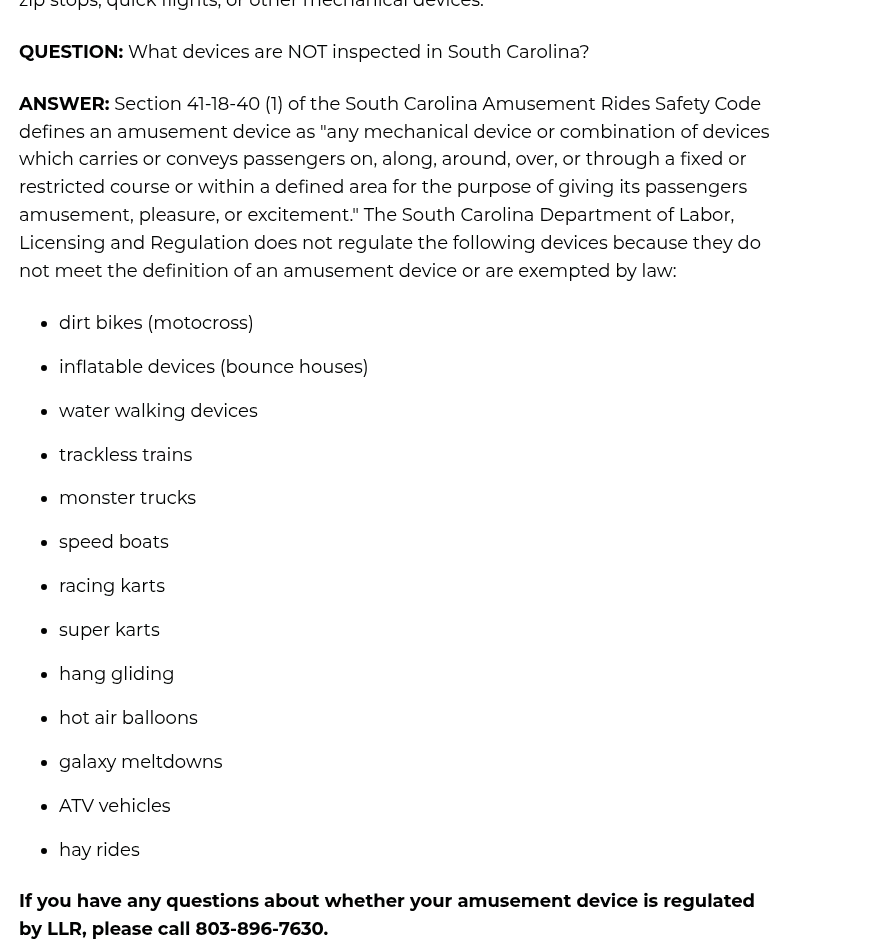
South Carolina, on its face, does not. The South Carolina Amusement Rides Safety Code, at S.C. Code Ann. Section 41-18-40(1), defines an amusement device as "any mechanical device or combination of devices which carries or conveys passengers on, along, around, over, or through a fixed or restricted course or within a defined area for the purpose of giving its passengers amusement, pleasure, or excitement." That definition sets two gates and both have to be cleared: the thing has to be mechanical, and it has to carry or convey passengers. A barricade you crouch behind does neither. The word "inflatable" does not appear anywhere in Chapter 18.
The administering agency reaches the same place directly. The South Carolina Department of Labor, Licensing and Regulation, through its Office of Elevators and Amusement Rides, publishes a list of devices it does not regulate "because they do not meet the definition of an amusement device or are exempted by law", and "inflatable devices (bounce houses)" is on that list. Asked whether it regulates slides, the office answers that it regulates portable slides but "we do not regulate inflatable slides."
State agency guidance
South Carolina's amusement ride regulator quotes the statutory definition, then lists "inflatable devices (bounce houses)" among the equipment it does not regulate because it does not meet that definition. The same page invites operators to call the office directly for a determination.
South Carolina Department of Labor, Licensing and Regulation, Office of Elevators and Amusement Rides, Frequently Asked Questions About Amusement Rides. Retrieved 18 August 2026. llr.sc.gov/elevators/amuseridefaq.aspx
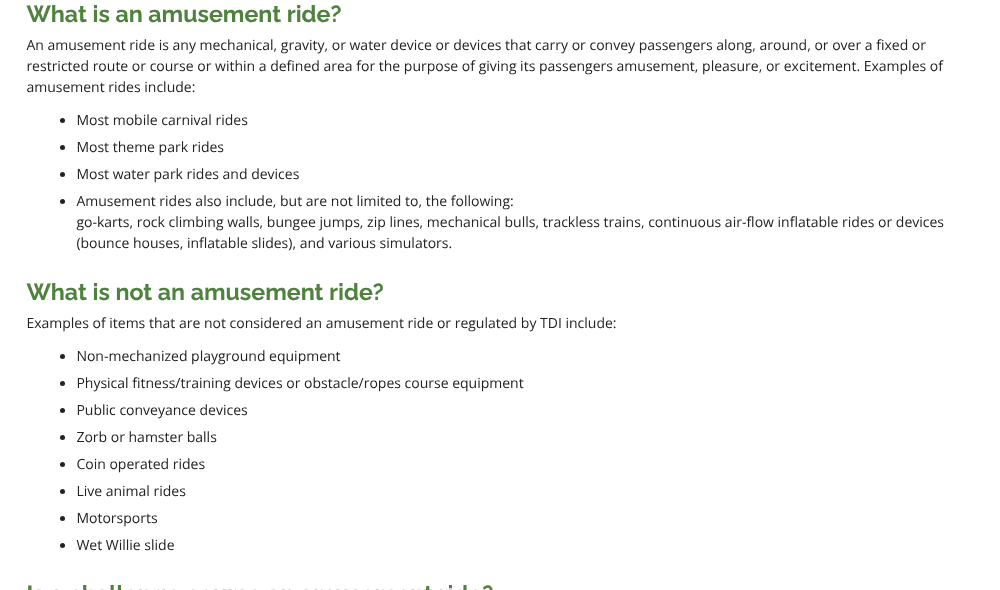
Texas gets to the opposite result. The Texas definition also sounds restrictive, requiring a "mechanical device that carries passengers", but the Texas Department of Insurance lists "continuous air-flow inflatable rides or devices (bounce houses, inflatable slides)" among the amusement rides it regulates, and Texas Occupations Code Section 2151.1012(b) requires the operator of a continuous-airflow inflatable that provides a bouncing surface or creates an enclosed space to carry a combined single limit policy of not less than $1,000,000 per occurrence. That is a statutory floor, not a recommendation.
The same Texas page lists "Physical fitness/training devices or obstacle/ropes course equipment" among items that are not amusement rides, which is where an operator might reasonably think a barricade course lands. That carve-out is conditional rather than automatic: under Section 2151.107, a challenge, ropes, team building or obstacle course sits outside the Act only if it is built and used for educational, team and confidence building, or physical fitness purposes, and only if the operator carries qualifying limits. A course built for entertainment does not qualify.
State agency guidance
Texas puts both halves on one page. Continuous air-flow inflatables including bounce houses are amusement rides it regulates. Obstacle and ropes course equipment is not. A mobile foam dart operator's kit can sit on either side of that line depending on what the inflatable does.
Texas Department of Insurance, Amusement ride FAQ. Last updated 24 March 2025. Retrieved 18 August 2026. tdi.texas.gov/commercial/lcamuseinfo.html
Illinois does not require the argument at all. Under the Amusement Ride and Attraction Safety Act, 430 ILCS 85/2-2, "any inflatable attraction" is its own standalone limb of the definition of amusement ride, with no mechanical requirement and no passenger requirement. The Act then defines an inflatable attraction by four characteristics that apply together: designed for bouncing, climbing, sliding or other forms of interactive play, made of flexible fabric, kept inflated by continuous airflow from one or more blowers, and relying on air pressure to maintain its shape.
So the same barricade is outside the statute in one state, carries a $1,000,000 statutory floor in another, and is named in the definition in a third.
Two honest limits belong on that. Neither South Carolina's statute nor its agency guidance addresses foam dart venues, battle arenas, or inflatable barricades used as cover by name, and we found no South Carolina case law or Attorney General opinion construing the definition against this kind of equipment. The reading above rests on the general definition and the agency's general position on inflatables. If you want a binding answer, the agency's own FAQ gives the route: it invites operators with questions about whether a device is regulated to call the office directly.
The second limit is the one that matters commercially. Falling outside a state's amusement device chapter is not the same as being risk free. It means the state sets no permit, no annual inspection and no statutory insurance floor for that equipment, which leaves your own policy and your landlord's requirements as the only things standing there. In South Carolina, where the permit route would otherwise require proof of insurance of "not less than five hundred thousand dollars for each occurrence", being outside the chapter means nobody is checking that you carry anything at all.
The first thing I ask a mobile operator is what they unload, not what they play. The blasters are rarely the regulated item. The inflatable they set up in somebody else's gym is the one a state has written a rule about, and the rule changes at the state line.
Bobby Sharp, Action Sports Practice Lead, Specialty Insurance
What nerf arena insurance costs
Specialty Insurance already publishes a foam dart venue figure, and it sits in context in our piece on foam dart eye injury coverage. The table below breaks that figure out line by line.
What belongs on this page is the shape of the bill rather than a headline. A foam dart venue does not buy one product at one price. It buys a set of lines, each with its own premium and its own limit, and the mix is what separates a fixed arena from a mobile operator far more than the size of either one does.
2026-2027 premium benchmark
What nerf arena insurance costs, line by line
Typical annual premiums for a foam dart venue, whether it runs a fixed arena, a mobile party operation, or both.
- Priced for
- Fixed foam dart arena or mobile party operator
- Basis
- Annual premium, United States
- Updated
- August 2026
| Coverage | Typical annual range | Monthly estimate | Typical limits |
|---|---|---|---|
| General Liability InsuranceFoundation Third-party bodily injury, property damage and legal defense costs. | $400 to $1,200 | $35 to $100per month | $1,000,000 per occurrence / $2,000,000 aggregate |
| Commercial Property InsuranceFoundation Buildout, netting, barricades and the blaster fleet at a fixed site, plus business income. | $750 to $2,000 | $65 to $170per month | Based on total insurable value |
| Workers' Compensation InsuranceFoundation Employee injury for the marshals, party hosts and front desk staff on payroll. | $200 to $1,000 | $20 to $85per month | Statutory limits by state |
| Inland Marine InsuranceSituational Equipment in transit and off premises, which is where a mobile operator's assets live. | $500 to $1,000 | $45 to $85per month | Scheduled equipment value |
| Excess / Umbrella InsuranceSituational Limits above the primary, for the landlord or venue contract that demands more than $1,000,000. | $250 to $1,000 | $25 to $85per month | Available in $1,000,000 increments |
Most operators do not buy all five. A pro shop selling darts or blasters adds Product Liability Insurance. A venue serving alcohol on premises after five o'clock in South Carolina faces a separate statutory liquor liability minimum under S.C. Code Ann. Section 61-2-145. A venue demanding more than $1,000,000 per occurrence pushes an operator into Excess or Umbrella Insurance. An operator who qualifies for a Business Owners Policy buys General Liability Insurance and Commercial Property Insurance together rather than separately.
Premium ranges supplied by Specialty Insurance underwriting. Updated . Ranges are an indication for budgeting, not a quote or a bindable offer.
Get a 24-hour quoteRating this class on the lines an operator genuinely carries, rather than on a single blended figure, is deliberate. Two operators turning over identical revenue look nothing alike to an underwriter if one runs a fixed site with open play and a party room and the other runs eight birthday bookings a month out of a van.
"Bobby Sharp and the team at Specialty Insurance had a fast turnaround, professional service, and answered every question I had as a brand-new operator. They wrote the policy I'd want defending me if a player ever filed a claim."
Grimnir Tactical LLC
Verified customer review
The name on the door
One exposure at a foam dart venue has nothing to do with darts, and a standard liability policy is the wrong place to look for it.
NERF is a Hasbro trademark, and the registrations are not limited to toys. Hasbro holds a matched pair of live United States service mark registrations in International Class 41, numbers 6463892 and 6463893, both registered on 24 August 2021, covering "providing facilities and equipment for playing recreational activities and games, namely, toy projectile foam dart and ball shooter tag games", along with "theme park and amusement park services" and "entertainment in the nature of an amusement center". That recitation describes a foam dart venue with some precision.
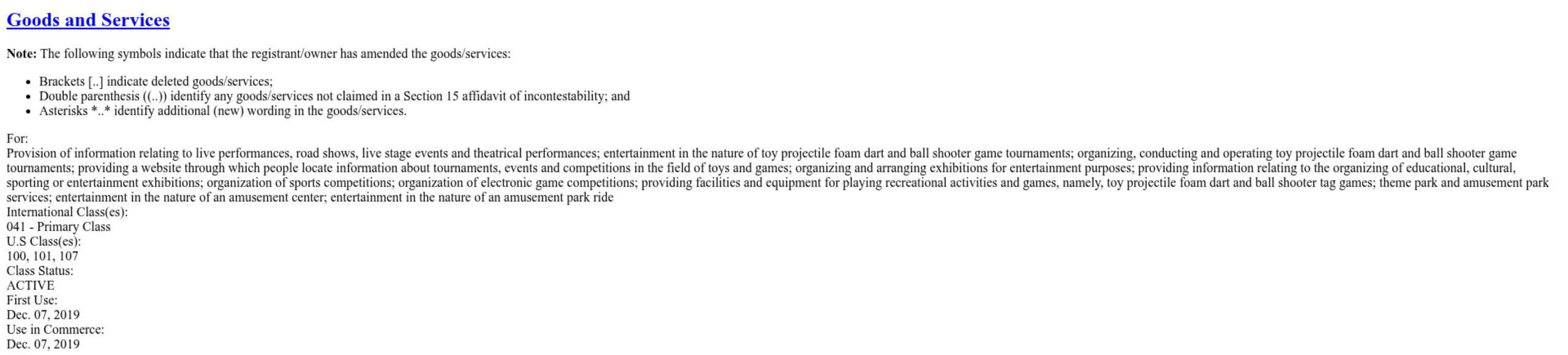
Federal trademark record
The Class 41 recitation on Hasbro's live NERF service mark registration covers "providing facilities and equipment for playing recreational activities and games, namely, toy projectile foam dart and ball shooter tag games" and "entertainment in the nature of an amusement center". Class status is active.
United States Patent and Trademark Office, Trademark Status and Document Retrieval, Registration Number 6463892. Retrieved 18 August 2026. tsdr.uspto.gov/statusview/sn87807416
There is also an officially licensed venue concept. NERF Action Xperience centres are built and run by independent operators under licence from Hasbro rather than by Hasbro directly. A brand licence is a commercial arrangement and nothing more: it does not extend the licensor's insurance to the operator, and a licensed operator still places its own liability and participant cover.
Hasbro polices the mark. It has opposed applications built on the NERF name at the Trademark Trial and Appeal Board three times since 2019, most recently in a proceeding that terminated on 24 June 2026 by default when the applicant did not answer. Those are oppositions to trademark applications rather than actions against venue operators, and we found no record of Hasbro suing or sending a cease and desist to a foam dart venue, party business or mobile operator. The point is not that a demand letter is likely. The point is what happens to the bill if one arrives.
Under the standard commercial general liability form, it lands on you. Coverage B, the personal and advertising injury section, lists the offences it covers, and trademark infringement is not among them: the two intellectual property offences named are the use of another's advertising idea in your advertisement, and infringing upon another's copyright, trade dress or slogan in your advertisement. The form then excludes injury arising out of the infringement of copyright, patent, trademark, trade secret or other intellectual property rights, and carves coverage back only for copyright, trade dress or slogan infringement committed in an advertisement. Trademark is not in the carve-back.
Courts have applied this to exactly this kind of business. In a 2026 decision, a federal court held that a family entertainment venue's general liability insurer owed no defence and no indemnity for service mark infringement claims brought over the venue's trading name, observing that trademarks are excluded whether or not they appear in an advertisement. A 2022 decision reached the same result for a restaurant name dispute.
One nuance is worth stating precisely, because it is easy to get backwards. In a 2021 Texas case the court found that the insured's website and social media pages were advertisements and that Coverage B was triggered, and only then held that the infringement exclusion relieved the insurer of the duty to defend. Coverage B is not unreachable. The exclusion is what does the work. There is also a second, independent barrier for anyone who builds a domain name around someone else's mark, because the same form excludes injury arising out of the unauthorised use of another's name in your email address, domain name or metatag.
Coverage always turns on the policy as issued, and many carriers write their own forms rather than the unmodified standard one. This is general information rather than legal advice. The practical takeaway is narrow and worth acting on: a name change is a business decision, but the cost of defending the name is usually not an insured cost, so the naming decision is cheapest to get right before the signage order goes in.
Adding mobile bookings, a second site, or a pro shop counter? Each one changes the submission. Book a 20-minute coverage review with Specialty Insurance before the change goes live, not at renewal.
Schedule a 20-minute coverage reviewWaivers are a layer, not the roof
Every foam dart venue runs waivers, and most operators believe the waiver is the protection and the policy is the backup. In South Carolina that has it the wrong way round, for a reason most operators have never been told.
South Carolina courts do enforce liability releases, but they do not like them. The rule comes from the South Carolina Supreme Court in Pride v. Southern Bell Telephone and Telegraph Company in 1964: "Since such provisions tend to induce a want of care, they are not favored by the law and will be strictly construed against the party relying thereon." South Carolina appellate courts have repeated that sentence for sixty years.
Strict construction has teeth. In McCune v. Myrtle Beach Indoor Shooting Range, a 2005 paintball case, the Court of Appeals held that an exculpatory clause "will never be construed to exempt a party from liability for his own negligence in the absence of explicit language clearly indicating that such was the intent of the parties." The release in that case was enforced against an adult player who was blinded in one eye after a rented mask failed, which is the closest South Carolina analogue a projectile sport venue has. In Fisher v. Stevens in 2003, the same court refused to enforce a catch-all release covering "any persons in any restricted area", holding the provision too broad to be enforceable.
Now the part that matters for a business whose customers are mostly children. No published South Carolina Supreme Court or Court of Appeals decision appears to have squarely decided whether a parent can sign away a child's right to sue before an injury happens. Every leading South Carolina release case, from Pride in 1964 through McCune in 2005, involves an adult who signed for himself or herself. A South Carolina foam dart venue is relying on a document whose enforceability against its actual customer has never been tested at the appellate level in this state.
Other states have decided it, and they have decided it both ways. New Jersey in 2006, Florida in 2008 and Kentucky in 2019 all refused to enforce a parent's pre-injury release of a minor's claims against a commercial recreational facility. The Kentucky facts could be a foam dart booking: a mother checked a waiver box online before taking her eleven year old and friends to a for-profit trampoline park. Massachusetts upheld a parental release in 2002, and Maryland upheld one for a retailer's supervised children's play area in 2013. Legislatures have moved the line too, and South Carolina has passed no equivalent statute.
Two South Carolina rules make the exposure concrete. Under S.C. Code Ann. Section 62-5-433, a parent or guardian can settle a minor's claim without court approval only up to two thousand five hundred dollars, and a settlement above twenty-five thousand dollars must be approved by the circuit court. If a South Carolina parent cannot fully settle a child's claim after an injury without a judge signing off, an operator should not assume a form signed at the front desk beforehand will do more. And under Section 15-3-40, the limitations clock does not run against a child while they are under eighteen. A child hurt at a party this weekend can still be a claimant years from now, long after the waiver, the staff roster and the incident report have been filed somewhere nobody remembers.
None of that makes waivers useless. They set expectations, they document the briefing, and they are the first thing a defence lawyer asks for. They are one layer. The layer underneath them is the policy.
How to buy it, in the right order
- Decide which business you are. Fixed, mobile, or both. Write it down before you call anyone, because every other answer follows from it.
- Get the activity described correctly on the submission. Read the activity description on the quote when it comes back. If it says bounce house, laser tag or party rental, the carrier is rating a different risk and putting your name on it.
- Confirm in writing that participant liability sits on the policy, and read the exclusions before the coverages. This is the line a generalist quote is least likely to reach, and it is the exposure your floor generates every session.
- Inventory your inflatables and check your own state. If you cross state lines, check every state you set up in, not just the one you are registered in.
- Schedule the kit before it travels, not after the first booking. A property policy stops at the property line.
- Settle the vehicle question before the first drive. If the van is personal, assume the personal policy excludes the business use and fix it.
- Set limits against the largest venue you want to serve, not the smallest. If a school district or a municipality wants more than $1,000,000 per occurrence, a $1,000,000 policy is a decision not to serve them.
- Get the name cleared before the signage order. It is the cheapest item on this list to fix in advance and one of the most expensive to fix afterwards.
If you are still deciding what the programme should look like, our nerf arena insurance page sets out what Specialty Insurance can bind for a foam dart venue in all 50 states.
Frequently Asked Questions
Does a nerf arena need its own insurance policy, or will a general business policy cover it?
A general business policy rarely covers it as sold. The recurring failure is that the people most likely to be injured at a foam dart venue are the paying participants, and a liability form written for a retail or premises risk is the document least likely to reach them. A foam dart venue needs general liability with participant liability written for the activity, and a mobile operator needs inland marine and a commercial auto answer alongside it.
Do inflatable barricades at a nerf arena count as amusement rides?
It depends entirely on the state, and the answers are genuinely opposite. South Carolina defines an amusement device as a mechanical device that carries or conveys passengers, and the Department of Labor, Licensing and Regulation lists inflatable devices among equipment it does not regulate. Texas regulates continuous-airflow inflatables as Class B rides and sets a statutory minimum of $1,000,000 per occurrence for them. Illinois names any inflatable attraction as its own limb of the amusement ride definition. Check the state you set up in, and confirm with that state's programme rather than assuming.
How much does nerf arena insurance cost?
It depends on which lines you carry and whether you run a fixed arena, a mobile operation or both, which is why the table above prices each coverage separately rather than quoting one blended figure. Be careful with the numbers circulating online: one widely republished band of $400 to $1,100 a year is applied by its publisher to laser tag, paintball and axe throwing venues as well, and has not changed since 2019.
Can I be sued over my venue's name if I use a trademarked brand, and would my insurance defend me?
Hasbro holds live Class 41 service mark registrations covering facilities and equipment for foam dart tag games and amusement centre services, and it does oppose trademark applications built on the NERF name. On the insurance question, the standard commercial general liability form does not list trademark infringement among the offences Coverage B covers, and it separately excludes infringement of trademark while carving coverage back only for copyright, trade dress or slogan in an advertisement. Federal courts have applied that exclusion to a family entertainment venue sued over its trading name. Coverage turns on the policy as issued, so send any demand letter to your broker and carrier immediately.
Does a parent's waiver protect my venue if a child is hurt?
Not as much as most operators assume, and in South Carolina the question is open. No published South Carolina appellate decision appears to have decided whether a parent can release a child's claims before an injury. Other states have split on it, with New Jersey, Florida and Kentucky refusing to enforce such waivers against minors and Massachusetts and Maryland enforcing them. South Carolina also limits what a parent can settle after an injury without court approval, and the limitations clock does not run while the child is under eighteen. Treat the waiver as one layer and the policy as the layer underneath it.
What is different about insuring a mobile nerf party business versus a fixed arena?
The fixed arena's exposures are premises exposures: the lease, the buildout, property and business income. The mobile operator's exposures travel: equipment in transit needs inland marine, the vehicle needs a commercial auto answer because personal auto policies exclude business use, and every booking happens under a third party's insurance requirements. Some states also treat mobile operation differently in statute, so the same equipment can carry different obligations once it moves.
Sources
- South Carolina Amusement Rides Safety Code, S.C. Code Ann. Title 41, Chapter 18, Sections 41-18-40(1) and 41-18-90. scstatehouse.gov. Retrieved 18 August 2026.
- South Carolina Department of Labor, Licensing and Regulation, Office of Elevators and Amusement Rides, Frequently Asked Questions About Amusement Rides. llr.sc.gov. Retrieved 18 August 2026.
- Texas Department of Insurance, Amusement ride FAQ. Last updated 24 March 2025. tdi.texas.gov. Retrieved 18 August 2026.
- Texas Occupations Code, Chapter 2151, Sections 2151.002, 2151.107 and 2151.1012. statutes.capitol.texas.gov. Retrieved 18 August 2026.
- Illinois Amusement Ride and Attraction Safety Act, 430 ILCS 85/2-2. ilga.gov. Retrieved 18 August 2026.
- United States Patent and Trademark Office, Trademark Status and Document Retrieval, Registration Numbers 6463892 and 6463893. tsdr.uspto.gov. Retrieved 18 August 2026.
- Pride v. Southern Bell Telephone and Telegraph Co., 244 S.C. 615, 138 S.E.2d 155 (1964).
- Fisher v. Stevens, 355 S.C. 290, 584 S.E.2d 149 (Ct. App. 2003).
- McCune v. Myrtle Beach Indoor Shooting Range, Inc., 364 S.C. 242, 612 S.E.2d 462 (Ct. App. 2005).
- Hojnowski v. Vans Skate Park, 187 N.J. 323, 901 A.2d 381 (2006); Kirton v. Fields, 997 So. 2d 349 (Fla. 2008); Miller v. House of Boom Kentucky, LLC, 575 S.W.3d 656 (Ky. 2019); Sharon v. City of Newton, 437 Mass. 99, 769 N.E.2d 738 (2002); BJ's Wholesale Club, Inc. v. Rosen, 435 Md. 714, 80 A.3d 345 (2013).
- S.C. Code Ann. Sections 62-5-433, 15-3-40 and 61-2-145.