
A gel blaster looks like a toy, and that is the most expensive thing about it. In 2026 the same device is three things at once, depending on who is looking. To the Consumer Product Safety Commission it is a toy or it is not, and the answer turns on who you market it to. To California and New York it may be an imitation firearm, with the answer turning on its colour and its barrel. To the fair that just accepted your vendor application it may be a prohibited projectile device, with the answer sitting in a contract nobody reads until load-in.
Your insurance has to satisfy whichever of those three is looking at you that week. That is a different problem from the one most operators bring to an agent, which is "how much for a gel blaster policy", and it is the reason a cheap quote and a workable programme are so rarely the same thing in this vertical.
This guide covers what a gel blaster business puts on the policy, what the venue demands before it lets you set up, and the order to buy the coverages in. It is written for all three of the businesses that call themselves gel blaster operators, because they do not buy the same policy. If you are still settling what the device is and how it differs from airsoft, our explainer on what a gel blaster is is the place to start.
Three gel blaster businesses, and they do not buy the same policy
The device is the same. The risk is not, and the certificate the customer asks for is not either.
The fixed arena runs a leased site: a soft-barrier course, open play sessions, party packages, usually a retail counter. Its problem is a premises problem. Fire, theft, tenant improvements, a lease with an indemnity clause, business income if the roof fails in July, and a landlord with an opinion about the certificate.
The mobile party rental loads a van and goes to the customer. Back gardens, church halls, school field days, corporate away days. Its problem is that every booking happens on somebody else's property under somebody else's rules, and a large share of those somebodies will not let the van through the gate until a document is in their hands. Specialty Insurance covers that buyer in depth in our guide to gel blaster party rental insurance, so this guide does not repeat it.
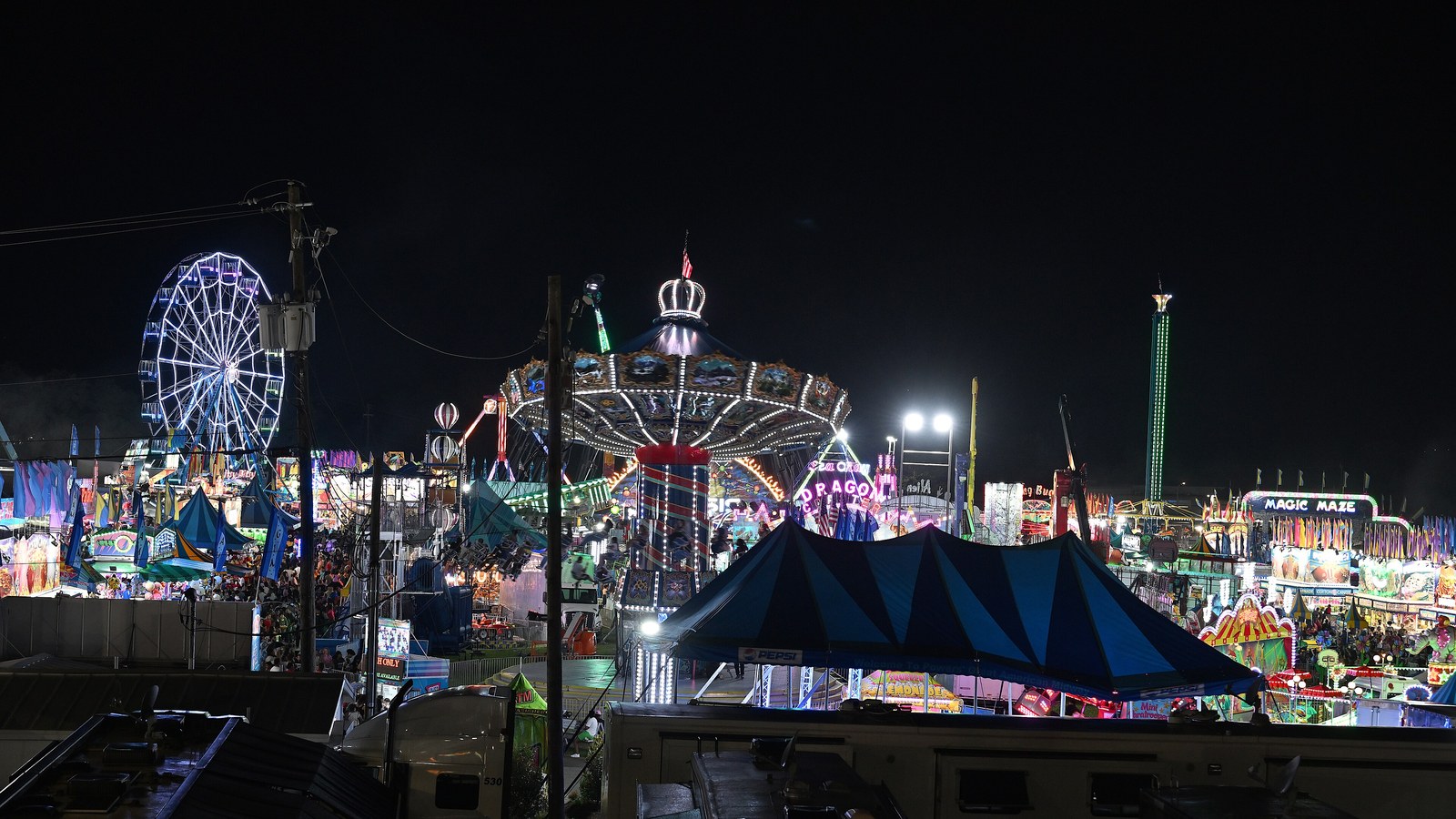
The traveling fair operator runs a route: state fairs, county fairs, festivals, a midway booth for ten days at a time, then a drive to the next state. Its problem is that it is simultaneously a premises risk, a mobile risk and a motor carrier, and that every stop on the route rewrites the certificate. This is the buyer almost nobody in the insurance market writes about, and it is where most of what follows is aimed.
| Fixed arena | Mobile party rental | Traveling fair operator | |
|---|---|---|---|
| Where the risk sits | The building and the people in it | The booking and the drive to it | The route, the rig and ten different contracts |
| Who sets the insurance terms | The landlord, once, at lease signing | Each venue, per booking | Each fair authority, per stop, with different wording |
| The line most often missing | Business income | Participant injury | Owned commercial auto |
| What stops the job | A lease that will not sign | A certificate that arrives late | A certificate that is the wrong shape entirely |
Plenty of operators are two of these at once, and a large number arrive at gel blaster as a second activity bolted onto an existing book: bounce house companies, laser tag arenas, foam dart venues, family entertainment centres. If that is you, the first question is not what a gel blaster policy costs. It is whether your current policy picked up the new activity at all, and whether anyone told the carrier. It is not automatic, and it needs to be added.
The coverages a gel blaster business buys
Eight lines do the work. Not all eight apply to every operator, and the three business models weight them very differently.
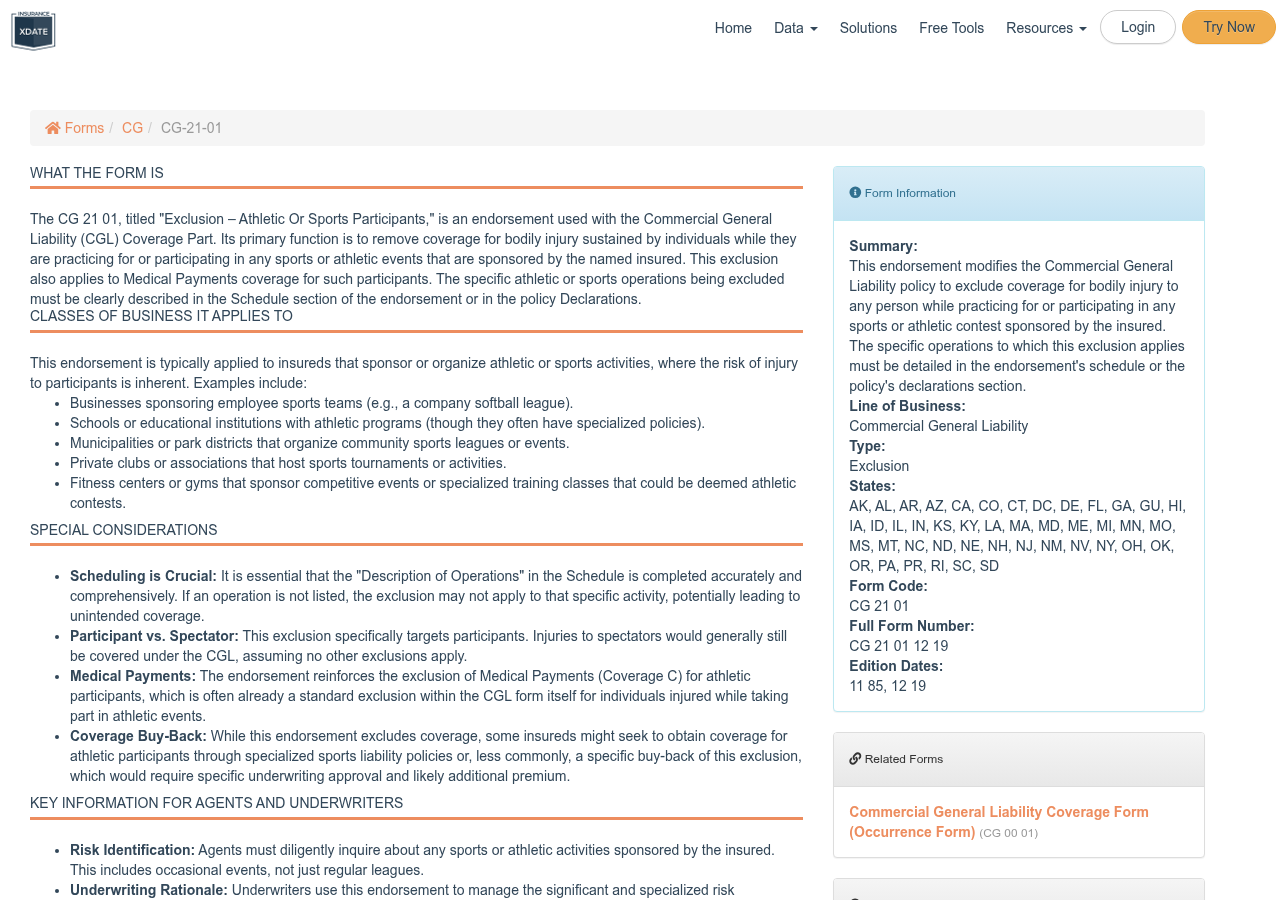
General liability with participant injury is the foundation, and the participant half is the whole argument. A standard commercial general liability form can carry an athletic or sports participants exclusion, ISO form CG 21 01, which removes bodily injury to anyone practising for or taking part in the sports or athletic contest the policy covers. Buy general liability without checking that line and you have bought coverage for the spectator, the car park and the caterer, and nothing at all for the twelve year old who took a gel bead to the eye. That is the single most expensive misunderstanding in this vertical, and it is why participant injury sits alongside general liability rather than inside it.
Source 1 of 5 · Standard ISO exclusion form
ISO form CG 21 01 removes bodily injury to any person practising for or taking part in the sports or athletic contest the policy covers. Attached to a gel blaster general liability policy, it is the players themselves who fall outside the cover.
Our breakdown of the gaps in a generalist general liability policy walks the same exclusion through a claim, in a different sport with the same form attached.
Participant accident is a different product from participant injury, even though the names sit next to each other, and venues ask for them separately. California State University, Long Beach tells facility renters running athletic activities to show that the general liability policy covers injuries to athletic participants and to provide evidence of participant accident insurance. Quote a university or a school and expect to be asked for both, and expect a generalist agent to supply one and call it finished.
Product liability is the line operators do not expect to need until they sell something. The moment a blaster or a tub of gel beads leaves in a customer's hand, the exposure continues after teardown, and fairs price it directly: the Arizona State Fair asks vendors for a $1,000,000 products and completed operations aggregate as a named sublimit.
Inland marine covers the kit while it moves. A fixed-location property policy stops at the property line, and a mobile or traveling operator's entire asset base spends its working life in a vehicle, a car park or a fairground service lane. This is also the line that answers a question the auto policy cannot, and the next section but one explains why.
Commercial auto decides whether the drive is covered, and for a traveling operator it decides whether the contract can be signed at all. It gets its own section below, because the fair contract asks for something most mobile operators do not own.
Commercial property and business income belong to the arena, and the second half gets forgotten. A leased site with published trading hours and a booked party diary has an income stream that stops when the site does.
Workers' compensation is the one line a statute puts on you rather than a contract. Fairs check it directly. The Wisconsin State Fair requires a certificate of workers' compensation insurance from every vendor with paid employees, and says so including family members, which is precisely the family-run operator who assumed the rule was written for somebody bigger.
Excess or umbrella is not a luxury on a fair route. The Florida State Fair escalates high-risk licensees to a commercial umbrella of not less than $5,000,000 per occurrence and $5,000,000 annual aggregate, and California's fair requirements run to $5,000,000 combined single limits per occurrence for fairtime carnival rides. An operator sitting at $1,000,000 per occurrence is not underinsured on those contracts so much as ineligible for them.
One more belongs in the conversation without being a policy of its own. Abuse and molestation cover is written by endorsement, not granted in a base liability form, and youth-serving venues have started policing it directly: California State University, Long Beach requires a policy of no less than $1,000,000 per occurrence where the work includes contact with under-18s and the general liability policy is not endorsed to cover it. A business whose core product is children's parties should know which of those two situations it is in.
Operators ask me what a gel blaster policy costs before they tell me which of the three businesses they run. An arena, a party van and a fair route are three different risks with one product in the middle. The classification moves the premium far more than any discount does.
Bobby Sharp, Action Sports Practice Lead, Specialty Insurance
What the federal rules say about the product you rent and sell
Three federal questions come up in this vertical, and two of them are usually answered wrong.
The water bead rule is real, and it is narrower than the alarm around it. The Consumer Product Safety Commission's final rule, "Safety Standard for Toys: Requirements for Water Beads", was published on 12 December 2025 at 90 FR 57820 and took effect on 12 March 2026. It reaches toys, and the Commission drew the boundary in its own words: "Water bead guns that are designed, manufactured, and marketed to adults (i.e., marketed for ages 14+ years old) for use in activities similar to paintball or air soft are outside the scope of this rule because they are not toys as defined by ASTM F963." An arena blaster marketed to adults is not swept into the toy standard.
The flip side is written just as plainly. Water bead guns "designed, manufactured, or marketed for children younger than age 14 ... are within the scope of the rule and subject to its requirements." That line is aimed straight at the party-rental fleet and the kids' midway booth.
Here is the part almost nobody has reported, and it is the one with a task attached. The test is marketing, and the Commission says it polices marketing: "CPSC assesses product packaging and marketing materials to determine whether certain water bead products are marketed for ages 14+ years old ... If CPSC finds water bead products that include images of children and other fun descriptive language, CPSC may determine those water bead products are toys within scope of the rule." An operator who labels the blasters 14+ and then fills the feed with photographs of eight year olds in the arena has, by the Commission's own stated test, undercut the position that keeps the product out of scope. Confirm with your supplier in writing which side of the line your stock sits on, keep the answer, and make sure your own marketing does not contradict it.
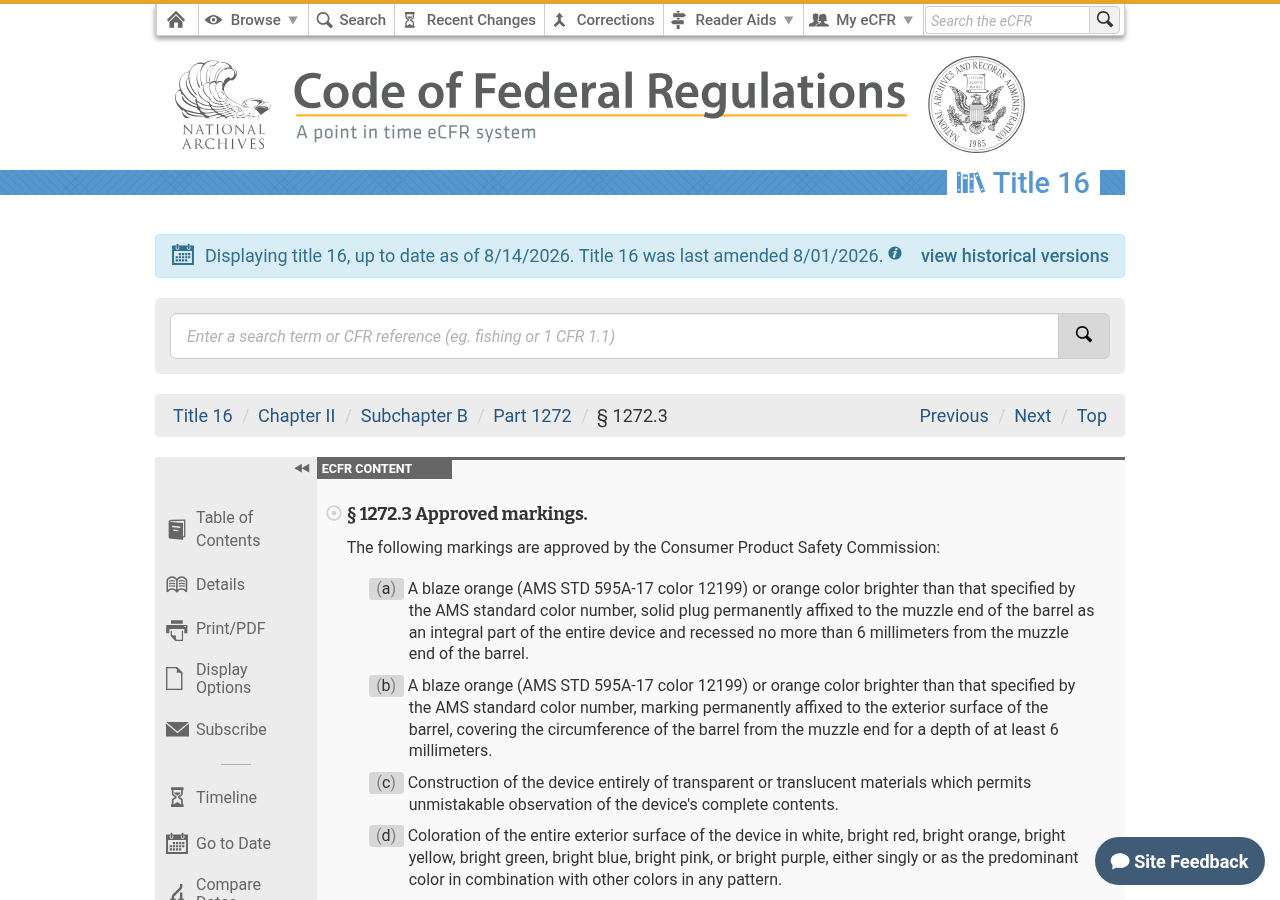
The orange tip is a myth in the form most operators repeat it. Federal marking of toy, look-alike and imitation firearms sits at 16 CFR part 1272, and enforcement moved from the Department of Commerce to the Consumer Product Safety Commission under Public Law 117-167 in August 2022. The rule approves four alternative markings, not one: a blaze orange recessed muzzle plug, an orange band around the barrel at least 6 millimetres deep, wholly transparent or translucent construction, or "coloration of the entire exterior surface of the device in white, bright red, bright orange, bright yellow, bright green, bright blue, bright pink, or bright purple". A blaster coloured bright orange from end to end complies without any plug at all. The part also carves out traditional B-B, paint-ball and pellet-firing air guns as described in ASTM F589-85, a carve-out keyed to those three named categories, which do not include gel blasters by name. Where a specific model falls is a question for its manufacturer, not something to guess at from a blog.
Source 2 of 5 · Federal marking regulation
The federal rule approves four alternative markings, not a single orange tip. A device coloured bright orange, yellow, green, blue, pink or purple over its entire exterior surface complies without any muzzle plug at all.
Recalls reach rental fleets, and they do not clear quickly. In October 2022 the Commission announced the recall of about 62,700 Gel Blaster SURGE 1.0 units because "the lithium-ion battery pack inside the handle can overheat and ignite, posing a fire hazard", after 30 reports of smoking or fire and no reported injuries. The remedy was a refund. By the Commission's own monthly progress data as at 15 September 2025, 193 of those 62,720 units had been corrected, a rate near a third of one percent. Separately, in December 2024 the Commission warned consumers to stop using an imported electric gel ball blaster sold on a major marketplace because it failed the federal projectile toy regulations such that "the projectile's impact can injure a child's eye", and issued a notice of violation to a seller who did not respond to the request for a recall. A rental fleet is a fleet of consumer products, and a charging bench full of lithium packs in a trailer is a property exposure as much as a liability one.
Where the device itself is restricted
The device is legal to own almost everywhere and regulated in ways that catch commercial operators specifically. Three layers matter, and they have to be checked in order.
State imitation firearm law. California runs the most detailed scheme in the country, and it is routinely misdescribed. Penal Code 20150 does not ban selling or owning anything: it makes it a misdemeanour to change, alter, remove or obliterate "any coloration or markings that are required by any applicable state or federal law or regulation" in a way that makes the device "look more like a firearm", and it expressly does not apply to manufacturers, importers or distributors. Its only carve-out is for theatrical productions. The commercial rule sits at Penal Code 20165, which exposes a person who deals in imitation firearms for commercial purposes to a civil fine of up to $10,000 per violation unless the activity is one of five authorised purposes, one of which is "For use in a certified or regulated sporting event or competition". Public display sits at 20170, which reaches parks, parking lots and any "building open to the general public, including one that serves food or drink, or provides entertainment", with thirteen exemptions at 20175 including subdivision (g) for use "at a fair, exhibition, exposition, or other similar activity for which a permit has been obtained from a local or state government". California also says the federal marking is not enough on its own: "Merely having an orange tip as provided in federal law and regulations does not satisfy this requirement. The entire surface must be colored or transparent or translucent."
New York is structured the other way round and is stricter on paper. General Business Law article 39-B defines an imitation weapon at section 871 through a conjunctive test, so a device escapes the definition only if it satisfies every condition, including a barrel "closed for a distance of not less than one-half inch from the front-end of its barrel with the same material of which the imitation weapon is made, unless it is a water gun". Section 872 then prohibits importing, manufacturing, selling, holding for sale and distributing, and allows exactly two purposes: onward interstate transportation, and lawful use in a theatrical production. There is no sporting-event exemption and no fair exemption in section 872. New York City goes further again at Administrative Code 10-131(g), which reaches possession and use as well as sale, sets civil penalties from $1,000 to $5,000 for a first offence with each device counted separately, and allows the department to seal the premises for up to five days after three or more violations in two years.
Municipal ordinance. This is the layer operators skip, and it is moving. The City of Fairfield, Ohio, in a 2025 parks and recreation resolution, names the device outright, prohibiting any person from possessing or discharging a "firearm, deadly weapon, dangerous ordinance, air rifle, sling shot, BB gun, pellet gun, paint gun, air soft gun, gel blaster gun, or missile throwing device" in any park or recreation site without written permission from the Director. The Borough of Magnolia, New Jersey adopted an ordinance in June 2026 addressing airsoft guns, gel blasters and BB guns in municipal parks, and separately banned "frozen projectiles, modified ammunition, metal pellets, hardened gel pellets, or any altered projectile designed to increase pain, injury, or physical impact". If your business model is running games in public parks, that is the layer that decides whether you have a business in that town.
The venue contract, which outranks both in practice. The Ohio State Fair vendor manual prohibits the sale, display, possession or distribution of a long list of projectile devices, including air soft weapons, slingshots, pea shooters, high pressure water guns and rubber band guns, and closes with a catch-all reaching any other device designed to launch or propel any type of projectile. A gel blaster attraction does not need to be named to be caught by a sentence like that. Read the vendor manual before you pay the application fee, not after.
I read the vendor manual before I read the insurance sheet. The sheet tells you what limits to carry. The manual tells you whether your attraction is allowed on the midway at all, and I have watched an operator clear every limit on the certificate and still get turned away at load-in.
Bobby Sharp, Action Sports Practice Lead, Specialty Insurance
The vehicle is the business, and the certificate knows it
For a traveling operator this is the section that matters most, and it is the one no competing page covers.
Start with how a commercial auto policy decides what it covers. Under the ISO Business Auto Coverage Form, the numbered symbols entered next to each coverage in the declarations "designate the only 'autos' that are covered 'autos'" for that coverage, and they are set coverage by coverage rather than once for the whole policy. Symbol 1 is any auto. Symbol 2 is owned autos only. Symbol 7 is specifically described autos. Symbol 8 is hired autos only. Symbol 9 is non-owned autos only, which is where an employee's own car sits.
A trailer is an auto under that form, because the definition of "auto" expressly includes a trailer or semitrailer designed for travel on public roads. Two details then decide whether your trailer is genuinely covered. Trailers with a registered gross vehicle weight rating of 3,000 pounds or less are picked up automatically, but the form is explicit that this applies for liability coverage only. Physical damage on the trailer needs it scheduled and rated. And physical damage coverage is written as a promise to "pay for 'loss' to a covered 'auto' or its equipment", which contains no coverage at all for the property being carried inside it. The blasters, hoppers, chargers, netting and inflatable barriers in the trailer are insured under inland marine, not under the auto policy. That is the single most common gap in a traveling operator's programme.
A personal auto policy will not fill it either. The ISO-style personal policy carries a business-use exclusion at A.7, barring use of a vehicle while the insured is engaged in any business other than farming or ranching, and it carves out private passenger autos, pickups, vans and trailers used with them. That carve-out is why an operator towing a small trailer behind a personal pickup may still find cover, and why the same operator who upgrades to a box truck has none.
Now the part that stops contracts. The California Fair Services Authority insurance requirements, used across California's district agricultural associations and county fairs, ask for commercial automobile liability "at least as broad as the current ISO policy form #CA 0001, Symbol #1 (Any Auto) with limits of not less than $1,000,000 combined single limits per accident for contracts involving use of contractor vehicles (autos, trucks or other licensed vehicles) on fairgrounds."
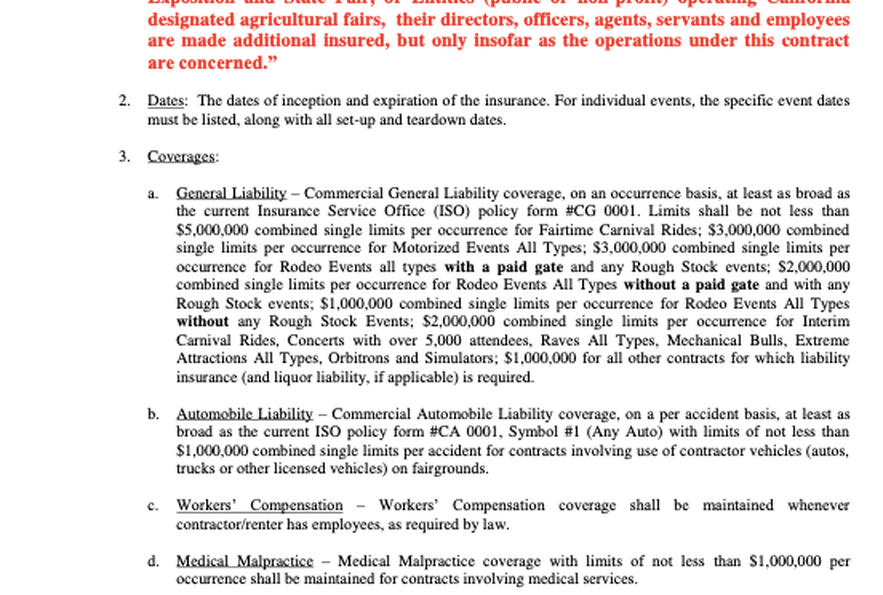
Source 3 of 5 · Fair contract insurance requirement
The automobile clause asks for coverage at least as broad as ISO form CA 0001, Symbol #1 (Any Auto), at $1,000,000 combined single limits. A hired and non-owned policy is written to symbols 8 and 9 and cannot meet it at any limit.
Read that against the symbol list above. A hired and non-owned auto policy is symbols 8 and 9. It cannot satisfy a requirement written to symbol 1, and no amount of raising the limit will make it satisfy it, because the objection is to the shape of the coverage rather than to its size. An operator who has run for years on hired and non-owned auto, correctly and cheaply, will be turned away at that gate. This is the concrete reason a traveling gel blaster business needs owned commercial auto with the trailer scheduled on the same fleet, and it is worth solving in February rather than at load-in.
Two federal points round it out, and both are commonly overstated. Crossing state lines with your own equipment can bring you inside the Federal Motor Carrier Safety Regulations: 49 CFR 390.5 defines a commercial motor vehicle at a gross vehicle weight rating or gross combination weight rating of 10,001 pounds or more used in interstate commerce, and 49 CFR 390.19T requires a carrier operating in interstate commerce to file form MCS-150 and obtain a USDOT number before it begins operations. Note also that the definition of interstate commerce reaches a trip between two places in one state where it forms part of a journey originating or terminating outside it, so "this leg never left the state" is not the test.
What does not follow is the $750,000 figure operators hear about. That minimum sits in 49 CFR 387, and 387.3(a) confines that subpart to for-hire motor carriers transporting property. An operator hauling its own gel blaster equipment to its own booking is a private motor carrier, and the federal financial responsibility minimum is not the number it has to hit. The number it has to hit is the one in the fair contract. Likewise, a commercial driver's licence is a separate and much higher threshold: 49 CFR 383.5 puts a group A combination vehicle at 26,001 pounds or more, not 10,001.
What a fair asks for before it lets you set up
Fair requirements are not standard, they are not close to standard, and the differences are the kind that get a certificate rejected on the day. These are published requirements, retrieved and verified in August 2026.
| Fair | Published general liability requirement | The detail that catches operators |
|---|---|---|
| Arizona State Fair | $1,000,000 general liability with no less than $2,000,000 aggregate, plus $1,000,000 products and completed operations aggregate and $1,000,000 combined single limit business auto | A.M. Best rating floor of A- VII, waiver of subrogation in favour of the State of Arizona, coverage must be primary, and 30 days notice of cancellation. Subcontractors must be insured under your policy or produce their own certificates at the same limits |
| Wisconsin State Fair | Minimum $1,000,000 general liability | Policy dates must run a minimum of 20 July to 20 August, the additional insured wording must appear in the description of operations box, and workers' compensation is required from any vendor with paid employees including family members |
| Ohio State Fair | $1,000,000 general aggregate | Certificate due by 1 July with the State of Ohio as additional insured covering setup and teardown, and the vendor manual separately prohibits projectile devices with a catch-all clause |
| Iowa State Fair | Minimum $1,000,000 per occurrence | Certificate by 15 July with prescribed wording naming the State of Iowa and the Iowa State Fair Authority, and the vendor carries responsibility for securing its own state business permits |
| Kansas State Fair | $1,000,000 each occurrence and $1,000,000 product liability | Declarations pages and renewal statements are refused, the named insured must match the exhibitor contract including any DBA or LLC, and the policy must cover the full ten day fair |
| Florida State Fair | $1,000,000 each occurrence, $2,000,000 general aggregate, $1,000,000 products and completed operations | High-risk licensees are escalated to a commercial umbrella of not less than $5,000,000 per occurrence and $5,000,000 annual aggregate |
| California district and county fairs | Tiered by activity, from $1,000,000 to $5,000,000 combined single limits per occurrence | Commercial auto must be as broad as ISO CA 0001 symbol 1, exclusions and sub-limits must be listed on the certificate, self-insured retentions of $100,000 or more must be disclosed, and executed participant waivers go to the fair at the end of the rental |
| Minnesota State Fair | Licensees are covered under the fair's own master group policy unless they fall on an excluded list | If you are excluded, you supply your own certificate naming the fair as additional insured for the full run, so the first question is which list you are on |
Three patterns are worth pulling out of that table.
The additional insured string is not one name. California's requirements ask a vendor to name the State of California, the California Fair Services Authority, the district agricultural association, the county fair, the county the fair sits in, the lessor or sublessor if the site is leased, and more, all in prescribed wording. One California fair adds the City of Los Angeles Department of Water and Power to that list. A certificate naming "the fair" will be rejected, and being listed as certificate holder is not the same as being named an additional insured.

Source 4 of 5 · State fair vendor requirement
Wisconsin sets the policy dates as well as the limit, requires the additional insured wording to sit in the description of operations box, and asks for workers' compensation from any vendor with paid employees including family members.
The deadlines are earlier than the fair. Ohio wants the certificate by 1 July, Iowa by 15 July, and Wisconsin wants policy dates that already run from 20 July. An operator who books three fairs in three states in one season is managing three different certificate deadlines, three sets of wording and three carrier rating floors, before the first gate opens. Our walkthrough of the certificate a city park demands covers the additional insured distinction in a smaller setting.
The fair can price you out or rule you out. Florida's umbrella escalation and California's tiering both mean the limit is set by how the fair classifies your attraction, not by how you describe it. Ask which classification you have been given before you sign, because it decides your premium and, occasionally, your eligibility.
"Specialty Insurance diligently takes their time and works with you, making sure your business has all the correct and specific coverages you need. There is no other source out there that does what they do for the airsoft and paintball industries."
Gel Tag San Diego LLC
Verified customer review
What gel blaster insurance costs
Specialty Insurance prices a gel blaster programme line by line rather than as one bundled number. General liability, the line every operator buys, runs $500 to $1,500 a year. The other priced lines sit between $200 and $2,000 each, depending on payroll, on the value of the kit and on whether there is a building to insure. The table below sets out all five, and they are not added together, because almost nobody buys all of them.
Three coverages this guide argues for are quoted case by case rather than to a published range, so they carry no figure here: participant injury, commercial auto and product liability. Ask for them by name. The GellyBall figures elsewhere on this site are for a related but separately classed product, and our GellyBall and gel blaster cost guide is the right place for the mobile party business number.
What can be said now is what drives the number, and in this vertical the drivers are unusually legible:
- Which of the three businesses you are. A fixed arena is rated on premises and attendance. A mobile operator is rated on bookings and equipment value. A traveling fair operator is rated on both, plus a fleet.
- Whether you own vehicles. Moving from hired and non-owned auto to an owned fleet with scheduled trailers is the largest single step-up on a traveling programme, and the fair contracts above are what force it.
- Whether you sell as well as rent. Resale of blasters and gel beads brings products and completed operations forward from a background exposure to a rated one.
- Who the players are. A venue whose customers are mostly under 14 attracts the abuse and molestation question, the participant accident question and the toy-standard question all at once.
- What limits your contracts demand. A route that includes a Florida high-risk classification or a California carnival tier is buying a $5,000,000 umbrella whether or not the exposure changed.
2026-2027 premium benchmark
What gel blaster insurance costs, line by line
Typical annual premiums for a United States gel blaster operator, whether a fixed arena, a mobile party rental or a traveling fair booth.
- Priced for
- Arena, mobile party rental and traveling fair operators
- Basis
- Annual premium, United States
- Updated
- August 2026
| Coverage | Typical annual range | Typical limits |
|---|---|---|
| General Liability InsuranceFoundation Third-party bodily injury, property damage, and legal defense costs. | $500 to $1,500 | $1,000,000 per occurrence / $2,000,000 aggregate |
| Inland Marine InsuranceFoundation Blasters, hoppers, chargers, netting and barriers while they travel and while they sit at a booking. | $500 to $1,000 | Scheduled to replacement value of the travelling kit |
| Commercial Property InsuranceSituational Building, contents, tenant improvements and business income at a fixed arena. | $750 to $2,000 | Based on total insurable value |
| Workers' Compensation InsuranceFoundation Statutory once you have employees, and fairs check the certificate directly. | $200 to $1,000 | Statutory, plus employers liability |
| Excess / Umbrella InsuranceSituational Limits above the primary, which fair contracts can force to $5,000,000. | $250 to $1,000 | Available in $1,000,000 increments |
Almost nobody buys all five lines, which is why these rows are not added into a programme total: a fixed arena rarely needs inland marine on a travelling kit, and a mobile operator rarely needs business income. Three coverages this guide argues for are deliberately not priced above, because Specialty Insurance quotes them case by case rather than to a published range: participant injury, which is where the athletic participants exclusion is answered; commercial auto, which is what a California fair contract tests when it asks for Symbol 1 Any Auto; and product liability, which follows whatever you sell across the counter. Ask for all three by name on the quote.
Premium ranges per the Specialty Insurance book, confirmed by Specialty Insurance underwriting in August 2026. Updated . Ranges are an indication for budgeting, not a quote or a bindable offer.
Get a 24-hour quoteRating gel blaster on business model rather than on revenue is deliberate. Two operators turning over the same money look nothing alike to an underwriter if one runs a fixed arena with open play and the other tows a booth between four state fairs.
The safety file that decides your premium
Underwriters price what you can document. In this vertical, for the first time, there is a published standard to document against.
Gel blaster venues now have their own ASTM operating standard. ASTM F3760-25, "Standard Practice for Hydrogel Projectile Launcher Field Operation", is an active standard published in May 2025, and its scope establishes minimum safety requirements for the operation of hydrogel projectile launcher playing fields. It sits with two companions, ASTM F3741-24 for the launchers and ASTM F3730-24 for the projectiles. "Hydrogel projectile launcher" is ASTM's formal term for a gel blaster. Paintball has had F1777 for years and airsoft has F2940, and operators in those sports have long used them as the backbone of an underwriting file. Gel blaster operators can now do the same, and an operator who has never heard of F3760 is at a disadvantage against one who has.
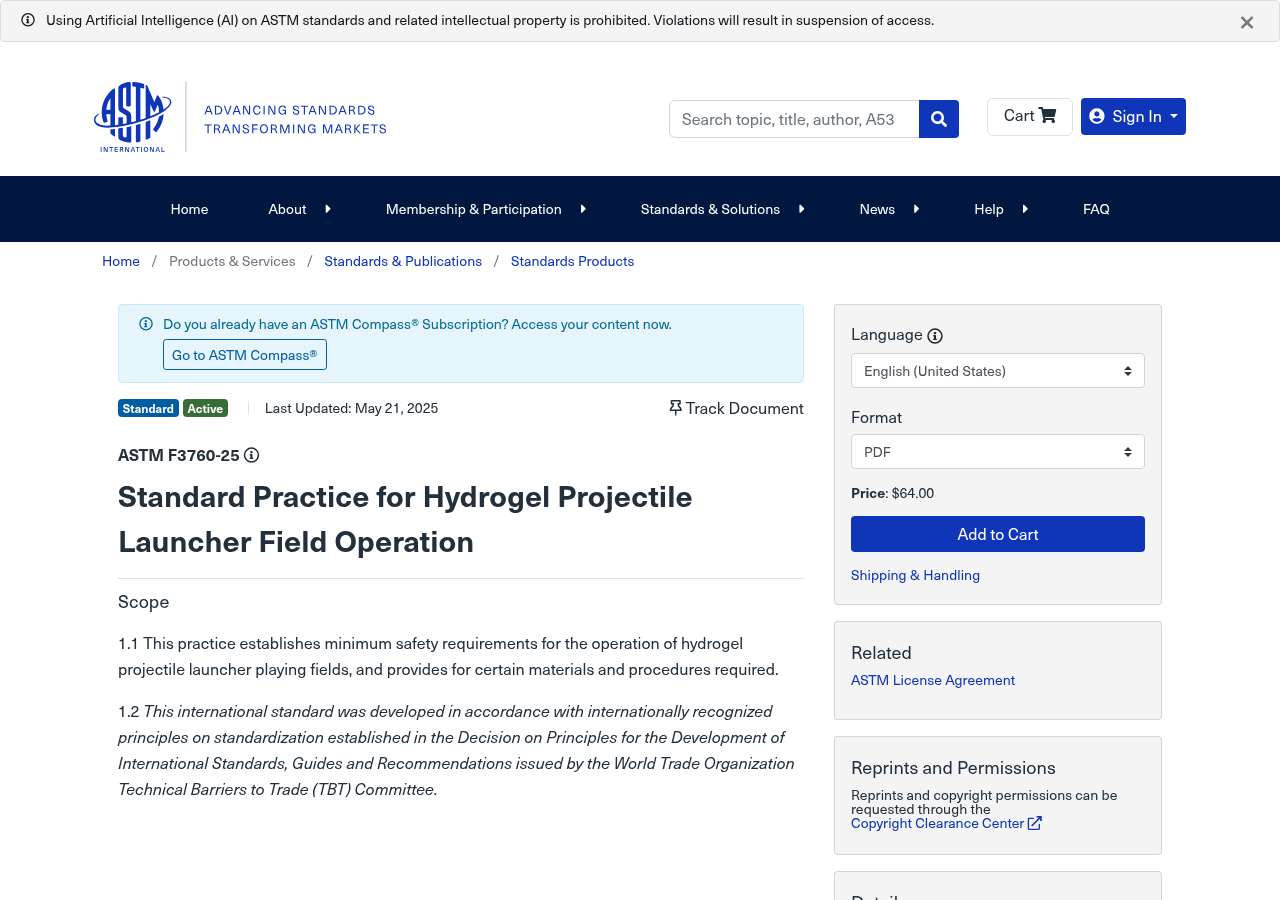
Source 5 of 5 · Consensus operating standard
Gel blaster fields now have their own active ASTM operating standard, published in May 2025. Hydrogel projectile launcher is ASTM's formal term for a gel blaster, and the standard sets minimum safety requirements for operating the field.
Source: store.astm.org/f3760-25.html
Eye protection is the exposure the clinical literature keeps returning to. A 2024 case series in the American Journal of Ophthalmology reviewed 17 eyes with gel pellet trauma, finding hyphema in nine and corneal abrasion in seven, and its authors concluded that "it is critical to raise awareness regarding the importance of wearing eye protection meeting high-impact standards". A 2019 BMJ Case Reports paper documented two children treated within two weeks of each other, one struck from around ten metres who presented with vision of hand movements only and an intraocular pressure of 45 mm Hg; their vision ultimately returned to normal, but the authors record lifelong risk of ocular complications. A 2026 retrospective study of 35 consecutive traumatic hyphema patients at one centre found eight of them, 23 percent, were water bead related, and that those patients were significantly younger. The Commission itself put it plainly in the water bead rulemaking, noting that gel blaster projectile incidents "commonly involve eye injury".
Note what none of that gives you: a national injury count. There is no NEISS product code for gel blasters. A water bead gun is coded to 1237, the same code as BB guns, pellet guns and paintball guns, so no published federal figure separates them. Any number claiming to be "the" gel blaster injury statistic is not one, and our GellyBall safety and injury data report sets out what the evidence does and does not support.
Velocity is the other number underwriters ask about, and the honest answer is that it varies by brand. GellyBall publishes up to 150 feet per second for its G2 and X-3 blasters. Gel Blaster lists an adjustable 180 to 240 feet per second for the Surge XL 2.0. SplatRBall lists up to 200 feet per second. Competitive paintball, by contrast, is chronographed to a 300 feet per second ceiling. These are manufacturer maximums for specific consumer models rather than a ceiling for the category, and imported or modified blasters can run above them, which is exactly why a chronograph log and a written policy on customer-supplied equipment belong in your file.
Five things belong in the underwriting file for every gel blaster operation: the eye protection standard you enforce and how you enforce it, a chronograph or velocity check log, your written policy on customer-owned blasters, the marketing-age position on your rental and resale stock, and the certificates you have issued this season with their additional insured endorsements attached. An operator who can hand that file over at renewal is a different risk from one reconstructing it after a claim, and it is the cheapest premium lever in the vertical.
Frequently Asked Questions
Do you need insurance to run a gel blaster arena?
No statute requires it, but in practice you cannot trade without it. The requirement is contractual: a landlord will not sign a lease, a municipality will not issue a permit, and a fair will not accept a vendor application without a certificate of insurance. For a fixed arena the binding document is usually the lease, which typically demands general liability at $1,000,000 per occurrence, names the landlord as an additional insured, and requires a waiver of subrogation. Workers' compensation is the one line that is genuinely statutory once you have employees.
What does gel blaster business insurance cover?
A complete gel blaster programme runs to eight lines: general liability, participant injury, commercial auto, inland marine on the equipment, commercial property and business income for a fixed site, workers' compensation, product liability if you sell blasters or gel beads, and excess or umbrella cover where a contract demands limits above your primary. The line most often missing from a cheap quote is participant injury, because a standard general liability form can carry the ISO CG 21 01 athletic or sports participants exclusion, which removes cover for the players themselves.
How much does gel blaster insurance cost?
Specialty Insurance prices a gel blaster programme line by line. General liability runs $500 to $1,500 a year, inland marine on the travelling kit $500 to $1,000, commercial property $750 to $2,000, workers' compensation $200 to $1,000, and an excess or umbrella layer $250 to $1,000. Participant injury, commercial auto and product liability are quoted case by case rather than to a published range. What you land on depends on which of the three gel blaster businesses you run, whether you own vehicles, whether you resell product, and what limits your venue contracts demand.
Do you need commercial auto insurance for a mobile gel blaster business?
Usually yes, and for a traveling fair operator the answer is almost always yes in a specific form. A personal auto policy carries a business-use exclusion, and while it carves out private passenger autos, pickups, vans and trailers used with them, it will not respond for a box truck. More decisively, California's fair insurance requirements ask for commercial automobile liability at least as broad as ISO form CA 0001 symbol 1, which is any auto. A hired and non-owned policy is written to symbols 8 and 9 and cannot satisfy that requirement at any limit.
What insurance does a state fair require from a gel blaster vendor?
Most large fairs require general liability of at least $1,000,000 per occurrence with a $2,000,000 aggregate, name multiple additional insureds in prescribed wording, and set a certificate deadline weeks before the fair opens. Several add a carrier rating floor such as A.M. Best A- VII, a waiver of subrogation, commercial auto, and workers' compensation for any vendor with paid employees. Check the vendor manual as well as the insurance sheet: the Ohio State Fair, for example, prohibits projectile devices in terms broad enough to reach a gel blaster attraction regardless of what your certificate says.
Are gel blasters legal to operate commercially in the United States?
There is no federal ban, but three layers of law can reach a commercial operation and they have to be checked in order. Federal marking rules for look-alike and imitation firearms sit at 16 CFR part 1272 and approve four alternative markings, not just an orange tip. State imitation-weapon law varies sharply: California regulates commercial dealing and public display with specific exemptions for permitted fairs and regulated sporting events, while New York's General Business Law article 39-B prohibits sale and distribution with only two narrow exceptions. Municipal ordinances are the fastest-moving layer, and some now name gel blasters directly in park and recreation rules.
Sources
- Consumer Product Safety Commission, "Safety Standard for Toys: Requirements for Water Beads", final rule, 90 FR 57820, 12 December 2025, effective 12 March 2026 (FR Doc. 2025-22643).
- 16 CFR part 1272, Marking of Toy, Look-Alike and Imitation Firearms, sections 1272.1 to 1272.4.
- Consumer Product Safety Commission recall announcement, Gel Blaster SURGE Model 1.0 toy guns, 20 October 2022, and CPSC monthly recall progress report, September 2025 update.
- Consumer Product Safety Commission product safety warning, electric gel ball blaster toy guns, 12 December 2024.
- California Penal Code sections 16250, 16700, 20150, 20160, 20165, 20170 and 20175.
- New York General Business Law article 39-B, sections 870 to 873, and New York City Administrative Code 10-131(g).
- City of Fairfield, Ohio, Parks and Recreation rules and policies, 2025 to 2026.
- ISO Business Auto Coverage Form CA 00 01 11 20, covered auto symbols and physical damage coverage grant.
- 49 CFR 390.3, 390.5, 390.19T and 390.21; 49 CFR 387.3 and 387.9; 49 CFR 383.5.
- California Fair Services Authority, Exhibit B insurance requirements, as published by California district agricultural association fairs.
- Arizona State Fair licensee insurance requirements; Wisconsin State Fair vendor insurance FAQ; Ohio State Fair rental manual; Iowa State Fair commercial space rules; Kansas State Fair commercial exhibitor insurance requirements; Florida State Fair vendor manual; Minnesota State Fair vendor FAQ.
- California State University, Long Beach, insurance requirements for facility rental including camps.
- ASTM F3760-25, Standard Practice for Hydrogel Projectile Launcher Field Operation; ASTM F3741-24; ASTM F3730-24.
- Krisch M et al., "Characterization of Ocular Injuries Caused by Orbeez Hydrated Gel Pellet Projectiles", American Journal of Ophthalmology, January 2024.
- Hayes R, Dai S, "Ocular injuries from gel blasters: not just a harmless toy", BMJ Case Reports, June 2019.
- Aggarwal AI et al., "Hyphema Associated with Water Bead Projectile Toys: A Retrospective Comparative Study", Clinical Ophthalmology, 2026.
- Consumer Product Safety Commission NEISS Coding Manual, January 2025 revision.
- Manufacturer published specifications: GellyBall G2 and X-3; Gel Blaster Surge XL 2.0; SplatRBall SRB400. NXL Divisional X-Ball Rules 2026, section 9.2.4(b).