
Specialty Insurance Data Report
The evidence on GellyBall, every figure sourced. The short version for parents and operators: it is the lowest-energy projectile sport on the market, serious injuries are rare, and the one real risk, an unprotected eye, is almost entirely preventable.
Every statistic below is written out with a numbered footnote. Full citations are listed under Sources and methodology.
Get a GellyBall-specific quote in 24 hours. 50 states. No obligation.
01What GellyBall is, and why the safety question is fair
GellyBall is a newer entry in the projectile-sport family, a battery-powered blaster that launches soft hydrated gel beads, and it is marketed for players of nearly any age. That "all ages" framing is exactly why parents and operators ask whether it is genuinely safe. The honest answer starts with the projectile itself. (New to the category? Our explainer on what is a gel blaster covers how it differs from Orbeez guns and airsoft.)
- A GellyBall bead is roughly 90% water, biodegradable, and non-toxic, with no paint and no stain.7
- Commercial GellyBall blasters fire at about 100 to 150 feet per second, well below paintball and below most airsoft.8
- High-power consumer gel blasters are a different animal. The ophthalmology literature puts the gel pellets used in injury cases at 200 to 350 feet per second, two to three times a commercial GellyBall blaster.12
- Once reconstituted, the beads are about 6 mm to 8 mm across and are soft and pliable, but on a direct hit the force still concentrates on a small surface area.1
Here is how GellyBall lines up against the two sports it is most often compared with, on the variables that actually drive injury risk. For the full head-to-head numbers, see our injury-rate comparison of all three, and for GellyBall against paintball specifically, GellyBall vs paintball.
| Data point | GellyBall | Airsoft | Paintball |
|---|---|---|---|
| Projectile | 7 to 8 mm hydrogel bead | 6 mm BB, 0.20 to 0.25 g | .68 cal gelatin, ~3 g |
| Typical velocity | ~100 to 150 fps (commercial) | ~350 to 400 fps | ~280 to 300 fps |
| Impact energy | Under 1 J | ~1 to 3 J | ~10 to 13 J |
| Typical min age | 4 to 5 and up | Often 12 and up | 10 to 12 and up |
| Energy-based risk | Lowest | Moderate | Highest |
02Impact energy: how hard a GellyBall bead actually hits
Every difference in injury risk between these sports traces back to one variable: how much energy the projectile carries on impact. GellyBall sits at the bottom of that ladder, and the gap is not small.
- A GellyBall bead carries under 1 joule of impact energy, a soft, low-velocity ball that bursts on contact.13
- An airsoft BB carries about 1 to 3 joules, already several times a GellyBall bead.13
- A paintball carries roughly 10 to 13 joules, more than ten times a GellyBall bead, computed from field-legal velocity and projectile weight.13
Low energy is why a GellyBall hit is usually a light tap rather than the welt a paintball leaves. It is also why GellyBall can be played by children years younger than the typical paintball or airsoft minimum. Low energy does not mean zero risk, though, and the data is clear about where the risk concentrates.
03The one documented serious risk: eye injuries
If GellyBall has a serious-injury record, it is about the eye, and it comes overwhelmingly from high-power consumer gel blasters fired without eye protection, not from supervised commercial GellyBall play. The distinction matters, but the lesson is the same on every field: eye protection is the line between a harmless game and an emergency-department visit.
- A six-center ophthalmology case series documented 19 eyes injured by gel pellets, average patient age 17.8 years, 17 of 19 of them male.1
- The two most common injuries in that series were hyphema in 12 eyes (bleeding inside the front of the eye) and a corneal surface defect in 8 eyes; 7 eyes needed an invasive procedure.1
- A separate single-center series of 17 eyes, patients aged 4 to 37, found elevated eye pressure above 21 mmHg in about 1 in 3 patients at presentation, with the pellets launched at speeds up to 350 feet per second.2
- The original clinical warning came from two children treated for a large hyphema at one eye center within two weeks of each other after being struck by gel blaster projectiles; their vision recovered, but both carry a lifelong risk of complications.3
- Both ophthalmology teams reached the same conclusion: anyone playing with or standing near gel blasters needs high-impact, paintball-grade eye protection.12
An unprotected eye is the one place a low-energy bead still does real damage.
Which is why rated eye protection, not the velocity of the blaster, is the single safety control that matters most.
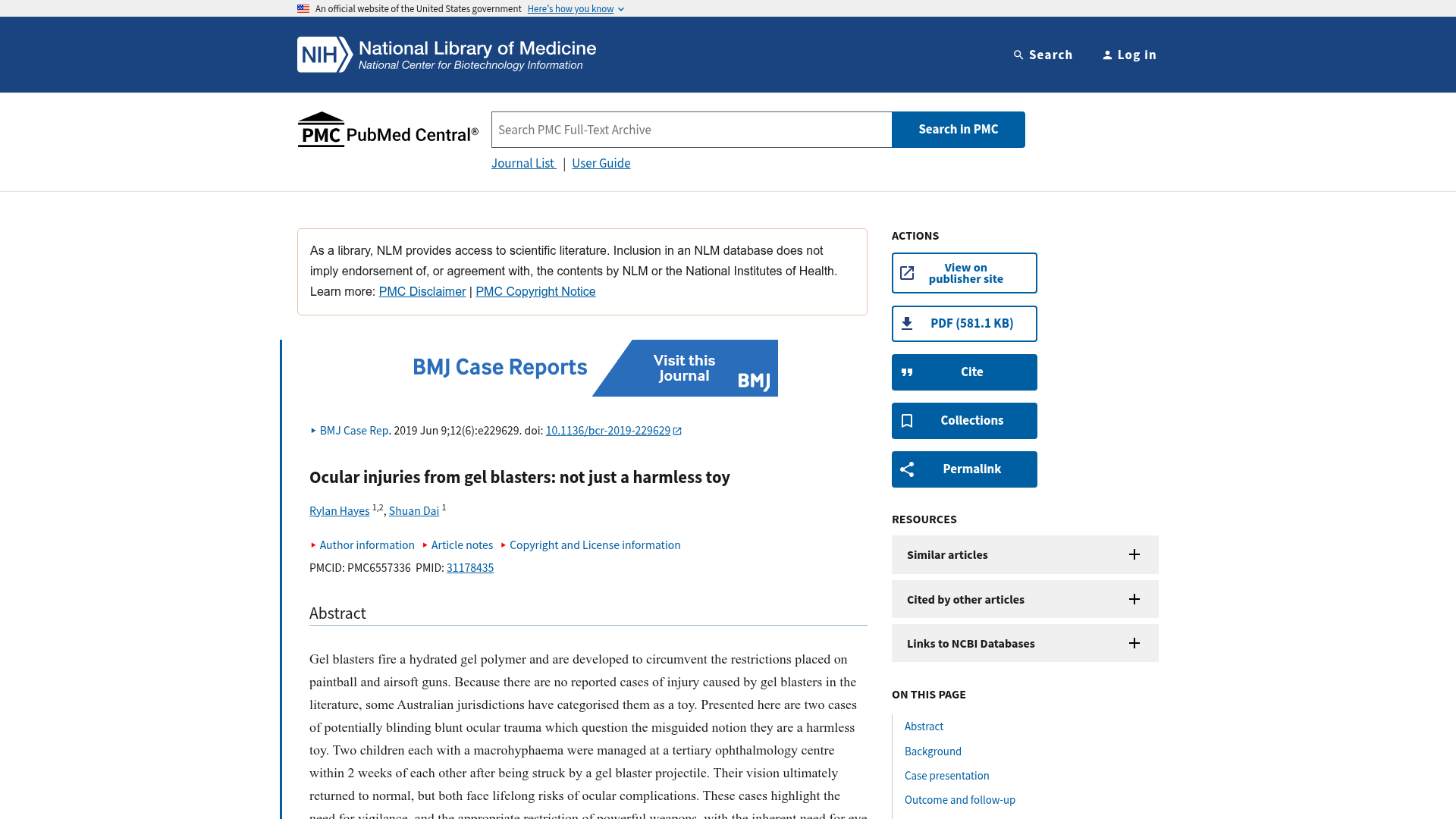
Reference · Gel-blaster eye injury
BMJ Case Reports, "Ocular injuries from gel blasters: not just a harmless toy." The clinical paper that first warned a low-energy bead can still cause potentially blinding blunt trauma to an unprotected eye.
Source 3
04The hazard parents ask about most: swallowing the beads
The second question parents raise has nothing to do with getting hit. It is the bead itself. GellyBall ammo is part of the superabsorbent-polymer family known as water beads, and for the youngest children the swallowing risk is a real, separate hazard worth understanding.
- An estimated 8,159 US pediatric emergency-department visits were tied to water beads from 2007 through 2022, and the count rose more than 130% from 2021 to 2022 alone.4
- Ingestion accounted for about 66% of those visits, and roughly 73% of the ingestions involved children aged 0 to 5.5
- The US Consumer Product Safety Commission tied an estimated 6,300 water-bead ingestion injuries to emergency departments from 2017 to 2022, recorded at least one related fatality, and its federal water-beads safety standard is now in effect.6
Read those numbers with a caveat: they cover decorative and sensory water beads broadly, the larger beads that expand in the body, not GellyBall game ammo specifically. There is no national injury dataset for GellyBall on its own, because the category is too new. The takeaway for an operator or a parent is simple: the swallowing risk lives with the youngest children, and supervision plus keeping loose beads off the floor is the control.
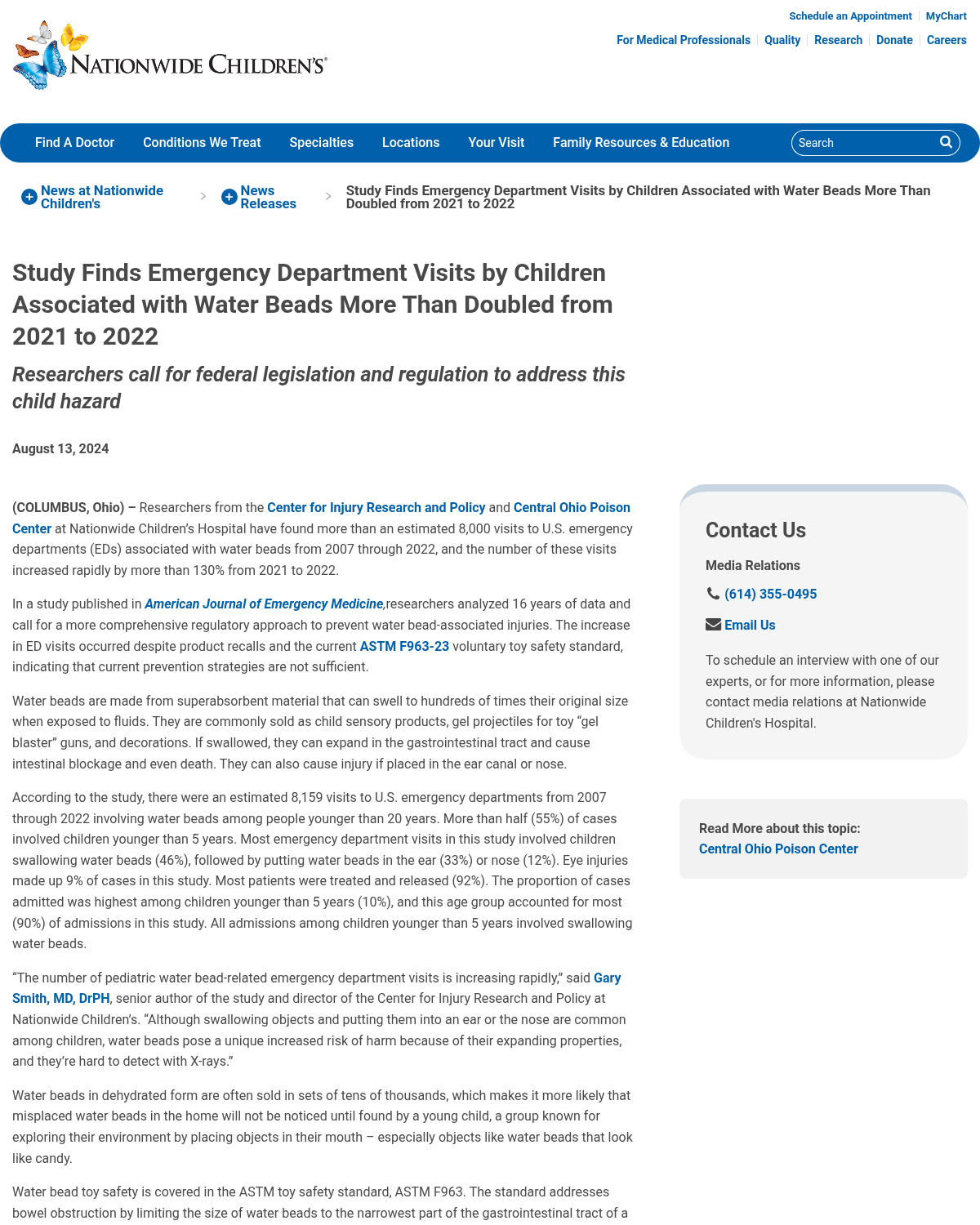
Reference · Ingestion hazard
Nationwide Children's Hospital, Center for Injury Research and Policy: emergency-department visits tied to water beads more than doubled from 2021 to 2022, with the youngest children most at risk from ingestion.
Source 4
05GellyBall in context: how the numbers compare
Set against the rest of recreation, the projectile sports are not the outliers people assume, and GellyBall sits at the gentle end of an already low-injury group.
- Paintball, which hits more than ten times harder than GellyBall, recorded just 614 emergency-department visits in the US in 2008 among more than 10 million players, roughly 0.06 visits per 1,000 players, and that count fell 48% from 2006 to 2008.9
- The broader nonpowder-firearm category, which includes airsoft and the harder-hitting BB and pellet guns, accounts for about 13,486 pediatric emergency-department injuries a year, a useful upper bound on the energy class above GellyBall.10
- Across sports, injury risk ranges from 0.04 to 127.3 injuries per 1,000 hours of exposure; contact-team sports sit near the top of that range and the shooting and projectile sports sit near the bottom.11
- National safety data ranks the shooting sports among the lowest-injury forms of recreation, below the mainstream team sports most parents never think twice about.12
Reference · Recreation context
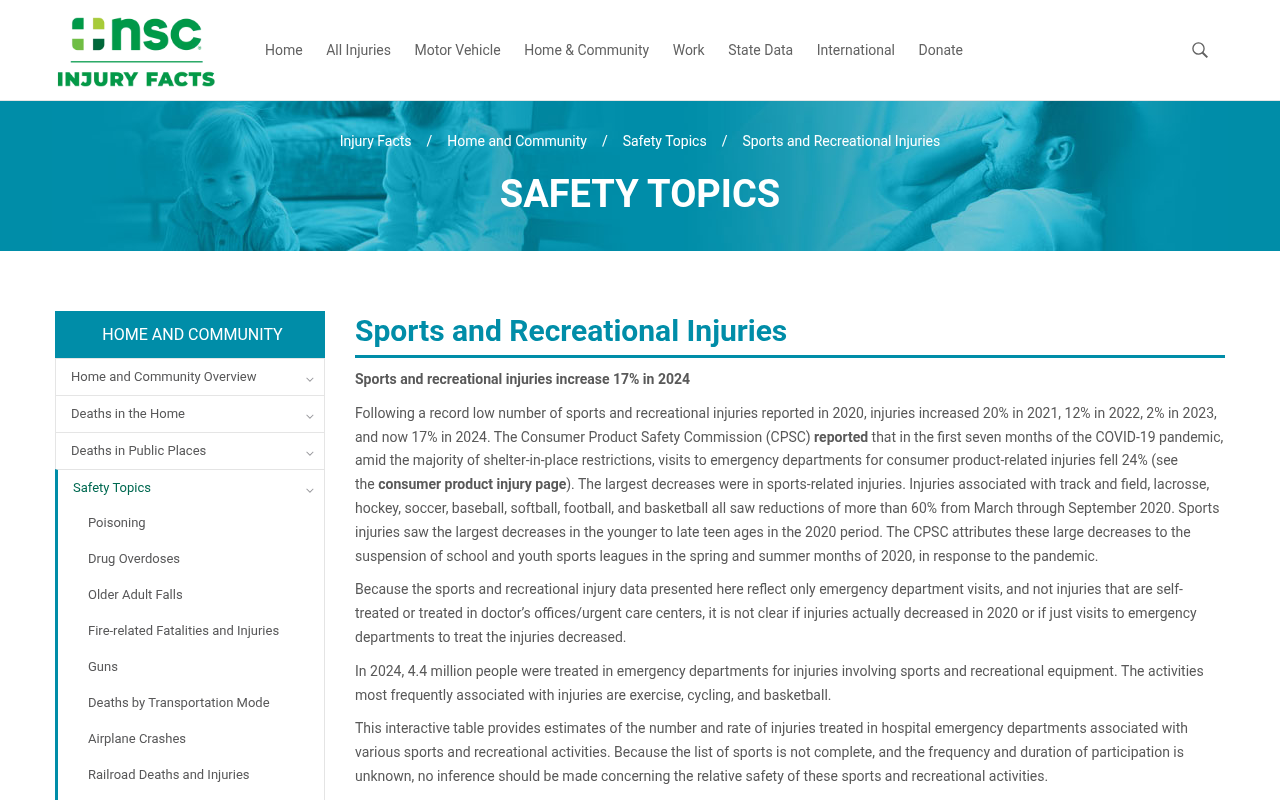
National Safety Council Injury Facts: where sports and recreational injuries land overall. The projectile sports, GellyBall included, sit at the low-frequency end of the recreation injury picture.
Source 12
06Risk-management takeaways for operators and parents
The data points to a short list of controls that do almost all of the work. None of them are expensive, and the first one is the difference between the eye-injury cases above and a clean record. If you run mobile parties, those same controls shape your coverage and certificate, covered in gel blaster party rental insurance.
- Mandate rated, full-seal eye protection for everyone in the play area, not just active players. The ophthalmology consensus is paintball-grade eyewear, and it is the single highest-value control on a gel-blaster field. See the safety practices underwriters actually check.
- Use commercial low-velocity blasters and cap the field at them. The injury literature involves high-power gel blasters at 200 to 350 fps, not the 100 to 150 fps commercial GellyBall equipment.18
- Supervise the youngest players and keep beads off the floor. The ingestion risk lives with children five and under, so a clean floor and a no-beads-near-the-mouth rule handle it.
- Document that you enforce eye protection. A written, dated record is worth real money at renewal and in a claim, the same lesson operators learn the hard way in why a general liability policy alone leaves gaps and in how family entertainment centers end up underinsured.
- Carry the coverage that matches the exposure. The player who takes a bead to the eye is a participant, and participants are excluded from standard general liability. You need participant injury coverage on top of it.
Get a 24-hour quote rated to GellyBall's real risk, not paintball's. 50 states.
07So, is GellyBall safe?
By the evidence, yes, when it is played with eye protection. GellyBall is the lowest-energy projectile sport in wide use, its impact hazard is minor, and its serious-injury record is the eye, a risk that rated eyewear designs out almost entirely. Ranked by how much each one should hold an operator's attention, the picture looks like this.
GellyBall is genuinely low-impact, but "low-impact" and "no eye protection needed" are not the same sentence. Every serious gel-blaster injury I have seen in the literature is an eye, and almost every one was preventable with the goggles already sitting in the bin. Enforce the eyewear, prove you enforce it, and you have a safe game and a clean risk.
Bobby Sharp, Action Sports Practice Lead, Specialty Insurance
For a parent, GellyBall is one of the safer organized activities a young child can do, provided the venue enforces eye protection. For an operator, "safe" is the game played to that standard and documented, and any of the projectile sports still needs the right coverage behind it. For the fuller comparison, see how airsoft and paintball stack up, and for the coverage side, why GellyBall is so often mispriced as paintball.
Get a 24-hour quote rated to your real risk. 50 states. Send your dec page and we will show you the gaps for free.
Specialty Insurance writes GellyBall and gel blaster coverage in all 50 states. Call (888) 673-7228.
08Frequently asked questions
Is GellyBall safe for young children?
Yes, with eye protection and supervision. GellyBall beads carry under one joule of energy, a fraction of paintball, which is why the game is marketed for children as young as four to five. The two things to manage are rated eye protection on the field and keeping the youngest children from putting loose beads in their mouths.
Does GellyBall hurt?
Barely. At about 100 to 150 feet per second and under one joule of impact energy, a commercial GellyBall hit is a light tap rather than the welt a paintball leaves. Most players feel it through clothing and nothing more.
Can GellyBall hurt your eyes?
An unprotected eye is the one place a gel bead can do real damage. Ophthalmology case series document hyphema, corneal injury, and elevated eye pressure from gel-blaster hits, almost all involving high-power blasters and no eyewear. Rated, full-seal eye protection prevents the large majority of it.
What are GellyBall beads made of, and are they toxic?
A GellyBall bead is roughly 90% water, biodegradable, and non-toxic, with no paint or stain. The one caution is the same as any water bead: they should not be swallowed, and the ingestion risk is real for children five and under, so supervise the youngest players.
Is GellyBall safer than paintball or airsoft?
By impact energy and severity, yes. A GellyBall bead carries under one joule, against roughly 1 to 3 joules for airsoft and 10 to 13 for paintball. All three share the same serious risk, eye injury, so the safest field is the one that enforces rated eye protection regardless of the sport.
Do you need insurance to run GellyBall as a business?
Yes. A general liability policy covers third parties like spectators, but it excludes the participant who is hit during play. A GellyBall operation needs participant injury coverage on top of general liability, and it should be rated to GellyBall's lower risk profile rather than priced as paintball.
Sources and methodology
- American Academy of Ophthalmology, EyeNet, "Risk of Ocular Trauma From Gel Pellets" (2023), summarizing Lin et al., Ophthalmology: six-center case series, 19 eyes, average age 17.8, hyphema in 12 eyes, invasive procedures in 7, gel pellets at 200 to 300 fps, eye-protection recommendation.
- Ophthalmology Advisor (2023), reporting Krisch et al., American Journal of Ophthalmology: 17 eyes, ages 4 to 37, elevated IOP above 21 mmHg in about 1 in 3 at presentation, projectiles up to 350 fps.
- Hayes R, Dai S, "Ocular injuries from gel blasters: not just a harmless toy," BMJ Case Reports 2019;12(6):e229629: two children with macrohyphaema, potentially blinding blunt ocular trauma.
- Nationwide Children's Hospital, Center for Injury Research and Policy (2024): estimated 8,159 US pediatric ED visits tied to water beads, 2007 to 2022; more than 130% rise from 2021 to 2022.
- AAP News, "More children visiting EDs due to water bead injuries" (2024): ingestion 66% of ED visits, 73% of ingestions among children aged 0 to 5.
- US Consumer Product Safety Commission, "CPSC's New Federal Water Beads Safety Standard Takes Effect" (2026): estimated 6,300 water-bead ingestion injuries treated in US emergency departments 2017 to 2022, at least one related fatality.
- GellyBall (gellyball.com): hydrated gel ammo roughly 90% water, biodegradable and non-toxic, lower-impact, marketed for all ages.
- Steeltown Event Park, GellyBall rules and game modes: commercial GellyBall gellets fired at roughly 100 to 150 fps, low-impact.
- HCUP / AHRQ Statistical Brief #119, "ED Visits for Injuries Caused by Air and Paintball Guns, 2008": 614 paintball ED visits, 10M+ players, 48% decline 2006 to 2008.
- AAP Pediatrics, "Nonpowder Firearm Injuries to Children Treated in Emergency Departments" (2019): about 13,486 pediatric ED injuries a year in the nonpowder-firearm category.
- "Quantifying the risk of sports injury: a systematic review": injury risk ranges from 0.04 to 127.3 injuries per 1,000 hours of exposure.
- NSSF sports injury study: shooting sports among the lowest-injury forms of recreation.
- Methodology: impact energy computed as E = ½mv² from the velocities and projectile weights above. Velocity and projectile profiles drawn from Specialty Insurance, Airsoft vs Paintball and Specialty Insurance, GellyBall Insurance. The paintball player-rate uses 614 ED visits against the 10M+ annual participants cited in Source 9.