

Specialty Insurance Data Report
Airsoft sends fewer people to the emergency room than almost any other projectile sport. The catch is where the injuries land. The serious airsoft injury is the eye injury, it is rising in adults, and it is almost entirely preventable with rated full-seal eyewear above a known velocity line.
Every statistic below is written out with a numbered footnote. Full citations are listed under Sources and methodology.
Get a discipline-specific quote in 24 hours. 50 states. Send your dec page and we will flag the gaps for free.
01Airsoft at a glance: the safety profile
Airsoft is a low-energy projectile sport with one concentrated risk. The numbers below set the frame: a light 6mm plastic pellet, a fraction of a paintball's energy, the lowest hospital-admission share of the projectile guns, and a single serious exposure at the eye. Everything after this section expands one row of this table.
| Data point | Airsoft |
|---|---|
| Projectile | 6mm plastic BB, 0.20 to 0.25 g |
| Typical field velocity | ~350 to 400 fps for automatic guns8 |
| Impact energy | ~1 to 2 J, computed from weight and speed8 |
| Eye-penetration threshold | About 325 fps for a 6mm BB4 |
| Eye-protection standard | ASTM F2879, full-seal goggles5 |
| Hospital-admission share | 7%, lowest of the projectile guns2 |
| The serious injury | Penetrating eye trauma |
02What the ER data shows
National injury surveillance tracks airsoft inside the nonpowder-firearm category, alongside BB, pellet, and paintball guns. Read against that group, airsoft is the gentle end.
- Nonpowder-firearm injuries to US children fell 48% over the surveillance period, from 16,456 in 1990 to 8,585 in 2016.2
- Of injuries where the gun type was identified, airsoft accounted for under 1%, the smallest share of the four nonpowder categories, behind BB guns (81%), pellet guns (16%), and paintball (3%).2
- Airsoft posted the lowest hospital-admission rate of the projectile guns at 7%, below pellet guns (8%) and paintball (12%).2
- The average age of a child treated for any nonpowder-firearm injury was 12 years.2
- Researchers note some nonpowder guns reach a muzzle velocity similar to a handgun, which is why the category is tracked as a firearm injury rather than a toy injury.2
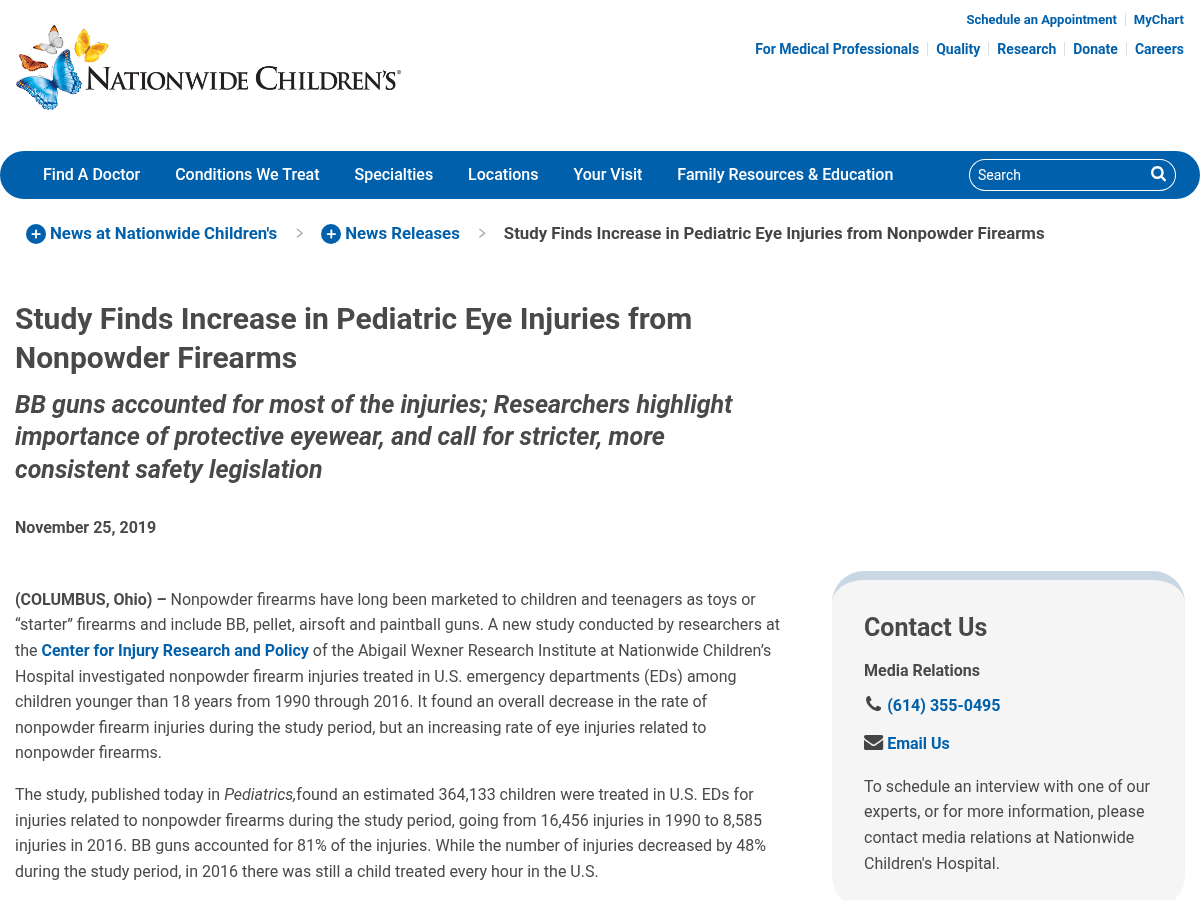
Reference · ER surveillance
The pediatric study behind these figures found nonpowder-firearm injuries falling overall, but eye injuries rising, and singled out protective eyewear as the prevention step.
Source 2
03The eye is the injury that matters
Strip out the eye and airsoft is a sport of welts and bruises. The eye is the reason it is regulated, studied, and underwritten as a real exposure.
- Eye injuries account for about 15% of all nonpowder-firearm injuries, and the rate of those eye injuries rose 50% even as the overall injury rate fell.2
- 22% of nonpowder-firearm eye injuries required hospital admission, far above the category average.2
- The most common eye diagnoses were corneal abrasion (35%), hyphema (13%), globe rupture (10%), and foreign body (9%).2
- A decade of newer surveillance estimated 16,756 US emergency-room visits for nonpowder-firearm eye injuries from 2013 to 2022, with adult rates climbing and peaking in 2022 even as the rate for children fell.1
- About 28% of documented airsoft and BB-gun eye-injury cases were left with visual acuity worse than 20/50 after initial treatment.3
- Over 98% of pediatric nonpowder-gun eye injuries occurred with no eye protection in place.3
More than 9 in 10 of these eye injuries struck an unprotected eye.
That is the whole underwriting story in one number: the serious airsoft injury is the one the field can design out by enforcing rated eyewear.
Documented safety practice is what a specialty broker rates on. Ask for a coverage review that credits it.
04FPS limits and impact energy: the safety thresholds
This is the section operators ask about most, because it is the one you can measure with a chronograph at the door. The physics is simple and unforgiving at the eye.
- A 6mm airsoft BB at typical field velocity carries roughly 1 to 2 joules of impact energy, about a tenth of a paintball, computed from projectile weight and chronographed speed.8
- Forensic testing on pig eyes set the eye-penetration threshold for a conventional 6mm airsoft pellet at velocities above 99 m/s, about 325 fps, the point at which it meets the legal definition of serious bodily injury.4
- That same work put the energy-density threshold for eye penetration at 4.3 to 4.8 J/cm² for 6mm plastic projectiles.4
- Most US fields cap automatic guns near 350 to 400 fps and bolt-action rifles near 450 to 500 fps with a minimum-engagement-distance rule.8
- The gap is the point: common field velocities sit above the eye-penetration line, so an unprotected eye is exposed at the speeds fields run every day, while a rated lens closes that gap completely.4
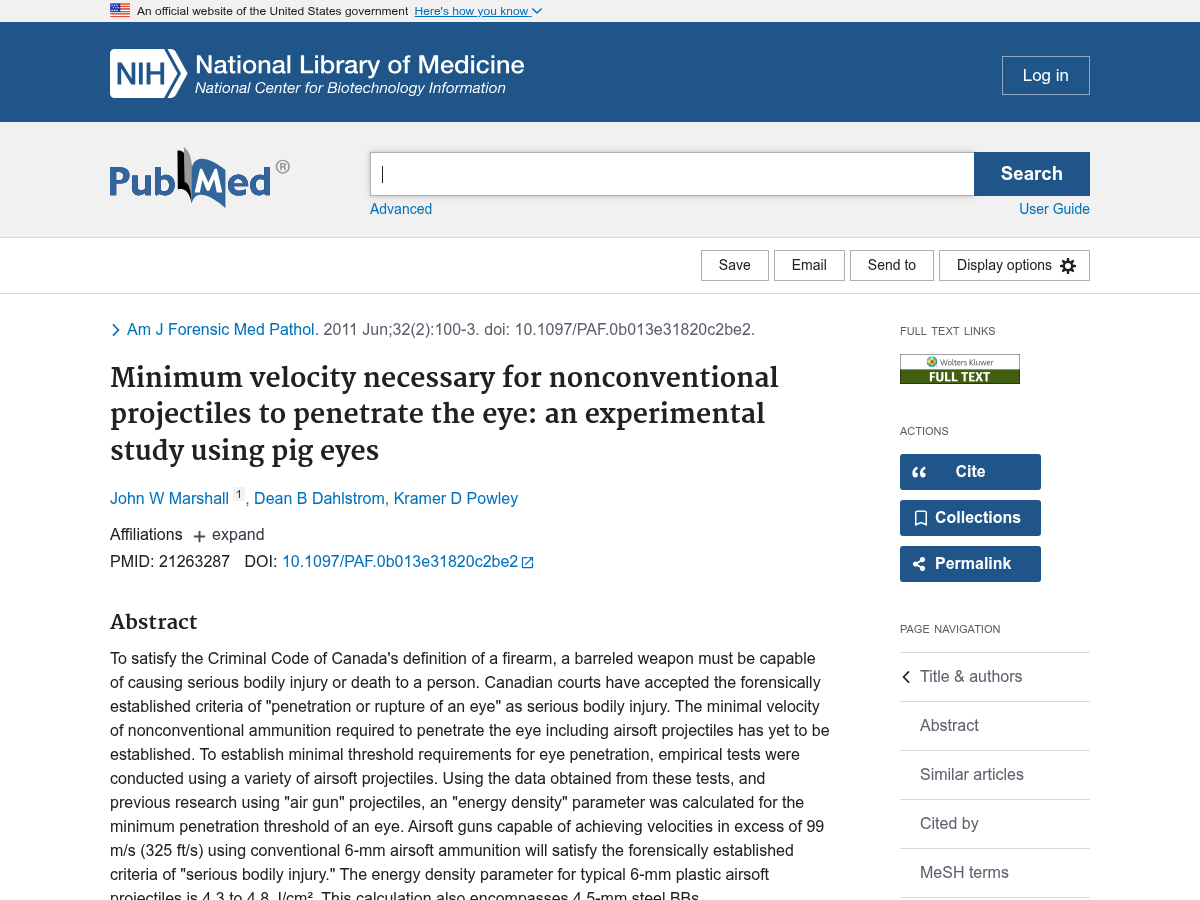
Reference · FPS threshold
The forensic study that established the 325 fps eye-penetration line for a 6mm airsoft pellet, the velocity at which the projectile meets the legal threshold of serious bodily injury.
Source 4
05The eye-protection standards underwriters expect
There are two standards in play, and the difference between them is the difference between a clean claim file and a bad one. The short version: a workplace impact rating is not the same as an airsoft rating.
- ASTM F2879 is written specifically for airsoft. It covers eye protective devices for 6mm projectiles, tests for both impact and penetration, and requires a full seal with no opening that admits a 4.5mm probe, which is why it points to goggles rather than open-sided glasses.5
- ANSI Z87 basic marks a lens that survives a one-inch steel ball dropped from 50 inches, with no high-velocity test at all.6
- ANSI Z87+ adds the high-velocity test: a quarter-inch steel ball fired at 150 fps for glasses and 250 fps for goggles. Useful, but built for industrial debris, not 6mm pellets.6
- The workplace standard itself states that it does not cover sports and recreation, which is the gap ASTM F2879 was created to fill.6
- For the neighboring sport, paintball, the matching standard is ASTM F1776, a useful comparison point when a venue runs both disciplines.7
| Standard | Built for | Impact test |
|---|---|---|
| ASTM F2879 | Airsoft, 6mm projectiles | Impact and penetration, full seal, no 4.5mm gap |
| ANSI Z87+ | Industrial high-impact | Quarter-inch steel ball, 150 fps glasses to 250 fps goggles |
| ANSI Z87 (basic) | General workplace | One-inch ball drop, no velocity test |
| ASTM F1776 | Paintball | Paintball-specific impact, for venues running both |

Reference · Eyewear standard
The ANSI/ISEA Z87.1 workplace eye-protection standard. Its impact marks are useful shorthand, but the standard's own scope excludes sports, which is why airsoft fields should specify the purpose-built ASTM F2879 instead.
Source 6
06How airsoft compares with the other projectile sports
Set beside its neighbors, airsoft is the low-energy option that still demands real eye protection. The energy is modest; the eye exposure is not.
| Data point | Airsoft | Paintball | BB / pellet |
|---|---|---|---|
| Projectile | 6mm plastic, 0.20 to 0.25 g | .68 cal gelatin, ~3 g | 4.5mm metal |
| Impact energy | ~1 to 2 J8 | ~10 to 13 J8 | Higher, metal |
| Admission share | 7%2 | 12%2 | 8% (pellet)2 |
| Share of ID'd injuries | Under 1%2 | 3%2 | BB 81%, pellet 16%2 |
| Eyewear standard | ASTM F28795 | ASTM F17767 | ANSI Z87+ |
The pattern holds across the category: the metal-projectile BB and pellet guns drive the overwhelming majority of injuries, paintball hits hardest by energy, and airsoft sits at the low-severity end. For the operator decision behind these numbers, see airsoft versus paintball and the broader question of what general liability does not cover at a projectile field.
07What the data means for your field
The evidence points one direction for an airsoft operator. Severity is low, the one serious injury is ocular, and that injury is almost entirely a function of eye protection and velocity, both of which a field controls. Here is what drives an airsoft injury claim, in order.
Airsoft is one of the lower-severity sports we write, but almost every serious claim file has the same line in it: the eye, and no rated protection. A field that mandates ASTM F2879 goggles, chronographs every gun to its FPS limit, and can document both is a fundamentally better risk than one that just hopes players brought goggles.
Bobby Sharp, Action Sports Practice Lead, Specialty Insurance
For an operator, the data turns into three habits: rated eyewear enforced on everyone, a chronograph and an FPS cap, and the paper to prove both at renewal. The same record that keeps players safe is what a specialty broker rates on, so it shows up in your premium. See the safety practices underwriters look for, and remember that any field still needs participant injury coverage stacked on top of general liability.
That same record sets the rate. For what an airsoft program actually costs and what moves it, see our airsoft insurance cost guide, and for how airsoft's risk stacks against paintball and GellyBall, our injury-rate comparison of the three sports.
Get a 24-hour quote rated to your real risk, not a generic class code. 50 states, no obligation.
Specialty Insurance writes airsoft and paintball operations in all 50 states. Call (888) 673-7228.
08Frequently asked questions
How dangerous is airsoft, really?
By the numbers, airsoft is among the lowest-severity projectile sports. It makes up under 1% of identifiable nonpowder-firearm injuries and has the lowest hospital-admission rate of the projectile guns at 7%. The one serious exposure is penetrating eye trauma, which is almost entirely preventable with rated eye protection.
What FPS is safe for airsoft?
There is no single safe number, but there is a clear line for the eye. Forensic testing found a 6mm airsoft BB can penetrate an unprotected eye above roughly 325 fps. Most fields cap automatic guns near 350 to 400 fps and bolt-action rifles near 450 to 500 fps with a minimum-engagement-distance rule, which is why rated full-seal eyewear is non-negotiable at those speeds.
What eye protection standard does airsoft require?
The airsoft-specific standard is ASTM F2879, which tests eye protective devices against 6mm projectiles for both impact and penetration and requires a full seal. A workplace ANSI Z87+ rating tests against industrial debris, not airsoft pellets, and the workplace standard explicitly excludes sports, so full-seal goggles meeting ASTM F2879 are the right specification for a field.
Are airsoft eye injuries common?
Eye injuries are the serious airsoft injury and they are rising. Eye injuries make up about 15% of nonpowder-firearm injuries and that rate rose 50% even as overall injuries fell, with about 28% of documented airsoft and BB-gun eye cases left with vision worse than 20/50. The decisive detail is that over 98% happened with no eye protection in place.
Does enforcing eye protection lower my insurance cost?
It helps, because it directly attacks the one severe airsoft exposure. Premium is driven most by loss history, participant volume, and documented safety practices like enforced rated eyewear and chronographed FPS limits. A field that can prove those practices is a better risk and should be rated like one, though the sport name alone never sets the price.
Sources and methodology
- IOVS (ARVO), Gillette et al., "The epidemiology of nonpowder firearm-related eye trauma in the United States, 2013-2022": estimated 16,756 ER visits, adult rates rising and peaking in 2022, 73% of cases in children, 89% male.
- AAP Pediatrics (Nationwide Children's, Smith et al.), "Nonpowder Firearm Injuries to Children Treated in Emergency Departments," 2019: 48% decline, eye injuries 15% and rising 50%, 22% admitted, diagnosis mix, type shares, admission by type (airsoft 7%, pellet 8%, paintball 12%), average age 12.
- J AAPOS (Lee and Fredrick, OHSU), "Pediatric eye injuries due to nonpowder guns in the United States, 2002-2012," 2015: roughly 3,161 children in 2012, severe injuries up over 500% since 2010, about 28% left worse than 20/50, over 98% without eye protection.
- Marshall, Dahlstrom, Powley, "Minimum velocity necessary for nonconventional projectiles to penetrate the eye," Am J Forensic Med Pathol, 2011: 6mm airsoft pellets above 99 m/s (about 325 fps) meet the serious-bodily-injury threshold; energy density 4.3 to 4.8 J/cm².
- ASTM F2879-22, "Standard Specification for Eye Protective Devices for Airsoft Sports": eye protective devices for 6mm airsoft projectiles, impact and penetration testing, full seal with no 4.5mm opening; references ASTM F2679 (6mm projectiles) and F2748 (airsoft guns).
- ANSI/ISEA Z87.1-2025, summarized by ANSI; high-velocity test velocities per HexArmor: Z87 basic (one-inch ball drop) versus Z87+ high-velocity (quarter-inch steel ball, 150 fps glasses to 250 fps goggles); the standard's scope excludes sports and recreation.
- ASTM F1776 and F803, eye protectors for paintball and selected sports: the paintball-specific comparison standard referenced for dual-discipline venues.
- Methodology: airsoft impact energy computed as E = one-half m v squared from 6mm pellets of 0.20 to 0.25 g at chronographed velocities of 350 to 400 fps, yielding roughly 1 to 2 J; paintball energy from the velocity and weight profiles in Specialty Insurance, Airsoft vs Paintball. Field FPS caps reflect common US field limits and vary by venue.