

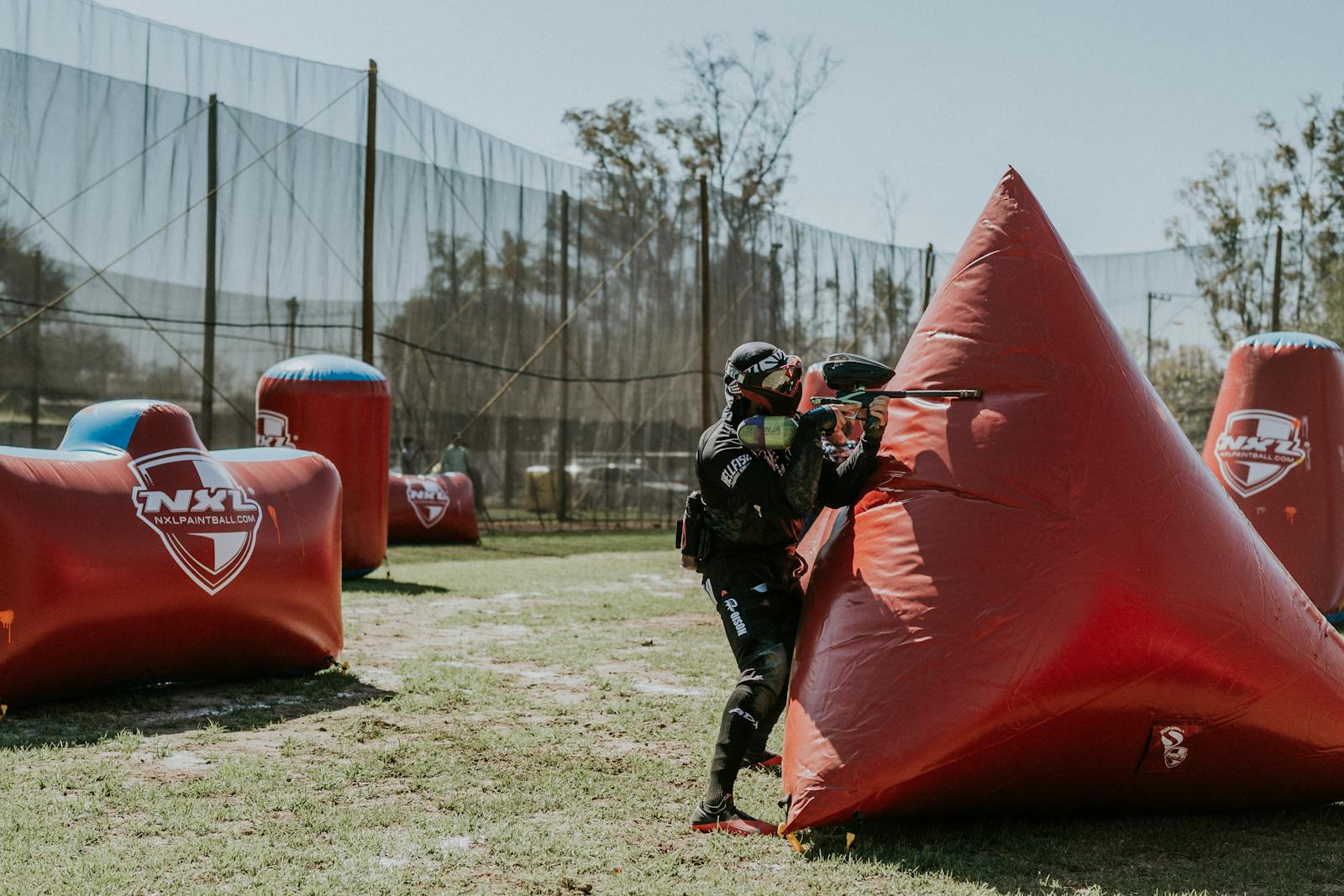
The word "general" is doing a lot of work
General Liability sounds like it covers everything. The word "general" carries that promise. At a paintball field, it does not keep it. A general liability policy is a specific instrument that covers a specific set of third-party exposures, and a paintball field has four large exposures that sit outside it.
I review paintball policies every week. Most field owners believe they are covered. Then we read the policy together, and the same four gaps show up: no participant coverage, property that excludes the field, rental gear capped at a token sub-limit, and products liability that does not match the pro shop. Here is each one, and how to close it.
What GL does cover, and what it does not
Start with what the policy is for. General Liability covers third-party bodily injury and property damage: people and property outside your business relationship with the customer.
| Exposure | Covered by GL? | What it really needs |
|---|---|---|
| Spectator slips in the parking lot | Yes | General Liability |
| Vendor trips over a tank in the lobby | Yes | General Liability |
| Stray paintball hits a passing car | Yes | General Liability |
| Player takes a welt and sues | No | Participant Injury |
| Player twists an ankle between bunkers | No | Participant Injury |
| Storm destroys outdoor bunkers and netting | No | Property (scheduled outdoor structures) |
| Rental marker fleet lost to fire | No | Property (equipment, not "stock") |
| A mask you sold is alleged to have failed | No | Product Liability |
Every "no" in that table is a gap. The gaps are not exotic. They are the most common things that happen at a paintball field.
Gap 1: No participant injury coverage at all
This is the biggest one. Standard General Liability carries the ISO athletic-participants exclusion, form CG 21 01, which removes coverage for bodily injury to anyone participating in the sport the field sponsors.
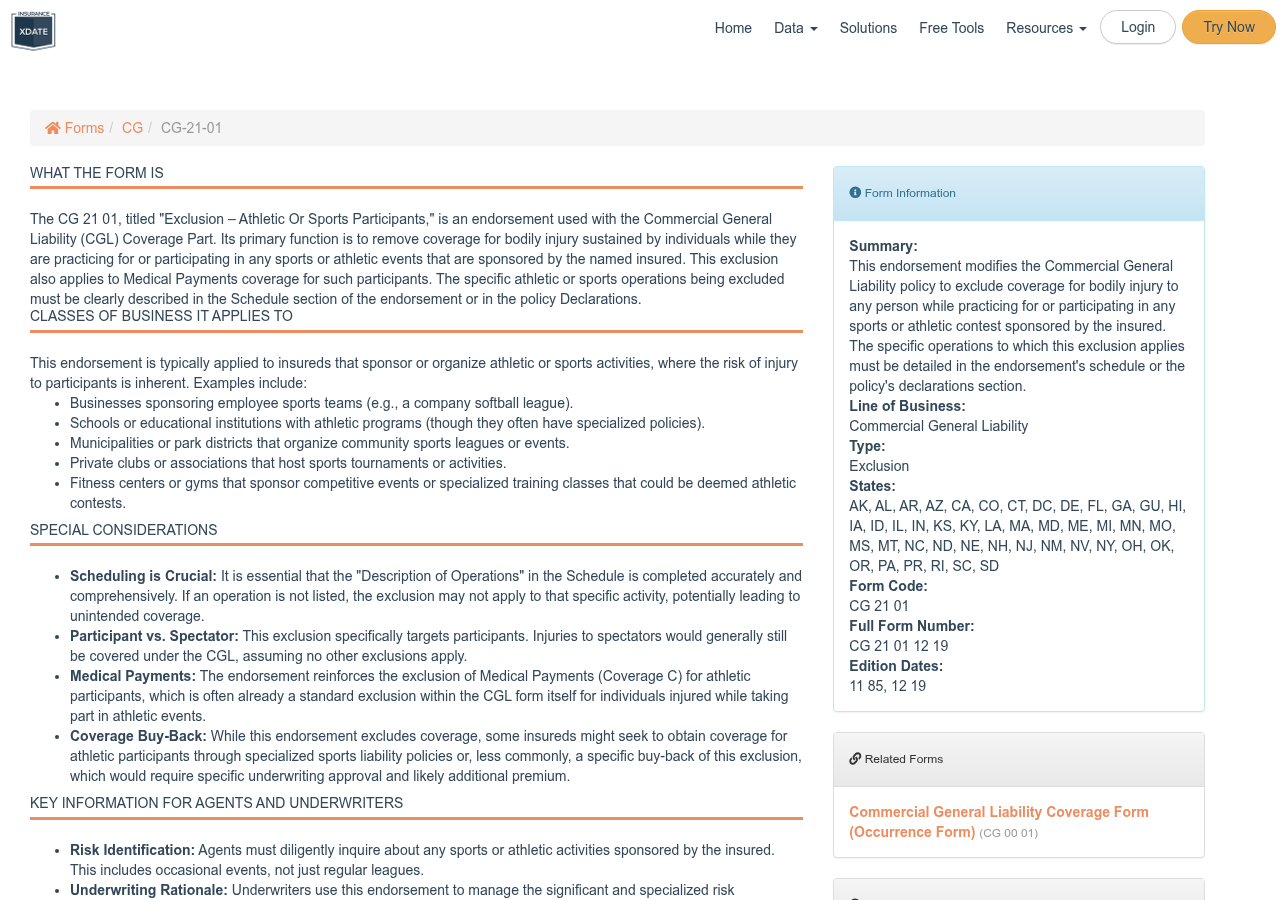
Source 1 of 2 · Standard ISO exclusion form
ISO Commercial General Liability form CG 21 01, the Athletic or Sports Participants exclusion. When attached, it turns a paintball field's GL policy into spectator-only coverage.
Read at a paintball field, that exclusion turns the policy into spectator-only coverage. The paying player, the person the field exists to serve, is outside it. A field owner once called after a player took a close-range neck shot and sued for $75,000 in medical bills and alleged nerve damage. The owner had $2,000,000 of GL coverage. The carrier classified the injury as a participant claim, declined it, and the field settled out of pocket for $42,000. The coverage that would have responded is Participant Injury, and it has to be named on the policy. The wider version of this exclusion problem is in the action-sports coverage gaps a generalist agent will miss.
A field owner shows me a $2,000,000 liability limit and assumes that is the player's coverage. It is not. With the participant exclusion attached, that $2,000,000 covers the parking lot. The player on the field has zero, and nobody told the owner.
Bobby Sharp, Paintball Practice Lead, Specialty Insurance
The injury exposure behind this gap is well documented. The American Academy of Pediatrics' foundational study on paintball eye injuries recorded emergency-department-treated paintball eye injuries rising from 545 in 1998 to over 1,200 by 2000, with 43% of patients having follow-up vision of 20/200 or worse (Listman, Pediatrics, January 2004). Those are participant injuries, and a GL-only policy responds to none of them.
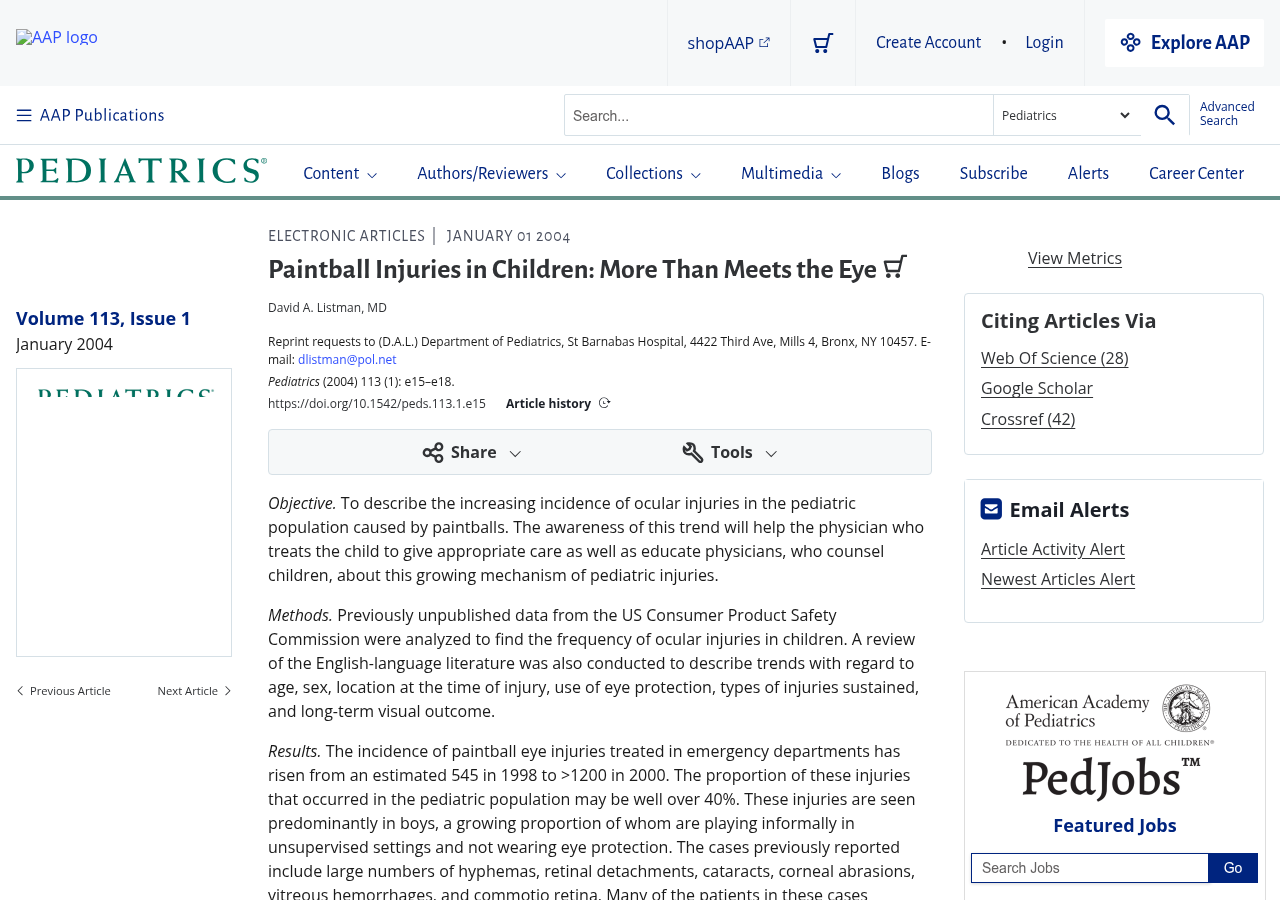
Source 2 of 2 · Peer-reviewed clinical record
American Academy of Pediatrics journal article on paintball eye injuries: 545 ER-treated injuries in 1998 rising to over 1,200 by 2000, with 43% of patients having follow-up vision of 20/200 or worse. These are participant injuries a GL-only policy excludes.
Gap 2: Property coverage that excludes your actual property
A standard commercial property policy covers the building. At a paintball field, the building is rarely the most valuable property. The netting, the bunkers, the air-fill station, the towers: those are outdoor structures, and most property forms exclude outdoor structures unless they are specifically scheduled.
A storm takes out $30,000 of field infrastructure and the operator learns at the claim that none of it was on the schedule. The fix is to schedule the outdoor structures by category and value, at replacement cost.
Gap 3: A rental fleet coded as "stock" and capped
A paintball field rents out markers, masks, and tanks by the hundreds. A rental fleet is equipment, an asset used to deliver the service. Some policies miscode it as stock, meaning inventory for resale, and stock often carries a sub-limit of $5,000 to $10,000.
If the field owns $80,000 of rental markers and the policy capped them at $5,000 as stock, a fire creates a $75,000 uncovered loss. The fix is to confirm the rental fleet is scheduled as equipment, valued at actual replacement cost.
Pull the property schedule and find the rental fleet. If it is sitting under a stock sub-limit, you own a fleet and you insured a coupon. That is one fire away from a five-figure surprise.
Bobby Sharp, Paintball Practice Lead, Specialty Insurance
Gap 4: Products liability that does not match the pro shop
A paintball field with a pro shop sells masks, tanks, CO₂, and paint. If a mask the field sold is later alleged to have failed and caused an injury, that is a products-liability claim. A standard GL policy may carry a products exclusion, or a products sub-limit of $50,000 that one lawsuit blows past.
The fix is product liability coverage sized to what the pro shop sells.
How to check your own policy this week
You do not need a broker to find the first signs of these gaps. Pull the actual policy, not the one-page certificate, and do four things:
- Search for "participant," "player," or "recreational sports participant." If those words are not present as covered, you probably have no participant injury coverage. Then look for form CG 21 01: if it is attached, the participant exclusion is in.
- Check the property schedule for your field equipment. Bunkers, netting, towers, air systems. If they are not listed, they are probably not covered.
- Find the rental fleet on the schedule. Confirm it is coded as equipment, not stock, and that the limit matches replacement cost.
- Check the products section against what the pro shop sells. Look for a products exclusion or a low sub-limit.
Then call your agent and ask one direct question: does this policy cover a player injured during normal paintball gameplay? If the answer is a hesitation, or "your waiver handles that," the gap is real. A waiver is a defense, not a coverage, a distinction we cover in participant injury vs general liability.
"Specialty Insurance diligently takes their time and works with you, making sure your business has all the correct and specific coverages you need. There is no other source out there that does what they do."
Gel Tag San Diego LLC
Verified customer review
That four-item read is exactly what the 24-hour audit covers, done across your full policy by underwriters who write paintball every week.
Frequently Asked Questions
Does general liability cover paintball player injuries?
Usually no. Standard GL carries the ISO CG 21 01 athletic-participants exclusion, which removes coverage for injuries to participants in the sport the field sponsors. Player injuries need separate Participant Injury coverage, named on the policy.
Are my paintball bunkers and netting covered by my property insurance?
Only if they are specifically scheduled. Most standard property forms exclude outdoor structures by default. Bunkers, netting, towers, and air-fill stations should be scheduled by category and value at replacement cost.
Why might my rental marker fleet be underinsured?
Some policies code a rental fleet as "stock," meaning inventory for resale, which often carries a $5,000 to $10,000 sub-limit. A rental fleet is equipment and should be scheduled as such at full replacement cost.
Does my GL cover products I sell in the pro shop?
Not always. A standard GL policy may include a products exclusion or a low products sub-limit. A paintball field selling masks, tanks, and CO₂ should confirm product liability coverage sized to the pro shop.
How do I know if my paintball policy has these gaps?
Pull the full policy and check four things: whether participant coverage is named, whether outdoor structures are scheduled, whether the rental fleet is coded as equipment, and whether products liability matches the pro shop. A specialty broker can review the whole policy and flag every gap.
Sources
- Listman, David A. "Paintball Injuries in Children: More Than Meets the Eye." Pediatrics, Vol. 113, January 2004. publications.aap.org
- ISO Commercial General Liability form CG 21 01, "Exclusion: Athletic Or Sports Participants." insurancexdate.com
- Specialty Insurance. The Action-Sports Coverage Gaps a Generalist Agent Will Miss
- Specialty Insurance. Participant Injury vs General Liability