

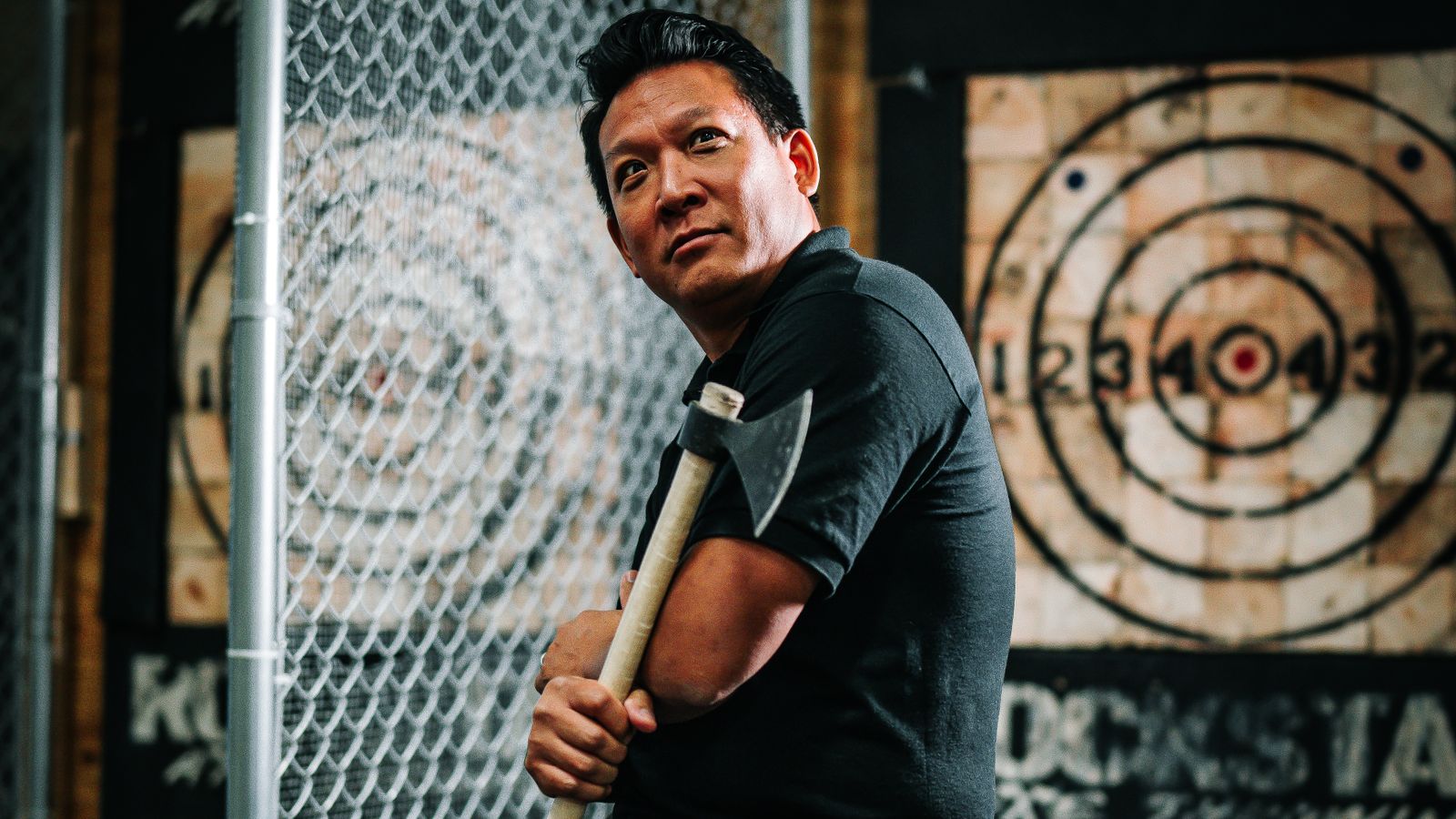
How Much Does Axe Throwing Insurance Cost? A 2026 Pricing Guide
Axe throwing looks like one of the cheaper venues to insure. A room, plywood targets, a rack of hatchets, and a waiver at the door. Then the underwriter asks one question: do you serve alcohol? For a lot of venues, that single answer moves the premium more than the lanes, the location, and the axes combined. Axe throwing insurance is priced on a short list of factors, and the order they matter in surprises most owners.
Here is what axe throwing insurance really costs in 2026, the three drivers that decide where your number lands (lane count, alcohol service, and league affiliation, in that order), and how to get a quote built on your operation instead of a search-result average.
What axe throwing insurance costs in 2026
For a new commercial axe throwing venue carrying a real program, General Liability with participant coverage, Property on your lanes and axe inventory, and Workers' Compensation once you have staff, a dry venue with no alcohol generally lands in the range of $2,500 to $6,000 a year at one million per occurrence and two million aggregate limits. That is the band most new no-alcohol venues sit in.
Add a bar, and the number commonly moves into five figures. Alcohol brings a separate liquor liability policy, and for late-night venues it adds assault and battery coverage on top. That one decision is the largest single swing in axe throwing pricing.
The figure moves from there with the shape of your operation:
- Mobile and event operators, running a trailer or a pop-up at fairs and parties, sit at the low end.
- Small or single-lane dry venues sit low.
- Established multi-lane dry venues sit in the middle of the range.
- Alcohol-serving axe bars sit higher, on the liquor liability layer.
- Multi-lane venues with alcohol, late hours, and live music sit highest, on frequency and severity together.
Underwriters usually build the base off your revenue and your lane or target count (a standard lane holds two targets), then adjust for everything else. Axe throwing also tends to price below a comparable paintball or airsoft field. The World Axe Throwing League notes that injuries in the sport are rare and the most common are minor splinters, and most serious incidents are self-inflicted, a dropped axe or a bad catch, rather than one player injuring another. We map where those two sports land in our paintball insurance cost guide and our airsoft field insurance cost guide.
Why a cheap axe throwing quote is rarely real coverage
The suspiciously cheap quote is cheap for a reason, and the reason is the form, not the carrier being generous. A policy that cheap is almost always a bare Commercial General Liability form, and the standard General Liability form excludes injury to anyone "practicing for or participating in any sports or athletic contest or exhibition." On an axe throwing floor, the paying customer holding a hatchet is a participant. So the bargain policy covers the guest who slips near the bar and excludes the thrower who catches an axe on the bounce-back, which is the claim an axe throwing venue is most likely to see.
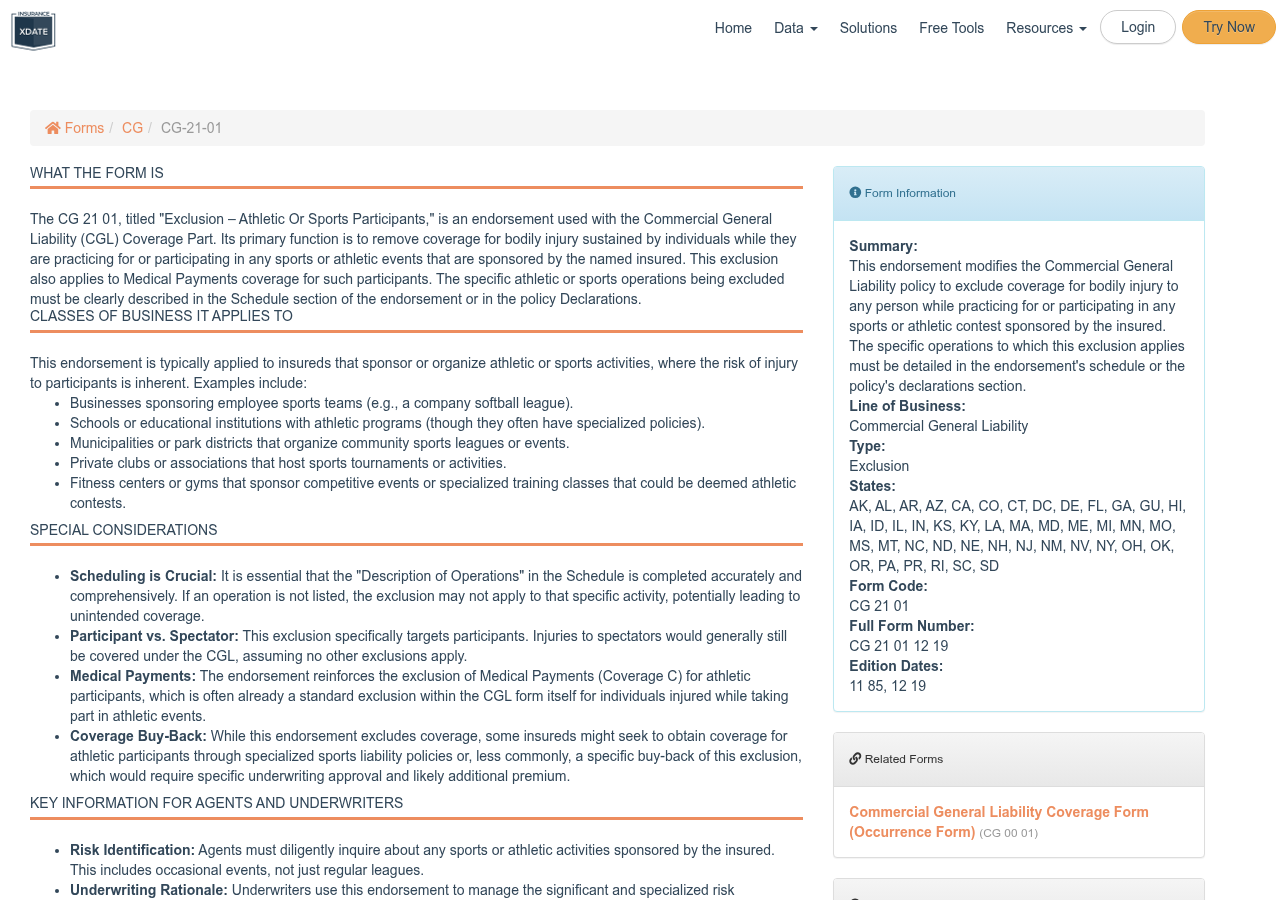
Source 1 of 3 · Standard ISO exclusion form
The standard ISO CG 21 01 endorsement removes coverage for athletic and sports participants. On an axe throwing floor that is every paying thrower, which is why a cheap General Liability-only quote is cheap: it leaves out the coverage your customers most need.
A real axe throwing program prices several coverages, not one. The table below is what your premium is buying, and what the discount quote leaves on the table.
| Coverage | What it pays for | In the cheap quote? |
|---|---|---|
| General Liability | The spectator struck by a stray axe, the guest who slips near the lanes, damage to a rented building | Usually yes, at minimum limits |
| Participant coverage | The paying thrower hurt during a session, the coverage the standard General Liability form excludes | Almost never |
| Liquor Liability | Injury or damage tied to a customer you served or allowed to drink, excluded from standard General Liability | No, it is a separate policy |
| Property | Your lanes, targets, cages, axe inventory, and build-out | Rarely, and rarely at replacement cost |
| Workers' Compensation | Coaches and bar staff injured at work, required in most states once you hire | No, it is a separate policy |
The axe throwing venues that come across my desk price on three things, in this order. Lane count sets the floor. Alcohol moves it the most, because it brings a whole separate liquor liability policy the General Liability form will not touch. League affiliation is the credit you earn back. A quote that ignores those three is not cheaper. It is quoting a smaller, different risk than the one you run.
Bobby Sharp, Action Sports Practice Lead, Specialty Insurance
For the full mechanics of the coverage the standard form leaves out, see our breakdown of participant injury versus general liability.
What drives an axe throwing venue's premium up
A handful of factors decide where in the range your venue lands. The first two carry the most weight with an underwriter.
| Driver | Why underwriters charge more for it |
|---|---|
| Lane and target count, and revenue | The base rating factor: more lanes and more throwers each year means more exposure and a higher premium |
| Alcohol service, bar or BYOB | The single biggest swing. Serving or allowing alcohol adds a separate liquor liability policy, and late-night venues add assault and battery coverage |
| Late hours, live music, private-event crowds | More intoxicated guests and more turnover mean higher claim frequency |
| Loss history | A prior claim, or missing loss runs, is among the biggest rate-ups a venue carries |
| Mobile or multi-site operation | Triggers commercial auto, inland marine on the trailer, and per-venue certificates |
| Lanes without full-height barriers between them | An axe that skips into the next lane is the bystander claim carriers price against hardest |
Alcohol is the driver that surprises owners the most. A standard Commercial General Liability policy specifically excludes liquor liability, so the moment you sell, serve, or even allow customers to bring their own alcohol, you need separate coverage (Insurance Information Institute). The reason it costs so much sits on the carrier's side of the ledger. In Specialty Insurance's home state, South Carolina's Department of Insurance found the liquor liability market losing $1.77 for every $1.00 of premium earned from 2017 to 2022, with the state's combined ratio reaching 290% in 2022 against North Carolina's 62%. Put a thrown axe in the same room as an open bar tab, and you can see why underwriters price the alcohol line carefully.

Source 2 of 3 · Insurance research body
The Insurance Information Institute reported that South Carolina's liquor liability market lost $1.77 for every $1.00 of premium earned from 2017 to 2022. Alcohol is the reason an axe bar's premium sits so far above a dry venue's.
Source: insuranceindustryblog.iii.org
Going BYOB does not reliably remove the exposure. Dram shop laws hold a venue responsible for harm caused by serving an intoxicated or underage customer (CDC), and whether a BYOB venue is treated as a social host or as a licensed establishment varies by state (National Conference of State Legislatures). The safe assumption is that alcohol on the premises, in any form, is a coverage conversation.
What brings an axe throwing venue's premium down
The good news for owners: most of the levers that lower an axe throwing premium are documentation and discipline, not spending. An underwriter prices what you can prove.
| Lever | What it does to your premium |
|---|---|
| Full-height barriers or caging between lanes | Removes the adjacent-lane axe-skip claim, the bystander injury carriers fear most |
| League affiliation and standardized lanes, through the World Axe Throwing League or the International Axe Throwing Federation | Signals inspectable lane geometry and trained coaches; carriers may credit venues that follow recognized safety protocols |
| Trained coaches supervising every session | One supervisor per two targets is the ratio carriers look for; trained supervision lowers frequency |
| Alcohol-trained bar staff, posted drink limits, and ID checks | The core liquor liability levers; they soften the biggest surcharge you carry |
| A signed waiver on file for every thrower | Cleaner claim defense, which the carrier sees in your loss runs over time |
| Property scheduled at replacement cost | Keeps an undervalued build-out from leaving you underinsured |
| Clean, documented loss runs | The biggest premium mover once you are in the specialty market |
The single biggest lever on an axe throwing premium is not the carrier. It is the file you hand me at renewal. Full-height cages between lanes, a coaching log, alcohol-trained bar staff, a signed waiver for every thrower: a venue that can produce those prices below one that only promises them. Affiliation with a body like the World Axe Throwing League is shorthand for all of it, because it means someone already built your lanes to a standard a carrier can inspect.
Bobby Sharp, Action Sports Practice Lead, Specialty Insurance
This is where league affiliation earns its place on the list. The World Axe Throwing League, the sport's largest governing body with roughly 300 affiliated venues, publishes a standardized lane: two targets per lane, fences or walls for containment, only two throwers and a judge inside, and five feet of clear space behind the throwers. Its International Axe Throwing Federation counterpart requires painted foot-fault and spectator-perimeter lines at every member venue. A carrier can inspect a lane built to that standard and price it with confidence, which is why a marketplace of insurers may offer lower rates to venues that follow those protocols or enforce equivalent standards of their own.
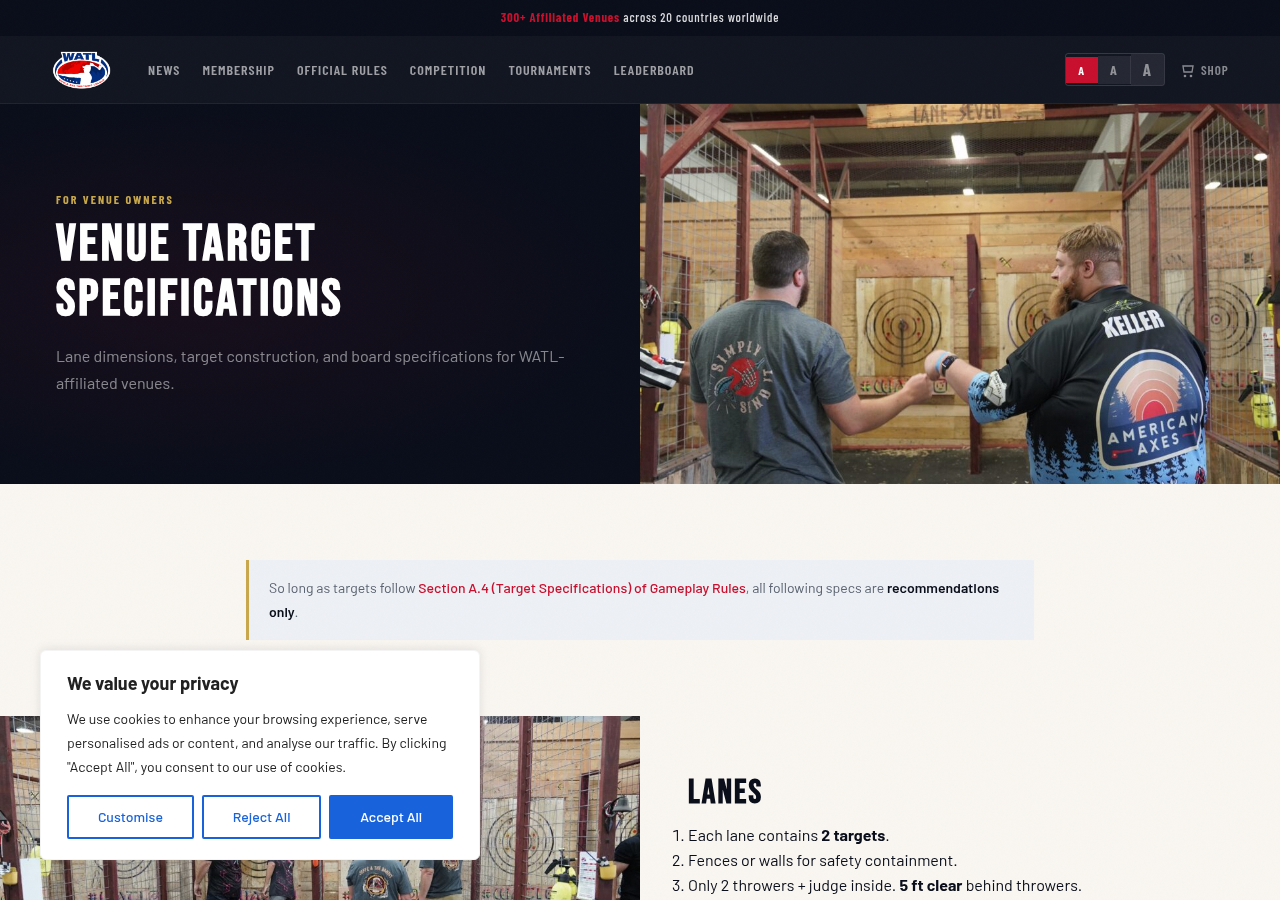
Source 3 of 3 · Sport governing body
The World Axe Throwing League's venue standards define a lane a carrier can rely on: two targets per lane, fences or walls for containment, and five feet of clear space behind the throwers. Affiliation is shorthand for lanes an underwriter can trust.
Source: worldaxethrowingleague.com/venue-target-specifications
Affiliation is not the only lever, but it is the one that signals all the others at once. An underwriter reads it as a proxy for a well-run venue, which is why it belongs on the short list of things that pull your number down.
Where your venue lands on premium
The headline band is the starting point. The chart below maps roughly where each venue type sits, the same picture an underwriter builds before quoting.
Two venues with the same number of lanes can be thousands of dollars apart at renewal on alcohol and loss history alone. That is why a real quote starts with your operation, not a price list.
How to get an accurate axe throwing insurance quote
Most generalist agents either decline axe throwing or shop it slowly, because it sits in the specialty and excess-and-surplus market, the part of the industry built to price risks the standard admitted market will not write. A broker who writes the class turns it around in 24 to 48 hours. To get there fast, your underwriter needs five things:
- A completed application with your lane or target count, indoor or outdoor, and annual thrower count
- Your gross receipts split by exposure: axe throwing, alcohol, food, and retail
- Your prior declarations page, or a note that you have never been insured
- Loss runs from any prior carrier, or a clean-record note if you are new
- Your waiver template, your coaching and supervision plan, and, if you serve alcohol, your staff alcohol-training and drink-limit policy
If you have those five, a specialty broker can usually quote within 24 to 48 hours and bind shortly after. If you do not have all five, a good broker tells you what they can quote now and what to assemble for the best renewal pricing later. That is the kind of guidance operators hear back in the first day after they send a declarations page, and it is why the reviews read the way they do.
"Specialty Insurance is a great choice! I highly recommend this company for your business! They diligently take their time and work with you, making sure your business has all the correct and specific coverages you need. Cathy was a huge help, and gave me exactly what I needed, making it budget friendly and greatly affordable. Choose Specialty Insurance if you want the best service and fair treatment for your business!"
Talk to an axe throwing specialty broker before you compare quotes
The cheapest line on a quote is rarely the cheapest policy once a claim lands. Before you choose on price, get a quote from a broker who writes axe throwing insurance on purpose, builds participant coverage into the program rather than leaving it out, schedules your property on what your venue truly owns, and prices the general liability base correctly. Then compare like for like. A real number for your operation beats a generic one every time.
Frequently Asked Questions
How much does axe throwing insurance cost per year?
For a new commercial venue with a real program, General Liability with participant coverage, Property, and Workers' Compensation once you have staff, a dry venue with no alcohol generally runs $2,500 to $6,000 a year at one million per occurrence and two million aggregate limits. Add a bar and the number commonly moves into five figures, because alcohol brings a separate liquor liability policy. Your alcohol exposure and loss history move the number more than anything else.
Why is axe throwing insurance more expensive when I serve alcohol?
Because a standard General Liability policy excludes liquor liability, so serving or allowing alcohol adds a separate policy, and late-night venues add assault and battery coverage on top. The liquor liability market is under pressure too. The Insurance Information Institute reported that South Carolina's liquor liability insurers lost $1.77 for every $1.00 of premium earned from 2017 to 2022. Alcohol is the single biggest swing in an axe throwing quote.
Does a cheap general liability quote cover the people throwing axes?
Often no. The standard General Liability form excludes injury to sports and athletic participants, and a paying thrower is a participant. A bargain General Liability-only quote tends to cover your spectators and exclude your throwers, the people most likely to be hurt. A real program adds participant coverage, which is a large part of why it costs more than the cheapest quote you find.
Does WATL or league affiliation lower my insurance cost?
It can. Affiliation with the World Axe Throwing League or the International Axe Throwing Federation means your lanes are built to a published standard, with containment barriers and trained coaches a carrier can inspect and rely on. Insurance marketplaces confirm carriers may offer lower rates to venues that follow those protocols or enforce equivalent standards of their own. It is a favorable factor, not a guaranteed percentage discount.
Do I need liquor liability insurance if my axe throwing venue is BYOB?
Often yes, depending on your state. A standard General Liability policy excludes alcohol-related incidents, and dram shop and social-host laws can hold a venue responsible for harm caused by an intoxicated or underage customer even when the customer brought the alcohol. BYOB does not reliably remove the exposure, so treat any alcohol on the premises as a coverage conversation with your broker.
Sources
- ISO Commercial General Liability form CG 21 01, Exclusion of Athletic or Sports Participants (insurancexdate.com): the standard endorsement that removes coverage for sports and athletic participants, the coverage a cheap General Liability-only axe throwing quote leaves out.
- Insurance Information Institute, "Commercial general liability insurance" and "Liquor liability" (iii.org): liquor liability is a named exclusion from standard Commercial General Liability, so venues that sell, serve, or allow alcohol need separate coverage.
- Insurance Information Institute (Triple-I Blog), "South Carolina Analysis Shows Liquor Liability Insurance Market in Crisis," February 2025 (insuranceindustryblog.iii.org): South Carolina liquor liability insurers lost $1.77 for every $1.00 of premium earned from 2017 to 2022, with a 290% combined ratio in 2022.
- World Axe Throwing League, "Venue Target Specifications" and "Official Rules" (worldaxethrowingleague.com): standardized lane geometry and the sport's own note that injuries are rare and most commonly minor splinters.
- Centers for Disease Control and Prevention, "Preventing Excessive Alcohol Use with Proven Strategies" (cdc.gov): dram shop liability means places selling alcohol are responsible for harms caused by illegally serving intoxicated or underage customers.
- National Conference of State Legislatures, "Social Host Liability for Underage Drinking Statutes" (ncsl.org): social-host statutes cover private hosts while licensed establishments are covered by dram shop laws.
- Specialty Insurance, "How Much Does Paintball Insurance Cost?" (internal): the sibling cost guide and the paintball comparison.
- Specialty Insurance, "How Much Does Airsoft Field Insurance Cost?" (internal): the sibling cost guide and the airsoft comparison.
- Specialty Insurance, "Participant Injury vs General Liability" (internal): the mechanics of the coverage the standard General Liability form excludes.