

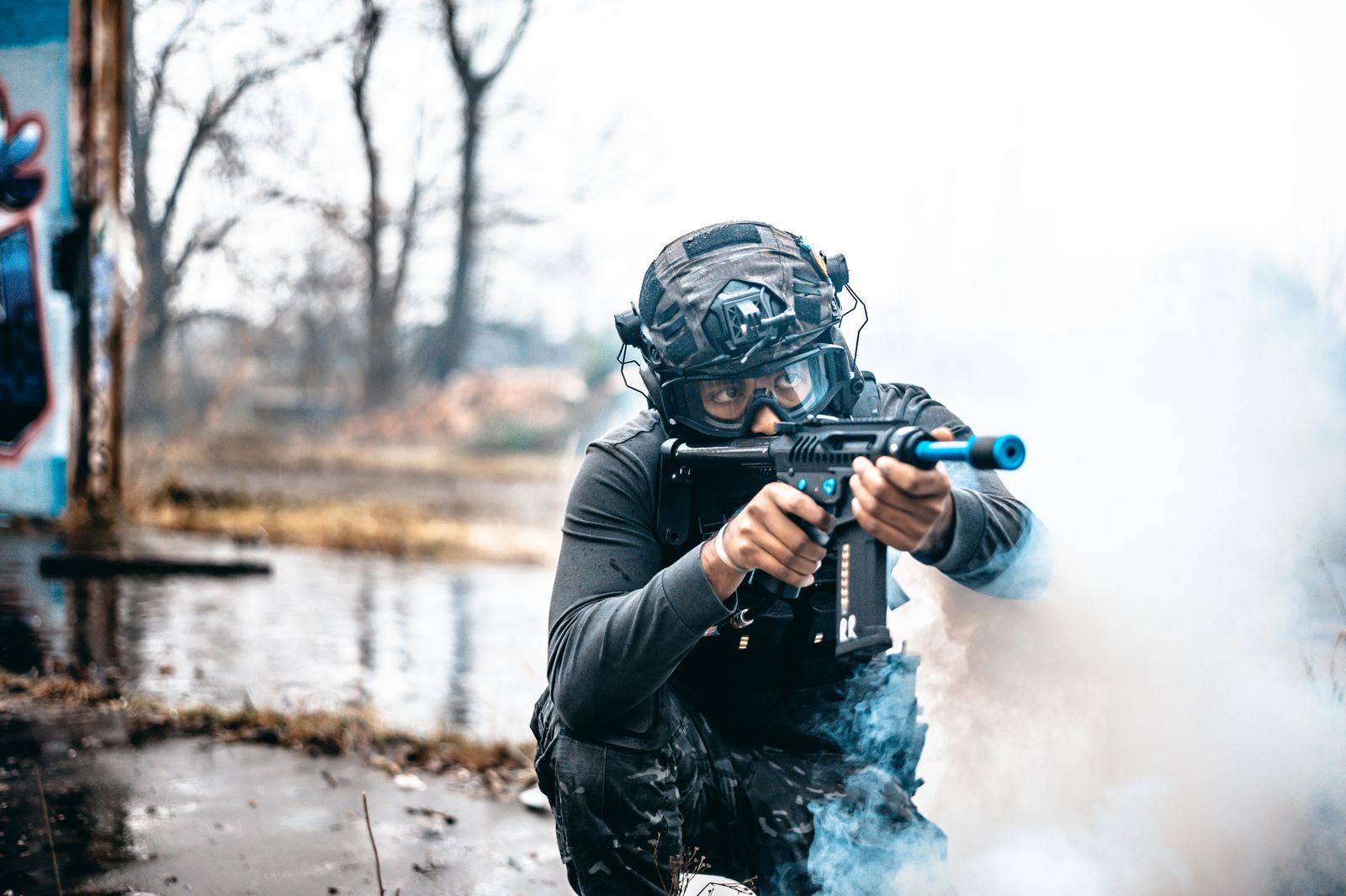
The short answer: two of these are the same device
What is a gel blaster? It is a toy-styled blaster that fires soft, water-absorbent gel beads, and it is the same device most parents and most search bars call an Orbeez gun. The two names describe one product. Airsoft is the one that does not belong in the same sentence: a replica of a real firearm that fires rigid plastic BBs, with a documented injury record and an insurance classification to match.
Operators inherit this vocabulary problem whether they want it or not. A customer books a "gel blaster party" expecting Orbeez softness, a landlord reads "blaster" on the lease application and pictures airsoft, and a carrier quoting the venue reaches for whichever class sounds closest. Sorting the three names is the fastest way to get the safety rules and the policy right, so here is the decoder.
| Factor | Gel blaster (Orbeez gun) | Airsoft |
|---|---|---|
| What it fires | 6 to 8mm hydrogel bead that bursts on impact | 6mm rigid plastic BB that does not break |
| Measured velocity | At least 200 to 300 fps in the published case series | Comparable, model dependent, with a rigid projectile |
| Looks like | A toy: bright colors, translucent shells | A replica of a real firearm |
| Typical audience | Kids' parties, backyard play, low-impact arenas | Teen and adult fields, milsim events |
| Documented injury pattern | Eye injuries without protection: hyphema, corneal damage | Nonpowder-gun eye injuries up about 50%; admissions up roughly 600% since 2010 |
| Eye protection | Paintball-grade protection recommended by researchers | Ballistic-rated, full coverage |
| Public-perception risk | The 2022 Orbeez Challenge drew police warnings | Realism drives mistaken-identity risk |
| Carrier classification | Low-impact gel class, when written correctly | Specialist action-sports class, replica-firearm questions |
Gel blaster and Orbeez gun: two names for one device
Both names describe a blaster that fires a superabsorbent polymer bead, usually 6 to 8 millimeters across once it has soaked in water. The industry calls the ammunition gellets or gel balls. Orbeez is a toy brand of the same water beads, and once the beads met the blasters, "Orbeez gun" became the household name. GellyBall, a third label operators will recognize, is a branded low-velocity arena format built on the same hydrogel ammunition.
The reason the vocabulary matters is the range hiding inside the category. At the soft end, party-grade equipment fires a light bead at low velocity for young children. At the hobby end, the record is harder than the toy shelf suggests: a multicenter case series in Ophthalmology, the journal of the American Academy of Ophthalmology, documented 19 patients with gel pellet eye injuries, including hyphema in 12 eyes and surgical procedures in 7, with pellets measured at no less than 200 to 300 feet per second (Lin et al., Ophthalmology, May 2023). The researchers' recommendation: eye protection similar to paintball, for players and for anyone standing nearby.

Source 1 of 3 · Peer-reviewed clinical record
The Ophthalmology case series behind the gel blaster safety conversation: 19 eyes across six centers, hyphema in 12, surgical procedures in 7, and pellet velocities of at least 200 to 300 feet per second. The authors recommend paintball-style eye protection for gel blaster play.
Source: aao.org/eyenet/risk-of-ocular-trauma-from-gel-pellets
The consumer name carries its own baggage. The 2022 "Orbeez Challenge" social-media trend, in which people fired gel beads at strangers in public, drew warnings from police departments in multiple states and put the device on law enforcement's radar. None of that involves a supervised venue, but it shapes how parents, neighbors, and underwriters hear the word "blaster" when an operator says it.
Two gel blaster accounts can sit at opposite ends of my desk. One is a birthday arena running low-velocity blasters for eight-year-olds. The other chronographs at paintball speed with no posted mask rule. The box says the same thing on both. The risk does not, and neither should the policy.
Bobby Sharp, Action Sports Practice Lead, Specialty Insurance
Airsoft is a different machine
An airsoft gun fires a rigid 6 millimeter plastic BB that does not burst on impact, and the American Academy of Ophthalmology describes the device itself as a replica of a real firearm. Both halves of that sentence drive the risk. The projectile concentrates its energy into a hard sphere that can rupture an eyeball, and the realism that makes the sport appealing is the same realism that triggers replica-handling rules on fields and replica-firearm questions from carriers.
The injury record is the part operators should read twice. Eye injuries from nonpowder guns, the category covering airsoft, BB, pellet, and paintball guns, have risen about 50% even as other injuries from the same devices declined, and hospital admissions for air-gun eye injuries have increased roughly 600% since 2010 (American Academy of Ophthalmology). In one study the Academy cites, about 3 in 10 young patients still had vision worse than 20/50 after treatment. The Academy's answer is ballistic-rated eye protection, and it notes that no federal law requires any of it, which leaves the eye-protection rule to the field that hosts the game.
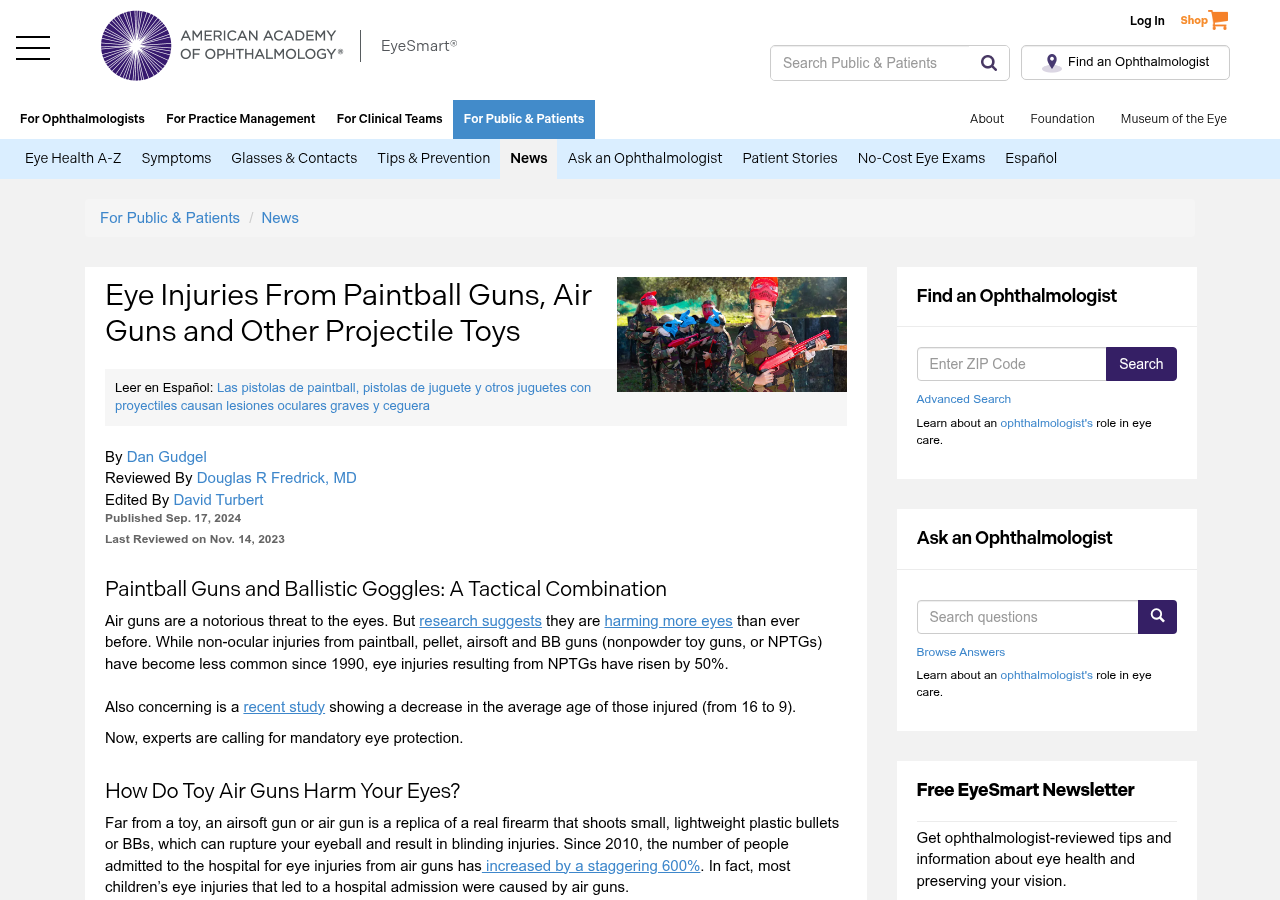
Source 2 of 3 · Industry safety body guidance
The American Academy of Ophthalmology's guidance on projectile toys: airsoft guns are replicas of real firearms, nonpowder-gun eye injuries are up about 50%, air-gun eye-injury hospital admissions are up roughly 600% since 2010, and ballistic-rated eye protection is the recommended fix.
Source: aao.org/eye-health/combating-eye-injuries-from-air-guns
For a venue weighing formats side by side, the operational differences run through age policy, protective gear, and field rules. We compare two of those profiles in airsoft vs paintball insurance, and the same logic extends to a gel blaster room: the device sets the rules, and the rules set the risk. For the gel side against paintball specifically, see GellyBall vs paintball.
Insurance: the name on the box is not the class on the policy
Whichever device a venue hosts, the policy hits the same wall first. A standard General Liability form carries the ISO CG 21 01 exclusion for athletic or sports participants, which strips coverage for injuries to the people playing. A hydrogel bead and a plastic BB are identical in the exclusion's eyes. If the venue's policy is a generic General Liability form with that exclusion attached, the players have no coverage, and Participant Injury has to be added as named coverage. We walk through how that exclusion guts a generic policy in why your paintball field's GL policy probably has gaps.

Source 3 of 3 · Standard ISO exclusion form
The ISO CG 21 01 athletic-or-sports-participants exclusion removes player-injury coverage from a standard General Liability policy. It reads the same whether the projectile is a hydrogel bead or a rigid airsoft BB, which is why Participant Injury must be named coverage for any hosted projectile play.
Source: insurancexdate.com/CG-21-01
Past the shared wall, the names pull pricing in opposite directions. A low-impact gel arena that a carrier writes up as "paintball-type activity" pays for an impact-severity tail the business does not carry; our GellyBall insurance guide covers that misclassification pattern in full, and the same fix applies to low-velocity gel blaster sessions. Airsoft pulls the other way: the replica-firearm classification and the harder projectile thin out the list of carriers willing to write the risk at all, which is why airsoft fields routinely land in the specialist market while a generalist quote comes back either hollow or mispriced. An operator hosting hobby-grade gel blaster play at airsoft-level velocities should expect underwriting questions closer to the airsoft side, whatever the equipment is called.
Operators ask me whether a gel blaster counts as a toy or as airsoft, and the policy form does not care either way. The standard exclusion strips coverage for the people playing, whatever the projectile is. The first question is never what the blaster is called. It is whether Participant Injury is named on the policy.
Bobby Sharp, Action Sports Practice Lead, Specialty Insurance
None of this requires the operator to become a forms expert. It requires two questions before binding: what class is the activity written under, and is Participant Injury named. Both answers sit on the dec page, and both are cheaper to fix at quote time than at claim time. If you are setting the business up from scratch, our guides to how to start a GellyBall party business and gel blaster party rental insurance walk the operational and coverage steps.
What this means if you host play
Hosting gel blaster or Orbeez-gun sessions. Decide which end of the velocity range you run, then put it in writing. The file that earns the low-impact rate has three documents in it:
- A posted velocity cap for the equipment you hand out, enforced at the counter.
- An eye-protection rule that follows the published research rather than the toy packaging.
- Age bands in the booking flow, matched to the equipment tier.
Hosting airsoft. Treat ballistic-rated eye protection as mandatory kit, run replica-handling rules for storage and transport, and expect the insurance conversation to happen in the specialist market.
Hosting both. Name both activities on the policy and price each on its own class. A policy that lists one activity while the venue runs another is the gap that surfaces at claim time.
Most of the operators asking these vocabulary questions are adding a new format or opening a first venue, and at that stage the speed and specificity of the broker matter as much as the premium. Here is what a new operator on the airsoft side of this comparison told us.
"Bobby Sharp and the team at Specialty Insurance had a fast turnaround, professional service, and answered every question I had as a brand-new operator. They wrote the policy I'd want defending me if a player ever filed a claim."
Grimnir Tactical LLC
Verified customer review
Talk to a broker who writes all three
A generalist agent hears "blaster" and reaches for the nearest class on the dropdown, which misprices the gel side and underprotects the airsoft side. A specialty broker works from the device, not the dropdown:
- Writes General Liability with Participant Injury named on the policy.
- Classifies gel blaster play on its measured velocity and audience, not its name.
- Prices airsoft on its real severity profile, in the specialist market that writes it.
- Names every activity the venue runs, including the mobile trailer that takes the blasters to birthday parties.
Frequently Asked Questions
Is a gel blaster the same as an Orbeez gun?
Yes. Both names describe the same device: a toy-styled blaster that fires soft, water-absorbent polymer beads, usually 6 to 8 millimeters once hydrated. Orbeez is a toy brand of water beads, and the name attached itself to every blaster that fires them. The industry's own terms are gel blaster, gel ball blaster, and water bead blaster.
Is a gel blaster the same as an airsoft gun?
No. A gel blaster fires a soft hydrogel bead that bursts on impact, while an airsoft gun fires a rigid 6 millimeter plastic BB and is built as a replica of a real firearm. The two differ in projectile, realism, injury record, field rules, and insurance classification.
Can a gel blaster cause serious injuries?
Yes, at the eye. A multicenter case series in the journal Ophthalmology documented 19 patients with gel pellet eye injuries, including hyphema in 12 eyes and surgical procedures in 7, with pellets measured at no less than 200 to 300 feet per second. The researchers recommend paintball-style eye protection for players and bystanders.
What eye protection do gel blaster and airsoft players need?
For gel blasters, researchers recommend protection similar to paintball play. For airsoft, the American Academy of Ophthalmology recommends ballistic-rated eyewear that covers the eyes fully; ski goggles and ordinary safety glasses can shatter on impact. No federal law mandates either, so the venue's posted rule is the standard that counts.
Does a venue hosting gel blaster or airsoft games need special insurance?
Yes. A standard General Liability policy carries the ISO CG 21 01 exclusion for athletic or sports participants, which strips coverage for player injuries regardless of the projectile. A venue needs General Liability with Participant Injury as named coverage, classified to the actual activity and velocity it hosts rather than to whichever sport the carrier knows best.
Sources
- Shaw J. "Risk of Ocular Trauma From Gel Pellets." EyeNet Magazine, American Academy of Ophthalmology, May 2023, summarizing Lin et al., Ophthalmology. aao.org
- American Academy of Ophthalmology. "Eye Injuries From Paintball Guns, Air Guns and Other Projectile Toys." aao.org
- ISO Commercial General Liability form CG 21 01, Exclusion: Athletic Or Sports Participants. insurancexdate.com
- Specialty Insurance. GellyBall Insurance: Why It Should Not Be Priced Like Paintball
- Specialty Insurance. Airsoft vs Paintball Insurance