

The quick answer: yes for what you resell, no for what you change
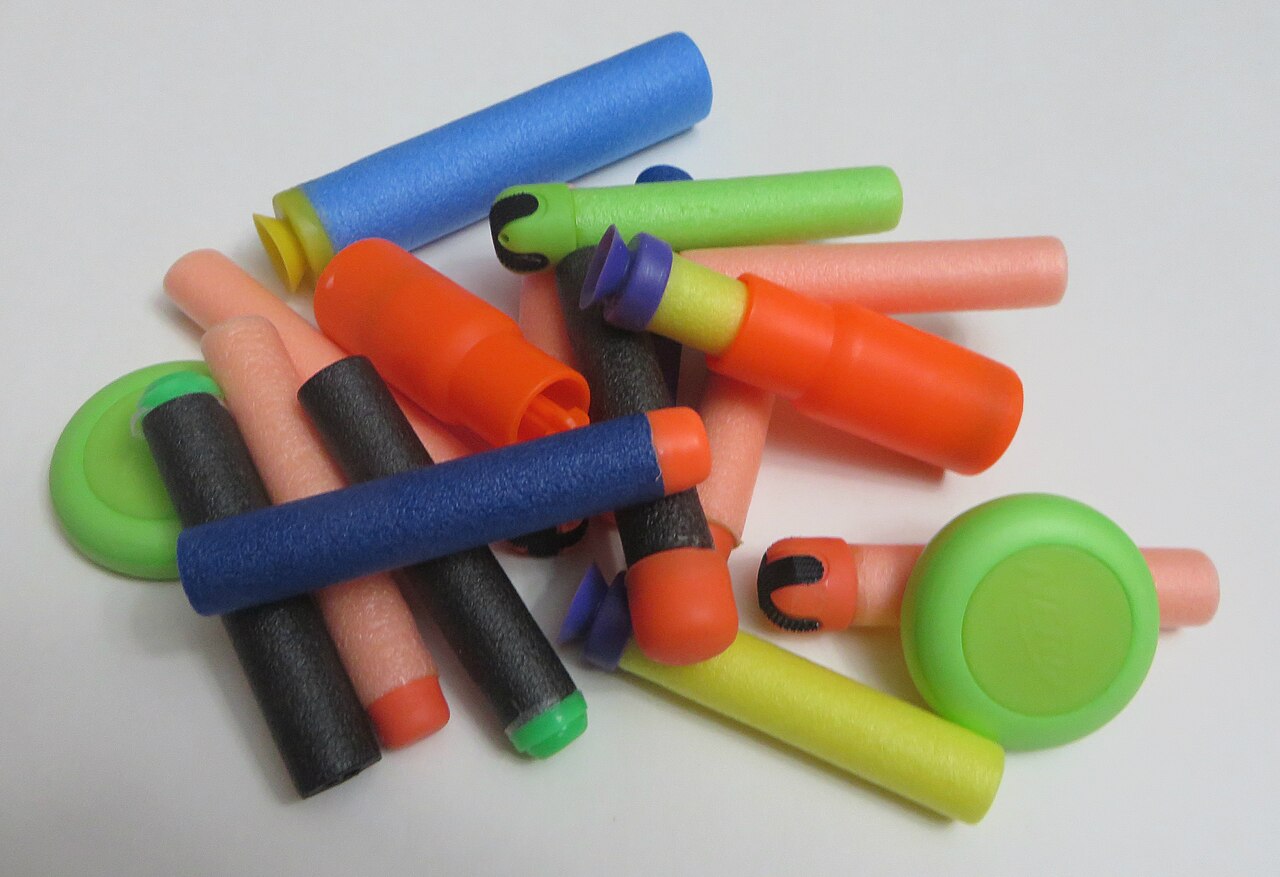
Does the product liability you already carry cover the Nerf darts you sell over the counter? For unmodified, brand-name darts sold in their original packaging, the honest answer is yes, most of the time. The exceptions are not fine print. They sit exactly where a pro shop makes its margin: house-brand darts, bulk imports, aftermarket upgrades, and the assumption that one policy covers both the arena and the shelf.
Here is the part most operators have never been told. At Nerf arena scale, product liability is usually not a separate policy. It lives inside your General Liability policy as the products-completed operations hazard: a defined term covering injury and damage that happens away from your premises, arising out of your product, after the product has left your physical possession. And "your product" is broad. The standard form sweeps in any goods "manufactured, sold, handled, distributed or disposed of" by you, wording the First Circuit read as plain and unambiguous, reaching all product-related injuries away from the premises, in a case about a sporting-goods distributor (Brazas Sporting Arms v. American Empire, 1st Cir. 2000). Sold and handled are the words doing the work: you do not need to make a single dart to carry a manufacturer-sized lawsuit.
What the products hazard covers at the counter
| The claim | Covered? | Why |
|---|---|---|
| A family buys darts, a child is hurt at home, the parents sue your shop as the seller | Generally yes | Injury away from your premises, arising out of a product you sold and no longer possess. This is the center of the products-completed operations hazard. |
| Your shop is named in a lawsuit alongside the dart's manufacturer | Defense, generally yes | Product suits name the whole chain of distribution, and the retailer sits at the bottom of that chain. The duty to defend is the coverage doing its quiet, expensive work. |
| A defective brand-name blaster you resold sealed and unopened | Generally yes | The passive retailer of a sealed product is the fact pattern the coverage was built for, and the manufacturer's policy typically responds in front of yours. |
One nuance before the gaps: this only describes what you sell. The rental blasters your players use inside the arena are not "your product" under the standard form, because rented gear is never sold. A claim from a poorly maintained rental blaster is a premises and operations claim, a different part of the same policy. Do not let anyone quote your pro shop as if the rental fleet were the exposure.
The chain-of-distribution point is not theoretical. Products liability law reaches "the retail store owner (at the bottom of the chain)," as Cornell's Legal Information Institute puts it, and it is generally strict liability: no negligence required, only a defect. South Carolina, our home state, wrote that rule into statute at S.C. Code § 15-73-10: a seller "engaged in the business of selling such a product" answers for a defective, unreasonably dangerous product even if the seller "has exercised all possible care." Some states soften this with innocent-seller statutes, and every one of those shields has holes shaped like a pro shop, which brings us to the gaps.
Where the coverage stops: the five gaps
| The gap | Why it opens |
|---|---|
| Injury during play inside your arena | The products hazard applies away from your premises. Inside the arena, an injured player is a participant claim, and the standard ISO CG 21 01 exclusion strips participant injuries out of an unmodified General Liability form. |
| Darts you modify or upgrade | Re-spring a blaster or sell "high-impact" tuned darts, and at claim time you are no longer a retailer. Texas' innocent-seller statute, for example, drops its shield the moment "the seller altered or modified the product" (Tex. Civ. Prac. & Rem. Code § 82.003). |
| House-brand darts with your logo | Put your arena's name on the bag and the apparent manufacturer doctrine treats you "as though [you] were its manufacturer" (Restatement § 400, adopted in nearly every state that has faced the question). |
| Generic imports with an unreachable manufacturer | Innocent-seller statutes tend to hold their shield only while the manufacturer can be reached and can pay. Texas' statute, for one, lifts it when the manufacturer is insolvent or outside the court's jurisdiction. An anonymous overseas wholesaler is both, and the retailer holds the whole claim. |
| A recall | The standard form's Exclusion n bars coverage for the "loss of use, withdrawal, recall, inspection, repair, replacement, adjustment, removal or disposal" of your product. Pulling a bad dart lot off the shelf is on you. |
The first row is the one that surprises operators at claim time, and it cuts in the opposite direction from everything above. Product liability handles the dart after it leaves the building. It does nothing for the player holding it inside your arena, because on an unmodified General Liability form the CG 21 01 exclusion removes the people playing from coverage entirely. We walk through how that exclusion guts a generic policy in why your paintball field's GL policy probably has gaps; the fix is named Participant Injury coverage sitting beside the products coverage, not one pretending to be the other.
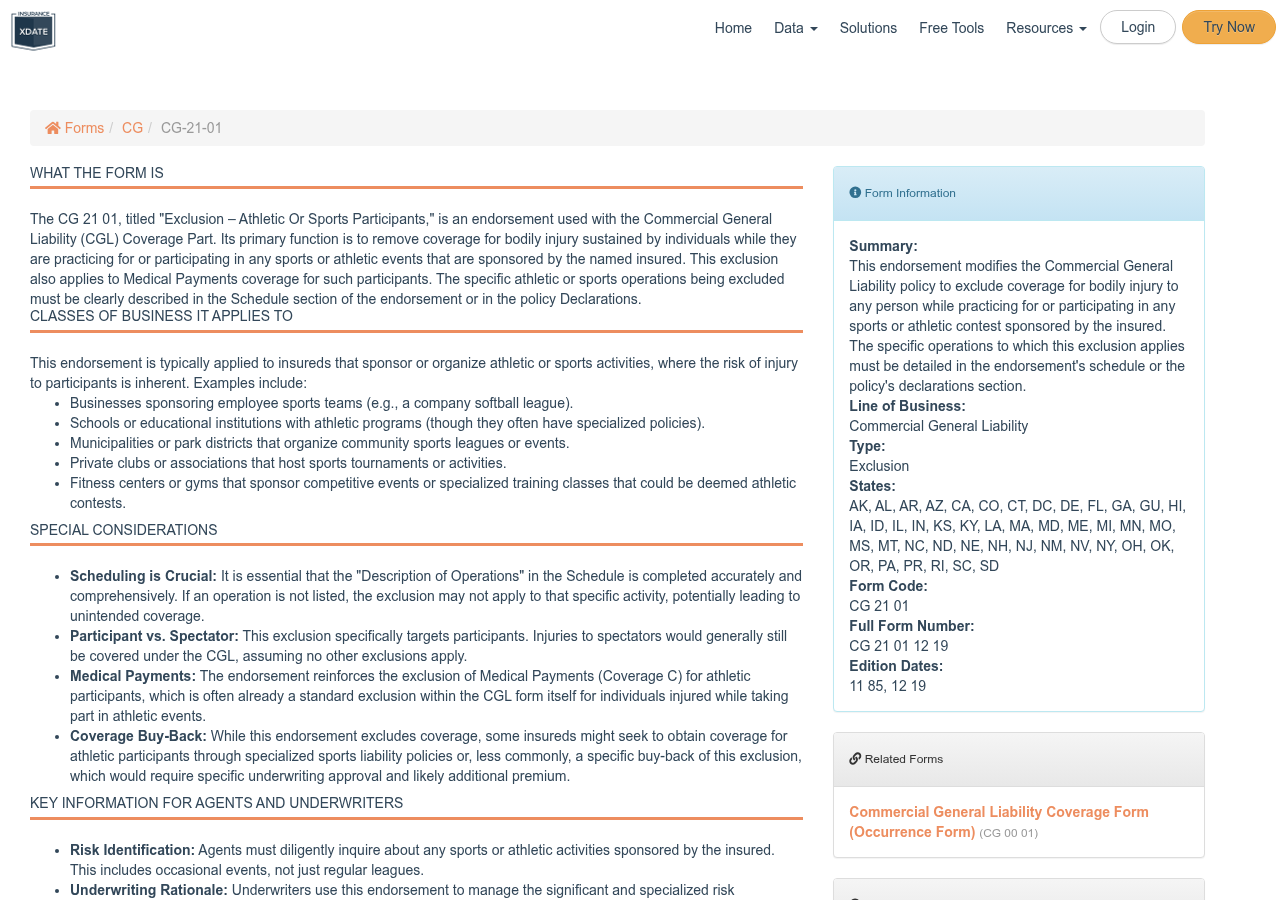
Source 1 of 3 · Standard ISO exclusion form
Product liability covers the dart you sold once it leaves the premises. This exclusion decides whether the player inside your arena is covered at all. Two different exposures, two different coverages.
That split, products coverage on one side and participant coverage on the other, only holds if the policy knows both sides of your business exist. The document that tells it is the description of operations, and it is the first page an adjuster turns to when a claim lands. A Nerf arena policy that never names the retail counter is a policy priced for half the business, and the half it left out is the half you asked about.
When a pro shop owner asks me whether the darts on the wall are covered, I read two lines on the dec page: the products-completed operations aggregate and the description of operations. If the description says arena and never mentions retail, the carrier priced a business without a shelf. The adjuster will read the same two lines I do.
Bobby Sharp, Action Sports Practice Lead, Specialty Insurance
The claim record behind a foam dart
A foam dart reads as the safest product in the building. The federal record says otherwise, and it is worth knowing because it is exactly the record a plaintiff's attorney will put in front of a jury.
In May 2010, the Consumer Product Safety Commission and Family Dollar recalled 1.8 million "Auto Fire" toy dart gun sets after children asphyxiated on the soft plastic darts. CPSC's recall notice reports the deaths of a 9-year-old in Chicago and a 10-year-old in Milwaukee, and its hazard line is blunt: the soft, pliable dart "can be inhaled into the throat and prevent the child from breathing." These were $1.50 generic sets, not Nerf-brand product, which is precisely the point for a shop deciding what to stock.
The distribution chain is the part a pro shop should sit with. The importer, Henry Gordy International, refused to conduct the recall, so the retailer carried it out with CPSC, and the importer later agreed to a $1,100,000 civil penalty for failing to report the hazard. Federal law puts that reporting duty on manufacturers, distributors and retailers, within 24 hours.
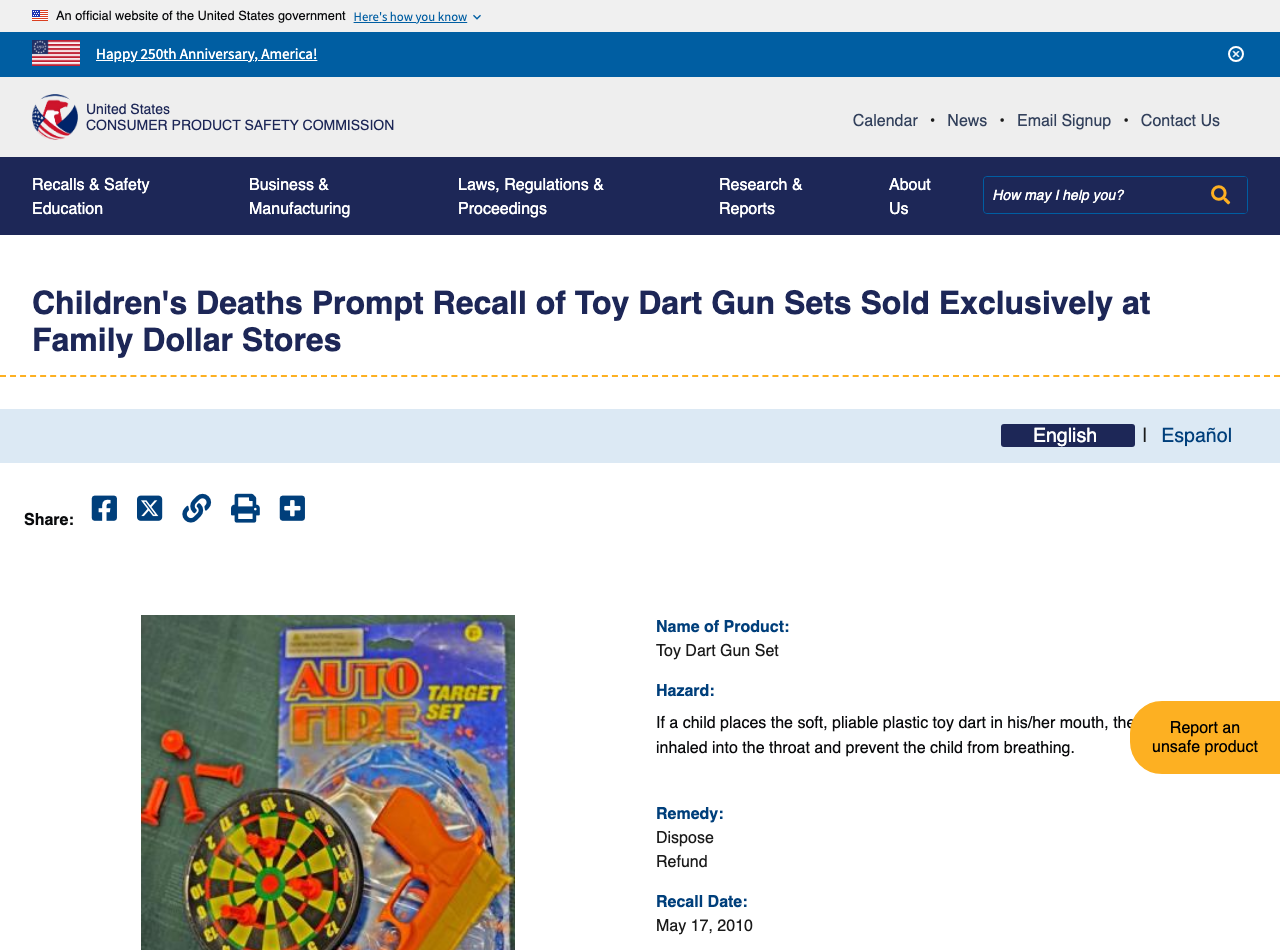
Source 2 of 3 · Federal recall record
CPSC's May 2010 recall of 1.8 million toy dart gun sets after two children asphyxiated on soft darts. The importer refused to act, and the retailer conducted the recall.
Source: cpsc.gov/Recalls/2010/childrens-deaths-prompt-recall-of-toy-dart-gun-sets
The eye-injury record is deeper. A BMJ Case Reports series from Moorfields Eye Hospital documented three patients in three months, each with traumatic hyphema (bleeding inside the eye) after Nerf gun shots, and flagged a detail every pro shop should read twice: the injuring darts in one case were unlabelled aftermarket darts, sold at roughly a tenth of the official price, with heads the authors found firmer to the touch (Bizrah and Verma, BMJ Case Reports, 2017). The American Academy of Ophthalmology's warning is the same: "Off-brand replacement darts can be even harder than the Nerf brand, causing even more damage" (aao.org).
At population scale the pattern holds. A 12.5-year French trauma-center study put foam projectiles at 151 of 304 toy-gun eye injuries, half the total, including two open-globe injuries and one boy under 10 left without light perception in one eye (Dentel et al., JAMA Ophthalmology, 2023).
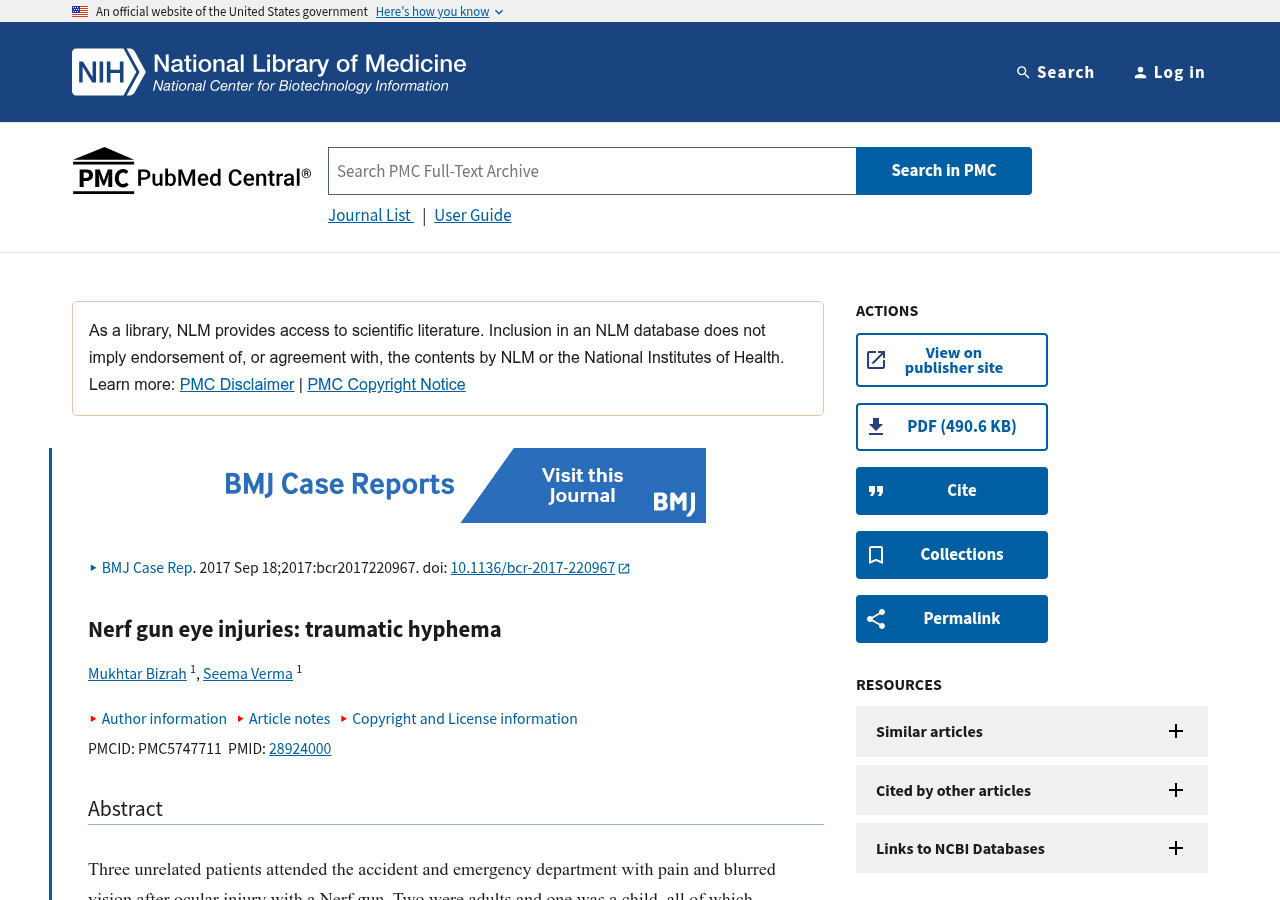
Source 3 of 3 · Peer-reviewed clinical record
The 2017 Moorfields case series that documented traumatic hyphema from Nerf gun shots and identified firmer aftermarket darts as a distinct hazard: the published version of "what you stock matters."
And the settlement question, since it is the one operators search for: no public settlement figure exists for any foam-dart choking or injury claim against a seller, manufacturer, or venue. The one Nerf blaster case tried to verdict, Schwartz v. Hasbro (N.J. App. Div. 2012), ended in a defense win, and the retailer that sold the blaster was dismissed before trial. Read that honestly: claims in this category either never get filed or settle confidentially, and the measurable exposure for a small seller is the defense bill, which is exactly what the products coverage exists to absorb.
There is also a compliance layer under all of this. Federal small-parts rules ban small parts outright in products intended for children under 3 and require the choking-hazard warning on products for ages 3 to 6, and the labeling rule reaches unpackaged product sold from a retail bin or display container (16 CFR § 1500.19). A pro shop selling loose darts from a counter bin is inside that sentence. Toy safety standard ASTM F963, mandatory under federal law, adds projectile-specific performance requirements. None of this is a reason not to run retail. It is the paperwork that decides whether a claim file opens with "compliant seller" or the opposite.
The moment your logo goes on the bag, the law stops treating you as the store and starts treating you as the factory. That is not a branding decision. It is a liability decision, and your policy needs to be told before the first bag sells.
Bobby Sharp, Action Sports Practice Lead, Specialty Insurance
How to close the gaps before the next sale
- Read the products-completed operations aggregate on your dec page. It is a separate limit from your per-occurrence limit, and it is the number a dart claim draws down.
- Name the retail operation in your description of operations. A policy that describes an arena and says nothing about a shop invites a described-operations argument, the same mismatch we cover in is GellyBall insurance the same as paintball coverage.
- Stock brand-name product from manufacturers who will add you as an additional insured. A vendors endorsement puts the manufacturer's policy in front of yours for products you resell unmodified.
- Keep SKU-level purchase records. The fastest exit from a chain-of-distribution suit is proving exactly whose product it was and when you bought it. If the manufacturer cannot be identified, you become the deepest pocket in the room.
- Match the shelf to the age labels. Keep under-3 product out of the shop, honor the 3-to-6 choking-hazard warnings, and label the loose-dart bin.
- Cover the arena side separately. Named Participant Injury coverage for the players, products coverage for the shelf. If you also run mobile parties, add off-premises liability and inland marine so the program travels.
On price: within Specialty Insurance's own book, a Nerf arena program typically quotes at $1,000 to $2,000 per year, and combined Nerf and archery operations at $2,000 to $3,000, with products-completed operations coverage written into the General Liability program rather than bolted on as a separate policy. What moves the number is retail volume, what you stock, and whether anything gets modified in-house.
Operators who moved from a generalist quote to a specialist program describe the same difference: someone finally asked what the business sells.
"Specialty Insurance diligently takes their time and works with you, making sure your business has all the correct and specific coverages you need. There is no other source out there that does what they do for the airsoft and paintball industries."
Gel Tag San Diego LLC
Verified customer review
Talk to a broker who reads the products line before selling it
A generalist agent quotes a Nerf arena as a room with foam in it and never asks what the register sells. A specialty broker writes the arena, the pro shop, and the mobile trailer as one described program: participant coverage for the players, a products-completed operations aggregate sized for the shelf, and certificates that match every booking. Specialty Insurance has underwritten action-sports venues for more than 20 years, holds licenses in all 50 states, and turns quotes around in 24 hours. The difference shows up on the worst day, when the adjuster reads the description of operations and finds your whole business inside it.
Frequently Asked Questions
Has a Nerf dart choking hazard ever produced a product liability settlement?
No public settlement figure is on record for any foam-dart choking claim. The public record shows a 2010 CPSC recall of 1.8 million toy dart gun sets after children asphyxiated on soft darts, and a $1,100,000 civil penalty paid by the importer for failing to report the hazard. Injury claims in this category settle confidentially or never get filed, so the exposure a seller can plan for is the defense cost.
How much does product liability insurance cost for a Nerf business?
Within Specialty Insurance's book of business, a Nerf arena program typically quotes at $1,000 to $2,000 per year, and combined Nerf and archery operations at $2,000 to $3,000. At pro shop scale, product liability is written into the General Liability program as products-completed operations coverage rather than priced as a separate policy. Retail volume, what you stock, and in-house modifications move the number.
Can a mobile Nerf arena get a product liability quote the same day?
Specialty Insurance quotes action-sports programs on a 24-hour turnaround in all 50 states, and same-day is realistic when the file arrives complete. A mobile Nerf arena needs the same products-completed operations coverage plus off-premises liability and inland marine on the traveling gear. Send your dec page, a list of what you sell, and your booking calendar.
Do I need product liability insurance for axe throwing?
Yes, if your venue sells throwing axes, blades, or branded merchandise. The mechanics are identical to the dart wall, with a sharper severity profile: the products-completed operations hazard follows what you sold out the door, while participant coverage handles throwers inside the venue. An axe pro shop should confirm both lines exist on the dec page before the next retail order.
How much product liability insurance do I need for a paintball field?
The structure most carriers quote is $1 million per occurrence with a $2 million products-completed operations aggregate, the same limits the general liability program carries. A paintball field with a busy pro shop selling markers, tanks, and paint should review whether that aggregate matches retail volume, because one serious product claim and its defense can draw the limit down faster than an owner expects.
Related reading: how the same described-operations discipline applies to axe throwing venues and paintball fields.
Sources
- U.S. Consumer Product Safety Commission. Children's Deaths Prompt Recall of Toy Dart Gun Sets Sold Exclusively at Family Dollar Stores. Recall 10-234, May 17, 2010. cpsc.gov
- U.S. Consumer Product Safety Commission. Henry Gordy Agrees to $1,100,000 Civil Penalty For Failure to Report. October 2011. cpsc.gov
- Bizrah M, Verma S. Nerf gun eye injuries: traumatic hyphema. BMJ Case Reports, 2017. pmc.ncbi.nlm.nih.gov
- Dentel A, et al. Incidence of Eye Trauma in Children Associated With Foam Bullets or Foam Darts From Nonpowder Guns. JAMA Ophthalmology, 2023. pmc.ncbi.nlm.nih.gov
- American Academy of Ophthalmology. Toy Guns, Crossbows and Nerf Darts Can Shoot Your Eyes Out. aao.org
- Brazas Sporting Arms, Inc. v. American Empire Surplus Lines Ins. Co., 220 F.3d 1 (1st Cir. 2000). law.justia.com
- Schwartz v. Hasbro, Inc., N.J. Super. Ct. App. Div., Docket A-3021-10T4 (2012). law.justia.com
- S.C. Code of Laws § 15-73-10, Liability of seller for defective product. law.justia.com
- Texas Civ. Prac. & Rem. Code § 82.003, Liability of Nonmanufacturing Sellers. statutes.capitol.texas.gov
- 16 CFR § 1500.19 and Part 1501, choking-hazard labeling and small-parts regulations. ecfr.gov
- U.S. Consumer Product Safety Commission. Toy Safety Business Guidance (ASTM F963 mandatory standard). cpsc.gov
- Cornell Law School Legal Information Institute. Products liability. law.cornell.edu
- Insurance Information Institute. Product liability, recall and contamination insurance. iii.org
- ISO Commercial General Liability form CG 21 01, Exclusion: Athletic Or Sports Participants. insurancexdate.com