

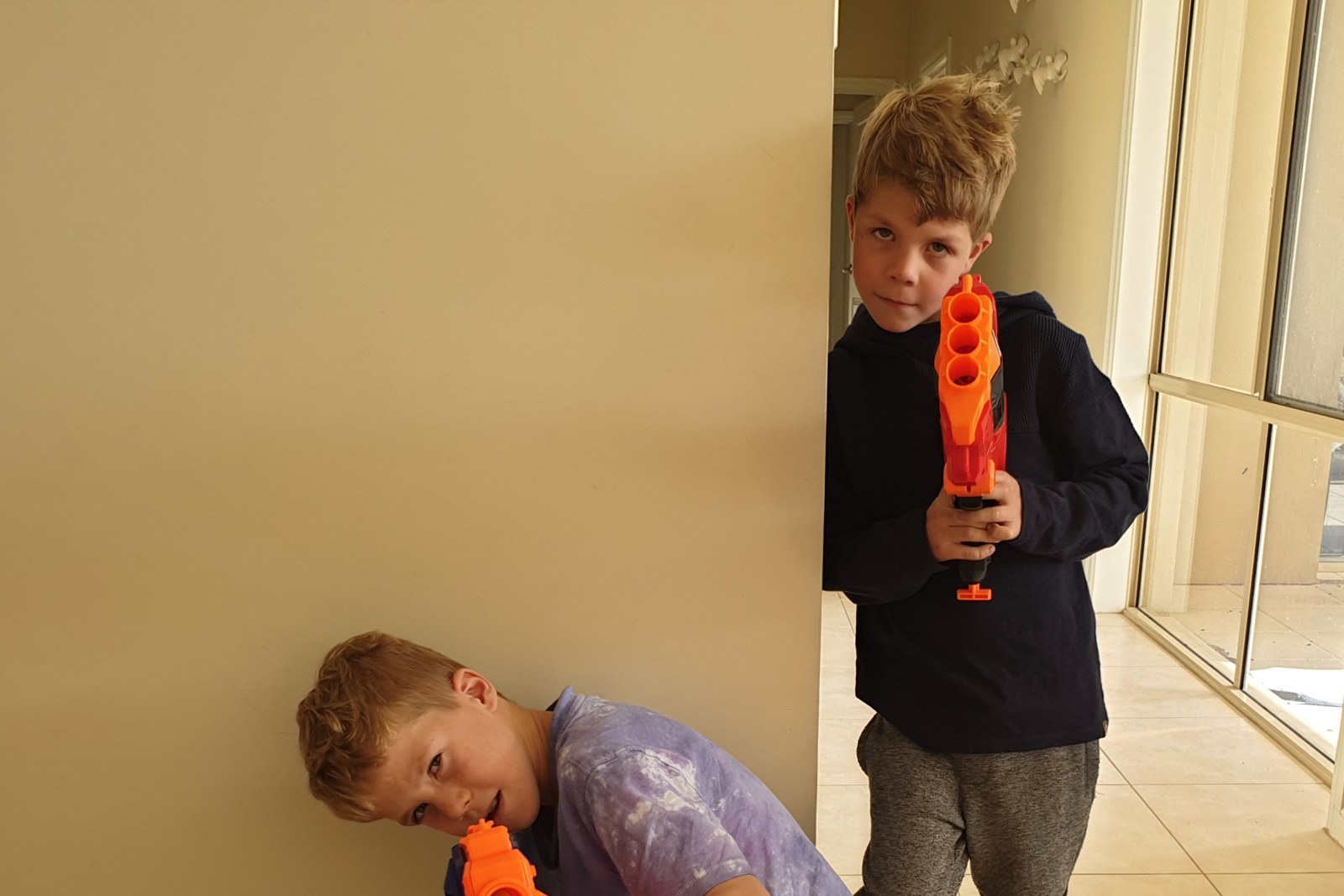
Hand your league-night referees thirty dollars in cash after the last game and call them volunteers. That is how a lot of nerf arenas staff their high-school league, and it quietly fails two separate bodies of law at once. Federal wage law does not recognize volunteers at for-profit businesses, and state workers comp law counts everyone you regularly pay, whether or not payroll software was involved.
The quick answer, and the three questions that decide it
If you pay your referees and your total headcount has reached your state's threshold, yes, you need workers compensation. The details come down to three questions:
- Are the referees paid? Per-game cash counts. Under the Fair Labor Standards Act, "employees may not volunteer services to for-profit private sector employers" (U.S. Department of Labor). The volunteer route exists for school and nonprofit leagues, not for your arena.
- How many people do you regularly employ in total? The threshold counts your whole staff: front desk, party hosts, floor marshals, and the referee crew. In South Carolina, part-time workers count toward the total (South Carolina Workers' Compensation Commission FAQ).
- Which state are you in? Most states require coverage from the first employee. South Carolina exempts employers with fewer than four. Texas leaves it elective.
One clarification: if the school or a booster club runs the league and pays the officials, those referees are the school's problem. This article is about the more common setup where the arena hosts the league and pays the people running it. Those referees are yours.
What workers comp covers at a nerf arena
Workers compensation responds when your own people get hurt doing their jobs, and recreation work is more physical than operators assume: the amusement, gambling, and recreation industries recorded 3.3 injury and illness cases per 100 full-time workers in 2024, against a 2.3 average across all private industry (Bureau of Labor Statistics). Referees who jog backward across a bunker field all night live inside that number.
| Who gets hurt | How workers comp responds |
|---|---|
| Paid referee rolls an ankle stepping off an inflatable bunker | Medical treatment and a share of lost wages, no fault argument required |
| Floor marshal strains a shoulder resetting barricades between rounds | Covered the same way; sprains and strains are the sector's most common injury type (BLS) |
| Front desk or party host slips in the lobby | Covered; falls, slips, and trips drive the largest share of days-away cases in recreation (BLS) |
| Injured employee sues you instead of claiming benefits | Part Two of the policy, employer's liability, defends the business (Insurance Information Institute) |
Premium is calculated on payroll: a classification rate per $100 of wages, multiplied by your payroll, then adjusted for loss history. We come back to the classification question in the cost section, because it moves the bill more than operators expect.
What workers comp does not cover
This is where nerf arena operators get the boundary wrong in both directions. Workers comp covers employees only. Everyone else in the building on league night needs a different policy, and your general liability form has been drafted specifically to push two groups of people away.
| Who gets hurt | Where coverage really lives |
|---|---|
| League player takes a dart to the eye mid-match | Participant accident coverage, because general liability can exclude athletic participants outright |
| Spectator parent trips on the viewing platform | General liability, premises exposure; spectators are generally still covered when a participant exclusion applies |
| True volunteer in a school or nonprofit league | The league's or school's accident policy; volunteers are generally not employees for workers comp purposes |
| Genuinely independent 1099 official | Their own coverage, but the classification has to survive scrutiny, and the presumption rarely favors the venue |
| Your own employee, any role | Never general liability: the standard form excludes employee injury and anything owed under a workers comp law |
The two exclusions doing that pushing are worth reading in the original. The standard commercial general liability form, ISO CG 00 01, excludes bodily injury to an employee of the insured "arising out of and in the course of" their employment, and separately excludes "any obligation of the insured under a workers' compensation, disability benefits or unemployment compensation law." Employees are carved out because, in the Insurance Information Institute's words, they "are usually covered for work-related injuries by workers compensation insurance." If you skipped workers comp, the carve-out does not soften. It points at a policy you do not have.
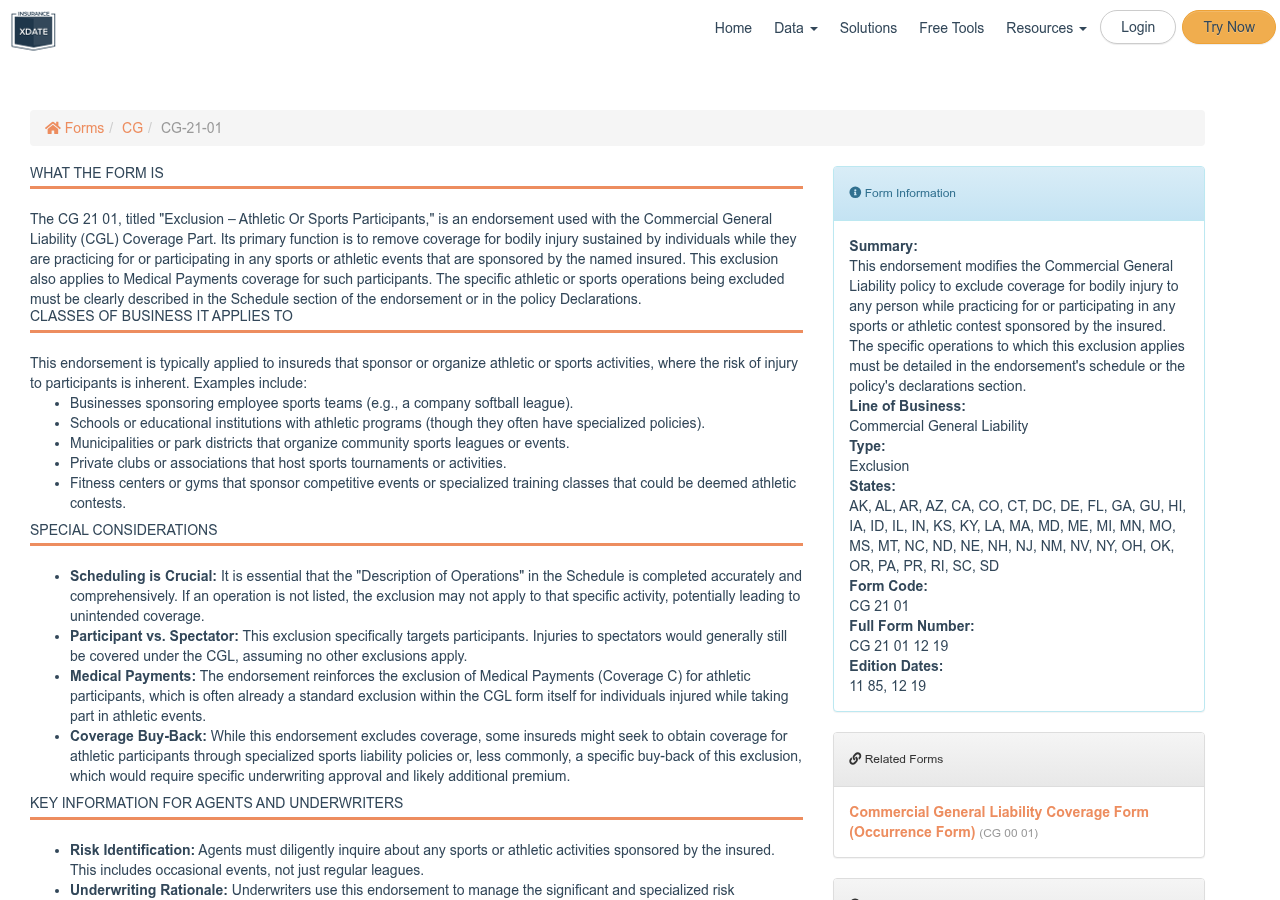
Source 1 of 3 · Standard ISO exclusion form
ISO endorsement CG 21 01, Exclusion: Athletic Or Sports Participants. When attached, it removes general liability coverage for injury to "any person while practicing for or participating in any sports or athletic contest sponsored by the insured." The form never defines "participating," and it does not mention officials.
That undefined word is the referee trap. Whether an official counts as a "participant" under CG 21 01 is the kind of ambiguity that gets litigated after the injury instead of resolved before it. A referee who is your employee never has to win that argument, because workers comp answers first. A referee who is neither employee nor clearly excluded participant leaves everyone reading the form in a conference room. We walked through the underlying exclusion mechanics in why an action-sports general liability policy has gaps; the same logic runs through every venue we write.
When a referee gets hurt on the floor, the first document I pull is not the incident report. It is the payroll record. Whether that referee was paid, and how, decides which policy answers, and whether one answers at all.
Bobby Sharp, Action Sports Practice Lead, Specialty Insurance
Claim time: three people get hurt on league night
Picture a Saturday league night. This scenario is hypothetical, but every mechanism in it is statutory, and each injury lands on a different policy.
A 15-year-old player takes a dart to the eye. A customer, not a worker. This claim belongs to participant accident coverage, with general liability behind it if the family alleges negligence, subject to whatever participant exclusion rides on the form. We compared the two coverages in detail in Participant Injury vs General Liability.
Your paid 17-year-old referee lands badly stepping off a bunker. With workers comp in place, this is a routine claim: treatment paid, wages partly replaced, exclusive remedy intact. Without it, South Carolina's machinery starts up:
- The Uninsured Employers' Fund pays the injured worker, then holds "a lien against the assets of the employer to the full extent of all costs, expenses, and benefits paid," collectible like state tax debt (S.C. Code § 42-7-200).
- The Commission can fine an uninsured employer up to $100 for each day without coverage (§ 42-5-40).
- The employee may skip the benefit system and sue you for damages with your common-law defenses barred, and willful failure to carry coverage is a criminal misdemeanor (§ 42-5-40, § 42-5-45).
The "volunteer" referee you hand $30 after each game tears a knee. The state does not read the word volunteer; it reads the payment. Federal rules allow a true nominal fee for public-agency volunteers, but a fee that substitutes for compensation or tracks games worked breaks volunteer status (29 CFR 553.106), and for-profit businesses were never eligible to begin with. Reclassified after the fact, this referee was an employee all along: the injury claim, back premium, and employment-tax exposure arrive together (IRS).
I have never seen a carrier or a commission accept the word volunteer on its own. They look at whether money changed hands after the games. If it did, the referee was on payroll, whether or not payroll knew it.
Bobby Sharp, Action Sports Practice Lead, Specialty Insurance
Three injuries, three doors, and only the operator who sorted the classification question in advance walks through the right one each time. That sorting is a twenty-minute exercise before the season and an expensive argument after an injury.
When workers comp is required, state by state
Specialty Insurance is licensed in all 50 states, and this is the question where the state line changes the answer most. Most states require coverage from the first employee. A minority set numeric thresholds, and Texas makes coverage elective for most private employers. South Carolina, our home state, is one of the threshold states:
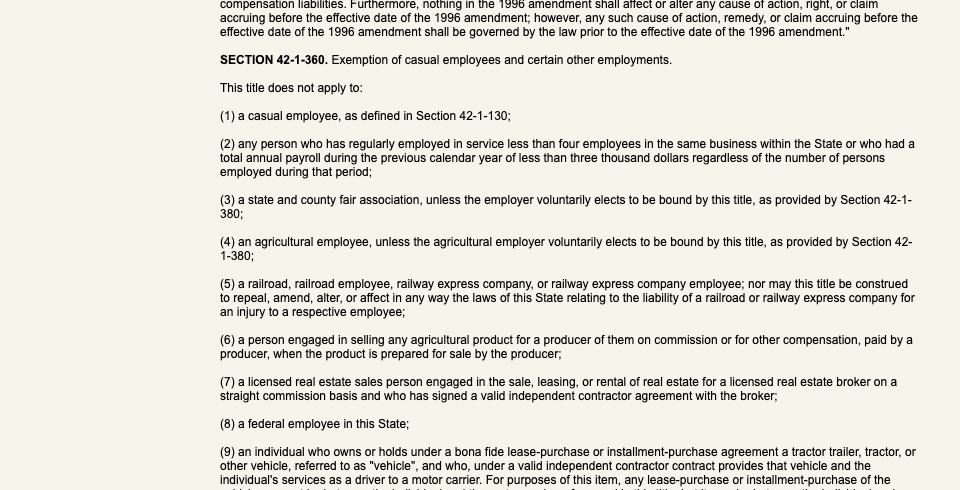
Source 2 of 3 · State statute text
S.C. Code § 42-1-360(2): the Workers' Compensation Act does not apply to a person "who has regularly employed in service less than four employees in the same business within the State" or whose prior-year payroll was under $3,000. Hire the fourth regular part-timer and the exemption ends.
| State | When coverage becomes mandatory |
|---|---|
| South Carolina | 4 or more regularly employed workers; part-timers and family members count (S.C. Code § 42-1-360; WCC FAQ) |
| Florida | 4 or more employees for non-construction businesses |
| Georgia | 3 or more workers, including regular part-time workers |
| Virginia | More than two employees |
| Missouri / Alabama / Tennessee | 5 or more employees |
| California / New York | From the first employee; New York covers virtually all employers |
| Texas | Elective for most private employers, with consequences for opting out |
Two wrinkles matter for a high-school league specifically. First, many of your referees are high-school students themselves, and federal law shapes their shifts: 14 and 15 year olds may work no more than 3 hours on a school day, Friday counts as a school day, and work must end by 7 p.m. during the school year (U.S. Department of Labor, YouthRules). A Friday-night league staffed by 15-year-old referees is a wage-and-hour violation before the first whistle. Second, workers comp covers minors like any other employee; South Carolina defines employee to include minors "whether lawfully or unlawfully employed." Some states go further: New York doubles the compensation owed to an illegally employed minor, the employer alone pays the increase, and any policy provision shifting it to the carrier is void (N.Y. Workers' Compensation Law § 14-a).
The school booking: certificates, field days, and what districts demand
The moment your league touches school property, or a school brings a field-day group to your arena, a certificate of insurance enters the picture, and districts are specific about what has to be on it. Here is a real district's posted facility-use requirement set:
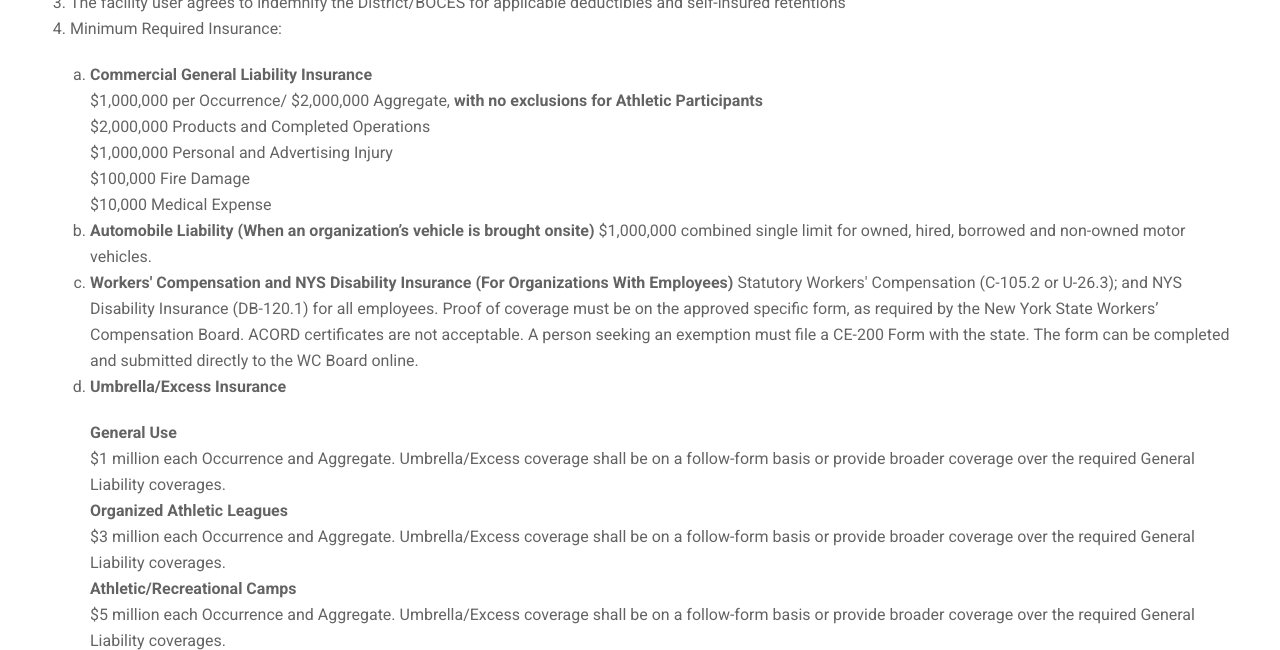
Source 3 of 3 · District facility-use insurance requirements
Briarcliff Manor Union Free School District (NY) posts a sample facility-use requirement set (the New York Schools Insurance Reciprocal template) demanding $1,000,000 per occurrence and $2,000,000 aggregate in general liability "with no exclusions for Athletic Participants," statutory workers comp for any organization with employees, and umbrella limits that step up to $3,000,000 for organized athletic leagues.
Source: briarcliffschools.org/district-information/facilities-use/facilities-use-requirements
Read that posted requirement set as a package:
- General liability with the athletic-participant exclusion removed.
- The district named as additional insured on a specific endorsement.
- A certificate of insurance delivered before the event.
- If you have employees, proof of statutory workers comp on state-approved forms; New York districts will not even accept a standard ACORD certificate as workers comp proof.
Districts elsewhere run the same play. Rockwood School District in Missouri requires third-party vendors to provide a certificate naming the district as additional insured, and its parent-group insurance program excludes laser tag and paintball style activities outright, so the vendor's own program has to carry the event. We covered the certificate mechanics in our guide to getting a certificate of insurance for city park bookings; school districts are the same discipline with stricter paperwork.
What the coverage program costs
Two numbers, honestly framed. First, the venue program: based on Specialty Insurance's own quoting ranges as of July 2026, a standalone nerf venue typically runs $1,000 to $2,000 a year for the core liability program, and $2,000 to $3,000 where the venue adds archery lanes. Your nerf arena program should pair that liability layer with participant accident for the players.
Second, the workers comp layer, where no honest flat number exists because premium rides on your payroll and your state's rates. The national average employer cost across all industries was $1.00 per $100 of covered wages in 2022, per the National Academy of Social Insurance. Run the arithmetic on a real crew: two referees working 12 hours a week at $12 an hour is roughly $15,000 in annual payroll, which at the all-industry average implies about $150 a year. Recreation class rates run higher and small policies hit carrier minimum premiums, so a real quote lands above that, but the order of magnitude holds: for a part-time crew, workers comp is a hundreds-of-dollars decision protecting you from a six-figure mistake.
Published state rates, example
Why the class code assignment matters
One state's published workers comp assigned-risk rates per $100 of payroll (West Virginia, effective January 1, 2025). The amusement-device code covers mechanical rides, not foam-combat play, but the spread shows how far the bill can move on classification alone. Code numbers are not uniform across rating bureaus: West Virginia's 9063 is a YMCA-type institution, while New York uses 9063 for amateur sports officials.
Source: West Virginia Offices of the Insurance Commissioner, assigned risk rates by class, eff. Jan 1, 2025
There is no foam-combat entry on any of those rate pages, which is the point: your carrier assigns your people by analogy, and the assignment moves the bill. New York's rating board, for one, places officials in amateur and recreational sports under class 9063, noting the classification "is assigned to coaches, managers, trainers, equipment managers, and sports officials." A broker who writes action-sports venues every week argues that classification before it binds. A generalist finds out at audit.
"Specialty Insurance has been an incredible foundation for our business. They are personal, professional, and easy to work with."
Ballahack Airsoft LLC
Verified customer review
Talk to a broker who writes the whole program
The referee question is never only a workers comp question. It touches your general liability exclusions, your participant accident layer, your school certificates, and your state's threshold arithmetic, and the pieces have to be placed together or a claim finds the seam between them. Specialty Insurance writes nerf, foam-combat, and action-sports venues in all 50 states, quotes in 24 hours, and reads the payroll question the way a claims adjuster will. Before league season books, have a specialist confirm which of your people are employees, what your state requires, and what every school on your calendar will demand on the certificate.
Frequently Asked Questions
Do volunteer nerf league referees need workers comp coverage?
A for-profit nerf arena cannot legally staff league night with unpaid volunteers. Under the FLSA, employees may not volunteer services to for-profit private sector employers; true volunteer referees exist only in school, public-agency, and nonprofit leagues. If your venue pays or compensates referees in any form, treat them as employees for workers comp purposes and confirm your state's rules before the season starts.
What workers comp class code applies to a nerf arena employee?
No rating bureau publishes a nerf-specific class code. Carriers classify foam-combat venues by analogy to existing amusement and recreation codes, such as 9016 for fixed-location amusement or exhibition operations, and the assignment varies by state. New York's rating board, for example, assigns amateur and recreational sports officials to code 9063. Published rates differ sharply between codes, so the classification is worth a specialist's review.
My referees earn minimum wage part time. Do I still need workers comp?
Wage level does not change the obligation; headcount and state law do. Part-time workers count toward thresholds in states like South Carolina. The upside is that premium is calculated on payroll, so a small part-time referee crew is a small premium base. At the national average employer cost of $1.00 per $100 of covered wages (NASI, 2022 data), a roughly $15,000 part-time payroll implies a cost in the hundreds of dollars a year, subject to carrier minimum premiums.
What insurance does a school require for a nerf event or field day?
School districts that publish facility-use requirements typically ask for commercial general liability of $1,000,000 per occurrence and $2,000,000 aggregate with no exclusions for athletic participants, an additional insured endorsement naming the district plus a certificate of insurance before the event, and statutory workers comp proof from any organization with employees. New York districts, for example, tier umbrella requirements up to $3,000,000 for organized athletic leagues. The district's own insurance does not cover your staff.
Is a participant injury at a gun range or nerf arena a workers comp claim?
No. Workers comp responds only to your employees. A customer hurt while playing at a nerf arena, or shooting on a gun range line, is a general liability and participant accident matter. Standard general liability forms can exclude injuries to athletic participants under endorsement CG 21 01, which is why participant accident coverage exists as its own line. The boundary is the payroll record: employees go to workers comp, customers go to the liability and accident program.
Can I pay nerf referees as 1099 contractors to avoid workers comp?
Issuing a 1099 does not settle the question. The IRS common-law test looks at behavioral control, financial control, and the relationship, and South Carolina's commission states the method of payment is not the sole determining factor. Misclassification means back premiums, employment-tax liability, and an uncovered injury claim. Even states with sports-official independent contractor statutes, such as Alabama and Georgia, wrote them for school, public-entity, and nonprofit leagues, not for-profit venues.
Sources
- S.C. Code Ann. § 42-1-360, § 42-1-130 (Title 42, Ch. 1): scstatehouse.gov/code/t42c001.php
- S.C. Code Ann. § 42-5-40, § 42-5-45 (penalties): scstatehouse.gov/code/t42c005.php
- S.C. Code Ann. § 42-7-200 (Uninsured Employers' Fund): scstatehouse.gov/code/t42c007.php
- South Carolina Workers' Compensation Commission, Coverage and Compliance FAQs: wcc.sc.gov/coverage-and-compliance-faqs-0
- U.S. Department of Labor, elaws FLSA Advisor, Volunteers: webapps.dol.gov/elaws/whd/flsa/docs/volunteers.asp
- 29 CFR § 553.106, Payment of expenses, benefits, or fees: ecfr.gov (29 CFR 553.106)
- IRS, Independent contractor (self-employed) or employee?: irs.gov
- N.Y. Workers' Compensation Law § 14-a, double compensation for illegally employed minors: law.justia.com
- Ala. Code § 25-5-50 (sports officials): law.justia.com; O.C.G.A. § 34-9-2: law.justia.com
- ISO CG 00 01 04 13 specimen (exclusions d. and e.): sonomacounty.gov (specimen PDF)
- ISO CG 21 01, Exclusion: Athletic Or Sports Participants: insurancexdate.com
- Insurance Information Institute, Workers Compensation Insurance and Liability Insurance guides: iii.org
- National Academy of Social Insurance, Workers' Compensation: Benefits, Costs, and Coverage (2022 data, Nov 2024): nasi.org (PDF)
- NYCIRB Classification Digest, classes 9016 and 9063: nycirb.org
- West Virginia Offices of the Insurance Commissioner, assigned risk rates effective Jan 1, 2025: wvinsurance.gov (PDF)
- U.S. Department of Labor, YouthRules, 14-15 year olds: dol.gov/agencies/whd/YouthRules
- Briarcliff Manor UFSD, Facilities Use Requirements: briarcliffschools.org; Rockwood School District, parent-group insurance guidance: rsdmo.org
- Bureau of Labor Statistics, Table 1, incidence rates by industry, 2024; news release USDL-26-0101: bls.gov/iif