
The largest bowling operator in North America told its shareholders something in 2025 that most center owners have not told their insurance program. In Lucky Strike Entertainment's Form 10-K for the fiscal year ended June 29, 2025, bowling produced 46 percent of revenue. Food and beverage produced 35 percent. Amusements and other produced 19 percent. Twenty years earlier, AMF's fiscal 2004 filing put bowling at 58 percent of centers revenue, and noted that league lineage had already been declining for years. The building did not change its name, but it changed its business: the modern bowling center is a bar, a restaurant and an arcade that happens to contain lanes, machinery and a sport.
That shift is the whole insurance question. A program written for the 1975 version of this industry, when sanctioned league membership peaked above ten million, covers a sports venue. The 2026 version needs a hospitality program, a machinery program and a sports program at the same time, and the institutions bowling operators grew up trusting cover almost none of it.
The sport's institutions insure the league's money, not your building
Start with the assumption that costs bowling proprietors the most, because the governing body's own rulebook disproves it in plain language.
USBC league sanctioning does come with insurance. Chapter 7 of the USBC Playing Rules is titled "League Bonding, Burglary and Holdup Insurance," and it opens: "The USBC maintains a policy of bonding, burglary and holdup insurance for all officers of certified leagues." The policy covers three things: misuse of funds by a league officer, funds taken from an officer or the center's messenger by violence or threat of violence, and funds taken through forcible entry into the premises or locked receptacle where the funds are kept. The League Operations Handbook describes it as free to certified leagues.
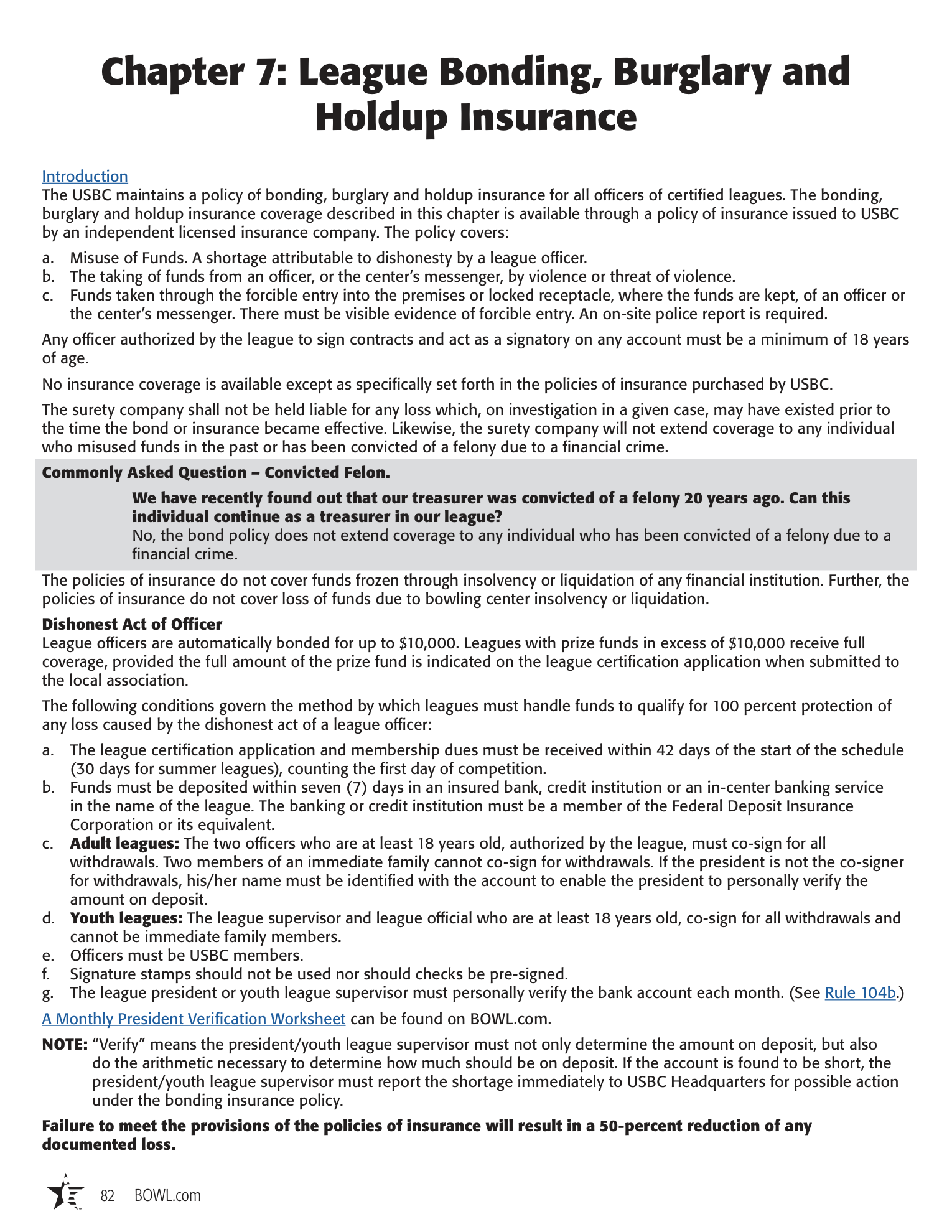
Source 1 of 5 · The sanctioning insurance, in the governing body's own words
Chapter 7 of the USBC Playing Rules: a bonding, burglary and holdup policy for league officers, with the $10,000 automatic bond, the bowling-center-insolvency exclusion, and the sentence that no other coverage exists.
Now read what it is, because the details describe a fidelity bond for the league treasury, not protection for the center:
| The question | What the USBC Playing Rules say |
|---|---|
| Who is protected | Officers of certified leagues, for league funds |
| Automatic bond | "League officers are automatically bonded for up to $10,000." Larger prize funds are covered in full only if the full amount is listed on the league certification application |
| Burglary and holdup limits | Receipts "not to exceed one week's receipts at any one time, with a limit of $2,000," and disbursements not to exceed $10,000 at any one time for a period of seven days |
| The conditions | Deposit within seven days in an FDIC-member or equivalent institution in the league's name, two authorized officers co-signing withdrawals, monthly verification. "Failure to meet the provisions of the policies of insurance will result in a 50-percent reduction of any documented loss" |
| What it excludes | "The policies of insurance do not cover loss of funds due to bowling center insolvency or liquidation" |
| Anything else | "No insurance coverage is available except as specifically set forth in the policies of insurance purchased by USBC" |
Read that exclusion again. The league's money is insured against your failure. You are not insured against anything.
The word "liability" does not appear anywhere in the 96 pages of the 2024-25 USBC Playing Rules. Not in the sanctioning chapter, not in the tournament rules, not once. Neither the Playing Rules nor the League Operations Handbook names the center as an insured or an additional insured. For certified tournaments, the only bond-type instrument in the rulebook is Rule 308, which lets USBC demand "a bond, or in lieu thereof, a satisfactory assurance that the prize fund obligations will be met." The governing body polices prize money. It does not police, and does not cover, premises liability.
Sanctioning does impose one operational duty on the center worth knowing. If your house offers in-center banking for leagues, the league's coverage extends only if the center deposits league funds within seven days of receipt "in a special trust account in an accredited, insured banking institution and NOT combined with the center or corporate accounts." A center that sweeps league money into its operating account has quietly stripped its own leagues of their bond protection, and it holds that money as a fiduciary either way.
The proprietors' side of the industry tells the same story. The Bowling Proprietors' Association of America, the nonprofit trade body that has served center owners for over 90 years and describes its network as more than 3,300 centers, endorses no carrier and sells no policy. Its 2026 Member Benefits Guide offers an insurance-resources program built around free risk-management materials and a scorecard for evaluating your current agent, and states its aim outright: "a marketplace full of good brokers," not one endorsed one. The association that exists to make centers profitable treats insurance as something each proprietor shops for and each broker earns.
So here is the spine of this guide, and everything after it is detail: bowling's institutions insure the league's prize fund. Every other dollar of risk in the building, the bowler on the approach, the drinker at the bar, the mechanic behind the pin deck, the machines, the roof, is the owner's to place. And because the modern center is majority hospitality by revenue, most of that risk no longer even looks like bowling.
When an operator tells me the league is sanctioned so the insurance is handled, I ask one question: handled for whom? The bond behind a sanctioned league protects the league's money, and its own rulebook says it does not cover the center's failure, let alone the center's liability. The moment a bowler, a bartender or a birthday party enters the conversation, you are the insurance program.
Bobby Sharp, Action Sports Practice Lead, Specialty Insurance
What bowling injuries look like in the federal record
Bowling generates a real, measurable injury load, and the federal surveillance record is unusually good for a venue owner willing to read it honestly.
The classic study, published in Clinical Pediatrics, went through the CPSC's National Electronic Injury Surveillance System for 1990 to 2008 and found 8,754 bowling injuries in sampled US emergency departments, corresponding to a national estimate of 375,468 injuries, roughly 19,800 per year. The most injured body parts were the finger (19.0 percent), the trunk (15.8 percent) and the ankle, foot and toe (14.9 percent), and the leading diagnosis was sprain or strain (42.7 percent). The current-decade update, published online in the Journal of Sport Rehabilitation in August 2026, covered 2014 to 2023 and estimated 141,844 injuries nationally, about 14,200 per year, with a mean patient age of 34. Injury counts declined across the decade, with a sharp 2020 drop the authors said was likely due to the pandemic and declining participation.
Two honest limits before the useful part. First, none of this work has an exposure denominator: nobody can tell you the injury rate per game or per bowler, so any claim that bowling is safer or more dangerous per hour than another activity is unsupported in either direction. Second, these are emergency department counts, a floor rather than a census of everything that happens on your concourse.
What the case mix tells an underwriter is where the claims live:
- Falls are the leading mechanism, at 27.5 percent of all ED-treated bowling injuries in the 2014 to 2023 data, concentrated in children and seniors. In the 1990 to 2008 study, bowlers 65 and older took 72.4 percent of their injuries from falling, slipping or tripping, against 38.3 percent for everyone younger. League rosters skew older every year, and a fall in a seventy-year-old is a different claim than the same fall in a thirty-year-old.
- Fingers are the children's story. Under age 7, 49.2 percent of all bowling injuries were finger injuries, and 42.8 percent involved dropping the ball, roughly triple the shares for everyone else. A pediatric analysis of 2014 to 2023 cases (raw counts, not national estimates) found the finger the most injured body part at 30.7 percent, with children aged 5 to 10 carrying four times the odds of finger injuries and roughly three times the odds of fractures and crushing injuries compared with adolescents. Your birthday-party demographic is your finger-injury demographic.
- The equipment has its own record. In 1998, CPSC and AMF announced a program to repair or replace Sure-Pik ball returns installed in approximately 238 establishments, after 14 reports of children's fingers becoming entrapped in the ball return's belt, with injuries ranging from bruises to partial amputations. In 2006, Brunswick recalled about 22,400 Frameworx chairs and bar stools sold only to bowling centers because the seat plate could fracture and drop the occupant. Machines manufactured in the 1970s are still in service in this industry; recall response is an operations duty, and an unrepaired recalled unit is a plaintiff lawyer's favorite exhibit.
- The ball is heavy and the population is aging. USBC's equipment manual caps ball weight at 16.00 pounds with no minimum. CPSC's 2024 Seniors Report estimates an annual average of 1,300 ED-treated overexertion injuries in bowling among players 65 and older, and 3,500 among adults 25 to 64, one of only seven named recreation and sports products in the report's overexertion table.
- Most of it resolves cheaply, which is exactly the trap. In the 2014 to 2023 study, 95 percent of patients were treated and released. The frequency story is mild. The severity story arrives when the fall is a hip, the finger belongs to a five-year-old, or the mechanism is the one in the next two sections: the oiled approach and the bar.
The approach is the most litigated ten feet in the building
Every day, your own staff coats the lanes with a petroleum-derived conditioner, a few feet from a walking surface where street shoes and slick-soled bowling shoes cross paths. Appellate courts have been sorting out what happens next for sixty years, and the pattern in the opinions should organize your general liability thinking.
Courts refuse to treat oil on the approach as a risk bowlers accept. In Young v. New Southgate Lanes (Ohio Ct. App. 2007), a league bowler broke her hip in a fall she attributed to oil at the approach. The center won summary judgment at trial and lost it on appeal. The court rejected the open-and-obvious defense in one sentence an operator should memorize: "In a bowling alley, customers are naturally expected to look at the pins, not down at the floor." It rejected the inherent-risk defense just as flatly: "Oil on the approach is not an inherent danger of bowling." And it stated the rule that makes these cases harder to defend than an ordinary retail slip-and-fall: "If the actions of the owner or the owner's employees created the hazardous condition, notice is immaterial." A grocery store gets sued over a hazard a stranger dropped. A bowling center gets sued over a substance its own employee applied by machine that morning.
New York's appellate courts have sent the same message twice. In Mandzyk v Manor Lanes (4th Dept 2016), a bowler's negligence claim was reinstated on appeal because there were triable issues on whether oil was on the approach and whether the center created it or had notice of it. The evidence that revived her case was the center's own: the manager's testimony that the lanes had recently been oiled and that the oiling machine could drip oil on the approach, and the center's own accident report, written within 15 or 20 minutes, reciting that the plaintiff had "slipped on oil." In Overton v. Leisure Time Recreation (2d Dept 2001), the mechanic was oiling lanes around the time of the fall and there was evidence of footprint-shaped oil spots near where the bowler went down on his first practice throw; the center's summary judgment motion was denied and the denial affirmed.
The doctrine runs deeper than the modern cases. In Guidani v. Cumerlato (Ill. App. Ct. 1965), a bowler picked up liquid on his shoe in the restroom, his sliding foot stuck at the approach, and a jury gave him $7,500; the appellate court reinstated the verdict after the trial judge had taken it away, writing that an accident befalling "a bowler with liquid on the soles of his bowling shoes is not only foreseeable but predictable." The same line of cases holds that the constructive-notice clock runs faster on a bowling approach than in a retail aisle: foreign matter need be present a shorter time before the proprietor is charged with notice, because ordinary care of the approaches demands more frequent inspection. A law review devoted entirely to the subject, Bowling Alley Tort Liability (16 Clev.-Marshall L. Rev. 284), synthesized the case law this way: everyone who walks in is a business invitee, and the proprietor owes a greater degree of care to a participant than to an ordinary invitee.
None of this means the center always loses. In Johnson v AMF Bowling Ctrs. (1st Dept, April 23, 2026), a plaintiff alleged her fall was caused by excessive oiling, waxing or conditioning of the floor, and the court affirmed dismissal because she produced no evidence supporting the allegation. Put Johnson beside Mandzyk and the operational lesson writes itself: these cases are decided on records. The center whose oiling log, inspection sheet and same-day incident report show a disciplined house defends itself with its own paperwork. The center whose accident report says "slipped on oil" hands the plaintiff the case. Our guide on how to handle an injury claim at your venue covers the first 24 hours in detail.
In the approach cases, the file the plaintiff builds is usually the file the center wrote for them. The oiling log, the same-day incident report, the inspection sheet: those documents either prove you ran a disciplined house or prove you did not. The operators who hand me dated paperwork settle small or win. The operators reconstructing that day from memory are the ones funding a structured settlement.
Bobby Sharp, Action Sports Practice Lead, Specialty Insurance
One more thing the waiver-minded should hear. Unlike almost every other venue in this practice, bowling centers generally collect no signature from a walk-in bowler, so there is usually no waiver to argue about in the first place. Where a center does use one, state law decides its worth, and in New York the answer is statutory: General Obligations Law section 5-326 voids liability waivers taken by fee-charging pools, gymnasiums and places of public amusement or recreation, a category that reaches establishments like bowling centers on its face. New York's appellate courts apply it to paid recreation venues; in Serin v Soulcycle (1st Dept 2016), a signed release did not bar the customer's claim. We wrote a full piece on what waivers do and do not do; the one-sentence version is that paperwork manages your defense, and only General Liability Insurance pays the judgment.
League night and the participant exclusion
Here is the clause that decides whether the sport inside your building is insured, and most owners have never read it.
Liability policies sold to sports venues frequently carry an athletic or sports participants exclusion. The standard version, identified in federal court as ISO endorsement CG 21 01 (Zurich Reinsurance v. Westville Riding Club, E.D. Okla. 1999), removes coverage for bodily injury to any person "while practicing for or participating in any sports or athletic contest or exhibition that you sponsor." Courts applying it use a four-element test collected in Leach v. Scottsdale Indemnity Co. (Or. Ct. App. 2014): the event must be a contest or exhibition, it must be athletic, the named insured must sponsor it, and the injured person must be practicing for or participating in it.
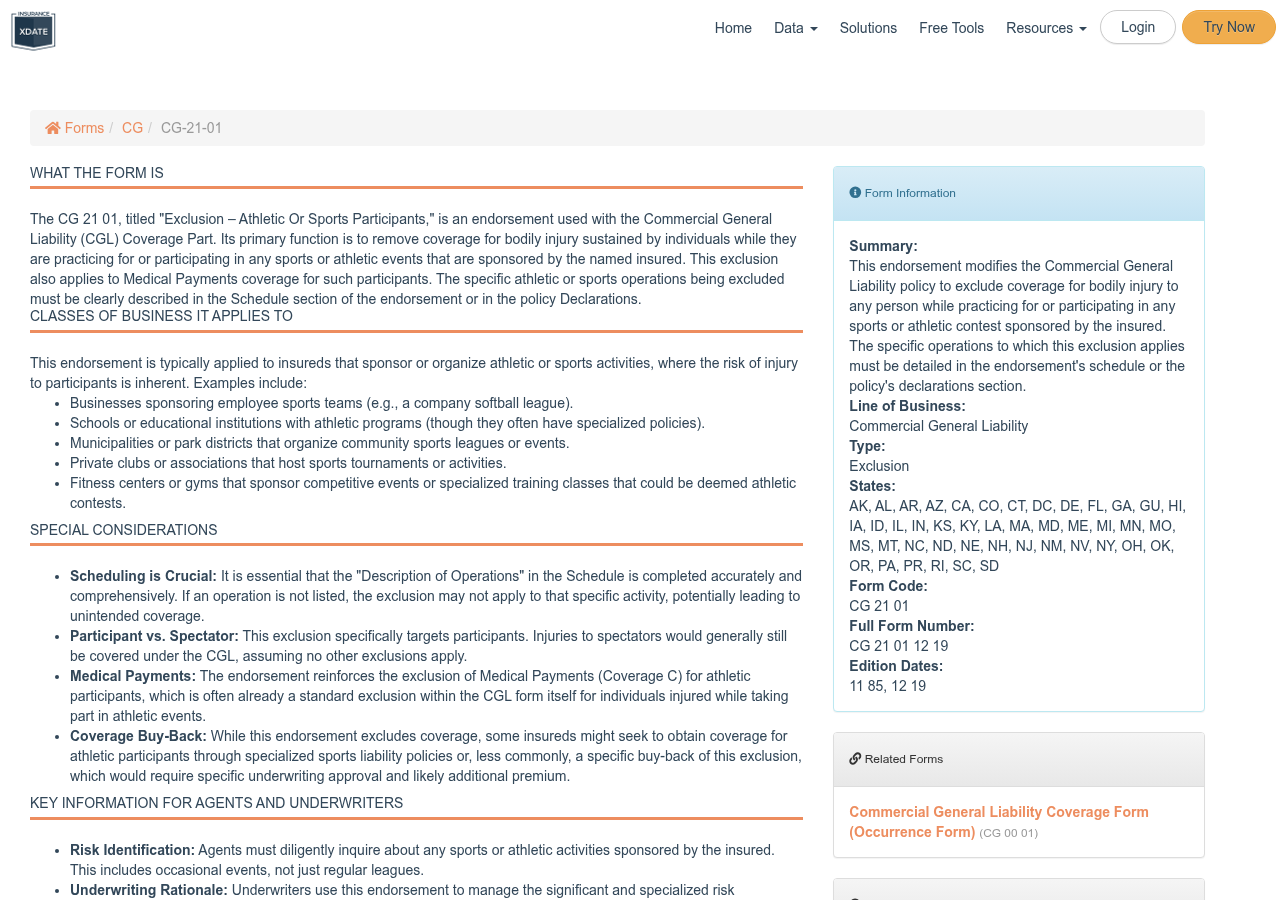
Source 2 of 5 · The standard exclusion, as filed
ISO form CG 21 01, Exclusion: Athletic or Sports Participants. The operative wording turns on a contest or exhibition "that you sponsor," which is why league night and open play sit on opposite sides of it.
Now apply the elements to a bowling house, and be clear that this is analysis, not a holding; no published bowling case decides the point. Casual open play is not a contest, so the standard wording should not reach the Tuesday birthday party or the walk-in pair on lane nine; in Leach itself, the insurer lost summary judgment because a routine practice session was not shown to be practice for any sponsored contest. A house league is a different conversation. It is a competition, it is athletic, the center organizes and runs it, and the bowler injured mid-league is participating in it. A house league sits close enough to a "contest that you sponsor" that no operator should bet a hip-fracture claim on winning the argument.
It gets worse off the standard form. Non-ISO participant exclusions can define sponsorship almost without limit: in Nautilus v. Bike & Build (E.D. Pa. 2018), a manuscript exclusion on an excess policy defined "you sponsor" to include merely "assisting in the planning, promotion, or execution" of an event, the court found sponsorship "clearly satisfied," and the exclusion removed coverage for a rider's serious-injury claim. The same decision held a differently worded participant exclusion ambiguous and construed it against the insurer. The whole area turns on precise wording, which is the strongest argument for having a specialist read yours; a generalist agent, as we have written before, often does not know these forms exist.
The fix is not to hope. It is to know which of three positions your program is in: a policy with no participant exclusion, confirmed in writing; a policy with the exclusion plus Participant Injury Insurance filling the gap it creates; or a policy with the exclusion and nothing behind it, which is the position most centers discover only after league night goes wrong. The difference between the first two and the third is the subject of our piece on participant injury versus general liability, and it is the first question we check on any bowling submission.
The bar is the second business, and it can follow a patron off the premises
By revenue mix, a modern center's bar and kitchen are not a sideline; at the largest operator they are 35 percent of the business. In insurance terms they are their own risk universe, with their own statutes.
Most states impose some form of dram shop liability on licensed sellers. Peer-reviewed legal research in Traffic Injury Prevention (Scherer et al., 2015) counts 44 states plus the District of Columbia with dram shop laws relating to intoxicated minors, defining dram shop liability as a private cause of action against a retailer for injuries caused by an intoxicated or underage drinking patron. What the statutes require varies enormously, and the spread matters to how your liquor policy gets priced:
- Texas (Alcoholic Beverage Code Sec. 2.02(b)) requires proof that it was apparent to the server that the patron was "obviously intoxicated to the extent that he presented a clear danger to himself and others," and makes the chapter the exclusive cause of action for serving persons 18 or older.
- Illinois (235 ILCS 5/6-21(a)) contains no visible-intoxication element at all: causing the intoxication is enough. Illinois also caps recoveries, and the caps are CPI-indexed by the regulator: for judgments on or after January 20, 2026, $90,411.55 per person injured and $110,503.00 for loss of means of support or society.
- New York (General Obligations Law Sec. 11-101) reaches whoever unlawfully sold or assisted in procuring the liquor that "caused or contributed to" the intoxication, and expressly allows exemplary damages.
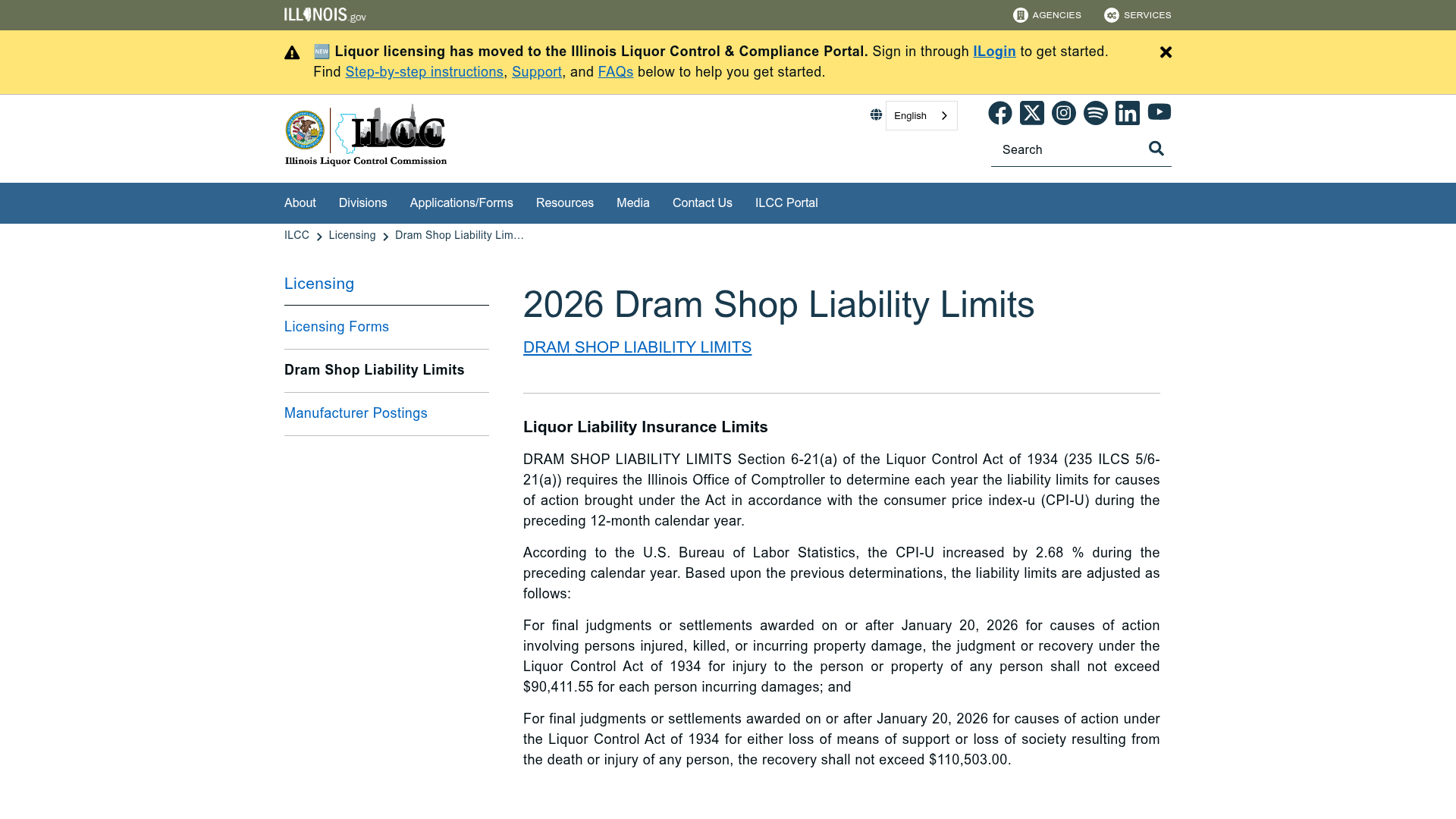
Source 3 of 5 · A regulator publishing this year's numbers
The Illinois Liquor Control Commission's 2026 dram shop liability limits: $90,411.55 per person injured and $110,503.00 for loss of means of support or society, CPI-adjusted annually under 235 ILCS 5/6-21(a).
Source: ilcc.illinois.gov/divisions/licensing/dram-shop-liability-limits.html
Two features make bowling's version of this exposure distinctive. The first is how far it travels. In Osborne v. Twin Town Bowl (Minn. 2008), a patron drank at a Mankato bowling alley, blew 0.18 at a traffic stop miles away, fled by jumping from a bridge into the flood-swollen Minnesota River, and drowned; the Minnesota Supreme Court held a jury could find his intoxication proximately caused his death and reversed the summary judgment the bowling alley had won. The claim follows the patron out of your parking lot. And even a defensible claim costs real money: in a 2024 Ohio case, a center was sued under the Dram Shop Act over a patron who fell onto another guest, won summary judgment in the original action and was voluntarily dismissed from the refiled one, which is a description of years of defense costs, not of a risk that never materialized.
The second is the room itself. A bowling center is a licensed premise full of minors, lawfully. Wisconsin's alcohol code generally bars unaccompanied underage persons from licensed premises and then exempts bowling centers by name, alongside movie theaters and similar venues. Families on the lanes and pitchers at the bar are the business model, and they are also the compliance problem: over-service checks and hand-off-to-minors controls are harder in a venue where the drinking age and the bumper-lane age share a concourse.
Some states put insurance itself into the license. Minnesota law provides that no retail liquor license may be issued, maintained or renewed without proof of financial responsibility for dram shop liability, with statutory minimums ($50,000 bodily injury per person, $100,000 per occurrence for two or more, $50,000 loss of means of support per person, or a surety bond or $100,000 deposit), and its exemptions are for tiny 3.2 malt liquor and small wine operations, none of which describes a bar pouring cocktails across 24 lanes.
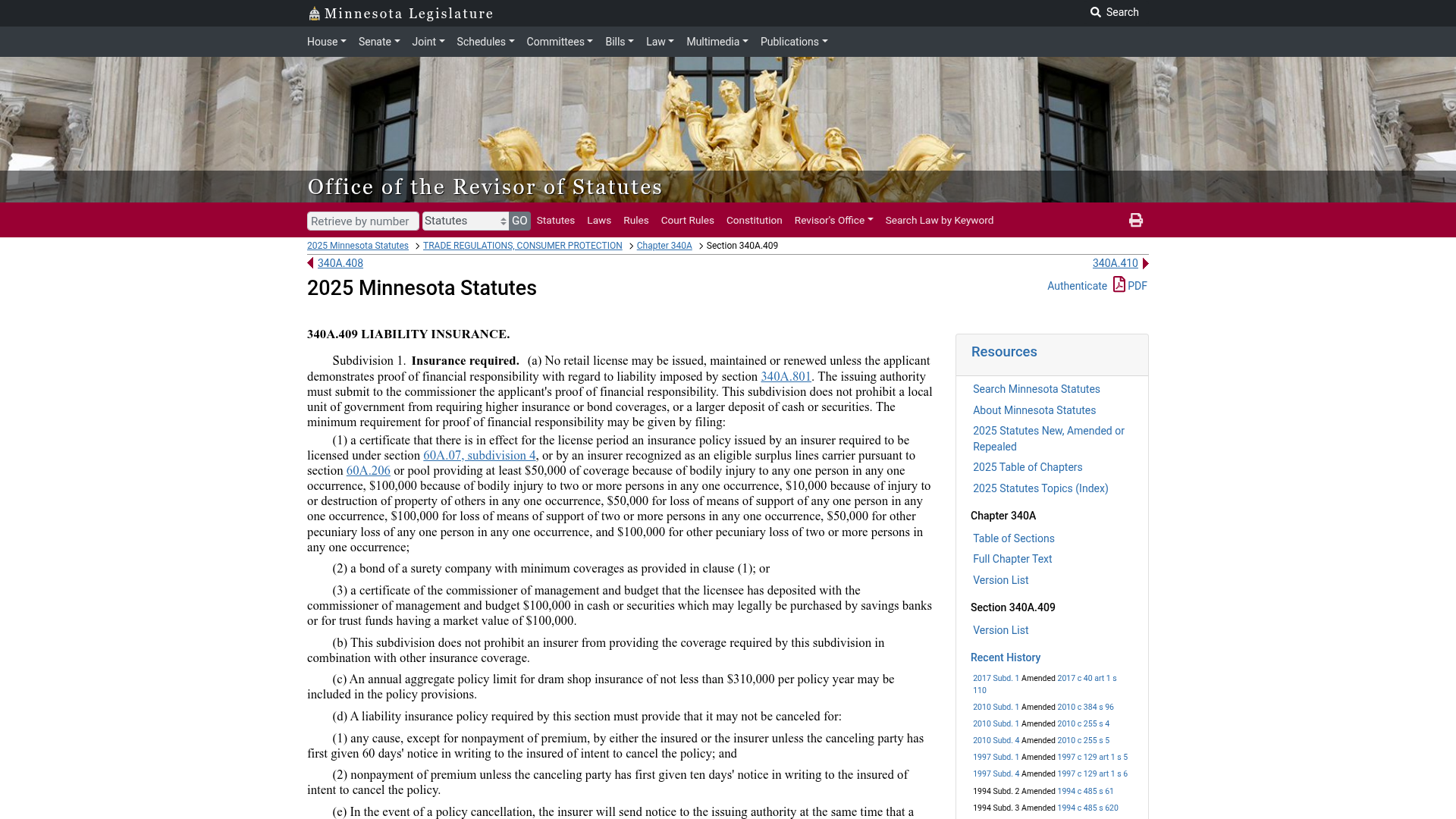
Source 4 of 5 · Where liquor liability insurance is the license
Minn. Stat. 340A.409, "Liability insurance," subdivision 1: "No retail license may be issued, maintained or renewed unless the applicant demonstrates proof of financial responsibility," with the statutory minimum limits in the text.
Then read your liquor policy for the assault and battery clause, because the bar fight is where venues discover what "excluded" means. In U.S. Underwriters v. Val-Blue Corp. (1995), New York's highest court enforced a standalone endorsement reading: "It is agreed that no coverage shall apply under this policy for any claim, demand or suit based on Assault and Battery and Assault and Battery shall not be deemed an accident, whether or not committed by or at the direction of the insured." The plaintiff had pleaded negligent hiring and negligent supervision; the court held every one of those claims was "based on" the underlying assault, so none was covered. Materially identical wording appears in bar coverage litigation since at least 1989, and IRMI commentary documents a Pennsylvania court enforcing an assault and battery exclusion in a bar's liquor liability policy for a parking-lot attack regardless of who committed it or where.
Set that beside what late-night bowling violence litigation looks like. In Ellington v. Jackson Bowling & Family Fun Center (Tenn. Ct. App. 2013), a 19-year-old was shot dead in the center's parking lot after a fight between rival groups, on a night the center had two regular employees on crowd control instead of the outside security it had used in prior years. The trial court let the center out on summary judgment; the Court of Appeals reversed in its entirety and sent the whole case back, applying Tennessee's balancing test under which prior crime on or near the premises drives the duty to protect patrons. Whether a claim like that is covered turns, once again, on wording: an assault and battery exclusion or sublimit on the liquor or liability form can leave the most severe claim in the building carrying the least limit. Ask the question in writing, and if the answer is a sublimit, price the buy-up. Our FEC sub-limit case study shows what a $100,000 sublimit does to a $425,000 claim.
The kitchen rounds out the hospitality book. CDC estimates 48 million foodborne illnesses a year in the United States, with 128,000 hospitalizations. Food service claims land in your general liability's products and completed operations coverage, and a full kitchen also raises the property questions in the next section: fryers, hoods and suppression.
The building and the machines are a property book of their own
The physical plant of American bowling is old, large-span and mechanical, and each of those three words is a property-insurance question.
Old first. The industry's construction boom is mid-century history: a 1958 American Society of Planning Officials report quotes the 1957 ABC Yearbook counting over 20,000 lanes in 2,000 establishments added since World War II, atop a 1956 estimate of about 97,000 lanes in some 9,000 alleys. The industry has consolidated ever since. BLS Quarterly Census of Employment and Wages data count 3,962 privately owned US bowling-center establishments in 2014, 3,587 in 2019 and 3,360 in 2024, employing 68,921 people with $1.73 billion in annual wages. The Los Angeles Times, citing industry reports, puts the 1960s peak around 11,500 houses. The surviving stock is disproportionately the older stock, which is why ordinance-or-law exposure belongs in every bowling property conversation: building codes classify bowling centers as Assembly Group A-3 occupancies (the 2021 International Building Code lists "bowling alleys" by name, with the bar and restaurant side classified A-2), and a 1958-era building rebuilt after a major loss is rebuilt to the current assembly code, with sprinkler, egress and alarm requirements its original construction never contemplated. Commercial Property Insurance limits that contemplate only what was there before the fire are limits chosen to come up short.
Fire is not hypothetical in this class. In March 2026, a two-alarm fire destroyed the Litchfield Bowling Alley in Litchfield, Illinois; the roof collapsed, wind interfered with suppression, fire kept burning through the night hidden under the metal roof, and the state fire marshal was called in, with the building a total loss. In April 2025, fire destroyed the former Candlelite Bowling and Banquet Center in Bridgeport, Michigan, with ATF assisting; the township fire chief observed that the alarm-to-flames transition was so fast the fire had likely been working through the building before detection, and that larger commercial buildings sometimes lack adequate smoke detection. And every operating center coats its lanes daily with a mineral-oil product: lane-maintenance manufacturer Kegel describes mineral oil as the main component of lane conditioners, historically about 98 percent of most formulas, and a Kegel safety data sheet for one conditioner (hosted by Shepherd University) lists 86 to 91 percent mineral oil with a flash point above 93.3 degrees C, instructing firefighters to "treat as an oil fire" and warning the oil "will float on water and can spread any fire." That flash point sits above the threshold for a flammable liquid, so the accurate framing is a combustible oil applied by machine to twenty-plus surfaces daily, with drums of it stored on site. Your underwriter will ask where.
Now the machines, because they are the line item that makes bowling property unlike any other hospitality risk. Nobody publishes a pinsetter price list; the leading manufacturers state cost depends on venue, lane count and whether the job is new construction or conversion, and publish savings estimators instead of prices. The only citable real-dollar figure is journalism: the Los Angeles Times reported that Napa Bowl, a 32-lane house, spent nearly $1 million in September 2023 converting to string pinsetters, which is roughly $31,000 per lane by our division, not the paper's. Before converting, the owner told the paper the center kept a full-time mechanic and spent up to $3,000 a month on parts for its free-fall machines. USBC certified string pinsetters as an independent category of equipment and competition effective August 1, 2023, and its lab data indicated a strike percentage about 7.1 percent lower on strings, which is why sanctioned-league houses weigh the conversion more carefully than party houses.
Three property questions follow directly. Valuation: insure the machines from invoices and appraisals, and settle actual-cash-value versus replacement-cost in writing, because a decades-old free-fall machine may be irreplaceable at any figure an ACV settlement produces. Equipment breakdown: mechanical and electrical failure of pinsetters, ball returns and scoring is classically an equipment breakdown question rather than a fire-and-wind question, and a center should know which policy answers for a dead motor bank on a Saturday. Downtime: a lane that cannot run is revenue that does not walk in, and Business Interruption Insurance with extra expense is what pays the payroll while the pin deck, the roof or the kitchen gets rebuilt. Whether business interruption rides your property form or stands as its own line is a program-design question we settle with the underwriter, not a box to assume.
Insure the machines from invoices and appraisals, not from a rule of thumb. Nobody publishes a pinsetter price list, and the difference between actual cash value and replacement cost on a forty-year-old machine is the difference between a repair and a permanently dark lane. Settle the valuation question with your broker before the loss, because the adjuster will not settle it in your favor after.
Bobby Sharp, Action Sports Practice Lead, Specialty Insurance
Workers' compensation and the space behind the pin deck
On paper, bowling centers are a comparatively gentle workplace. On the federal accident record, one room in the building is not.
The paper first. Workers' compensation policies classify bowling centers under class code 9093, "Bowling Lane," an NCCI classification you can see published in state assigned-risk schedules. BLS injury data for the industry show a days-away-restricted-transfer (DART) rate consistently below the all-private-industry average: 0.5 versus 1.5 in 2023, and 0.8 versus 1.4 in 2024. OSHA's November 2024 low-hazard industries listing included bowling centers on exactly that basis. The honest asterisk: the industry's total recordable rate is more volatile, 2.0 versus 2.4 in 2023 but 2.5 versus 2.3 in 2024, so "low-hazard" describes lost-time claims, not everything that gets recorded.
Then the pin deck. OSHA's accident investigation database, searched for "Pinsetter" on August 25, 2026, returns eight investigation summaries from 1984 to 2022, three of them fatalities, with the nonfatal entries running to amputated and crushed fingers in belts and pulleys. That keyword search is a floor, not a census, and the documented record is worse than its three flags: at least five workers have been killed in pinsetter work since 1988. A mechanic crushed inside a machine at Fair Lanes Aurora in 1988 after crawling in without making it electrically safe. A worker at an AMF house in 2011, killed clearing a jam on an A-2 pinsetter without deenergizing or locking it out. A 53-year-old at Northwest Lanes in Ohio in 2014, asphyxiated when his hooded sweatshirt caught in a machine whose operating parts were exposed; OSHA proposed $45,500 in penalties across eight serious violations, found no lockout program and unguarded pulleys, belts and shafts, and the company contested the citations. A 27-year-old at Blackhawk Bowl in Iowa in 2019, listed in OSHA's record under the occupation "bartender," electrocuted on an unguarded live 208-volt system while unjamming a pinsetter. And a 37-year-old at a bowling-restaurant venue in Austin in 2022, killed when his neck was caught inside a string-type machine while working a problem lane, proof that the modern, simpler string pinsetters still kill during servicing.
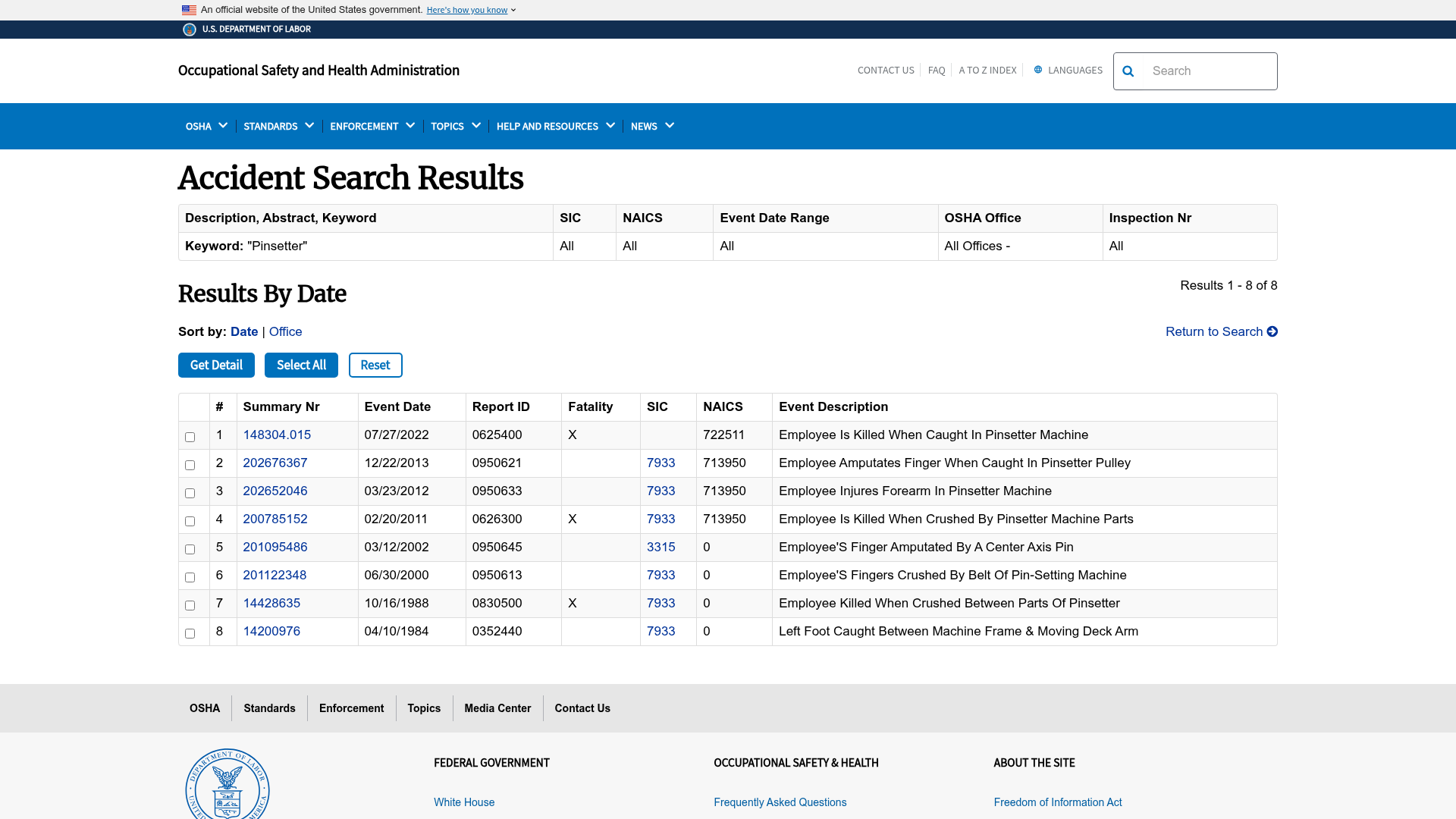
Source 5 of 5 · The federal accident record for one machine
OSHA's IMIS accident search for "Pinsetter": eight investigation summaries, three flagged fatalities (1988, 2011, 2022), plus amputation and crushing injuries. Two further deaths (2014, 2019) are documented in separate OSHA and DOL records.
The regulatory frame is settled even though no OSHA standard names pinsetters. In a 1990 interpretation letter, OSHA wrote that it has no regulations specific to pin-setting machinery and that enforcement "would probably come under" 29 CFR 1910.212, the machine guarding standard, or 29 CFR 1910.147, lockout/tagout. Its modern citations do exactly that. The lockout standard's scope covers "servicing and maintenance of machines and equipment in which the unexpected energization or start up of the machines or equipment, or release of stored energy could cause injury," which is a regulatory description of clearing a pin jam. A written lockout program, training records and machine guarding on the belts and pulleys are what your workers' compensation underwriter wants to see, and what the last decade of fatalities says most centers were missing. Retaliation exposure rides alongside: in 2017, a bowling operator signed a consent judgment agreeing to pay $40,000 in back wages to a mechanic who alleged he was fired after raising safety concerns, resolving a Labor Department suit under the OSH Act's anti-retaliation provision.
One more staffing rule, because bowling centers are classic teen employers. Federal child labor rules bar 14- and 15-year-olds from "operating, tending, setting up, adjusting, cleaning, oiling, or repairing any power-driven machinery" (29 CFR 570.33(e)) and from any work connected with maintenance or repair of the establishment's machines (570.33(d)); pinsetters are not named because they do not need to be, the generic clause covers them, and the regulation states flatly that employment not specifically permitted is prohibited. The same rules confine that age group to between 7 a.m. and 7 p.m. during the school year (9 p.m. in summer), which makes late-night league and cosmic shifts unlawful for under-16 staff, and the snack bar carries its own limits: no open-flame cooking, and deep fryers only with automatic basket-lowering devices. DOL's Fact Sheet #37 adds the warning that the FLSA's seasonal and recreational exemption does not exempt child labor rules. Your under-16 hires can run the counter and the shoe desk. They cannot touch the machines, and a written policy saying so is cheap underwriting goodwill.
What a bowling center buys, line by line
Pull the threads together and the program map for a US bowling center looks like this. Foundation lines first, the ones nearly every house carries; situational lines after, the ones your operation either clearly needs or clearly does not. For a smaller house, several of these can package into a Business Owners Policy; a multi-attraction center usually needs them written separately, and if you run more than one location the structure question compounds, as we covered in our multi-location guide.
"Specialty Insurance has been an incredible foundation for our business. They are personal, professional, and easy to work with."
Ballahack Airsoft LLC
Verified customer review
The premium table below is the machine-readable version. For a small to mid-size center, the lines run from $250 to $1,500 a year for Participant Injury Insurance up to $750 to $2,500 for Liquor Liability Insurance, with General Liability Insurance at $500 to $1,500. The ranges come from the Specialty Insurance book and are an indication for budgeting, not a quote.
2026-2027 premium benchmark
What bowling alley insurance costs, line by line
Typical annual premiums for a small to mid-size US bowling center.
- Priced for
- Small to mid-size bowling center
- Basis
- Annual premium, United States
- Updated
- August 2026
| Coverage | Typical annual range | Monthly estimate | Typical limits |
|---|---|---|---|
| General Liability InsuranceFoundation Third-party bodily injury, property damage and legal defense, including slip-and-fall claims on the approach and concourse. | $500 to $1,500 | $45 to $125per month | $1M per occurrence / $2M aggregate |
| Liquor Liability InsuranceFoundation Dram shop and over-service claims arising from the bar; proof of coverage is a license condition in some states. | $750 to $2,500 | $65 to $210per month | $1M per occurrence / $1M aggregate |
| Commercial Property InsuranceFoundation Building, lanes, pinsetters, scoring and furnishings, with business income and equipment breakdown designed in. | $500 to $1,500 | $45 to $125per month | Based on total insurable value |
| Workers' Compensation InsuranceFoundation Employee injuries, including machine work behind the pin deck. Class code 9093, Bowling Lane. | $500 to $1,500 | $45 to $125per month | Statutory state limits |
| Participant Injury InsuranceSituational Injuries to league and tournament bowlers that a participant exclusion removes from the liability form. | $250 to $1,500 | $25 to $125per month | $1M per occurrence |
| Assault and Battery CoverageSituational Patron-on-patron violence claims that assault and battery exclusions remove or sublimit on bar placements. | $500 to $1,250 | $45 to $105per month | Follows the liquor and liability forms; sublimits common |
| Excess / Umbrella InsuranceSituational Additional limits above the primary general liability and liquor lines. | $500 to $2,000 | $45 to $170per month | $1M to $5M per occurrence |
Most centers do not buy every line: the situational rows follow the operation, and a smaller house may package several lines into a Business Owners Policy. Product Liability Insurance is not part of the standard bowling program and is quoted separately where a pro shop or kitchen warrants it.
Specialty Insurance book. Updated . Ranges are an indication for budgeting, not a quote or a bindable offer.
Get a 24-hour quoteReading the rows:
- General Liability Insurance answers for the approach cases, the concourse falls, the birthday parties and the food, subject to the endorsements this guide keeps returning to. It is the line the oiling log defends.
- Liquor Liability Insurance is a foundation line for any licensed house, because the standard general liability form carves out liquor liability for businesses in the business of serving alcohol, and because in at least one state the license itself requires proof of it.
- Commercial Property Insurance carries the building, the lanes, the pinsetters and the furniture, with the valuation, equipment breakdown and ordinance-or-law questions settled in writing, and business interruption designed in rather than assumed.
- Workers' Compensation Insurance is statutory nearly everywhere once you have employees, class 9093, priced against a good DART record you protect with a lockout program and guarded machines.
- Participant Injury Insurance exists because of the exclusion in the league-night section. If your liability form carries a participant exclusion, this is the line that answers for the bowler mid-league.
- Assault and Battery Coverage exists because of Val-Blue and Ellington. If your liquor or liability form excludes or sublimits it, the bar's worst claim is the program's thinnest spot.
- Product Liability Insurance is not a standard row in the bowling program. Where a pro shop drills and sells balls or the kitchen sells packaged goods, product liability for what you sell is quoted separately from premises liability for what you operate.
- Excess / Umbrella Insurance sits above the primary casualty lines. The severity stories in this guide, a fatality in a parking lot, a hip in a seventy-year-old, a dram shop death miles away, are excess-layer arguments, and the layer is priced against everything above it.
The regulations most owners have not read
A short list of rules that surface in bowling-center diligence, each one citable and each one routinely missed:
- Accessible lanes are a design mandate. The 2010 ADA Standards require that "at least 5 percent, but no fewer than one of each type of bowling lane, shall be on an accessible route" (section 206.2.11), with wheelchair spaces required in the team seating serving those lanes. The Justice Department's status reports record a Michigan bowling center agreeing, through DOJ's mediation program, to ramp a lane and renovate a floor. Renovation planning that ignores 206.2.11 is renovation planning that invites a Title III complaint.
- Cosmic bowling does not suspend the egress code. Bowling centers are assembly occupancies, and the IBC requires egress illumination of not less than 1 footcandle at the walking surface whenever the space is occupied; the reduced-lighting allowance is written for auditoriums and theaters during performances, and even it requires illumination to restore automatically on fire alarm. Exit signs stay illuminated at all times, on 90 minutes of emergency power. Run blacklight nights with the egress paths lit and the fire marshal has nothing to find.
- Attractions can pull you into amusement-ride law. New Jersey's ride-safety rules regulate climbing walls and inflatables by name and require, for each regulated ride, an annual permit whose application includes documentation of insurance at $1,000,000 per occurrence; Pennsylvania registers more than 800 ride owners and 10,000 rides and attractions a year, with inspection affidavits every 30 days for portable setups. Bolt a ropes course or bumper cars onto the FEC side of your building and, in some states, part of your bowling center becomes a permitted amusement ride.
- Prize funds live inside gambling carve-outs. Washington authorizes bowling sweepstakes without a gambling license only inside statutory conditions (tickets at a dollar or less, all proceeds returned to participants, the proprietor taking no share); Florida exempts entry-fee bowling tournaments from its gambling chapter only at a "bowling center" the statute defines as having at least 12 lanes. League jackpots and strike pots are lawful the way the statute says, and not otherwise.
None of these is an insurance policy, and that is the point: they are the compliance surface underwriters ask about, and the paper trail that decides how the liability sections above go for you.
Frequently Asked Questions
Does USBC league sanctioning insure my bowling center?
No. The insurance that comes with USBC sanctioning is a bonding, burglary and holdup policy protecting certified league funds: $10,000 of automatic bonding against misuse by a league officer, with a $2,000 limit on one week's receipts taken by burglary or holdup. The USBC Playing Rules state that no insurance coverage is available beyond the policies USBC purchased, and the rules never name the center as an insured. Every liability and property exposure in the building is the operator's own to insure.
What insurance does a bowling alley need?
A typical program starts with four foundation lines: General Liability Insurance, Liquor Liability Insurance where the center holds a license, Commercial Property Insurance covering the building and the machines, and Workers' Compensation Insurance. Situational lines follow the operation: Participant Injury Insurance for league and tournament play, Assault and Battery Coverage for the bar, and Excess / Umbrella Insurance above the primary limits.
Does general liability insurance cover league bowlers?
Read the endorsements before assuming it does. The standard athletic participants exclusion removes coverage for people practicing for or participating in a sports contest the insured sponsors, and a house league the center organizes and runs sits close to that wording. Manuscript versions of the exclusion can sweep even wider. If your policy carries one, Participant Injury Insurance is the line built to answer for the bowler on the lanes.
Do bowling alleys need liquor liability insurance?
Any center that sells or serves alcohol should treat it as a foundation line. Most states impose some form of dram shop liability on licensed sellers, and Minnesota will not issue, maintain or renew a retail liquor license without proof of financial responsibility. Standard general liability forms carve out liquor liability for businesses in the business of serving alcohol, so the bar needs its own line, and the assault and battery question should be settled in writing.
Are bowling alley waivers enforceable?
Most centers never collect a signature from a walk-in bowler, so there is usually no waiver to argue about. Where one exists, enforceability is state law: New York General Obligations Law section 5-326 voids liability waivers taken by fee-charging places of public amusement or recreation, and New York courts have applied it to paid recreation venues. Treat waivers as a supplement to insurance, never a substitute.
Sources
- USBC Playing Rules, 071724 edition, Chapter 7 (League Bonding, Burglary and Holdup Insurance) and Rule 308, bowl.com (PDF).
- USBC League Operations Handbook, bowl.com (PDF).
- USBC, 2026 State of the Association, bowl.com (membership 1,075,194 for 2024-25); California USBC News, "The Fate of League Bowling," August 13, 2026 (league peak of more than 10,000,000 sanctioned members in 1975).
- Bowling Proprietors' Association of America, About BPAA, and 2026 Member Benefits Guide, page 14 (Insurance Resources), bpaa.com.
- Lucky Strike Entertainment Corporation, Form 10-K for fiscal year ended June 29, 2025, SEC EDGAR; AMF Bowling Worldwide, Inc., Form 10-K for fiscal year ended June 27, 2004, SEC EDGAR.
- US Bureau of Labor Statistics, Quarterly Census of Employment and Wages, NAICS 713950, annual averages 2014, 2019 and 2024.
- Kerr ZY, Collins CL, Comstock RD, "Epidemiology of bowling-related injuries presenting to US emergency departments, 1990-2008," Clinical Pediatrics 2011;50(8):738-46, PubMed.
- Au WY, Weeks M, Collis RW, "Epidemiology of Bowling-Related Injuries Presenting to US Emergency Departments From 2014 to 2023," Journal of Sport Rehabilitation, online August 5, 2026, PubMed.
- Swanson T et al., "Pediatric bowling injuries presenting to U.S. emergency departments," The Physician and Sportsmedicine 2025;53(6):448-455, PubMed.
- CPSC, Senior Injuries and Deaths Associated with Consumer Products: 2024 Report, Table 47 (bowling, product code 1206).
- CPSC, Recall No. 98-144, AMF Sure-Pik bowling ball returns (1998); CPSC, Brunswick Frameworx seating recall (2006).
- USBC Equipment Specifications and Certifications Manual (ball weight, 16.00 pounds maximum); USBC string pinsetter certification news release (April 27, 2023) and FAQ (November 9, 2023), bowl.com.
- Guidani v. Cumerlato, 59 Ill. App. 2d 13, 207 N.E.2d 1 (Ill. App. Ct. 1965), Justia.
- Young v. New Southgate Lanes, 2007-Ohio-2923 (Ohio Ct. App., 8th Dist. 2007), Justia.
- Overton v. Leisure Time Recreation, 280 A.D.2d 655 (N.Y. App. Div. 2001), Justia; Mandzyk v Manor Lanes, 2016 NY Slip Op 03338 (4th Dept 2016), Justia.
- Johnson v AMF Bowling Ctrs., Inc., 2026 NY Slip Op 02452 (1st Dept, April 23, 2026), NY Official Reports (uncorrected slip opinion).
- Matthew J. Koch, "Bowling Alley Tort Liability," 16 Cleveland-Marshall Law Review 284 (1967), EngagedScholarship at Cleveland State University.
- New York General Obligations Law section 5-326, NY Senate Open Legislation; Serin v Soulcycle Holdings, LLC, 145 A.D.3d 468 (1st Dept 2016), NY Official Reports.
- Leach v. Scottsdale Indemnity Co., No. A151680 (Or. Ct. App. 2014), Justia; Zurich Reinsurance (London) Ltd. v. Westville Riding Club, Inc., 82 F. Supp. 2d 1254 (E.D. Okla. 1999); Jefferson Ins. Co. v. Sea World of Florida, 586 So. 2d 95 (Fla. Dist. Ct. App. 1991); Garcia v. St. Bernard Parish School Bd., 576 So. 2d 975 (La. 1991).
- Nautilus Ins. Co. v. Bike & Build, Inc., 340 F. Supp. 3d 399 (E.D. Pa. 2018), OpenJurist.
- Osborne v. Twin Town Bowl, Inc., 749 N.W.2d 367 (Minn. 2008), Justia; Irani v. AMF Bowling Co., 2024-Ohio-2504 (Ohio Ct. App., 10th Dist. 2024), Justia.
- Scherer M et al., Traffic Injury Prevention 2015;16(S2):S59-S65, PubMed Central (44 states plus DC, dram shop laws relating to intoxicated minors).
- Texas Alcoholic Beverage Code sections 2.02 and 2.03; New York General Obligations Law section 11-101; 235 ILCS 5/6-21(a), Illinois General Assembly.
- Illinois Liquor Control Commission, 2026 Dram Shop Liability Limits.
- Minnesota Statutes section 340A.409 (liability insurance required for retail license), Office of the Revisor of Statutes.
- U.S. Underwriters Ins. Co. v. Val-Blue Corp., 85 N.Y.2d 821 (1995), Justia; Terra Nova Ins. Co. v. 900 Bar, Inc., 887 F.2d 1213 (3d Cir. 1989), Justia; IRMI expert commentary on Acceptance Ins. Co. v. Seybert, 757 A.2d 380 (Pa. Super. 2000).
- Ellington v. Jackson Bowling & Family Fun Center, L.L.C., No. W2012-00272-COA-R3-CV (Tenn. Ct. App. 2013), Justia.
- Wisconsin Statutes section 125.07(3)(a)3, Wisconsin Legislature; CDC, Facts About Food Poisoning.
- American Society of Planning Officials, PAS Information Report No. 110, "Bowling Alleys" (May 1958), planning.org; Los Angeles Times, November 21, 2023 (Napa Bowl conversion figures; 1960s house count attributed to industry reports).
- Kegel, "10 Things That Everyone Should Know About Lane Conditioners"; Kegel Defense-W Lane Conditioner Safety Data Sheet (June 2005), hosted by Shepherd University; First Alert 4 (KMOV), March 16, 2026 (Litchfield Bowling Alley fire); ABC12 WJRT, April 29, 2025 (Candlelite Bowling and Banquet Center fire).
- 2021 International Building Code sections 303.3, 303.4, 1008.2, 1008.2.1, 1008.3.4 and 1013.6.3, ICC Digital Codes; Washington Administrative Code 51-50-0303.
- OSHA IMIS accident records: search "Pinsetter"; accident details 14428635 (1988), 200785152 (2011), 148304.015 (2022); inspection 1413901.015 (2019, Blackhawk Bowl); DOL/OSHA news release, March 16, 2015 (Northwest Lanes); DOL/OSHA news release, December 29, 2017 (Lucky Strike consent judgment).
- OSHA standard interpretation, "Guarding of machinery in bowling centers," May 23, 1990 (archived); 29 CFR 1910.147 and 1910.212, eCFR.
- 29 CFR 570.32, 570.33, 570.34 and 570.35 (Child Labor Regulation No. 3), eCFR; DOL Wage and Hour Division, Fact Sheet #37; DOL elaws FLSA Advisor.
- BLS Survey of Occupational Injuries and Illnesses, Table 1, 2023 and 2024 (NAICS 71395); OSHA 2024 Low-Hazard Industries Table (November 14, 2024, archived); West Virginia Offices of the Insurance Commissioner, assigned-risk rate schedule (class code 9093, Bowling Lane).
- 2010 ADA Standards for Accessible Design, sections 206.2.11 and 221.2.1.4, ADA.gov; DOJ, Enforcing the ADA status report, July-September 1996 (archived).
- New Jersey Department of Community Affairs, Carnival-Amusement Ride Safety FAQs; N.J.A.C. Title 5, Chapter 14A, subchapters 13 and 14; Pennsylvania Department of Agriculture, Amusement Rides and Attractions.
- Washington RCW 9.46.0345 and 9.46.0269; Florida Statutes section 849.141.