

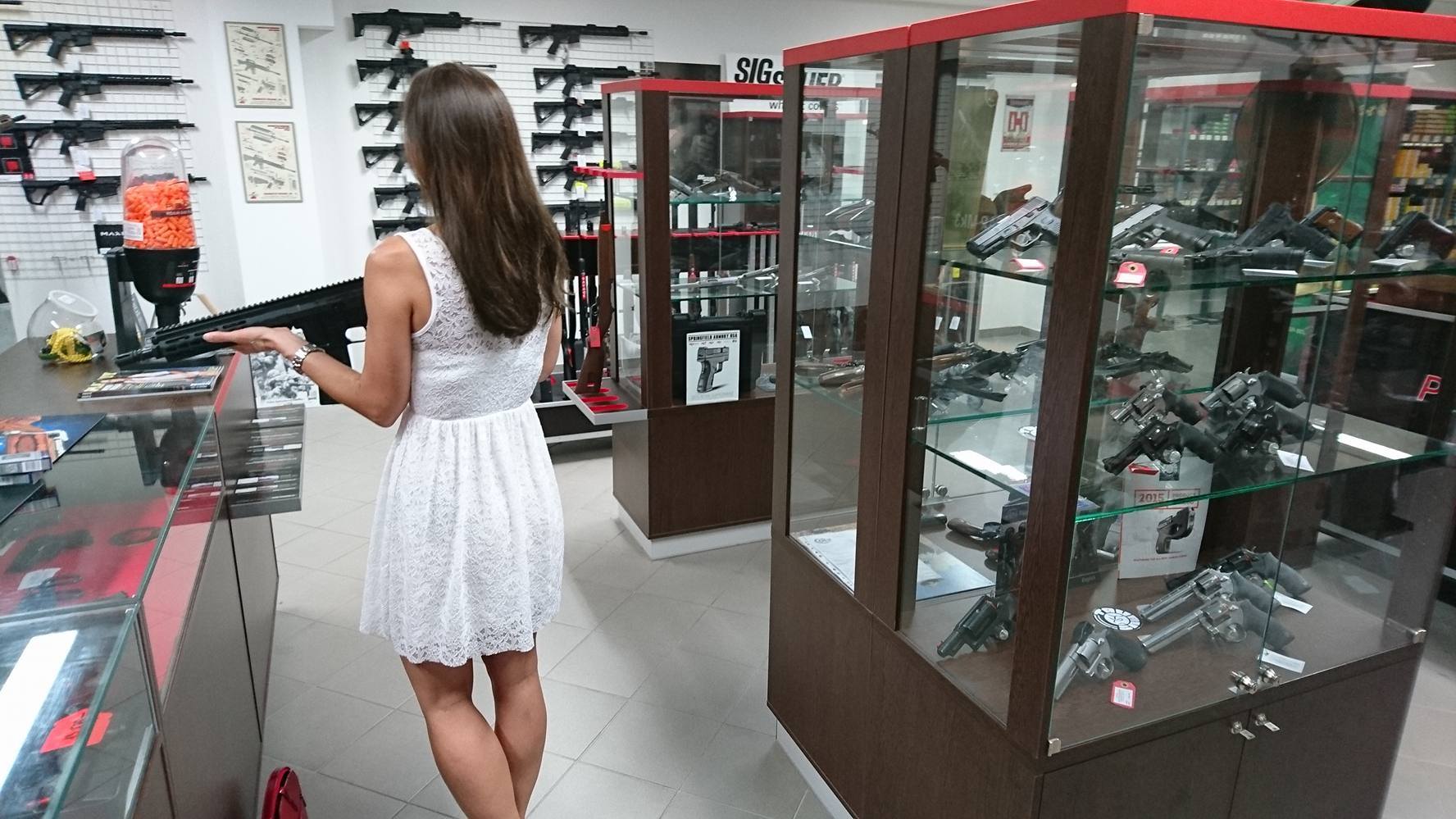
One address, one policy, one class code. That is how most commercial ranges buy insurance, and it is the single decision that puts the largest hole in the cover.
It is an easy mistake to make, because the building really does have one address. But the federal government does not think a range is one business, the Bureau of Alcohol, Tobacco, Firearms and Explosives does not, and the Occupational Safety and Health Administration files you somewhere most operators would never guess. The insurance policy is usually the only document in the building that treats the whole operation as a single thing.
Send us your current declarations page. Specialty Insurance reads range and firearms retail policies every week and will tell you in one free review which of your operations are described on the policy and which are not. 24-hour turnaround, licensed in all 50 states.
Get a 24-hour quoteA gun range is four businesses, and the government files it as one
Start with the classification, because everything downstream follows from it.
The Census Bureau's own activity index, the file that maps what a business does to the code it gets, splits a full service range across four different industries in four different sectors. Shooting ranges are 713990. Gun shops are 459110, which is retail. Firearms training is 611699, which is educational services. Gunsmith shops without retailing new guns are 811490, which is repair and maintenance. There is no single code that describes a range with a counter, a classroom and a bench.
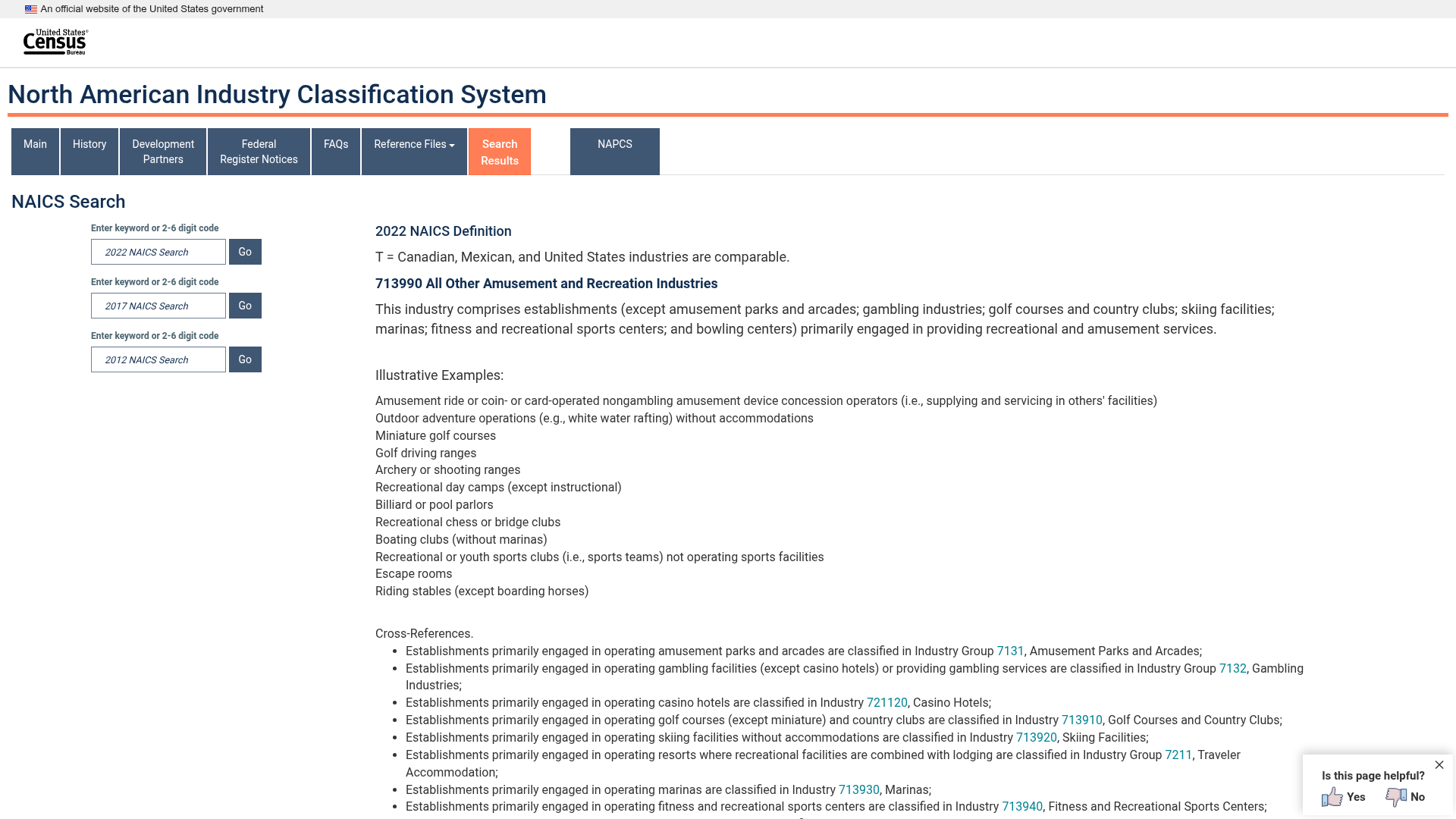
The code you land in is worth reading closely. NAICS 713990 is All Other Amusement and Recreation Industries, and the Census Bureau defines it by subtraction: everything recreational that is not an amusement park, a casino, a golf course, a ski hill, a marina, a gym or a bowling alley. The index file assigns 117 distinct business activities to that one code. Axe throwing clubs are in it. So are escape rooms, trampoline facilities, bathing beaches, riding stables and wax figure exhibitions.
That matters in a practical way. Any benchmark, loss cost or industry average built on 713990 is blending a live fire range with a wax museum. The Census Bureau's 2022 County Business Patterns counts 21,689 establishments and 191,441 employees under that code, but the number cannot be read as a count of ranges, because 116 other kinds of business are inside it.
For the size of the class you have to go to the agencies that regulate the activity rather than the one that counts the economy. The National Institute for Occupational Safety and Health estimates that 16,000 to 18,000 firing ranges operate in the United States. The Environmental Protection Agency estimates 9,000 non-military outdoor ranges. As of the 2025 federal fiscal year there were 127,739 active federal firearms licensees, of which 46,072 were Type 01 dealers, though neither figure is a count of ranges either.
The submission decides the policy long before the claim does. When a range comes to me described as one recreation business, the retail counter, the rental rack and the classroom are all invisible to the underwriter. Every one of those is a separate way to get sued, and none of them is priced. We rewrite the description of operations first, and the coverage that comes back is a different document.
Bobby Sharp, Action Sports Practice Lead, Specialty Insurance
The four activities are not academic distinctions either. They are four different liability theories. The range is a premises and supervision risk. The counter is a products and completed operations risk. The classroom is a professional services risk. The bench is a bailment risk, because you are holding a customer's property. A policy written for the first one is not automatically wrong about the other three. It is usually silent about them, and silence is what an adjuster reads.
The shooter on your line is the person your policy is least likely to cover
The insurance industry's standard tool for removing participant exposure is an endorsement rather than a clause in the base form. It is titled Exclusion: Athletic Or Sports Participants, form CG 21 01, and it removes bodily injury to any person while practicing for or participating in any sports or athletic contest or exhibition that the insured sponsors.
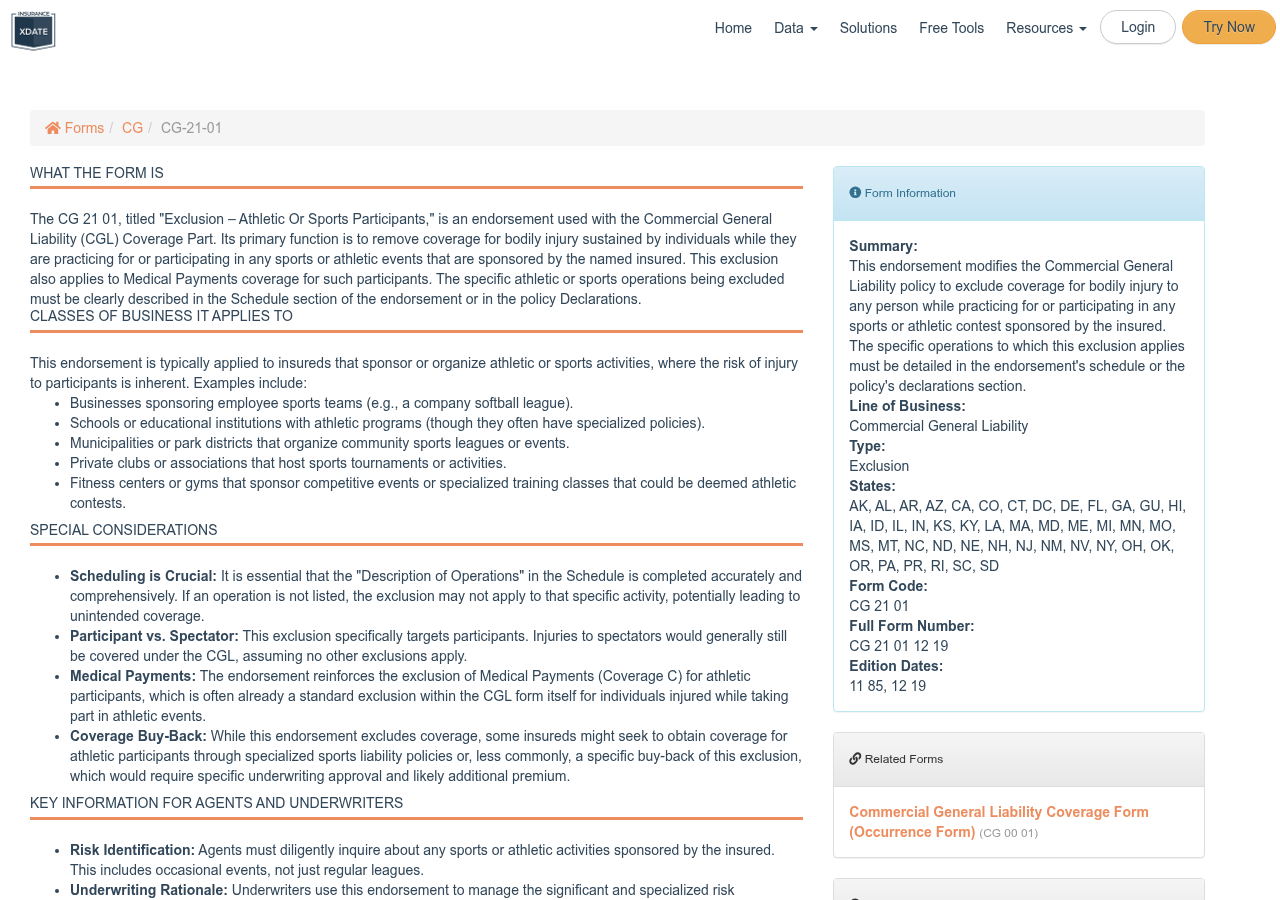
Read that against your own floor. The customer most likely to be hurt at a range is the one holding the firearm. If the participant exclusion is attached and nothing writes the exposure back in, your liability limit is answering for the lobby, the car park and the spectator, and not for the shooter. We broke that failure down in detail in our piece on participant injury versus general liability, and it is the first thing to check on a quote rather than the last.
Whether shooting counts as a sport for exclusion purposes is a live argument, and a carrier has already made it. In a 2024 Delaware Superior Court case, an insurer denied both defense and indemnity to an indoor range and firearms store under a Rental of Sporting Equipment Exclusion, on the express theory that the range rents firearms for the sport of target shooting. The court declined to hold that all firearms are definitionally sporting equipment or that everything happening at a shooting range is a sport, and construed the exclusion against the insurer. Worth being precise here: that case turned on a carrier's own manuscript wording, not on CG 21 01, and no published opinion applies CG 21 01 to shooting at all. The lesson is not that you are safe. It is that the wording is not standard across carriers, so the answer for your policy is in your policy.
Two other exclusions deserve a look before you assume the liability limit answers a shooting. An Illinois appellate court has held a carrier had no duty to defend a fatal shooting claim, applying both an assault and battery exclusion and a firearms exclusion, and found both unambiguous. The assault and battery exclusion in that policy reached not only the assault itself but any claim for negligent hiring, training, placement, supervision or monitoring connected to it, which closes the usual back door. There is no firearms exclusion in the standard Insurance Services Office series, so anything you find is carrier manuscript wording, which means it varies and it has to be read. What one incident does to the rest of your program is a longer story, and we set it out in our guide to gun range insurance after an unintentional discharge.
The rental gun is the exposure with no ceiling
Renting firearms is the highest severity thing a commercial range does, and it is the exposure most often assumed away.
The assumption usually rests on a federal statute. The Protection of Lawful Commerce in Arms Act bars qualified civil liability actions against firearms sellers arising from the criminal or unlawful misuse of a firearm. Operators hear that and conclude they are shielded. Read the definition and the shield has a hole cut in it on purpose: the Act expressly excludes an action brought against a seller for negligent entrustment from the definition of a barred action. The statute defines negligent entrustment on a knows, or reasonably should know standard, which is objective and does not require actual knowledge.
Two qualifications matter, and both cut against overstating this. The Act does not create a negligent entrustment claim; it only declines to preempt the ones state law already provides, so whether a claim survives depends on your state's tort law. And no published opinion applies that exception to a commercial shooting range. The clearest authority is a Missouri Supreme Court decision involving a firearms retailer, where the court held the Act preempted a general negligence claim but did not preempt negligent entrustment, and allowed the claim to proceed against the store manager personally as well as the company. In that case the buyer's mother had warned the manager by name, two days before the sale, that her daughter was severely mentally ill.
A rental transaction takes ninety seconds at the counter, and it is the only ninety seconds in the day where your staff decides whether a stranger should be handed a loaded firearm. I ask every range the same two questions: what does the person at the counter do when something feels wrong, and where is that written down. A range that can answer both is a different risk from one that cannot.
Bobby Sharp, Action Sports Practice Lead, Specialty Insurance
Suicide on the premises is the version of this that ranges deal with in practice, and it is the reason to be careful about what is claimed. Two real cases against ranges after a rental customer took their own life were located for this guide, one in Texas and one in Delaware. Both were resolved on procedural or insurance coverage grounds without any court reaching whether a range owes a duty to screen. There is no settled answer here to hand you, and anyone offering one is guessing.
What does exist is industry guidance. The American Foundation for Suicide Prevention and the National Shooting Sports Foundation jointly publish After a Suicide: A Guide for Firearms Retailers and Range Owners, which describes an on-site suicide as a rare but devastating event you need to be prepared to face, and which advises appointing a single point of contact for legal inquiries and consulting an attorney. The Foundation states that suicide accounts for over half of all firearms-related deaths in the United States. A range with a written protocol, trained counter staff and a documented refusal policy is doing the loss control an underwriter can price. A range without one is carrying the exposure bare.
Lead is a regulated exposure, and your liability policy has an exclusion with its name on it
Most operators think of lead as a housekeeping issue. Two federal agencies think of it as a regulated workplace hazard, and the insurance industry thinks of it as pollution. Those three views collide on your balance sheet.
Start with the numbers that create the duty. The Occupational Safety and Health Administration's general industry lead standard sets a permissible exposure limit of 50 micrograms per cubic meter of air over 8 hours, and an action level of 30 micrograms, measured without regard to respirator use. Cross the action level for more than 30 days a year and medical surveillance becomes mandatory. A part time range safety officer working three days a week crosses 30 days by the middle of February. If a shift runs longer than 8 hours, the limit is reduced by formula, 400 divided by the hours worked, so a 12 hour Saturday drops the effective limit to roughly 33 micrograms.
The expensive part is medical removal. Where blood testing shows a worker at or above the removal threshold, the employer must take them off lead exposure, and the standard requires their earnings, seniority and benefits to be maintained for the removal period. That is a wage continuation obligation, and no standard liability policy pays it.
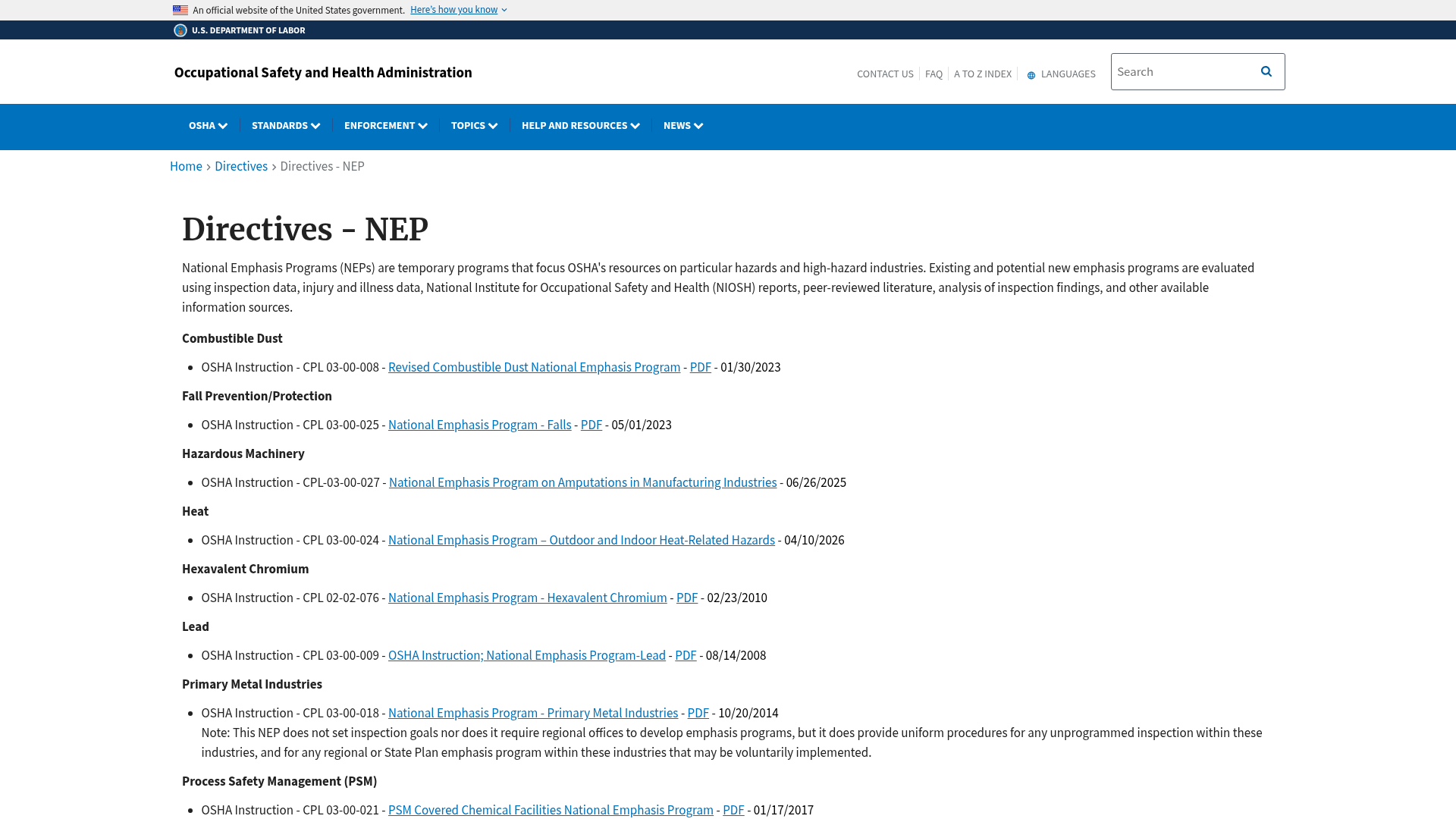
That last point is the one that surprises people. A National Emphasis Program means programmed inspections rather than complaint driven ones, and the lead directive has been in force since 14 August 2008 without being canceled. Its appendix explains that the two targeted codes cover gun clubs and shooting clubs on one side and shooting galleries and shooting ranges on the other, and states the assumption that occupational lead exposure in those codes comes from exactly those businesses. Most range owners believe they run an amusement business. This directive files them alongside smelters and battery plants.
It is applied in practice. An OSHA inspection of an indoor range in Tupelo, Mississippi was opened under NAICS 713990 with the emphasis field recording Lead, and produced four serious violations, three of them under the lead standard, with an initial penalty of $16,192 settled at $9,715. That is the realistic middle of the distribution. At the top end, OSHA announced penalties totaling $214,387 against an indoor range in Killeen, Texas in February 2019 after finding airborne lead above the limit and contamination on surfaces throughout the facility, with citations for failing to medically monitor employees and for sweeping up lead rather than using proper methods. The agency's inspection record for that case shows an initial penalty of $224,735 and a final penalty of $114,077 at closure, which is the useful lesson about announced numbers.
The largest documented penalty in this class did not land on a range at all. In August 2010 OSHA cited a gun range cleaning company in Miami with more than 50 violations and proposed penalties of $2,099,600, of which $1,884,000 was for 42 willful and serious violations of the lead standard. If you outsource bullet trap or berm cleaning, you are buying a contingent exposure, and the certificate of insurance you hold from that contractor is worth reading.
The health data is not a tail risk. Centers for Disease Control surveillance recorded 2,056 workers in police protection and the amusement and recreation category that contains firing ranges with blood lead at or above 10 micrograms per deciliter between 2002 and 2012, of whom 785 were at or above 25, plus a further 2,673 people whose elevated levels were attributed to non-work target shooting. The agency is careful to say the industry category also contains non-range businesses, so the share attributable to ranges is unknown. During one Washington State range renovation in 2012, 46 of the 98 people tested had elevated blood lead, including a construction worker who reached 153 micrograms per deciliter roughly ten weeks after starting to dismantle a sand berm.
Now the insurance turn, and it is the reason this section sits in an insurance guide rather than a safety one. Lead is a pollutant. The Georgia Supreme Court held unanimously in 2016 that lead unambiguously qualifies as a pollutant under the standard commercial general liability definition, and that the absolute pollution exclusion barred the claimant's lead poisoning claims. Courts are split on how far that exclusion reaches into non-environmental claims, and the Georgia court acknowledged the split before siding with broad application. A federal court in Delaware had already held that a pollution exclusion barred coverage for lead shot contamination at a Connecticut gun club, describing the clause it was construing as mirroring the one used by virtually all carriers. Where a total pollution exclusion endorsement is attached instead, it replaces the standard wording with a but-for test and removes cleanup costs outright.
So the sequence is: a federal agency treats your lead as a regulated hazard, a second federal agency treats spent lead as a waste problem, and your liability policy quite possibly treats a lead claim as pollution and declines it. That gap is a coverage decision, not a housekeeping one. The indoor and outdoor versions of the exposure diverge sharply, and we compared them side by side in our breakdown of indoor versus outdoor gun range insurance.
An outdoor range inherits the ground, and the liability outlives the business
If your range is outdoors, the exposure does not stop at the property line or at the closing date.
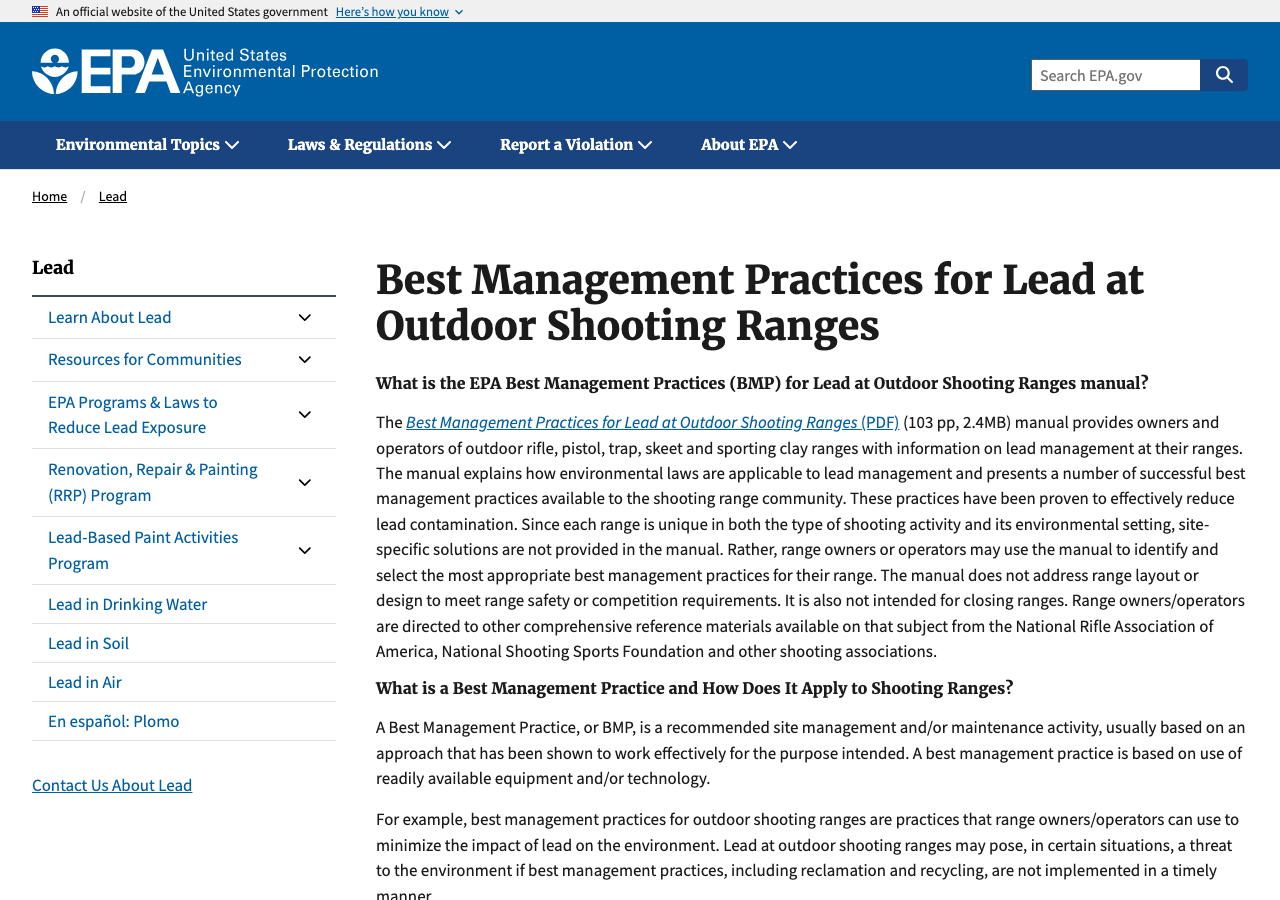
The agency's position is that lead shot is not a hazardous waste when it is fired, but that spent shot left in the environment falls inside the broad statutory definition of solid waste used in the Resource Conservation and Recovery Act. Sections 7002 and 7003 of that Act let the agency, a state, or a private citizen sue to compel cleanup of spent lead posing an imminent and substantial endangerment, whether the range is open or closed. Under the Comprehensive Environmental Response, Compensation, and Liability Act, lead is a hazardous substance, ranges may be liable for government cleanup costs and natural resource damages, and liability can extend to past owners and operators long after the range stops operating.
The reported cases give the order of magnitude:
- At a Connecticut trap and skeet club, roughly 2,400 tons of lead shot and 11 million pounds of clay target fragments accumulated over nearly 70 years, and the Second Circuit held the material had accumulated long enough to be considered solid waste for the purposes of a citizen suit.
- A federal court in Oregon refused summary judgment to a rifle club facing a citizen suit over lead in its berms and an adjacent creek, sending it to trial.
- In a dispute over a 60 year gun club lease, the parties' experts estimated remediation at between under $1 million and $7 million, and the club conceded it did not have the funds to do the work.
- A subsequent owner of a former commercial range that operated from 1965 to 1978 sought more than $5.3 million in remediation costs from prior owners.
- The Environmental Protection Agency recovered $827,425.76, its full past costs, over the cleanup of a roughly one acre former range site in Washington State that is now a public park.
- After more than 200 Canada geese died of acute lead poisoning near a Wisconsin trap and skeet club, the agency issued an order against a current and a former owner and recovered $1 million of its costs.
Two of those cases involve people who no longer owned the range. That is the point worth carrying: an outdoor range sells, and the liability does not necessarily go with the keys.
The range protection act in your state probably does not do what you think
Almost every operator has heard that their state protects shooting ranges. It is true, and it is narrower than the telling.
Sixteen states were read against official sources for this guide. The pattern is consistent: these are noise, nuisance and zoning statutes. Several of them say so on their face and then expressly preserve injury claims. Florida's provision states that it does not prohibit an action for negligence. North Carolina and California carry the same carve-out. Missouri grants broad noise immunity and then expressly refuses to limit liability for physical injury to a person. Pennsylvania's act is titled as a noise pollution exemption. South Carolina's Shooting Range Protection Act of 2000 addresses noise nuisance actions and noise ordinances, and contains nothing touching injury liability anywhere in the chapter. Ohio's immunity runs to harm caused by the creation of noise or the failure to suppress it, and no further.
No state range protection act located in this review bars a negligence claim by an injured shooter. The protection is real, and it is protection against the neighbors, not against your customers.
Texas is the genuine outlier, and even there the shelter is procedural rather than absolute. A claimant suing a Texas sport shooting range must serve an expert report on each implicated defendant within 90 days of filing, and must prove deviation from the standard of care of an ordinarily prudent sport shooting range through expert testimony. That is a heightened burden, not immunity, and it applies to the range entity rather than sweeping in everyone.
Texas is also the state that answers a question most operators assume has no answer.
Texas requires outdoor ranges to carry insurance, by statute. Health and Safety Code section 756.045 requires the owner of an outdoor shooting range to purchase and maintain an insurance policy providing coverage of at least $500,000 for bodily injuries or death, and another policy at that same level for property damage resulting from firing any weapon on the range, and to prominently display a sign stating that the owner has done so. The subchapter applies only to outdoor ranges in counties with a population of more than 150,000.
The same subchapter requires the range to be built and maintained to standards at least as stringent as those in the National Rifle Association range manual, backed by a civil penalty of $50 a day capped at $500 in total, and by a Class C misdemeanor where an intentional or reckless failure results in injury.
Two details in that statute are easy to miss and expensive to get wrong. It requires two policies, not one combined limit, so an outdoor Texas range holding a single policy with a combined limit may not literally comply. And the $500 cap on the construction penalty tells you what the statute is really for: the fine is trivial, and the injury liability sitting behind it is not.
Licensing conditions are the other place insurance becomes compulsory, and they are municipal rather than state. Chicago runs a dedicated shooting range facility license and requires every licensed range to carry at least $1,000,000 per occurrence in commercial general liability insurance as an ongoing condition, with failure a ground for suspension or revocation. The practical instruction is to stop asking whether your state requires insurance and start asking what your county, your city and your landlord require, because that is where the binding numbers live.
What gun range insurance covers, line by line
A range does not buy one product at one price. It buys a set of lines, each with its own limit and its own job, and the mix is set by which of your four businesses are running. General Liability Insurance, the one line every range buys, runs $1,000 to $5,000 a year on the ranges Specialty Insurance places. What sits on top of that is a different question for an indoor lane range with no counter than it is for an outdoor range with a pro shop and a classroom, which is why the lines below are priced separately and why they do not add up to a program total.
2026-2027 premium benchmark
What gun range insurance costs, line by line
Typical annual premiums for a commercial indoor or outdoor shooting range or firearms training facility in the United States.
- Priced for
- Commercial shooting range or firearms training facility, with or without a retail counter
- Basis
- Annual premium, United States
- Updated
- August 2026
| Coverage | Typical annual range | Monthly estimate | Typical limits |
|---|---|---|---|
| General Liability InsuranceFoundation Third-party bodily injury, property damage and legal defense costs, including the lobby, the car park and the spectator. | $1,000 to $5,000 | $85 to $420per month | $1,000,000 per occurrence / $2,000,000 aggregate |
| Participant Injury InsuranceFoundation Liability for injury to the shooter on the line, the exposure the participant exclusion is written to remove. | $200 to $1,000 | $20 to $85per month | $1,000,000 per occurrence |
| Commercial Property InsuranceFoundation Building, ventilation plant, bullet traps, baffles, lane equipment, rental inventory and retail stock, plus business income. | $250 to $1,000 | $25 to $85per month | Based on total insurable value |
| Product Liability InsuranceFoundation Firearms, ammunition and accessories you sell, and the gunsmithing work you complete. | $500 to $1,250 | $45 to $105per month | Products and completed operations aggregate, stated separately |
| Workers' Compensation InsuranceFoundation Employee injury and occupational illness, which for this class includes lead and noise exposure claims by range staff. | $750 to $1,500 | $65 to $125per month | Statutory, rated per $100 of payroll |
| Excess / Umbrella InsuranceFoundation Limit above the underlying liability lines, which is what a catastrophic single-claimant loss reaches. | $500 to $2,500 | $45 to $210per month | $1,000,000 or $2,000,000 over the underlying limits |
| Pollution Legal Liability InsuranceSituational Lead cleanup, migration and bodily injury claims that the liability pollution exclusion removes. | $250 to $750 | $25 to $65per month | $1,000,000 per pollution condition / $2,000,000 aggregate |
Almost no range buys every line, so these do not add up to a program total. An indoor range with no retail counter drops Product Liability Insurance; an outdoor range on owned ground is the one most likely to need the pollution line; a range with no employees drops Workers' Compensation Insurance.
Premium ranges supplied by Specialty Insurance underwriting, August 2026. Updated . Ranges are an indication for budgeting, not a quote or a bindable offer.
Get a 24-hour quoteTwo limits are worth setting deliberately rather than by default, because third parties write them into contracts. Specialty Insurance's published guidance for action sports operations is a minimum of $1,000,000 per occurrence and $2,000,000 aggregate on general liability, with a $1,000,000 or $2,000,000 umbrella over it. Texas sets a statutory floor of $500,000 on two separate policies for qualifying outdoor ranges, and Chicago sets $1,000,000 per occurrence as a license condition. When a public authority puts a range contract out to tender the requirements get more specific again: Clark County, Washington's 2023 solicitation to operate its public range required workers compensation, commercial general liability, and pollution cover conditioned on construction work that disturbs hazardous material. Set your limit against the largest counterparty you intend to serve, not the smallest.
"Specialty Insurance is a great choice! I highly recommend this company for your business! They diligently take their time and work with you, making sure your business has all the correct and specific coverages you need. Cathy was a huge help, and gave me exactly what I needed, making it budget friendly and greatly affordable. Choose Specialty Insurance if you want the best service and fair treatment for your business!"
Gel Tag San Diego LLC
Verified customer review
One line deserves a note of its own. Workers compensation for this class has a dedicated classification in at least one state rating bureau: California maintains classification 9180(2), Shooting Clubs or Shooting Ranges, covering indoor and outdoor ranges and expressly including gun rental. Where your state has no range specific class, the rate comes from an amusement device classification by analogy, which is one more place your operation gets priced as something it is not. Operators weighing this class against a neighboring one may find our comparison of axe throwing and gun range insurance costs useful for context.
How to buy it, in the right order
The sequence matters more than the shopping.
- Write the description of operations first. List every activity: lane rental, memberships, firearm rental, retail sales, ammunition sales, gunsmithing, training and qualification courses, private events, any food or alcohol. If an activity is not on the submission, do not assume it is on the policy.
- Settle the participant question in writing. Ask the carrier, in an email you keep, whether a customer injured while shooting is covered, and which form answers. If the participant exclusion is attached, find out what writes the exposure back in.
- Get the lead position in writing too. Ask specifically whether a lead exposure claim by an employee, a customer or a neighbor is caught by the pollution exclusion, and whether cleanup costs are payable. If the answer is no, that is a separate placement, not a gap to live with.
- Bind before you sign the lease. Landlords, municipalities and public authorities set their own limits and named insured requirements, and rebinding to satisfy a lease you already signed is how new operators pay twice.
- Document the rental protocol. A written refusal policy, trained counter staff and a retained record are the loss control that moves this class. They are also what you will want to produce if a claim ever comes.
- Put the compliance calendar in the diary. Quarterly ventilation inspection where ventilation is your exposure control, blood lead testing for anyone over the action level for more than 30 days a year, acquisition and disposition entries within the federal deadlines, and theft or loss reported to the Bureau within 48 hours.
Get a free coverage review before your renewal. Send us the declarations page and the description of operations, and Specialty Insurance will tell you which of your four businesses the policy names. 24-hour turnaround, licensed in all 50 states.
Get a 24-hour quoteFrequently Asked Questions
Does my state require my shooting range to carry insurance?
Usually not at state level, with one clear exception. Texas Health and Safety Code section 756.045 requires the owner of an outdoor shooting range in a county of more than 150,000 people to buy and maintain a policy of at least $500,000 for bodily injury or death and a separate policy at that level for property damage, and to display a sign saying so. Most states have no such mandate, and there is no federal requirement that a range or a federal firearms licensee carry liability insurance. The binding requirements are far more often municipal or contractual: Chicago requires $1,000,000 per occurrence as a condition of its shooting range facility license, and landlords and public authorities routinely set their own limits.
Do I need a Federal Firearms License to rent firearms to customers at my range?
Renting a firearm for use on your own premises and selling or transferring one are different legal acts. The Bureau of Alcohol, Tobacco, Firearms and Explosives has taken the position that renting a firearm for use on the licensee's own business premises is not a transfer requiring a Form 4473 and a background check. Renting or loaning a firearm for use away from the range is a transfer, and it requires the license, the form, the check and a disposition entry in your records. Separately, the Bureau's own definition of a dealer treats a gun range or club as a place where dealing can happen, and gunsmithing for profit as a regular course of trade is dealer activity in its own right.
Am I liable if a customer I rent a firearm to hurts themselves or someone else?
Possibly, and the federal statute most operators rely on does not close it. The Protection of Lawful Commerce in Arms Act shields firearms sellers from suits arising out of criminal misuse, but it expressly excludes negligent entrustment claims from that shield, on a standard of what the seller knows or reasonably should know. The Act does not create the claim; it leaves your state's law of negligent entrustment intact. No published decision has applied that exception to a shooting range specifically, but it has been applied to firearms sellers, including against a store manager personally. A documented refusal policy and trained counter staff are the practical answer.
If I close my outdoor range, does the lead liability go away?
No. The Environmental Protection Agency's position is that spent lead left in the environment is solid waste for the purposes of citizen suits under the Resource Conservation and Recovery Act, and those suits can be brought whether a range is operating or closed. Under the federal superfund statute, liability can reach past owners and operators long after the range stops trading. Reported cases include a subsequent owner seeking more than $5.3 million in remediation from prior owners, and a gun club whose lease ended facing expert estimates of between under $1 million and $7 million. Implementing the agency's best management practices is what reduces the exposure, and it should happen before the sale, not after.
Does the sport shooting range protection act in my state stop an injured shooter from suing me?
Almost certainly not. Across the sixteen states reviewed for this guide, these acts protect ranges against noise, nuisance and zoning actions, and several of them expressly preserve claims for negligence. Florida, North Carolina, California and Missouri all carry that carve-out in terms. Texas is the only state reviewed whose provisions reach injury litigation directly, and even there the effect is a procedural gate, requiring an expert report within 90 days and proof of deviation from the standard of care by expert testimony, rather than immunity.
Do I need separate cover for the firearms training classes I run?
Check the policy before you assume. Instruction is a professional services exposure, and the standard endorsement excluding designated professional services is drafted so that repleading the claim as negligent training or supervision does not restore coverage. Where training is a meaningful part of your revenue, it should be named on the submission and answered for explicitly rather than left to sit under a premises liability form.
Insuring a range, a counter, a classroom or all four? Specialty Insurance writes gun ranges and firearms training facilities on a purpose-built application rather than a generic recreation form, and can quote the lanes, the retail counter, the rental rack and the classroom on one placement. 24-hour turnaround, licensed in all 50 states.
Get a 24-hour gun range quoteSources
- United States Census Bureau. 2022 NAICS definition and 2022 NAICS Index File, codes 713990, 459110, 611699 and 811490; 2022 County Business Patterns.
- National Institute for Occupational Safety and Health. Alert: Preventing Occupational Exposures to Lead and Noise at Indoor Firing Ranges, DHHS (NIOSH) Publication No. 2009-136.
- United States Environmental Protection Agency. Best Management Practices for Lead at Outdoor Shooting Ranges, EPA-902-B-01-001; Case Summary, Salt Creek Park Firing Range Site.
- Bureau of Alcohol, Tobacco, Firearms and Explosives. Facts and Figures, fiscal years 2024 and 2025; Federal Firearms Licensee Quick Reference and Best Practices Guide; 27 CFR Part 478.
- Occupational Safety and Health Administration. 29 CFR 1910.1025, lead in general industry, via eCFR; Directives, National Emphasis Programs; OSHA Instruction CPL 03-00-009, National Emphasis Program: Lead.
- Occupational Safety and Health Administration and United States Department of Labor. News releases and establishment inspection records for E.N. Range Inc. (2010), Tap Rack Bang Indoor Shooting Range LLC (2019) and Trigger Time Indoor Shooting Range Inc.
- Centers for Disease Control and Prevention. MMWR, Indoor Firing Ranges and Elevated Blood Lead Levels, United States, 2002 to 2013.
- Insurance Services Office form CG 21 01, Exclusion: Athletic Or Sports Participants; Commercial General Liability Coverage Form CG 00 01; form CG 21 16, Exclusion: Designated Professional Services; form CG 21 49, Total Pollution Exclusion Endorsement.
- Texas Health and Safety Code chapter 756, subchapter D, sections 756.041 to 756.045; Texas Civil Practice and Remedies Code chapter 128.
- Florida Statutes 823.16 and 790.333; South Carolina Code Title 31 Chapter 18, Shooting Range Protection Act of 2000; Ohio Revised Code 1533.83 and 1533.85; Missouri, North Carolina, California, Pennsylvania, Michigan, Wisconsin, Colorado, Virginia, Tennessee, New York, Arizona and Georgia range provisions, read against official state sources.
- Georgia Farm Bureau Mutual Insurance Co. v. Smith, 298 Ga. 716 (2016); Remington Arms Co. v. Liberty Mutual Insurance Co., 810 F. Supp. 1406 (D. Del. 1992).
- Connecticut Coastal Fishermen's Ass'n v. Remington Arms Co., 989 F.2d 1305 (2d Cir. 1993); Benjamin v. Douglas Ridge Rifle Club, 673 F. Supp. 2d 1210 (D. Or. 2009); Calmat Co. v. San Gabriel Valley Gun Club, 809 F. Supp. 2d 1218 (C.D. Cal. 2011); Otay Land Co. v. U.E. Ltd., L.P., 15 Cal. App. 5th 806 (2017); Kamb v. United States Coast Guard, 869 F. Supp. 793 (N.D. Cal. 1994).
- 15 U.S.C. 7901 to 7903, Protection of Lawful Commerce in Arms Act; Delana v. CED Sales, Inc., 486 S.W.3d 316 (Mo. banc 2016).
- American Foundation for Suicide Prevention and National Shooting Sports Foundation. After a Suicide: A Guide for Firearms Retailers and Range Owners.
- Workers Compensation Insurance Rating Bureau of California, standard classification 9180(2), Shooting Clubs or Shooting Ranges; New York Compensation Insurance Rating Board and West Virginia Offices of the Insurance Commissioner, class 9180.
- Municipal Code of Chicago, shooting range facility license, insurance requirements; Clark County, Washington, Request for Proposals 863, English Pit Shooting Range (2023).