

How much does golf simulator insurance cost? There is a real published answer, and it did not come from anyone in insurance. It came from a state regulator's filing cabinet.
In April 2026, GolfTRK filed its franchise disclosure document with the Minnesota Department of Commerce. Buried in Item 19, where a franchisor discloses financial performance, are the operating statements of two real indoor golf venues in Kansas, one with three golf bays and one with four. The insurance line for 2025 reads $5,151 at both. A month later, Another Nine filed its own document disclosing insurance at 4.1 percent of a three-suite location's $125,425 of operating expenses, which divides out to roughly $5,100.
Then read X-Golf's filing from the same season. Its Item 7 estimate for a venue with six to eight simulators that serves food and alcohol is $15,000 to $20,000, and that row states twelve months on its face.
Same sport. Same season. Three to four times the money.
The gap is not bays, and it is not golf. It is what you serve, when you are open, and what is standing in the room. Those three answers are what a carrier is really pricing, and the rest of this guide is about why.
What golf simulator insurance costs, line by line
An indoor golf venue does not buy one policy. It buys a program, and the lines below are the ones that show up on a simulator venue's schedule. Foundation lines are the ones nearly every venue carries. Situational lines follow the operation, and in this program that means the bar.
Specialty Insurance's ranges for a golf simulator venue run $250 to $1,000 a year for General Liability Insurance, $250 to $500 for Commercial Property Insurance and $100 to $300 for Workers' Compensation Insurance, with Liquor Liability Insurance at $500 to $1,500 where the venue serves alcohol.
Those ranges and the franchise figures above are not measuring the same thing. A franchise insurance line covers every policy the franchise agreement requires. GolfTRK's required list runs to property, business interruption, general liability, business automobile liability, workers' compensation, employment practices and cyber, and Five Iron Golf's filing names ten separate coverages, from employment practices and cyber to crime. The table below prices a simulator venue's core lines one at a time.
2026-2027 premium benchmark
What golf simulator insurance costs, line by line
Typical annual premiums for a US indoor golf simulator venue.
- Priced for
- Indoor golf simulator venue, three to eight bays
- Basis
- Annual premium, United States
- Updated
- September 2026
| Coverage | Typical annual range | Monthly estimate | Typical limits |
|---|---|---|---|
| General Liability InsuranceFoundation Third-party bodily injury, property damage and legal defense, including a struck-by injury to a guest standing inside the arc of a swing. | $250 to $1,000 | $25 to $85per month | $1,000,000 per occurrence / $2,000,000 aggregate |
| Commercial Property InsuranceFoundation Tenant improvements, fixtures and business personal property in leased space, with business income designed in rather than left on the thirty-day default. | $250 to $500 | $25 to $45per month | Based on total insurable value |
| Workers' Compensation InsuranceFoundation Employee injuries, including staff working in and around live bays. Required in most states, with employee-count thresholds that vary by state. | $100 to $300 | $10 to $25per month | Statutory state limits |
| Liquor Liability InsuranceSituational Dram shop and over-service claims. The standard liability form excludes them outright for a venue in the business of serving alcohol. | $500 to $1,500 | $45 to $125per month | $1,000,000 per occurrence / $1,000,000 aggregate |
Most venues do not buy every line: Liquor Liability Insurance follows the bar, and a smaller dry venue may package several lines into a Business Owners Policy. Inland Marine Insurance, Participant Injury Insurance and Excess / Umbrella Insurance are not part of the standard golf simulator program. Mobile and event simulators also need Commercial Auto Insurance, and venues running self-service member access should ask about Cyber Liability Insurance.
Specialty Insurance book. Updated . Ranges are an indication for budgeting, not a quote or a bindable offer.
Get a 24-hour quoteThe table prices each line on its own, so it is not a program total, and it is not a quote. The rest of this guide is about what moves an individual venue's number.
Nobody prices what nobody has named
Ask an operator what went wrong with their first insurance conversation and you get a version of the same sentence: the agent did not know what to call them.
That is literally true, and it is measurable. Search the New York rating bureau's classification digest for the word simulator and the result reads "Showing 0 to 0 of 0 entries (filtered from 594 total entries)." Search Pennsylvania's 630 classifications and you get the same nothing. Search the California plan, more than a million characters of it, and the word does not appear. Search the US Census Bureau's official NAICS index, all 20,399 entries of it, and the only match is a manufacturing entry for flight simulators.
New York's position is the sharpest illustration, because the state does have a modern classification for exactly this kind of venue. Code 9093, Sports Related Entertainment Facilities, reads: "Code 9093 applies to employers engaged in operating bowling lanes, roller and ice skating rinks, enterprises involving throwing balls or darts at various targets, miniature golf, batting cages, golf driving ranges, laser tag, paintball, archery ranges, shooting galleries (using air rifles only), public tennis courts, bocce ball and ping pong parlors."
Twelve formats, including your outdoor cousin the driving range. No simulator.
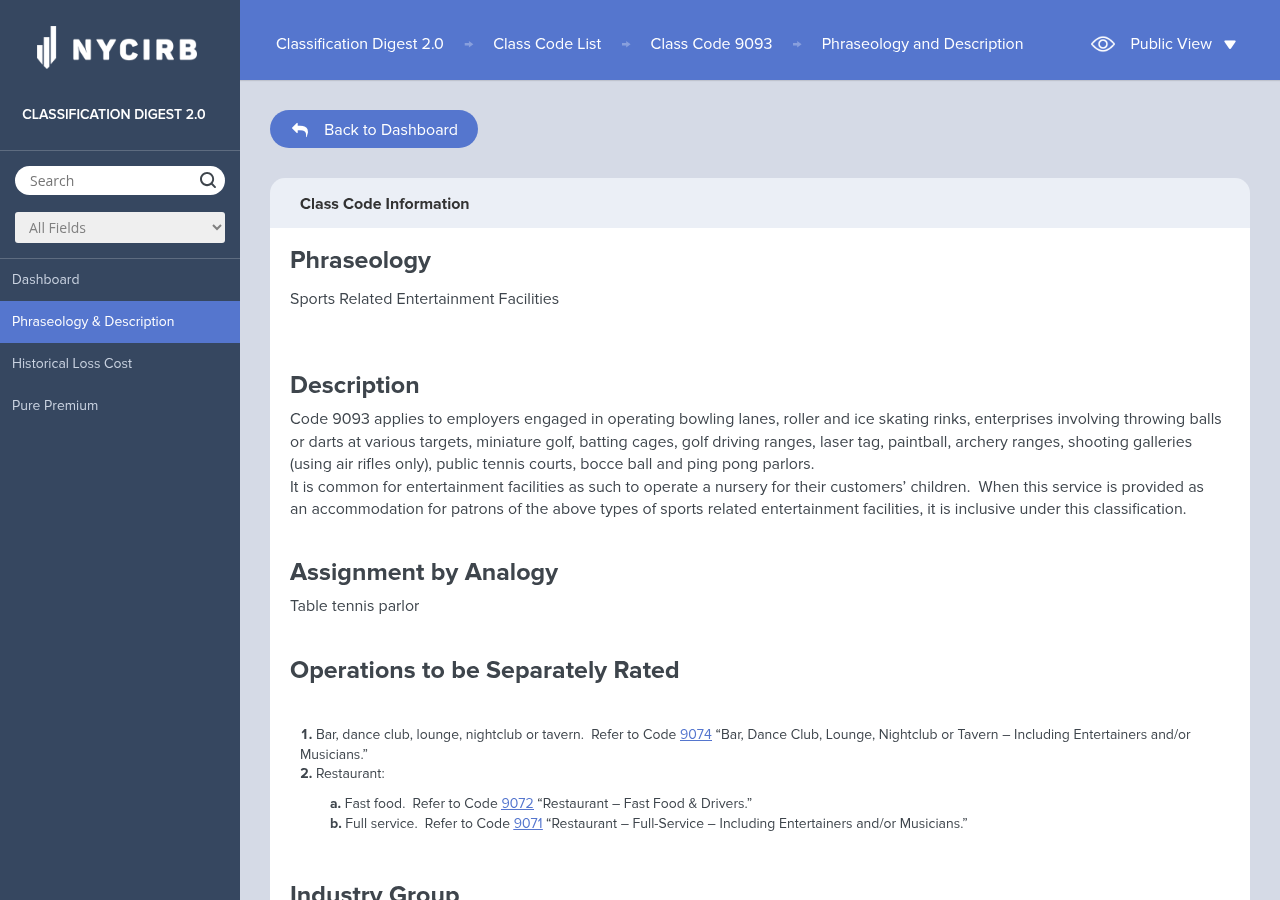
Source 1 of 5 · The classification that lists everyone except you
New York's Class 9093 enumerates bowling lanes, skating rinks, miniature golf, batting cages, golf driving ranges, laser tag, paintball and archery ranges, and never reaches indoor golf. The panel below it, Assignment by Analogy, is how a venue with no name of its own gets rated.
Source: nycirb.org/classification-digest
The Census picture is the same and, if anything, more pointed. When the federal classification was revised in 2022, the statisticians did add index entries for axe throwing clubs, escape rooms, esports and pickleball. The eight golf facility entries were left byte-identical to the 2017 version. Nothing was added for indoor golf. The proposed 2027 revision does not touch the arts, entertainment and recreation sector at all, so the federal system will not name a golf simulator venue this decade.
Where do simulator venues land? By elimination, in NAICS 713990, All Other Amusement and Recreation Industries, which the Census defines as everything that is not an amusement park, an arcade, a gambling business, a golf course or country club, a ski facility, a marina, a fitness centre or a bowling centre. That placement is an inference from the definitions, not a federal statement. Nobody in Washington has ever written it down.
Here is the part that matters commercially, and it is the opposite of what most operators are told. An unnamed operation is not an uninsurable one. Every one of those manuals contains a written rule for exactly this situation. California's states it plainly: "Any business or operation not described by a classification shall be assigned to the classification(s) most analogous from the standpoint of process and hazard." New York's digest even publishes an Assignment by Analogy panel on each class page.
So the absence is real, and it is a pricing problem, not a coverage problem. The venue gets rated by analogy, and the analogy chosen decides the number. Are you most analogous to a sports entertainment facility, an indoor training facility, a restaurant with an attraction attached, or a self-service premises open at four in the morning? Those are not the same rate, and nobody at a call centre is going to work it out on your behalf.
When an operator tells me nobody will write them, what they usually mean is that nobody has decided what they are. The manuals have a rule for a business they have never named, and it sends the underwriter looking for the closest analogous operation. If you let a generalist pick that analogy for you, you find out which one they chose when you get the renewal, or worse, when you get the denial.
Bobby Sharp, Action Sports Practice Lead, Specialty Insurance
Pennsylvania is the useful counter-example, because it does have a class that fits: an indoor facility where patrons practise or receive instruction in a specific sport, with swimming, tennis, gymnastics, racquetball, skating and martial arts named as examples. An indoor golf venue sits comfortably in that description. The lesson is not that one state is right. It is that the same venue can be a different animal in three states, and the operator who cannot argue their own classification takes whatever the first form-filler picked.
Two US legislatures have managed what the classification bureaus have not. Wisconsin has had "indoor golf simulator facilities" written into its alcohol statute since 1995, in a list that now sits alongside axe throwing facilities. And Maryland has gone further than any classification system in the country, which is a section of its own further down.
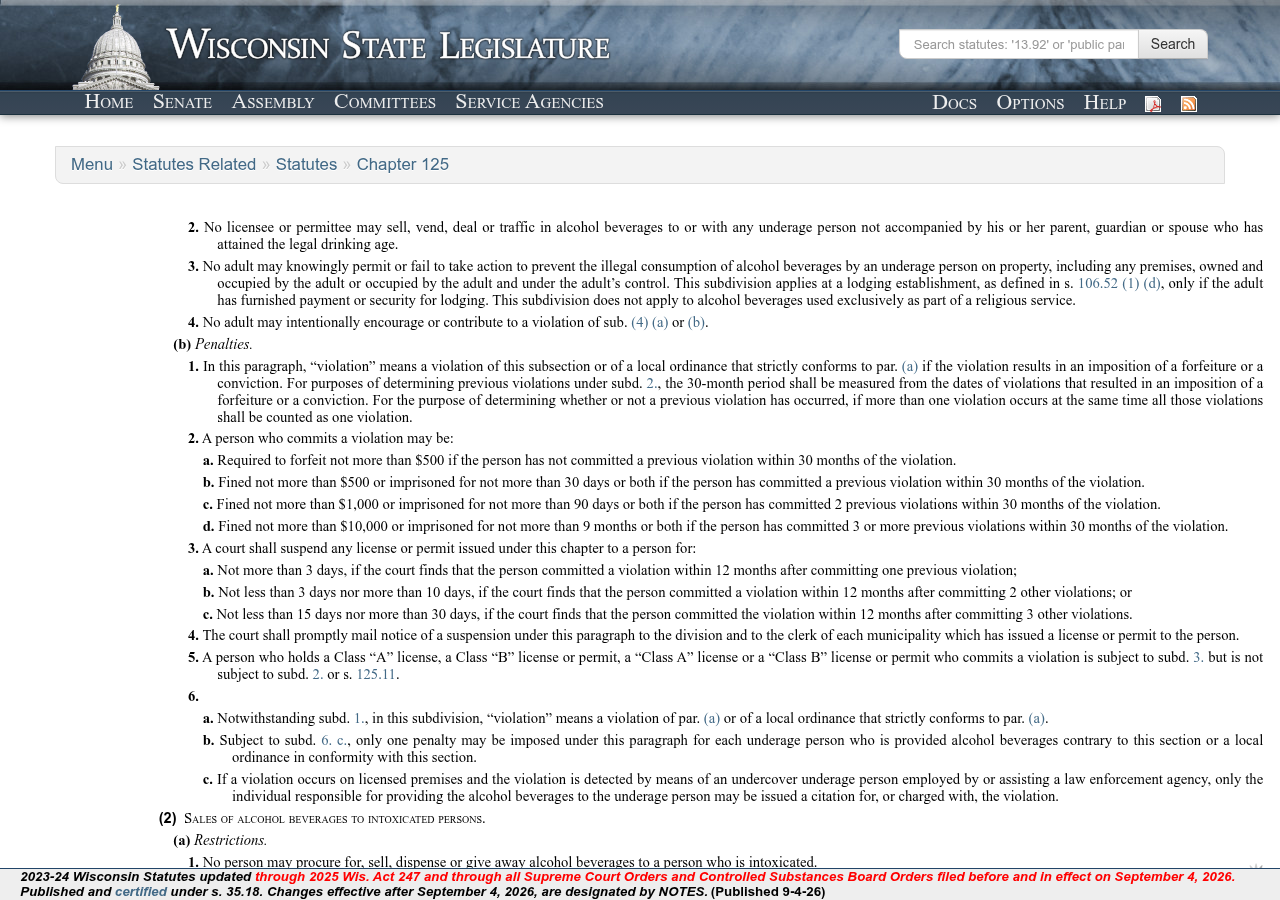
Source 2 of 5 · Named by a legislature in 1995
Wisconsin's alcohol statute exempts a specific list of premises from the rule on unaccompanied minors, and indoor golf simulator facilities have been on that list for three decades. The classification manuals have still not caught up.
What operators are being told, in their own words
The classification gap is not an abstraction. It shows up in what carriers say to people trying to open.
One owner posting in r/Insurance in April 2025 reported the response from a direct writer word for word: they would not insure him because "They don't have a classification for golf sims, so I have to register as a golf instructor just to get a quote." He had already sunk fifty thousand dollars into the build. In a separate thread the same month, titled bluntly, he described trying for over a month to place general liability, workers' compensation and liquor liability for a new simulator business, through local agents and national direct writers alike, without a single quote coming back.
Another owner opening a two-bay venue with code entry, no food, no alcohol and nobody on site wrote: "It has been impossible to find business insurance for this club." When a quote finally arrived for a comparable operation with beer service it was $8,000 a year for general liability plus liquor liability, and it came from the only local agent who could work out how to rate the business at all. An owner of a staffed four-bay facility put the market in one line in February 2026: "It seems that no one wants to insure indoor golf facilities, you need a specialized carrier."
Then there is the workaround, which is where this stops being an inconvenience and starts being a coverage problem. In one thread an unstaffed venue owner described how he got written: "I did a lot of searching pretending I was a 24 hour gym." About five minutes later, a different operator replied on the same thread that the policy he had looked at was not assigned to the concept correctly, and that he expected a claim to be denied because of it.
Both of those operators are right. That is the trap. Misdescribing the operation is often the only way to get a policy issued, and it is also the thing that gives a carrier its cleanest path to walking away when something happens.
The cost of getting the analogy right rather than convenient is not small either. An agent in the same discussion described taking an esports arcade that was "barely getting quoted" as an event centre at around $6,000 a year, moving it to a specialty surplus lines market that classified it as an arcade, and binding it at $1,100. Same business, same risk, same year. The classification was the whole difference. This is the failure mode we mapped in the coverage gaps a generalist agent will miss, and golf simulators are now its clearest example.
The exclusion that can delete the simulator itself
Getting a policy issued is not the same as getting the room covered, and there is one endorsement in this market that operators should read before they sign anything.
A person starting a mobile golf simulator business, shopping general liability at the end of 2025, published the exact wording he was being offered. The Amusement Devices Exclusion reads: "This insurance does not apply to 'bodily injury' to any person arising out of the ownership, maintenance, or use of any electric, electronic, mechanical, inflatable, or computer operated amusement rides or device other than those which may be specifically designated and scheduled on the declarations attached to this policy."
Read that against your floor plan. A golf simulator is an electronic, computer operated device that patrons use for amusement. If the form is attached and the bays are not specifically scheduled on the declarations page, the policy has excluded bodily injury arising out of the use of the only thing in the building anyone came for.
That is not a theoretical worry. It is the same structural failure as the athletic participants exclusion, which a federal court has already applied to wipe out both indemnity and the duty to defend at a recreation venue. The standard form's language is short: "With respect to any operations shown in the Schedule, this insurance does not apply to 'bodily injury' to any person while practicing for or participating in any sports or athletic contest or exhibition that you sponsor." Run a league, a club championship or a junior programme, and the argument that your customers are participants in a contest you sponsor is available to your carrier. If you run any of those, ask for the schedule of forms and confirm whether that exclusion is attached before you bind.
On a simulator account I read the schedule of forms before I read the limits. If there is an amusement devices exclusion attached and the bays are not scheduled on the declarations, the operator has bought a policy that covers the lobby and the car park and stops at the door of the thing they sell. Nobody tells them. It is one line on a form list, and it is the difference between a program and a receipt.
Bobby Sharp, Action Sports Practice Lead, Specialty Insurance
There is a real case behind this too, at an indoor golf facility. In litigation that reached the Eighth Circuit, a student was struck in the head by a golf ball and suffered severe permanent brain injury at an indoor facility, and the head golf professional involved found that his employer's liability policy did not cover him, because he was not acting within the scope of his employment at the time. The court affirmed there was no duty to defend him at all. Coverage disputes at indoor golf venues are not hypothetical. They are just rare enough that nobody has built a playbook for them.
What a swung driver does in a room with a ten foot ceiling
Here is the honest state of the evidence, because it matters more than any confident claim: there is no injury rate for golf simulator venues. No federal dataset, no academic study, no trade body and no research organisation publishes one. There is not even a product code for a golf simulator in the federal injury surveillance system, so a simulator injury gets recorded as a golf injury or occasionally as an amusement attraction injury.
What does exist is the underlying record, and it is more useful than a rate. The Consumer Product Safety Commission's national surveillance system estimates that golf activity, apparel and equipment sent 48,756 people to US emergency departments in 2025, from 1,042 sampled cases. Head and neck is the largest injured region every single year, at an estimated 14,309 in 2025. And of those 1,042 raw case records, 785 were coded to a place of recreation or sports, against 55 at home. This is not a driveway problem. It happens at venues.
Inside that file are the cases that name the venue type outright. One 2025 record reads, in the coder's own capitals: "12YOM WAS AT A GOLF SIMULATION STORE WHEN HE WAS STRUCK IN THE FACE BY SOMEONE SWINGING A GOLF CLUB DX FRACTURED FACE." Another from the same year: "PATIENT WAS AT GOLF SIMULATOR EXPERIENCE X 1 DAY AGO, HAD A GOLF BALL HIT HER IN RIGHT SIDE OF HEAD GOING ABOUT 85MPH. DX; HEAD TRAUMA, CONCUSSION."
A twelve year old with a fractured face, struck by a second person's club in the bay. A concussion from a ball at eighty five miles an hour in a room you could park two cars in.
The club-strike pattern is the one that scales with your business model. Across the federal microdata, case narratives describing a club strike number 96 in 2025, up from 69 in 2024 and 59 in 2023, and 65 of the 2025 cases were patients under eighteen. The clinical literature explains why that age skew matters. A neurosurgical case series of children aged ten or under struck in the head by a golf club found thirteen depressed skull fractures, and recorded that "All 13 patients sustained their injuries after being struck in the head by a golf club. Seven sustained injuries on the follow-through of the initial swing and 3 sustained injuries on the backswing." At one paediatric trauma centre, golf injuries carried a mean injury severity score of 11.0 against 6.8 for every other sport, with 57 percent caused by a club strike.
Now put that next to the room. Every launch monitor manufacturer that publishes space requirements converges on ten feet of ceiling as the practical minimum for a full swing, with fifteen feet of width. Trackman's own guidance says the room has to do three things, the third being to keep people and property safe, and adds that "Safety matters more in small spaces. Impact screens should be properly rated."
The venues that treat that as an engineering problem show it in their purchasing. When the Town of Harrison, New York went out to bid for two commercial golf simulation bays at its municipal country club, the bid sheet listed an archery netting layer, four ceiling protective baffles and wall upholstery padding as line items sitting alongside the launch monitor, projector, screen, mats and turf. Safety layers were not an upgrade. They were part of the specification.
Underwriters ask about birthday parties and junior programmes for a reason, and it is not that children are clumsy. It is that a bay holds a group, a group holds a second person, and the second person is standing inside the arc of a driver.
The room is a property policy with a very small footprint
A four-bay indoor golf venue might occupy 2,500 square feet of leased retail space. Inside that footprint sits a concentration of high-value electronics that has no real equivalent in the rest of the action sports world.
The cleanest public evidence of what that is worth comes from a city council, not a vendor. In 2018 the City of Centerville, Ohio accepted a bid of $156,450 from a simulator manufacturer for three golf simulators at its municipal course. In December 2025 the same city accepted a proposal of $177,195.75 from a different manufacturer to replace them. Same three-bay room, seven years apart, and the replacement cost went up, not down.
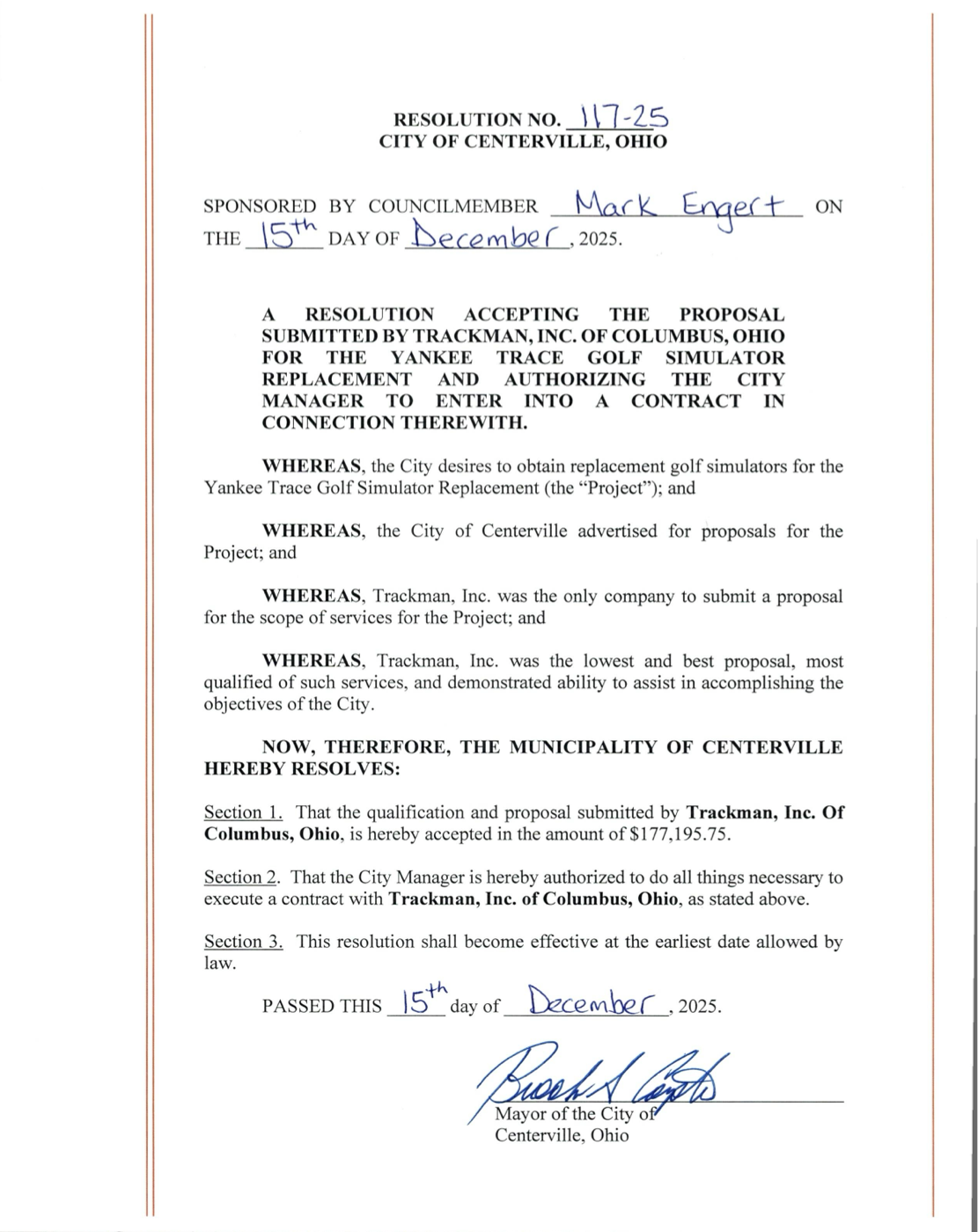
Source 3 of 5 · What a three-bay room costs to replace, from a public purchasing file
Centerville, Ohio, Resolution 117-25, passed 15 December 2025, accepting a proposal of $177,195.75 to replace the golf simulators at the municipal Yankee Trace course. Municipal resolutions are one of the few auditable public records of simulator replacement cost.
Manufacturer pricing tells the same story from the other end. One maker lists a ceiling-mounted launch monitor from $13,995, described as its home entry price. A commercial flatscreen simulator system is published from $37,900, and a curved commercial system from $69,500. One vendor publishes a fully itemised single-bay kit at $16,749, with the launch monitor at $10,999, the enclosure and impact screen at $2,759, the camera system at $1,700 and the projector at $1,499. Enclosure kits alone run from about $1,000 to nearly $4,900.
Two things follow, and both are underwriting conversations rather than shopping decisions. First, the values need declaring at full replacement cost, not estimating. On a fixed site the bays sit inside the property program as business personal property, and a franchisor has already put the number in writing: one indoor golf brand requires business personal property cover of at least $300,000 at full replacement cost value and states in the requirement itself that the figure includes the simulators, alongside at least $225,000 for tenant improvements.
Second, the things that break are not the things that get stolen. Projectors take club strikes. Impact screens fray and take snapped shafts through the fabric. Those are attritional losses on a deductible, and they belong in a maintenance budget, not a claim file. What belongs in the claim file is the fire, the water loss, the electrical event, and the month you cannot open afterwards.
That last one is where simulator venues are most exposed and least prepared, because the default is worse than most operators assume. The Insurance Information Institute states it in plain terms: "The standard property policy limits the business income restoration period to 30 days, but this period can be extended to 360 days by endorsement." A four-bay venue with six-figure equipment does not get rebuilt, re-cabled, recalibrated and reopened in thirty days. Your lease, as the next section shows, may already require twelve months.
Your lease sets the floor before any carrier does
Almost every indoor golf venue is a tenant. That makes the lease, not the carrier, the first document that decides your limits, and operators routinely sign it months before they shop insurance.
A published retail lease form used at a county-run harbour development sets a tenant's liability insurance minimum at $2,000,000 and, unusually and importantly, caps the tenant's deductible at $25,000. It requires business interruption insurance sufficient to cover twelve months of base rent and additional rent, with the landlord named. It makes the tenant insure its own alterations and fit-out at not less than 100 percent of full replacement cost. And it reserves the landlord's right to raise the required limits: "Landlord may from time to time, but not more frequently than once every three (3) years, require that the amount of insurance to be maintained by Tenant under this Article 11 be increased."
Read those four clauses together and the shape of the problem appears. Your buildout is your property, not the landlord's. Your business interruption requirement is twelve months, while the standard policy default is thirty days. Your deductible is capped by contract, which quietly removes the cheapest lever agents reach for when a premium comes back high. And your limits can be moved on you every three years for the life of the lease.
A university system's risk office, writing as a landlord, states the tenant-side rule that follows: a business personal property policy covers improvements and betterments and does not cover the building shell. Its advice to its own staff is worth stealing from the other side of the table, because it tells you what the negotiation really is: start with higher limits and negotiate down, and treat additional insured and waiver of subrogation endorsements as things that should not cost extra.
One more clause that catches simulator venues specifically. Property values under a coinsurance provision are not a formality. A state insurance regulator publishes a worked example in which an $80,000 policy pays only $33,332 on a $40,000 loss because the building was insured below the required percentage. Under-schedule your bays to save premium and you have not bought a smaller policy. You have bought a smaller share of every claim.
Public bodies buy simulators too, and when they do they publish their requirements. A public university system's golf simulator solicitation from October 2025 requires $1,000,000 per occurrence of commercial general liability on an occurrence form, names the university as additional insured, and states that the required limit can be met with a single policy or with a primary policy combined with an umbrella.
The bar is the second business, and the law knows it
Just under half of US commercial simulator venues serve alcohol, and just over half serve food. That single fact does more to your premium than any other choice you make.
Start with what the liability policy does on its own, because operators consistently misread it. The standard commercial general liability form excludes liquor liability outright for a business in the trade: bodily injury or property damage for which any insured may be held liable by reason of "Causing or contributing to the intoxication of any person," furnishing alcohol to someone underage or already intoxicated, or any statute relating to the sale, gift, distribution or use of alcoholic beverages. A state supreme court quoting the modern version in 2025 confirms it reaches further than most people expect: the exclusion applies even where the claim is framed as negligent hiring, training, supervision or monitoring, which closes the obvious workaround.
So the bar needs its own line. That is not a preference, and in several states it is not optional either. South Carolina rewrote its rules with effect from 1 January 2026. Any venue open after five in the afternoon selling alcohol for consumption on the premises must carry liquor liability, and the requirement is now a $1,000,000 annual aggregate with a per-occurrence floor of half that. The same reform created a mitigation ladder that lets a licensee reduce the required aggregate through operating behaviour, down to a hard floor of $300,000, and a companion section makes a licensee jointly and severally liable for fifty percent of a plaintiff's actual damages where a verdict lands against both the licensee and an impaired driver.
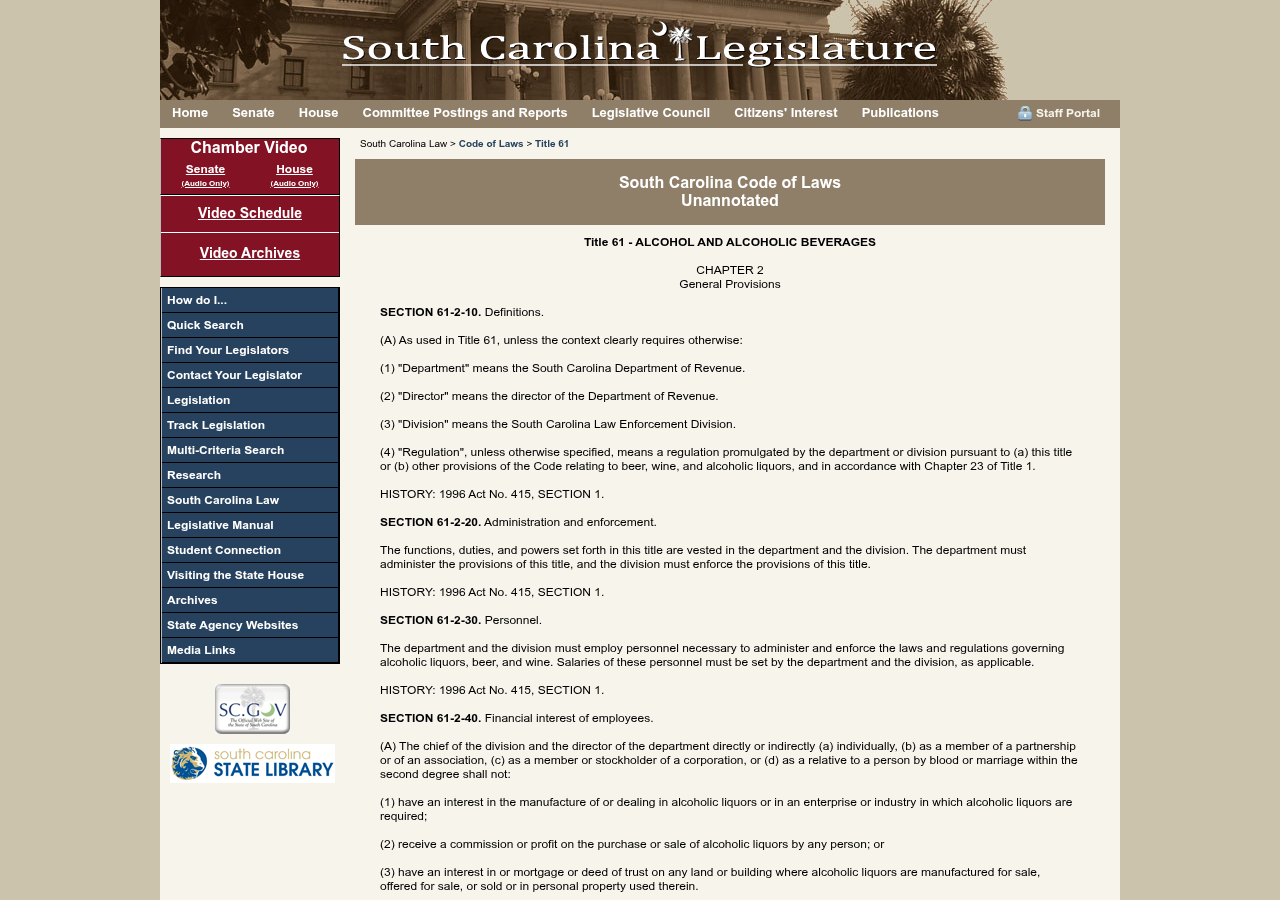
Source 4 of 5 · A liquor liability regime that changed on 1 January 2026
South Carolina Code section 61-2-145, as amended by 2025 Act No. 42. Venues open after five in the afternoon must carry an annual aggregate of $1,000,000, with per-occurrence coverage of at least fifty percent of that, reducible through a defined mitigation ladder.
Other states draw the line in their own places, and the spread is wide enough that a multi-state operator cannot assume anything. Utah requires evidence of dramshop coverage of at least $1,000,000 per occurrence and $2,000,000 aggregate before a retail licence issues. Vermont's mandatory liquor liability requirement took effect on 1 July 2026, tied to licence issuance and renewal. Massachusetts bars issue or renewal of an on-premises licence under its section 12 until the applicant proves liquor legal liability of at least $250,000 per person and $500,000 per accident. Illinois publishes hard statutory recovery caps that move every year, currently $90,411.55 per injured person for judgments on or after 20 January 2026. Texas requires the patron to have been obviously intoxicated to the point of presenting a clear danger before a provider is liable at all.
And then there is Maryland, which has done something no classification bureau has managed: it wrote the underwriting question into statute.
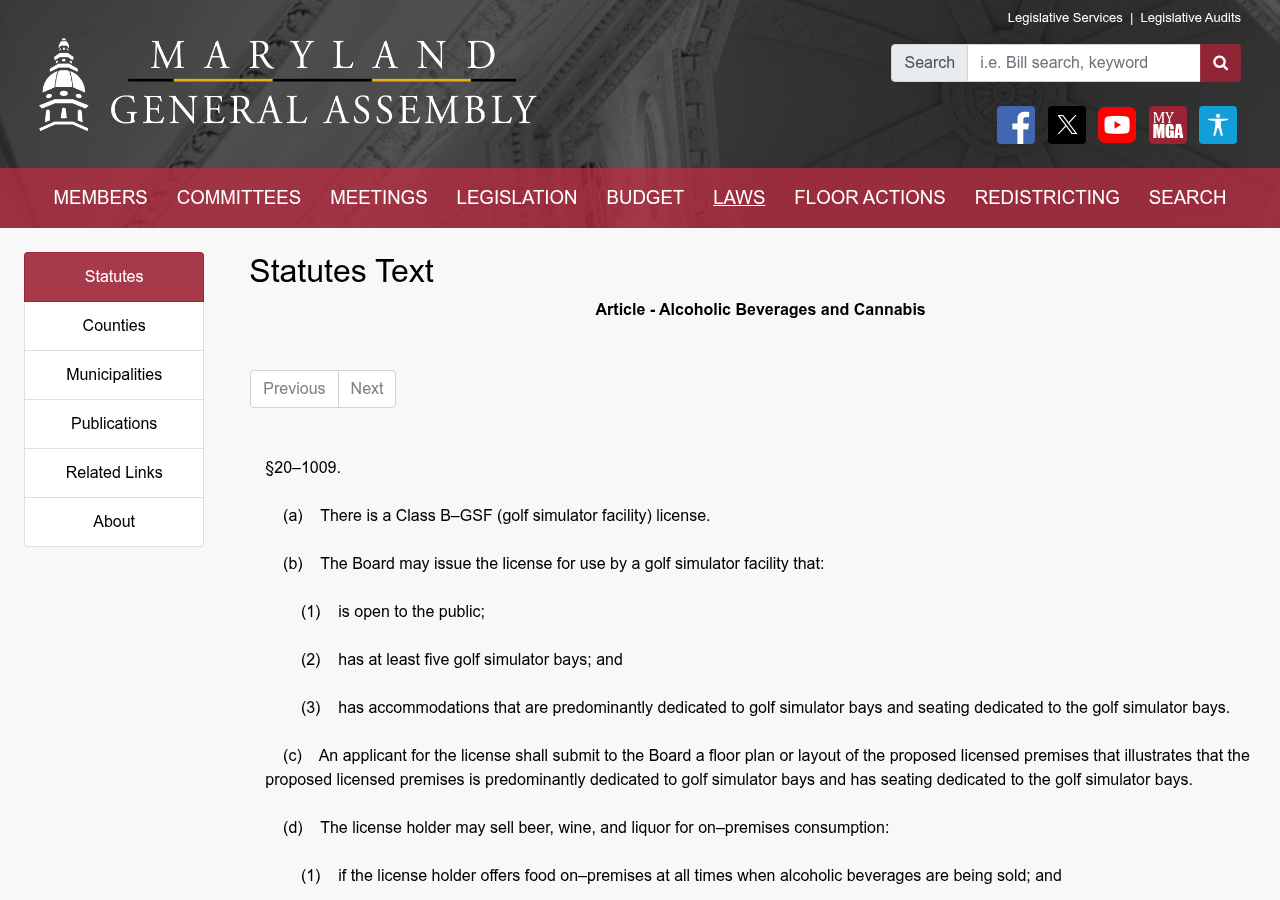
Source 5 of 5 · A liquor licence class that exists only for golf simulator facilities
Maryland's Class B-GSF licence requires at least five golf simulator bays and defines the venue by revenue mix, capping alcohol at 35 percent of annual gross sales while requiring bay rental to be at least 50 percent and food at least 15 percent, with an annual gross sales report before renewal.
Read what that statute is doing. A legislature has drawn, in numbers, the exact line an underwriter draws by instinct: the difference between a golf venue that serves drinks and a bar with hitting bays in it. Alcohol may not exceed 35 percent of annual gross sales. Simulator bay rental must be at least 50 percent. Food must be at least 15 percent. And the licensee has to file a gross sales report to keep it.
If you are anywhere near those proportions, you now have a defensible answer to the question every carrier asks and most operators answer with a shrug. If you are past them, you are a bar, and you should expect to be priced as one. The franchise filings show the same split with money attached: one franchisor prices insurance for its alcohol-serving lounge format at $3,500 to $7,140 for three months against $366 to $3,375 for its non-alcohol lab format, in the same document, for the same period. Another requires separate dram shop cover of not less than $1,000,000 single limit per occurrence and reserves the right to buy the coverage for a lapsed franchisee and bill it back with a ten percent administrative fee.
One operational detail from the market that operators should check before they assume a self-pour model works. An Oklahoma owner reviewing several liquor policies for his simulator venue reported that every one specifically forbade free drinks and patrons serving themselves, and required all drinks to be served by a certified server. The bar model and the unstaffed model do not naturally coexist, which brings us to the hours.
Your opening hours are a rating factor
Nothing in this vertical moves a premium like the decision to run unstaffed at three in the morning, and this is where operator experience is most consistent.
An Arizona owner building a four-bay, 3,300 square foot facility in Scottsdale described it directly in 2024: quotes of $14,000 to $20,000 a year if he ran twenty four hours, and roughly half that on a five in the morning to ten at night schedule. He later reported binding around $7,000 for the year and dropping twenty four hour access altogether, because keeping it would have more than doubled the premium. Earlier in the same discussion he reported finally getting a placement done at $5,800.
A Texas operator pivoting from a staffed bar model to unstaffed set out the trade in one line, choosing six in the morning to midnight over true round-the-clock: cheaper insurance, and midnight to six is a window he can live without. Another Texas operator publicly offered a finder's fee worth a full month's premium to anyone who could name an insurer that covers unstaffed hours together with a bring-your-own-bottle policy. Seven and a half months later the thread has three replies and he has not reported a bind.
The exposure is easy to state and hard to underwrite. A member unlocks a commercial premises alone, at any hour, and operates powered equipment in a confined space with nobody present to stop a second person standing in the wrong place, and in a bring-your-own-bottle venue, with no server controlling the alcohol. Multi-location operators market exactly this as the product. Alongside alcohol, it is also the choice operators most consistently report moving their premium.
Two consequences worth planning around. Access control stops being a convenience and becomes a rated safety control, which means cameras, individually identifiable entry credentials and retained logs are worth having before you ask for terms rather than after. And the data those systems generate creates its own exposure: one franchisor requiring a self-service access system also requires cyber liability of at least $2,000,000, double its own $1,000,000 general liability per-occurrence minimum. That is not a typographical error in the filing. A venue that holds member identity, payment credentials and door logs, with no staff on site, is a data business that happens to sell golf.
On the road: mobile and event simulators
A trailer-mounted simulator is a different risk with a different policy, and the road half of it is bigger than the golf half.
The clearest published figure comes from a mobile simulator franchisor's own filing, which lists vehicle and business insurance at $1,683 to $4,500 as an estimated initial investment item, and separately requires auto liability for scheduled vehicles at a $1,000,000 combined single limit. That same requirement contains the clause most mobile operators miss: coverage for vehicles and trailers must include physical damage, with comprehensive and collision deductibles no more than $2,500. The trailer is not cargo. It is a scheduled vehicle carrying your entire revenue-generating asset.
The scale explains the underwriting. A purpose-built 2026 golf simulator trailer listed in the US carries a 13,200 pound gross vehicle weight rating at a price of $234,900. One manufacturer's mobile unit travels at forty feet long and thirteen feet six inches tall. The federal motor carrier threshold for a USDOT number in interstate commerce starts at 10,001 pounds of gross vehicle weight rating, so a fully specified golf simulator trailer can clear the federal line before the tow vehicle is attached. And the road is where people are genuinely killed at work: transportation incidents were the most frequent type of fatal occupational event in 2024, at 38.2 percent of all workplace fatalities.
Between bookings, the exposure changes character again. The national crime bureau's guidance on cargo is blunt about when losses happen: trucks and cargo are most vulnerable when sitting idle. A mobile simulator spends most of its life parked.
Then there is the paperwork the booking imposes on you, which is where mobile operators lose events. Municipalities and universities publish their requirements and they are specific. One city requires special event general liability of $1,000,000 per occurrence and $2,000,000 aggregate maintained through set-up and dismantle, not just the event itself, and separately triggers $1,000,000 of auto liability simply because vehicles are used. Another city names the exact additional insured endorsement forms it will accept and rejects certificates whose wording assumes a written contract, on the reasoning that a permit is not a contract. A large public university requires automobile liability on the certificate whenever a vendor drives onto campus to provide a service, plus additional insured status with primary and non-contributory wording and a waiver of subrogation. Another university steps its general liability requirement to $2,000,000 per occurrence for elevated-risk events and adds a separate $2,000,000 liquor liability requirement on top when alcohol is served.
None of that is negotiable on the morning of the booking. A mobile operator whose certificate cannot be issued in the right form, with the right endorsements, does not get to set up. This is the same certificate discipline we cover in what changes when you open a second location, compressed into a single Saturday.
Same sport, three different books
Golf simulators, golf courses and driving ranges get lumped together because the ball is the same shape. As insurance risks they have almost nothing in common, and the clearest way to see it is to ask what really hurts people at each one.
At an outdoor golf facility, the answer is not the golf swing. Across two peer-reviewed analyses of federal emergency department data, the golf cart is the largest single mechanism: 40 percent of lower-extremity golf injuries and 44.63 percent of upper-extremity injuries, against 10.37 percent for the golf swing itself. A state supreme court has already established what a cart fleet means in liability terms, allowing a venue to be sued as the owner of the cart its customer was driving, on a statute, with no negligence of its own.
An indoor simulator venue deletes that entire loss driver. It has no carts, no acreage, no water, no chemical application and no weather. What it does instead is take the smallest mechanism on the list, the swing, and concentrate it into a room with a ten foot ceiling and a second person standing in it.
The other two venue types carry an exposure a simulator venue does not have at all: the ball that leaves the property. The Illinois Supreme Court recorded neighbours of a public course collecting 2,128 golf balls on their land across two seasons, some landing 300 feet past the boundary. A Massachusetts jury awarded $3.5 million in an errant-ball case, of which $3.4 million was emotional distress and only $100,000 was property damage, in litigation where the course's own architect testified that as far as he knew nobody in the golf industry has any standard about what is acceptable. The Supreme Judicial Court set that verdict aside in December 2022 and ordered a new trial, so the $3.5 million is what one jury awarded, not a final judgment. A New York club that had paid neighbours for ball damage on at least three occasions over twenty one years was permanently enjoined from operating its driving range in a manner constituting a private nuisance and trespass. That litigation is current, not historical: a New York appellate court issued a decision in a live errant-ball nuisance action against a range operator in May 2026.
Netting is the range's answer, and it is a double-edged one. An Oklahoma appellate court reversed summary judgment for a country club in December 2024, holding that neighbours of a driving range sit within its zone of risk, in a case where, according to the club's own counsel, the netting had been raised from forty feet to sixty feet between some of the poles during the dispute. Municipalities regulate the problem from both directions: one Minnesota county permits a driving range in agricultural districts only on a 35 acre minimum lot with a 150 foot setback and daylight-only hours, so that the site is large enough that safety netting is unnecessary; a Utah city instead permits netting and support structures up to 180 feet tall, with a building permit, engineer-approved posts and an affirmative duty on the owner to repair torn netting.
An indoor venue has none of that, and one thing the outdoor venues do not: a landlord, a shared wall and a fire suppression system it does not control. The scale difference underneath all of this is easy to miss. The median 18-hole golf facility occupies about 150 acres, of which 95 acres are maintained turf. A driving range in that Minnesota county needs at least 35 acres. A leased four-bay simulator venue might use 2,500 square feet. And the payroll difference drives workers' compensation directly: the average private golf course establishment employs 39 people, against about 10 in the industry group that contains driving ranges.
| Venue type | What the premium is really rating | The line operators miss |
|---|---|---|
| Indoor golf simulator venue | Alcohol service, staffed against unstaffed hours, and a high equipment schedule concentrated in a leased footprint of a few thousand square feet. | Business personal property declared at full replacement cost for the bays, and business income beyond the thirty-day default. |
| Golf course | Acreage, a cart fleet, maintenance equipment, chemical application, water, weather and a clubhouse bar, with roughly 39 employees at the average private establishment. | Commercial Auto Insurance and cart liability, plus Liquor Liability Insurance for the beverage cart as well as the clubhouse. |
| Driving range | The ball that leaves the property: netting adequacy, setbacks, neighbouring property damage and nuisance exposure, plus ball-picking equipment and night lighting. | Excess / Umbrella Insurance sized for a nuisance and trespass claim brought by someone who never entered the property. |
For what a course-side or range-side program looks like in full, see our golf course insurance and driving range insurance pages. The pattern of a venue that is really three businesses under one roof is the same one we mapped for bowling centres, and the sub-limit failure it produces is the subject of the sub-limit trap.
What moves the number up, and what moves it down
Everything above collapses into a short list. These are the levers, in the order they matter.
What moves it up.
- Alcohol service. The single largest step, and the one the franchise filings quantify most clearly.
- Unstaffed or twenty four hour access. Operators consistently report roughly double.
- Bring-your-own-bottle combined with unstaffed hours. The combination the market is least willing to write at any price.
- Leagues, junior programmes and birthday parties. These push you toward the athletic participants question.
- A high equipment schedule concentrated in a small footprint.
- A lease that dictates limits, caps your deductible and requires twelve months of business income.
- Employees, which bring workers' compensation and its own classification argument.
- A mobile unit, which adds a commercial auto exposure rated on driving records rather than on golf.
What moves it down.
- Getting classified by analogy on purpose rather than by accident, with a written description of your operation an underwriter can rate.
- Scheduling the simulator bays explicitly on the declarations page, so no amusement devices exclusion can quietly remove them.
- Documented access control with individual credentials and retained logs.
- A staffed schedule, or a defined unstaffed window rather than an open-ended one.
- Certified servers and no self-service alcohol.
- Netting, ceiling baffles and wall padding specified as part of the build rather than added after an incident.
- Values scheduled honestly, because under-scheduling to save premium buys a smaller share of every claim.
- A clean, documented first year, which is the file that wins year-two pricing.
Two of those are worth stating as a rule. Your hours and your alcohol are the two biggest numbers on your quote, and neither of them is golf. Waivers, for what it is worth, are not on either list, because they are a supplement to a program and never a substitute for one, as we set out in do waivers replace insurance.
The venues that get the best second-year pricing in this class are the ones that can hand me a description of their own operation. Bay count, staffed hours, the alcohol share of revenue, the access control system, the equipment schedule with serial numbers. That document is worth more than shopping the market, because it lets an underwriter rate what you genuinely are instead of the nearest thing they can think of.
Bobby Sharp, Action Sports Practice Lead, Specialty Insurance
That description is also the thing that survives a change of carrier, a change of agent and a change of market cycle. It is the closest thing this vertical has to a class code, and you are the only person who can write it.
"Specialty Insurance diligently takes their time and works with you, making sure your business has all the correct and specific coverages you need. There is no other source out there that does what they do for the airsoft and paintball industries."
Gel Tag San Diego LLC
Verified customer review
How to get a quote that matches the operation
Bring four things and most of the difficulty in this guide disappears.
A written description of the operation. Bay count, square footage, staffed hours against unstaffed hours, whether alcohol is served, poured or brought in, and the revenue split between bay rental, food and alcohol. That last figure is the one Maryland wrote into statute and the one an underwriter will ask for whether or not your state does.
The equipment schedule. Launch monitors, projectors, screens, enclosures and computers, with values and serial numbers, plus the tenant improvements separately, because those are yours to insure and not your landlord's.
The insurance article of your lease. Required limits, deductible caps, the business interruption period, additional insured and waiver of subrogation wording, and any clause letting the landlord raise the limits later.
Your access control and safety build. Entry credentials and log retention, camera coverage, and whether netting, ceiling baffles and wall padding are part of the room.
Specialty Insurance places action sports and entertainment venues that generalist markets decline or misclassify, in all 50 states, and reads policies for a living. If your current quote arrived without anyone asking about your hours or your alcohol share, it was not written for a golf simulator venue. It was written for whatever the last form said.
Frequently Asked Questions
How much does golf simulator insurance cost?
Specialty Insurance's 2026-2027 ranges for a US indoor golf simulator venue run $250 to $1,000 a year for General Liability Insurance, $250 to $500 for Commercial Property Insurance and $100 to $300 for Workers' Compensation Insurance, plus $500 to $1,500 for Liquor Liability Insurance if you serve alcohol. They are line-by-line indications for budgeting, not a quote. Published franchise filings sit higher and measure something different, the whole insurance line for every policy a franchise agreement requires: two indoor golf franchisors disclosed insurance lines of about $5,100 a year for small venues, and one estimates $15,000 to $20,000 for twelve months at a venue with six to eight simulators serving food and alcohol.
Is there a class code for a golf simulator business?
No published classification system in the United States names golf simulators, indoor golf or virtual golf. A search of New York's classification digest for the word simulator returns zero results out of 594 classifications, Pennsylvania's 630 classifications contain none, and none of the 20,399 entries in the US Census NAICS index names one. That absence is a pricing problem rather than a coverage problem, because every classification manual contains a rule assigning an unnamed operation to the most analogous classification from the standpoint of process and hazard. The analogy chosen is what decides the premium.
Does general liability insurance cover the simulator bays themselves?
Not automatically, and this is worth checking on your schedule of forms before you bind. An Amusement Devices Exclusion in circulation in this market removes bodily injury arising out of the use of any electric, electronic, mechanical, inflatable or computer operated amusement device other than those specifically designated and scheduled on the declarations. A golf simulator fits that description. If the exclusion is attached and your bays are not scheduled, the policy has excluded the main activity in the building. Separately, an athletic participants exclusion can remove injuries to people taking part in a contest you sponsor, which reaches leagues and junior programmes.
Do I need liquor liability insurance for an indoor golf venue?
If you serve alcohol, treat it as a foundation line, because the standard general liability form excludes liquor liability for a business in the trade and the exclusion applies even where a claim is framed as negligent supervision or training. Several states also make it a licensing condition. South Carolina requires venues open after five in the afternoon to carry a $1,000,000 annual aggregate from 1 January 2026, with per-occurrence cover of at least half that and a defined mitigation ladder. Utah requires evidence of dramshop cover of $1,000,000 per occurrence and $2,000,000 aggregate before a retail licence issues, and Vermont's mandatory requirement took effect on 1 July 2026.
Why does 24/7 unstaffed access cost so much more to insure?
Because a member unlocks a commercial premises alone, at any hour, and operates powered equipment in a confined space with nobody present. Operators report the difference candidly: one four-bay owner was quoted $14,000 to $20,000 a year for round-the-clock operation against roughly half that for restricted hours, and abandoned twenty four hour access rather than pay it. Access control also creates a data exposure, and one franchisor requiring a self-service access system requires cyber liability of at least $2,000,000, double its own general liability per-occurrence minimum. Documented individual entry credentials, camera coverage and retained logs are the controls that make the model writable.
Sources
All sources retrieved and verified 8 September 2026.
- GolfTRK Franchising, LLC; X GOLF Franchise Corporation; Golf VX Franchising, LLC; Five Iron Golf Franchising LLC; Another Nine, LLC; and Golf Envy Franchising, LLC, 2026 Franchise Disclosure Documents, Items 7, 8 and 19, filed with the Minnesota Department of Commerce. Dryvebox Franchising, LLC Franchise Disclosure Document, Item 7 and Franchise Agreement section 5.10.
- New York Compensation Insurance Rating Board, Classification Digest 2.0, Class 9093 and search results for "simulator"; Pennsylvania Compensation Rating Bureau, Workers Compensation Manual Section 2, Code 0968; WCIRB California, Uniform Statistical Reporting Plan 1995, effective 1 September 2026.
- US Census Bureau, 2022 NAICS Index File and 2022 NAICS Descriptions; Office of Management and Budget, Statistical Policy Directive No. 8, NAICS proposed updates for 2027, 91 FR 42976.
- Wisconsin Statutes section 125.07(3)(a)3; Maryland Annotated Code, Alcoholic Beverages and Cannabis section 20-1009 and 2024 Laws of Maryland Chapter 1009; South Carolina Code of Laws sections 61-2-145 and 61-2-147 as amended by 2025 Act No. 42; Utah Code section 32B-5-201; Vermont Statutes 7 V.S.A. section 501(i); Massachusetts General Laws chapter 138 section 12; Texas Alcoholic Beverage Code section 2.02; Illinois Liquor Control Commission 2026 dram shop liability limits.
- Commercial General Liability Coverage Form CG 00 01, liquor liability exclusion, hosted by the New York State Office of General Services; Georgetown Chicken Coop, LLC v. Grange Insurance Company (Ky. 2025); Zurich Reinsurance (London) Ltd. v. Westville Riding Club, Inc., 82 F. Supp. 2d 1254 (E.D. Okla. 1999); Travelers Property Casualty Co. of America v. General Casualty Insurance Companies, 465 F.3d 900 (8th Cir. 2006).
- Tenczar v. Indian Pond Country Club, Inc., 491 Mass. 89 (2022); Geddes v. Mill Creek Country Club, Inc. (Ill. 2001); Gellman v. Seawane Golf & Country Club, Inc., 24 A.D.3d 415 (2005); 11 Grace Lane, LLC v. East Norwich Land Company, LLC, 2026 NY Slip Op 02808; Lawrence v. ClubCorp NV II, LLC, 2025 OK CIV APP 17; Jones v. The Glenwood Golf Corporation (Iowa 2021).
- CPSC National Electronic Injury Surveillance System, 2025 annual microdata and Estimates Query Builder, products 1212 and 1213; NEISS Coding Manual January 2025 rev. 1.
- "The swing-ding: a golf-related head injury in children," Journal of Neurosurgery: Pediatrics (2011); "Morbidity associated with golf-related injuries among children," Pediatric Emergency Care (2011); "Golf-Related Lower Extremity Injuries Presenting to United States Emergency Departments," Orthopaedic Journal of Sports Medicine (2025); "Estimates of Golf-Related Upper Extremity Injuries in the United States," Sports Health (2024).
- City of Centerville, Ohio, Resolution No. 56-18 and Resolution No. 117-25; Town of Harrison, New York, Request for Bid 2024-005; Washington County, Minnesota Ordinance No. 139; Vineyard City, Utah Ordinance No. 2019-01.
- National Golf Foundation, "Screen Golf's Growth is Not Simulated" (2025) and Golf Industry Facts; US Bureau of Labor Statistics, Quarterly Census of Employment and Wages 2024 and Census of Fatal Occupational Injuries Summary 2024; USGA, "Golf Courses: Living Bio-Filters."
- OC Parks / County of Orange, Dana Point Harbor retail lease form, Article 11; University of Texas System Office of Risk Management; University of Maine System RFP for Golf Simulator, October 2025; Michigan State University and Oregon State University vendor and event insurance requirements; City of Boulder and City of Seattle special event insurance requirements.
- Insurance Information Institute, "Do I need business interruption insurance?"; Georgia Insurance and Safety Fire Commissioner, The Georgia Business Guide to Insurance; Federal Motor Carrier Safety Administration, "Do I Need a USDOT Number?"; National Insurance Crime Bureau cargo theft guidance.
- Trackman, aboutGOLF, Uneekor, Full Swing and Carl's Place published product specifications and pricing.
- Operator accounts quoted in prose are verbatim from public posts in r/Insurance, r/golf and r/golfsimulatorbusiness between 2024 and 2026, retained on file with permalinks and dates. They are not linked, in line with our outbound-link policy.