

In the federal government's emergency room injury sample for 2019 to 2025, eighteen case records describe someone hurt in a rage room and thirteen describe someone hurt in an escape room. The rage room records read like a list of things a glove is supposed to stop. Glass through the glove while breaking a car window with a bat. A wine bottle that refused to break and ricocheted into an ankle. A hand through a windshield. An eighteen year old who wore her eye shield for the whole session and found a sliver of something, possibly glass, under her eyelid later, while washing her face.
The escape room records are different. A woman who fell down a flight of stairs at an escape room and fractured her ankle. A player who fell off a balance beam built into the set and struck a wall. A face into a mantle, a head into a dresser. An eleven year old whose asthma was set off by a fog machine.
Two businesses, one word in common, and almost nothing else. A rage room is priced on what gets smashed and who is standing near it. An escape room is priced on whether the door locks and what a guest can fall off in the dark. That is why "how much does rage room and escape room insurance cost" has no single answer, and why a quote built for one of them is the wrong quote for the other.
This guide sets out the premium by coverage line, shows what six working rage rooms and the largest escape room chain have disclosed to a state regulator about their own insurance, then walks through the handful of decisions that move it: the lock on the door, the list of things you let people break, the alcohol, the age of your guests, and the room you built.
What rage room and escape room insurance costs, line by line
A rage room or escape room does not buy one policy. It buys a program, and the lines below are the ones that show up on these venues' schedules. Foundation lines are the ones nearly every venue carries. Situational lines follow the operation, and in this program that means alcohol.
Specialty Insurance's 2026-2027 ranges for a rage room or escape room venue run $500 to $2,500 a year for General Liability Insurance, $250 to $1,000 for Participant Injury Insurance, $750 to $5,000 for Commercial Property Insurance and $250 to $1,500 for Workers' Compensation Insurance, with Liquor Liability Insurance at $500 to $5,000 where alcohol is part of the operation.
The single most important row is the second one. A standard general liability form is written for the customer who slips in your lobby. The guest swinging a crowbar, or climbing your set in the dark, is a participant, and that is the claim a participant exclusion removes. The table prices each line on its own, because almost no venue buys every line.
2026-2027 premium benchmark
What rage room and escape room insurance costs, line by line
Typical annual premiums for a US rage room or escape room venue.
- Priced for
- Fixed-site rage room or escape room venue
- Basis
- Annual premium, United States
- Updated
- September 2026
| Coverage | Typical annual range | Monthly estimate | Typical limits |
|---|---|---|---|
| General Liability InsuranceFoundation Third-party bodily injury, property damage and legal defense, including a guest who trips on a darkened stair or a bystander struck by debris. | $500 to $2,500 | $45 to $210per month | $1,000,000 per occurrence / $2,000,000 aggregate |
| Participant Injury InsuranceFoundation Liability for injuries to paying guests while they smash, climb or play, the claim a participant exclusion removes from a standard liability form. | $250 to $1,000 | $25 to $85per month | $1,000,000 per occurrence |
| Commercial Property InsuranceFoundation Build-out, sets, props, puzzle electronics, control systems and smash inventory, with business income designed in for a room that cannot be sold. | $750 to $5,000 | $65 to $420per month | Based on total insurable value |
| Workers' Compensation InsuranceFoundation Employee injuries, including staff resetting rooms, sweeping broken glass and handling debris. Required in most states, with thresholds that vary. | $250 to $1,500 | $25 to $125per month | Statutory state limits |
| Liquor Liability InsuranceSituational Claims arising from alcohol sold on site, and the bring-your-own-bottle question where a carrier will not accept the standard form's wording. | $500 to $5,000 | $45 to $420per month | $1,000,000 per occurrence / $1,000,000 aggregate |
Most venues do not buy every line: Liquor Liability Insurance follows the alcohol, and a smaller venue may package several lines into a Business Owners Policy. Participant accident medical cover, Sexual Abuse and Molestation Insurance for venues hosting minors, Excess / Umbrella Insurance, Commercial Auto Insurance for mobile rage rooms and escape room trailers, and Cyber Liability Insurance for online booking are quoted separately where the operation needs them.
Specialty Insurance book. Updated . Ranges are an indication for budgeting, not a quote or a bindable offer.
Get a 24-hour quoteThe table is an indication for budgeting, not a quote. Before the rest of this guide gets to what moves an individual venue's number, it is worth seeing what working venues have disclosed about their own insurance spend.
What working rage rooms and escape rooms disclosed to a state regulator
Before the rating questions, the closest thing this industry has to published actuals. A franchisor that sells in a registration state has to file a franchise disclosure document, and the Minnesota Department of Commerce publishes those filings. Two of them carry real insurance numbers for these venues.
The only rage room franchisor we found with a public filing in Minnesota, Wisconsin or California is iSmash. Its 2026 disclosure document reports the 2025 insurance spend of six named locations in Item 19, the section where a franchisor discloses financial performance, each for the full calendar year.
| Location | Ownership | 2025 insurance | Share of gross sales |
|---|---|---|---|
| Tampa, Florida | Franchised | $19,823.56 | 2.45% of $808,833.40 |
| Farmingdale, New York | Franchised | $16,104.75 | 1.93% of $834,618.16 |
| Omaha, Nebraska | Franchised | $7,855.04 | 1.14% of $689,987.88 |
| Rochester, New York | Company-owned, open since 2018 | $5,963.35 | 0.68% of $874,545.66 |
| Las Vegas, Nevada | Franchised | $4,787.00 | 0.98% of $486,604.07 |
| Syracuse, New York | Company-owned | $2,101.35 | 0.47% of $450,509.05 |
Read that table with its caveats attached, because the filing attaches them too. The figures are unaudited, and the franchised locations' numbers came from the franchisees themselves. Every location is a mixed venue: the franchisor sizes a typical center at 4,000 to 7,500 square feet with three to four smash rooms, splatter paint rooms and three to four axe throwing lanes, so none of these is a pure rage room premium. The two company-owned outlets may not carry their insurance the same way the franchisees do, and the filing does not say.
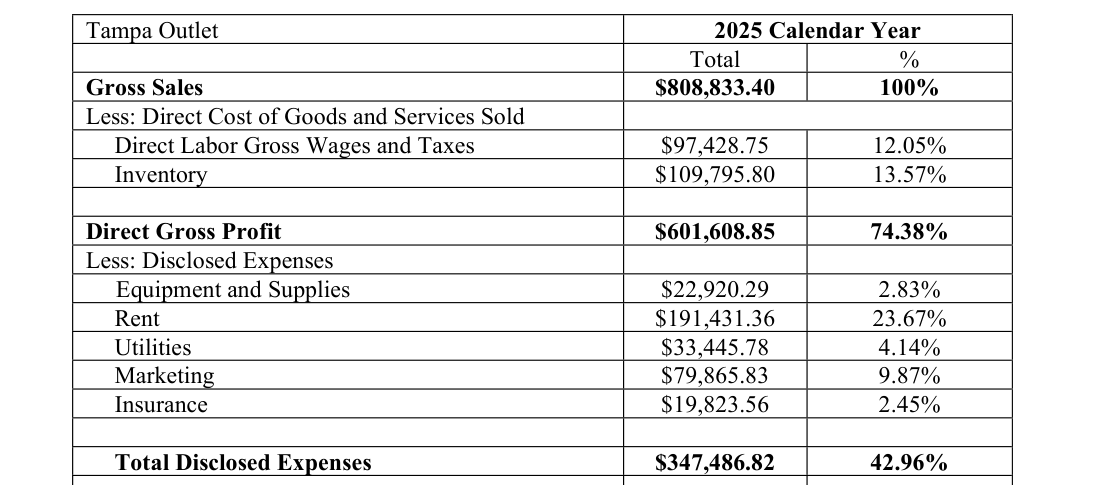
Source 1 of 6 · A rage room's insurance line, filed with a state regulator
Item 19, Table 4 of the iSmash 2026 franchise disclosure document on file with the Minnesota Department of Commerce. The Tampa franchise reported $808,833.40 of gross sales in 2025 and an insurance line of $19,823.56, the highest of the six locations disclosed.
Even with those caveats, two things stand out. The first is the spread. Rochester and Farmingdale reported almost the same gross sales, and Farmingdale's insurance line was nearly three times Rochester's. Sales volume is not what separates them, and the filing gives no reason, so we will not invent one. The second is movement. The same brand's 2025 filing shows Farmingdale's insurance rising from $12,168.14 in 2024 to $16,104.75 in 2025, an increase of about 32 percent by our arithmetic, and Tampa's rising from $18,180.78 to $19,823.56. At the company-owned Rochester venue the line fell, from $9,483.03 in 2023 to $5,963.35 in 2025. Rage room insurance is not a fixed cost, and it does not only move in one direction.
The franchisor's own planning figures sit beside those actuals. Its Item 7 budgets $2,500 to $6,500 as an insurance deposit, described as three months of premium payments. Its Item 8 requires property cover at 100 percent of property value including improvements and betterments, general liability of $1,000,000 per occurrence and $2,000,000 aggregate written on an occurrence basis and including personal and advertising injury, workers' compensation, twelve months of business interruption including royalties, $1,000,000 of cyber insurance, and a carrier rated at least A-, VII by AM Best. It sets no liquor, umbrella or abuse and molestation requirement.
On the escape room side, Escapology, the largest US escape room chain in Room Escape Artist's 2025 count, files in Minnesota too. Its 2026 disclosure document estimates $8,000 to $25,000 for insurance before opening and states plainly that "The estimate represents the cost of the semi-annual premium of the required minimum coverage." That is six months of the minimum program, not a year. The required minimum is general liability of $1,000,000 per occurrence and $2,000,000 aggregate, including liquor liability when applicable and personal injury, an umbrella at the same limits, statutory workers' compensation, and property insurance at replacement value, placed with a carrier rated A or A+ in financial size category IX or higher. Escapology's Item 19 does not report an insurance line at all. Its profit measure for 48 stand-alone franchised units, which averaged $793,521 of 2025 gross sales and seven game rooms each, excludes property insurance, and buyers are told to deduct it themselves.
An older filing shows how far a franchisor's requirements can go. Escape Hunt's 2022 disclosure document, from a brand no longer registered in Minnesota or Wisconsin, required a general liability policy with no exclusion or sublimit for assault and battery, a $5,000,000 umbrella for an operator of up to five centers, $2,000,000 each of employment practices and cyber liability, twelve months of business interruption and deductibles of no more than $25,000.
Those franchise figures and the Specialty Insurance table earlier in this guide do not measure the same thing. A franchise insurance line covers every policy the franchise agreement requires, at a mixed venue, with the franchisor's carrier-rating floor attached. The table prices a venue's core lines one at a time. Both are useful, and neither is your quote.
Two venues that share a word and not much else
Escape rooms are the mature half of this pairing. Room Escape Artist, which has tracked the US industry since its early days, counted just over 2,000 escape room facilities in December 2025, a figure that has held steady since mid 2022. Those facilities belong to about 1,450 companies and hold roughly 7,800 individual games, an average of 3.8 rooms per venue. The industry turns over quickly: 8.86 percent of facilities closed in 2025, and 48 percent of every facility the directory has ever listed has since closed. For an underwriter that means a steady stream of first-year operators with no loss history, and a meaningful number of venues changing hands with leases, sets and old policies attached.
Rage rooms are the opposite. Nobody publishes a credible count. California's toxic substances regulator describes them only as "rapidly growing in popularity," and the market-size figures that circulate online do not state a method anyone could repeat. That absence matters commercially, because an underwriter with no loss data for a class prices the uncertainty.
The injury record shows why the two cannot share a rating sheet. The federal emergency department sample has no product code for either venue, so these cases only surface when a hospital coder writes the venue into the free-text narrative. Read them that way and a pattern appears. Of the eighteen rage room cases, fourteen are injuries to fingers, hands or forearms, with lacerations and fractures the two most common diagnoses, and every patient was treated and released. Six of the eighteen were fifteen or sixteen years old. The escape room cases are falls on stairs and set pieces, strikes against props and furniture in dim rooms, and one special effects exposure.
Those are sample counts, and they are small. The Consumer Product Safety Commission will not publish a national injury estimate below twenty sample cases, and neither venue comes close in any single year, so no honest national injury figure exists for either business. What the records do show is the shape of the claim a carrier expects: frequent, low-severity hand injuries in a rage room, and slip, trip and strike injuries in an escape room, with fire egress sitting at the severe end of the escape room book.
| Venue type | What the premium is really rating |
|---|---|
| Standalone rage room, fixed site | What guests break and where the debris goes, PPE and in-room supervision, and alcohol. |
| Mobile rage room, trailer or box truck | Everything a fixed rage room rates, plus the vehicle, the drivers and a different host site at every booking. |
| Single-room escape room | Whether the exit locks, how staff observe the game, stairs, lighting and climbable set pieces. |
| Escape room venue with three or more rooms | Occupant load and the fire code class it triggers, actors and special effects, and the value of several built sets. |
| Escape room franchise location | The limits and endorsements the franchise agreement requires, on top of everything an independent venue rates. |
| Combined rage room and escape room venue | Both rating sheets at once: the smash list and the door lock, under one roof and one set of limits. |
That table is the shortest version of this guide. The sections below take each of those rating questions in turn, beginning with the one that decides whether a carrier will quote you at all.
Nobody has a box for a rage room
Ask an operator what went wrong in their first insurance conversation and the answer is usually some version of the same sentence. One escape room owner, writing in 2016, described general liability and workers' compensation as things that "can be expensive if the insurance company doesn't really know what you are or how your business works," and added that "there's no option for 'escape room' in their spreadsheets so to speak." His business had so much trouble placing workers' compensation that it ended up buying it through its payroll provider.
A decade later, escape rooms at least have a federal name. When the Census Bureau revised the North American Industry Classification System in 2022, it added "Escape rooms" and "Escape game rooms" to the index under code 713990, All Other Amusement and Recreation Industries, alongside axe throwing clubs and recreational pickleball clubs. Neither entry existed in the 2017 index. Escape rooms now appear in the code's own list of illustrative examples.
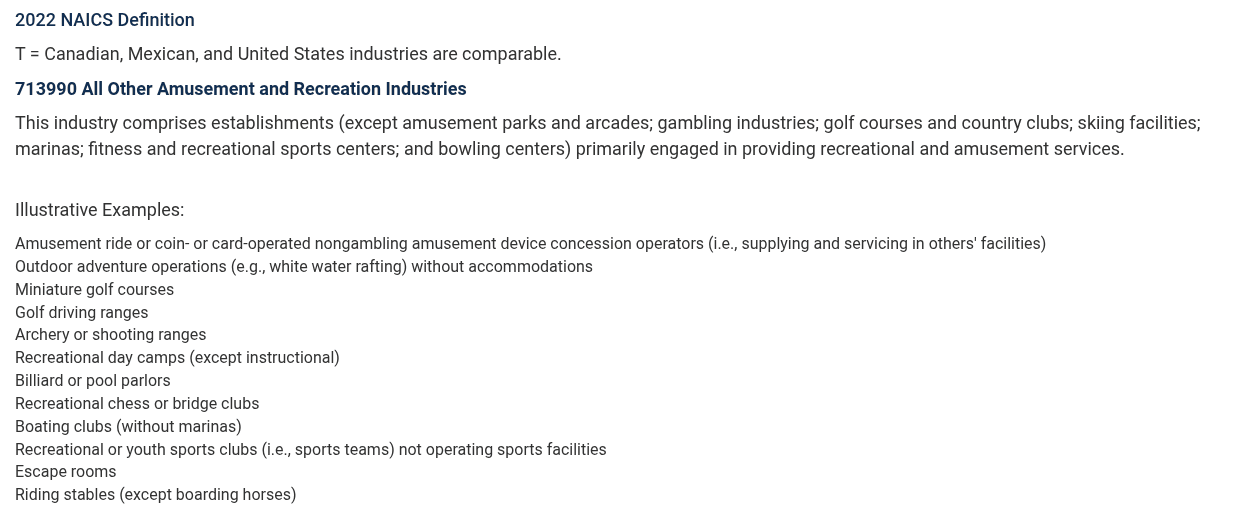
Source 2 of 6 · Escape rooms got a federal name in 2022
The 2022 NAICS definition for 713990, All Other Amusement and Recreation Industries, lists escape rooms among its illustrative examples. The 2022 index contains no entry for rage rooms, smash rooms, anger rooms or wreck rooms.
Source: census.gov/naics, 713990
Rage rooms got nothing. A search of all 20,398 entries in the 2022 index for rage, smash, anger or wreck rooms returns zero. The workers' compensation manuals are no better for either business. California's statistical reporting plan, effective 1 September 2026, never mentions an escape room or a rage room. Pennsylvania's April 2025 manual, all 554 pages of it, mentions neither. New York's public classification digest lists 536 classification names, and none of them names either business.
An unnamed operation is not an uninsurable one. Every one of those manuals contains a written rule for exactly this situation. California's reads: "Any business or operation not described by a classification shall be assigned to the classification(s) most analogous from the standpoint of process and hazard." Pennsylvania's is nearly word for word. The venue gets rated by analogy, and the analogy chosen decides the number.
That is where the pricing spread comes from. The 2016 escape room owner who paid about $780 a year for what he called "bare-minimum, legally required coverage" got there because his carrier was, in his words, "basically treating me as if I were a haunted house." Several of the large carriers he called before that gave him "a complete 'no-go'." A rage room founder in Rochester, New York told the same story from the other side in 2019: "it was difficult for my broker to find a company willing to insure it. Took a few months." Before opening, he reported a $7,500 premium for a $2.5 million general liability and business insurance package, with a carrier that "will not cover med pay." And in 2025, the owner of an axe throwing bar who had looked into adding a rage room gave up on the idea in one line: "the insurance is a killer."
Those are single accounts from different years, and none of them is a market rate. What they share is the mechanism. When nobody has named your business, the first person to fill in the form names it for you, and every price after that follows the name.
A rage room that comes to me already written as a generic recreation risk usually has a participant exclusion on it and nobody has told the owner. The guest with the sledgehammer is the whole business. If the form treats that guest as someone the policy was never meant to cover, the premium can look reasonable and the program still fails on the first claim that matters.
Bobby Sharp, Action Sports Practice Lead, Specialty Insurance
The practical instruction is simple. Ask whoever quotes you which classification they used, and what it assumes about who is being hurt. If the answer is a haunted house, an amusement arcade or a generic recreation class, ask what that class says about participants. We wrote about this failure mode in the coverage gaps a generalist agent will miss, and rage rooms are one of its clearest current examples.
The lock on the door is the most expensive decision in an escape room
Every escape room underwriting conversation eventually arrives at the same question: can a guest get out without solving the puzzle and without a member of staff? The building codes have spent the last several years answering it, and the answer changes both what you have to build and how a carrier reads the risk.
The 2021 International Building Code defined a "puzzle room" as a type of special amusement area and allowed its exits to comply in one of three ways, one of which let the doors stay locked provided they opened on activation of the fire alarm, the sprinkler system and a manual control at a constantly attended location. The 2024 edition removed that section. It now exempts a puzzle room from the special amusement rules altogether where the means of egress is "unlocked, readily identifiable and always available." New York State carried that wording into its 2025 Building Code, whose effective date is deemed 31 December 2025, and its definition adds that a puzzle room "is sometimes referred to as an escape room."
Read the exemption from the owner's side. Keep the exit genuinely unlocked and the room can drop out of the special amusement rules. Lock players in, and the model code treats the space as a special amusement area, which requires the whole building, not just your suite, to be sprinklered and fitted with automatic smoke detection and an emergency voice alarm system, with interior finishes meeting the Class A flame spread standard. For a tenant in an older, unsprinklered strip center, the difference between those two designs can be a building-wide retrofit. Adoption varies by state and city, so the edition your jurisdiction enforces decides which version of this applies to you.
The Life Safety Code draws the line differently again. NFPA 101 classifies a special amusement building as an assembly occupancy regardless of occupant load, so there is no minimum headcount; NFPA's own guidance says an escape room only falls into that class where its egress path is genuinely hidden or not readily available, and that otherwise it might be classified as a business occupancy. The building code applies its special amusement rules either way and splits only which set of occupancy requirements comes with them, assembly at fifty occupants or more and business below that. New York City draws its line at seventy five and goes further than either.
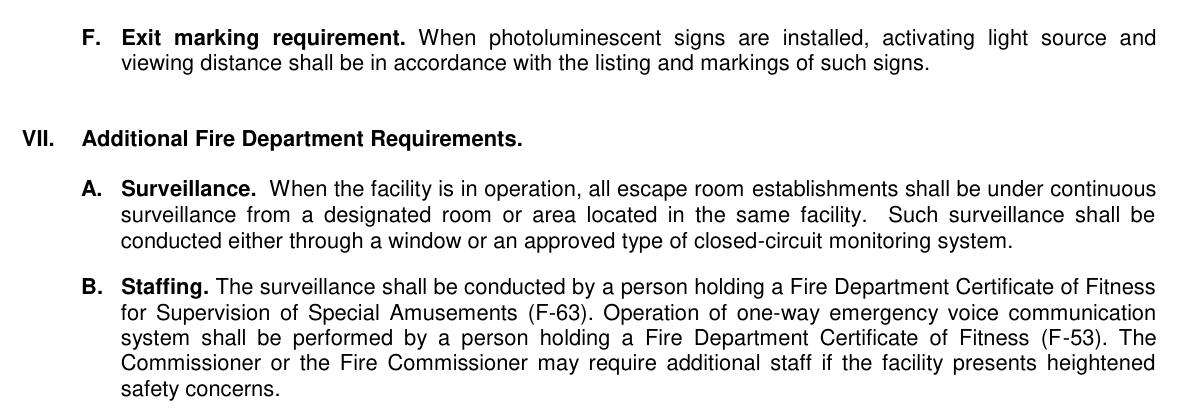
Source 3 of 6 · A staffing rule written into a building bulletin
New York City treats every escape room as a special amusement building. Its 2019 bulletin requires continuous surveillance of the game from inside the facility, conducted by a holder of an FDNY Certificate of Fitness for Supervision of Special Amusements, alongside central station fire alarm monitoring and a new or amended certificate of occupancy.
New York City's rules followed a hard enforcement season. After five fifteen year old girls died in an escape room fire in Koszalin, Poland in January 2019, an FDNY task force inspected the city's escape rooms. NBC New York reported seven vacate orders by 1 April 2019, and the New York Post reported violation orders for hazardous conditions including blocked exits, a lack of sprinklers and inadequate exit signs. The US code work on escape rooms predates that fire: a model code proposal on puzzle rooms was already moving in 2018, and Verisk, the organization behind the standard insurance forms, was writing about escape room risk in 2017. The fire did not create the rules. It made every inspector and every underwriter read them.
Verisk's point to insurers from that 2017 piece still frames the underwriting file. "The other issue for insurers is how escape rooms should be classified," it wrote, adding that "Insurers need to know if the property in question follows requirements for special amusement occupancies. If so, adherence to the requirements will mitigate risk."
So the documents that answer the lock question are the same documents that lower the premium: a certificate of occupancy that matches the use, the fire permit where your jurisdiction requires one (Clark County, Nevada, for example, requires a permit to operate a special amusement area and names puzzle rooms as an example), a tested emergency release, a written description of how staff watch the game, and a vacate order history of zero. A closure is also a business income problem, and the section on the room itself comes back to that.
What gets smashed decides what gets covered
A rage room's version of the lock question is its inventory list. The two exposures that separate a well-run rage room from an uninsurable one are both about what the guest is handed to break.
The first is the one the emergency room records already show: glass. The only US rage room injury lawsuit we found in the public record was filed in New York County Supreme Court in July 2022 against the company behind a Manhattan smash bar, by a guest who told the New York Post that a shard "went through my protective glove and severed my tendon." Those are allegations, the venue's insurance adjuster denied the incident occurred, and the court record shows the case as disposed with no public ruling. As a loss scenario it is exactly what the federal injury data predicts: gloves and eye shields reduce debris injuries, and they do not remove them.
The second exposure is newer and less understood: electronics. Old televisions, monitors and laptops are popular smash items for the obvious reason that they are cheap to acquire and satisfying to destroy. California's Department of Toxic Substances Control has a direct view on that.
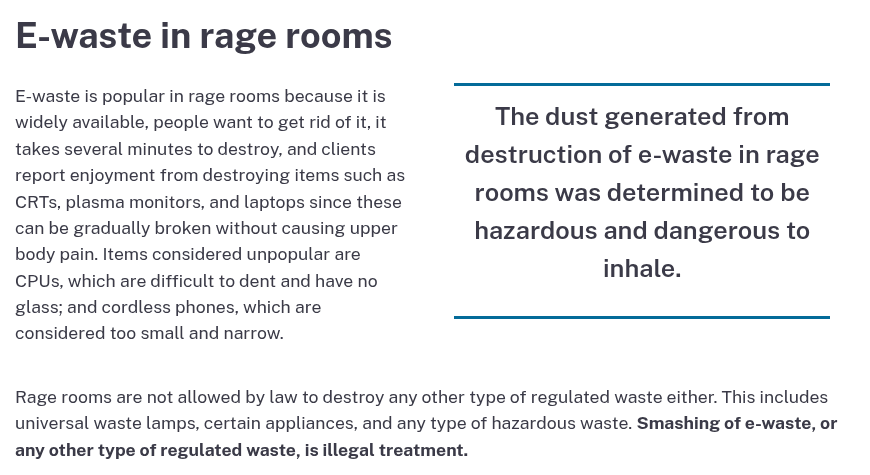
Source 4 of 6 · A state regulator on the smash list
California's toxic substances regulator says the dust from destroying e-waste in rage rooms "was determined to be hazardous and dangerous to inhale," that smashing e-waste or any other regulated waste "is illegal treatment," and that rage rooms which do it face enforcement, penalties and shutdown.
Source: dtsc.ca.gov, The Hazard of Electronic Waste in Rage Rooms
The regulator is careful to say it "does not consider rage rooms themselves to be illegal." The problem is the inventory. CalMatters reported in 2022 that state inspectors who scanned debris at a Sacramento rage room in April 2019 found elevated levels of lead, zinc and cobalt, and cited the business for two alleged hazardous waste violations, and that Los Angeles County's fire department had cited another rage room that year.
This is not only a California question. When the Plan Commission in Waupun, Wisconsin approved a rage room permit in August 2024, the minutes record the fire chief naming "the breaking/smashing of items that would typically fall under the category of e-waste" as the biggest concern, and the approval required a safety plan listing items not accepted, "such as old televisions, computer monitors, refrigerators," plus evidence of a routine waste disposal contract. Galesburg, Illinois wrote a rage room section into its zoning code in 2021 that bans alcohol on the premises and requires at least one trained employee on site at all times.
The insurance consequence follows directly. The standard general liability form defines pollutants to include "smoke, vapor, soot, fumes, acids, alkalis, chemicals and waste," and excludes injury arising from their release at premises the insured occupies. How far courts stretch that exclusion over indoor dust varies by state, so nobody can promise you it applies or that it does not. What is certain is that a rage room smashing monitors has created a regulatory exposure and a possible bodily injury exposure that its liability policy may not answer, and that a carrier who asks for your smash list is asking the right question. Federal rules on broken cathode ray tube glass and OSHA's lead standard do not mention rage rooms, but staff who sweep that debris may be within their scope, which is a workers' compensation conversation as much as a liability one.
The first document I ask a rage room for is not the waiver. It is the list of what guests are allowed to break and where it goes afterwards. Plates, bottles and furniture are a glove and eyewear conversation. Televisions and monitors are a pollution and waste conversation, and that one changes which markets will write you at all.
Bobby Sharp, Action Sports Practice Lead, Specialty Insurance
A written, dated smash list with the electronics struck off, a signed waste disposal contract and a PPE standard you can photograph are cheap to produce. They are also, at the moment, rarer than they should be.
Four lines in the standard liability form that decide these claims
Most rage room and escape room claims are decided before anyone argues about negligence, by the wording of the commercial general liability form. The current ISO version, edition CG 00 01 04 13, is published in full by Sonoma County, California, and four of its clauses do most of the work.
Medical payments stop at the participant. Medical payments coverage is the small, no-fault limit that pays a guest's emergency room bill without anyone proving fault. The form excludes anyone injured "while practicing, instructing or participating in any physical exercises or games, sports, or athletic contests." The word "games" is in the current edition, and it is the reason a rage room founder can be told his carrier "will not cover med pay," and the reason Participant Accident Insurance exists as a separate line. No reported decision has yet tested whether an escape room or rage room session is a "game" under that wording, so treat the exclusion as live.
Expected or intended injury. The form excludes bodily injury or property damage "expected or intended from the standpoint of the insured." In a rage room the smashing is intentional by design, but the objects belong to the venue, so the exclusion bites when the venue itself is alleged to have expected the harm. The Iowa Supreme Court held in a 2020 amusement park case that "some, but not all, acts of gross negligence may not be accidents," which is a reminder that the intent question is argued claim by claim.
False arrest, detention or imprisonment. This is the escape room clause. The personal and advertising injury section of the form lists it as the first covered offense.
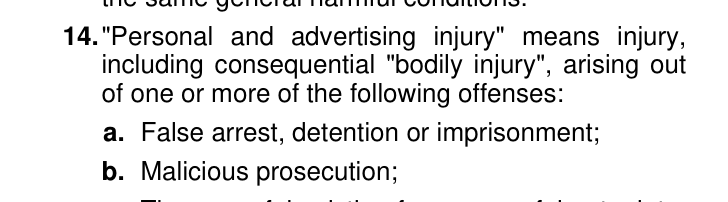
Source 5 of 6 · The clause that answers "I was locked in"
The standard liability form's definition of personal and advertising injury opens with "False arrest, detention or imprisonment." It is the part of the policy that responds when a guest alleges they were held in a room against their will, subject to the form's own exclusions for knowing violations and criminal acts.
We found no reported US court decision applying that offense to an escape room, which means no carrier has lost the argument yet either. The practical check is whether your policy includes personal and advertising injury at all, because some low-cost placements strip it out, and whether an endorsement narrows it for your class.
Property in your care, custody or control. General liability does not pay for damage to property you own, rent or occupy, or to personal property in your care, custody or control. Your sets, props and smash inventory belong on a property policy. A rage room that invites guests to bring their own printer to destroy has also taken that printer into its care, custody or control.
Two endorsements sit on top of those four clauses and change the answer again. An athletic or sports participants exclusion removes bodily injury to anyone taking part in a contest or exhibition you sponsor, and courts enforce it. In one Kentucky case, a venue's contract required its event organizer to carry public liability insurance that would "cover both participants and spectators," the policy the organizer bought excluded participants, and the Kentucky Court of Appeals upheld the denial after a participant died. The contract demanded the coverage. The policy did not contain it. This is the gap we cover in detail in participant injury versus general liability.
The second is the abuse or molestation exclusion, form CG 21 46, which removes claims arising from abuse of anyone in your care, custody or control and the negligent hiring, supervision or retention claims that travel with them. It exists because the older wording lost. In a 1994 federal case, an employee of an amusement business molested a nine year old on the premises, the only relevant exclusion was expected or intended injury, and the court held that the insurer still had to defend the business against the negligent hiring and supervision claims. Escape rooms that host birthday parties and school groups should expect that exclusion on a base policy and ask what buys the coverage back.
One live escape room lawsuit shows how these pieces combine. A complaint filed in Los Angeles County Superior Court in October 2025 against the operator of a horror-themed escape room pleads negligence, premises liability and assault, and names an unnamed actor as a defendant. The case is pending and the claims are allegations, but the structure is worth noticing: a single guest complaint that reaches the premises, the performer and an intentional tort at once. Venues with live actors should read their assault and battery wording as closely as their participant wording.
Bring your own bottle is a coverage decision
Bring-your-own-bottle smash sessions are a common rage room marketing hook, and escape rooms that run adult nights face the same question. The standard form's answer is more precise than most operators assume.
The liquor liability exclusion applies only if you are "in the business of manufacturing, distributing, selling, serving or furnishing alcoholic beverages." The current edition then adds a sentence that matters to every rage room.
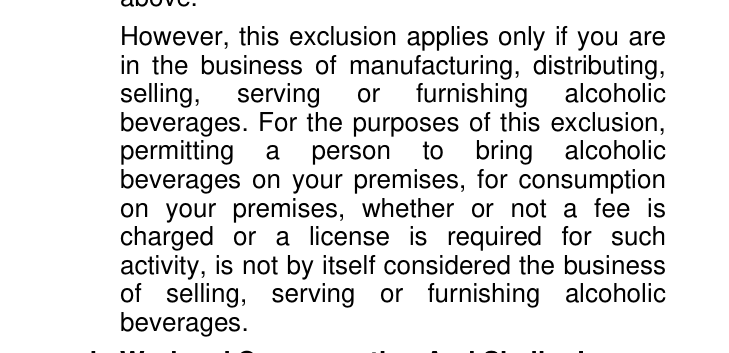
Source 6 of 6 · The sentence that decides a bring-your-own-bottle claim
Under the 2013 edition of the standard form, permitting a guest to bring alcohol onto the premises, whether or not a fee is charged or a license is required, "is not by itself considered the business of selling, serving or furnishing alcoholic beverages." The sentence does not appear in the older 1996 edition.
Three cautions keep that sentence from being a free pass. "By itself" carries weight: a venue that charges corkage and also sells mixers, cups or drink packages can be argued into the business. The sentence is absent from the older 1996 edition, so check which edition your policy uses. And carriers writing entertainment classes frequently attach their own liquor or bring-your-own-bottle exclusions, which override the standard wording entirely.
State and local law can take the decision out of your hands before any policy does. Michigan's Liquor Control Commission states that where consumers pay "any cover charge, entry fee, donation, or any other fee for any goods or services," the law prohibits allowing alcohol consumption unless the establishment is licensed, which on its face reaches a paid smash session. Galesburg's rage room ordinance bans alcohol outright. In Chicago, one escape room's agreed plan of operation with the city committed the licensee "not to apply for a liquor license and not allow BYOB," and stated that "No force will be used such as in a rage room," a licensing authority drawing the same line between the two businesses that an underwriter draws.
If you sell alcohol, Liquor Liability Insurance is a foundation line, not a situational one. If you allow guests to bring their own, get the answer to the bring-your-own-bottle question in writing from the carrier before you advertise it.
Birthday parties, school groups and the paperwork buyers demand
Rage rooms and escape rooms sell heavily to groups, and the groups with the strictest paperwork are the ones with minors in them. The federal injury sample makes the point without any help: six of its eighteen rage room patients were fifteen or sixteen.
Public buyers publish their requirements, and they are stricter than most landlords. Oregon State University's risk office lists "Rage Room" among the activities prohibited on university premises, next to car smashes and axe throwing. For events it does allow, anything elevated risk requires general liability of $2,000,000 per occurrence, alcohol service adds $2,000,000 of liquor liability, and events with unaccompanied minors require sexual abuse and molestation coverage of at least $1,000,000 per occurrence or claim. San Diego Unified School District's contract for an escape room style student program required $2,000,000 per occurrence and $4,000,000 aggregate of general liability, abuse and molestation coverage "up to the full policy limit," and a waiver of subrogation. When a Springfield, Missouri rage room applied for a grand reopening block party permit, the city's form required a $1,000,000 certificate naming the city as additional insured if the event used public property.
Landlords set the everyday floor. An escape room co-owner in St. Augustine, Florida wrote in 2017 that his general liability and fire insurance were "both required by the landlord as a stipulation in our lease," and that together they cost less than $300 a month. Your lease is the first document that decides your limits, and it is usually signed before anyone shops the insurance.
Waivers belong in the file, and they do less than many operators hope. In New York, a waiver signed at any "place of amusement or recreation" that charges a fee cannot release the operator from its own negligence; General Obligations Law section 5-326 declares such clauses "void as against public policy and wholly unenforceable." Virginia's Supreme Court held in 1992 that a pre-injury release for negligence causing personal injury is void. Louisiana's Civil Code article 2004 nullifies any clause that in advance excludes or limits liability for causing physical injury. Montana goes the other way for recreation, allowing waivers of ordinary negligence only when they state the known inherent risks and carry a specific bold statement. A waiver is an underwriting control and a supplement to a program, never a substitute for one, which is the argument we make at length in do waivers replace insurance.
The room is the asset
An escape room's most valuable property is usually the thing it built: walls, false floors, hidden doors, wired puzzles, control systems and props. A rage room's is its build-out and its constantly replenished inventory. Both are easy to under-insure.
Built-in sets in rented space can fall under a property policy's "improvements and betterments," which a Maryland appellate court quoted from a standard form as fixtures, alterations, installations or additions "made a part of the building or structure you occupy but do not own" that you paid for and "cannot legally remove." Free-standing props and movable puzzles are business personal property instead. Both need an honest replacement value, because coinsurance punishes a low one. Virginia's insurance regulator publishes a worked example in which a building insured for $80,000 under an 80 percent clause, that turns out to cost $120,000 to replace, collects only $33,200 on a $40,000 fire loss.
Business income is the other half, and it is triggered by physical damage. On the common policy wording quoted by a federal appeals court in 2022, the period of restoration begins 72 hours after the direct physical loss and ends when the property should be repaired with reasonable speed, and a separate extended business income provision kept paying for up to 60 days after reopening while revenue recovered. The physical damage trigger is not a technicality. When escape room operators sued their carrier over pandemic closures, a federal court in Texas dismissed the claims because "R&J has not alleged that its property has been physically lost or damaged, as required under Texas law." That policy had been issued under a master policy to the escape room trade association, ARENA, and it still did not pay for a closure without physical loss.
That is also why a vacate order or a fire marshal closure is a double loss: the room stops earning, and a closure with no physical damage behind it may not be a covered business income loss at all. A basement fire at a Harlem escape room in December 2016 closed the business and caused thousands of dollars of damage, according to DNAinfo. That one would have been a property claim. An FDNY vacate order for blocked exits would not.
Mobile rage rooms and escape room trailers
A trailer-mounted escape room or a rage room in a box truck is a different risk, and the road half of it is often the larger half. A Chicago mobile escape room operator told Room Escape Artist in 2018 that trailer-based rooms need commercial auto on top of liability, and that "Most insurance companies will lump you in as a commercial truck driver, which is anywhere in excess of $10,000 per year just on auto policies." That operator also builds mobile rooms for other companies, so read the figure as one operator's experience rather than a rate. The difficulty has not gone away: a Western Pennsylvania entertainment company building a mobile escape room trailer in 2025 described one agent who laughed at the request and another who did not know how to insure it.
Mobile operations add three things to the program. Commercial Auto Insurance for the vehicle and trailer, rated on the vehicle and the drivers rather than on the game. Inland marine cover for props, sets and control equipment while they travel and sit parked between bookings, which we cover in inland marine for action sports. And a certificate for every booking, often naming the host as additional insured on primary and non-contributory wording, as the school and university requirements above show.
What moves the number up, and what moves it down
Everything above collapses into a short list of levers.
What moves it up.
- A locked-in game without a tested release chain, which pulls the whole building into special amusement area requirements where the codes are enforced.
- Electronics on the smash list, which adds a waste, pollution and regulatory exposure to a rage room.
- Alcohol, whether sold or brought in, and especially a bring-your-own-bottle model with no written carrier position.
- Minors at birthday parties, school groups and youth events, which brings abuse and molestation requirements with it.
- Live actors who touch, chase or confine guests, which widens the claim to assault and personal injury.
- Climbable sets, stairs, dim lighting and special effects such as fog, which are the escape room injury pattern in the federal data.
- A mobile unit, which adds commercial auto rated like trucking.
- A classification by accident, where a haunted house or generic recreation class was chosen for you.
What moves it down.
- An exit that is unlocked, identifiable and always available, or a documented, tested release chain where the game locks.
- A certificate of occupancy and fire permit that match the use, with no vacate order history.
- Continuous staff observation of every game, written down and followed.
- A written smash list with electronics excluded and a waste disposal contract on file.
- A PPE standard of cut-resistant gloves, full face protection and closed footwear, enforced at the door.
- No alcohol, or a written carrier position on it before you market it.
- Values scheduled honestly for sets, props and improvements, because under-insuring buys a smaller share of every claim.
- A clean, documented first year of incident reports and signed waivers, which is the file that wins year-two pricing.
Two of those are worth stating as a rule. An escape room is priced on its door, and a rage room is priced on its smash list. Everything else refines the number those two set.
The venues that get the best second-year pricing in this class can hand me a description of their own operation without being asked twice. Room count, how the exits work, who watches the game, what guests are allowed to break, whether anyone drinks, and how many of the groups are kids. That document is worth more than shopping the market, because it lets an underwriter rate what you are instead of the nearest thing they can think of.
Bobby Sharp, Action Sports Practice Lead, Specialty Insurance
That description also survives a change of carrier, a change of agent and a change of market. For a business with no class code of its own, it is the closest thing there is to one, and the owner is the only person who can write it.
"Bobby Sharp and the team at Specialty Insurance had a fast turnaround, professional service, and answered every question I had as a brand-new operator. They wrote the policy I'd want defending me if a player ever filed a claim."
Grimnir Tactical LLC
Verified customer review
How to get a quote that matches the operation
Bring five things and most of the difficulty in this guide disappears.
A written description of the operation. Room count, games per week, group sizes, the share of bookings that are birthday parties or school groups, whether actors are used, and your annual revenue projection. For a combined venue, split the revenue by attraction.
Your egress and supervision file. How every exit works, whether any game locks, the release mechanism and its test log, how staff observe each room, and your certificate of occupancy and fire permit.
Your smash list and PPE standard. For a rage room: what guests may break, what is banned, where debris goes, your waste disposal contract, and the protective equipment every guest wears.
The insurance article of your lease, plus any franchise, school or event contract. Required limits, additional insured and waiver of subrogation wording, and any abuse and molestation or liquor requirement.
Your values. Build-out, sets, props, control systems and inventory at replacement cost, and a realistic view of how long a damaged room would take to rebuild.
Specialty Insurance places rage rooms, escape rooms and other entertainment venues that generalist markets decline or misclassify, in all 50 states. If your current quote arrived without anyone asking about your locks, your smash list or your bring-your-own-bottle policy, it was not written for your business. It was written for whatever the last form said.
Frequently Asked Questions
How much does rage room insurance cost?
Specialty Insurance's 2026-2027 ranges for a US rage room run $500 to $2,500 a year for General Liability Insurance, $250 to $1,000 for Participant Injury Insurance, $750 to $5,000 for Commercial Property Insurance and $250 to $1,500 for Workers' Compensation Insurance, plus $500 to $5,000 for Liquor Liability Insurance where alcohol is part of the operation. They are line-by-line indications for budgeting, not a quote, and most venues do not buy every line. The number moves most on what guests are allowed to break, whether electronics are on the smash list, alcohol, and the protective equipment and supervision in the room. For comparison, the iSmash franchise disclosure document on file in Minnesota reports 2025 insurance spend of $2,101.35 to $19,823.56 across six mixed rage room, splatter paint and axe throwing venues, covering every policy the franchise requires.
How much does escape room insurance cost?
The same Specialty Insurance ranges apply line by line: $500 to $2,500 a year for General Liability Insurance, $250 to $1,000 for Participant Injury Insurance, $750 to $5,000 for Commercial Property Insurance, $250 to $1,500 for Workers' Compensation Insurance and $500 to $5,000 for Liquor Liability Insurance where alcohol is served. An escape room's number moves most on how the exits work, how staff observe each game, the number of rooms, actors and special effects, and the value of the sets. Escapology, the largest US escape room chain, estimates $8,000 to $25,000 in its 2026 franchise disclosure document for the semi-annual premium of its required minimum coverage, which includes an umbrella.
Does general liability insurance cover a guest who says they were locked in an escape room?
The part of the policy that responds is personal and advertising injury, not bodily injury. The standard ISO general liability form, edition CG 00 01 04 13, lists false arrest, detention or imprisonment as the first covered offense in its definition of personal and advertising injury, subject to exclusions for knowing violations of rights and criminal acts. No reported US court decision has yet applied that offense to an escape room, so confirm that your policy includes personal and advertising injury and that no endorsement narrows it for your class.
Can a rage room let guests bring their own alcohol?
It depends on state and local law first and on your policy second. Michigan prohibits alcohol consumption at an unlicensed business that charges any entry fee, and Galesburg, Illinois bans alcohol at rage rooms outright. Where it is lawful, the 2013 edition of the standard liability form says that permitting guests to bring their own alcohol is not by itself the business of selling or serving alcohol, but that sentence is missing from older editions and many carriers add their own exclusions, so get the carrier's position in writing before you advertise it.
Is it legal to smash TVs and computers in a rage room?
In California it is not. The Department of Toxic Substances Control says rage rooms themselves are legal but that destroying e-waste in them is illegal treatment of hazardous waste, that the dust is hazardous to inhale, and that operators face enforcement, penalties and shutdown. Outside California, a Waupun, Wisconsin rage room permit approved in 2024 required a list of banned items such as old televisions and computer monitors plus a waste disposal contract. Smashing electronics also raises a pollution exclusion question on a standard liability policy.
Do waivers protect a rage room or escape room from lawsuits?
Only partly, and in some states not at all. New York General Obligations Law section 5-326 makes a waiver void for negligence at any place of amusement or recreation that charges a fee, Virginia's Supreme Court has held pre-injury releases for personal injury void, and Louisiana's Civil Code nullifies any clause that limits liability for physical injury in advance. Montana allows recreation waivers only if they state the inherent risks and carry a required bold statement. A waiver supports an insurance program and never replaces one.
Sources
All sources retrieved and verified 16 September 2026.
- Smash Franchising LLC (iSmash), Franchise Disclosure Documents 2025 and 2026, Items 7, 8 and 19; Escapology, LLC, Franchise Disclosure Document 2026, Items 7, 8 and 19 and Franchise Agreement section 15.1; Escape Hunt USA Franchises Ltd., Franchise Disclosure Document 2022, Items 7 and 8. All filed with the Minnesota Department of Commerce.
- US Consumer Product Safety Commission, National Electronic Injury Surveillance System annual microdata 2019 to 2025, case narratives naming escape rooms and rage rooms; NEISS publication criteria.
- Room Escape Artist, US Escape Room Industry Report, December 2025.
- US Census Bureau, 2017 and 2022 NAICS Index Files and 2022 NAICS Descriptions, code 713990.
- WCIRB California, Uniform Statistical Reporting Plan, effective 1 September 2026; Pennsylvania Compensation Rating Bureau, Workers Compensation Manual, effective 1 April 2025; New York Compensation Insurance Rating Board, Classification Digest.
- International Code Council, 2021 and 2024 International Building Code Section 411; 2025 Building Code of New York State, New York Department of State; NFPA Journal, In Compliance: NFPA 101, July 2019; Clark County Fire Department, Permit Submittal Guideline: Special Amusement Areas, January 2026.
- New York City Department of Buildings, Buildings Bulletin 2019-008; NBC New York and New York Post reporting on FDNY escape room inspections, March and April 2019; BBC News reporting on the Koszalin, Poland escape room fire, January 2019; Verisk, Escaping escape room risk, July 2017.
- California Department of Toxic Substances Control, The Hazard of Electronic Waste in Rage Rooms; CalMatters, July 2022; City of Waupun, Wisconsin, Plan Commission minutes, 21 August 2024; City of Galesburg, Illinois, Code of Ordinances section 152.122; City of Chicago, Agreed Plan of Operation, Art of Escape Room Corp.; Michigan Liquor Control Commission, Consumption on Unlicensed Premises; 40 CFR 261.39 and 29 CFR 1910.1025.
- Insurance Services Office, Commercial General Liability Coverage Form CG 00 01 04 13, hosted by the County of Sonoma, California, and CG 00 01 01 96, hosted by the New York State Office of General Services; Abuse or Molestation Exclusion CG 21 46 07 98.
- Johnson v. Capitol Specialty Insurance Corp., Kentucky Court of Appeals No. 2017-CA-000171-MR (2018, unpublished); T.H.E. Insurance Co. v. Glen, Iowa Supreme Court No. 18-1550 (2020); Silverball Amusement, Inc. v. Utah Home Fire Insurance Co., 842 F. Supp. 1151 (W.D. Ark. 1994); R&J Entertainment LLC v. Houston Casualty Co., S.D. Tex. No. 4:20-cv-03782 (2021, adopted 2022); SA Palm Beach, LLC v. Certain Underwriters at Lloyd's London, 11th Cir. No. 20-14812 (2022); Nationwide Mutual Insurance Co. v. Regency Furniture, Inc., Court of Special Appeals of Maryland (2009).
- Robbins-Sennewald v. The Wrecking Club LLC, N.Y. Sup. Ct., New York County, Index No. 155811/2022, and New York Post reporting, 16 July 2022; Feng v. Spectre LLC, Los Angeles County Superior Court No. 25PSCV03765 (pending); DNAinfo New York, 21 December 2016.
- Oregon State University Insurance and Risk Management, Events and Activities; San Diego Unified School District, Agreement PS23-0582-47, Exhibit B; City of Springfield, Missouri, Special Event Permit SPE2023-00135.
- New York General Obligations Law section 5-326; Hiett v. Lake Barcroft Community Ass'n, 244 Va. 191 (1992); Louisiana Civil Code article 2004; Montana Code Annotated section 27-1-753; Virginia State Corporation Commission, Virginia Consumer's Guide for Commercial Insurance.
- Room Escape Artist, Mobile Escape Room Trailers: 16 Questions with Jason Garvett, March 2018.
- Operator accounts quoted in prose are verbatim from public posts in r/escaperooms, r/escaperoomdev, r/Entrepreneur and r/smallbusiness between 2016 and 2025, retained on file with permalinks and dates. They are not linked, in line with our outbound-link policy.