

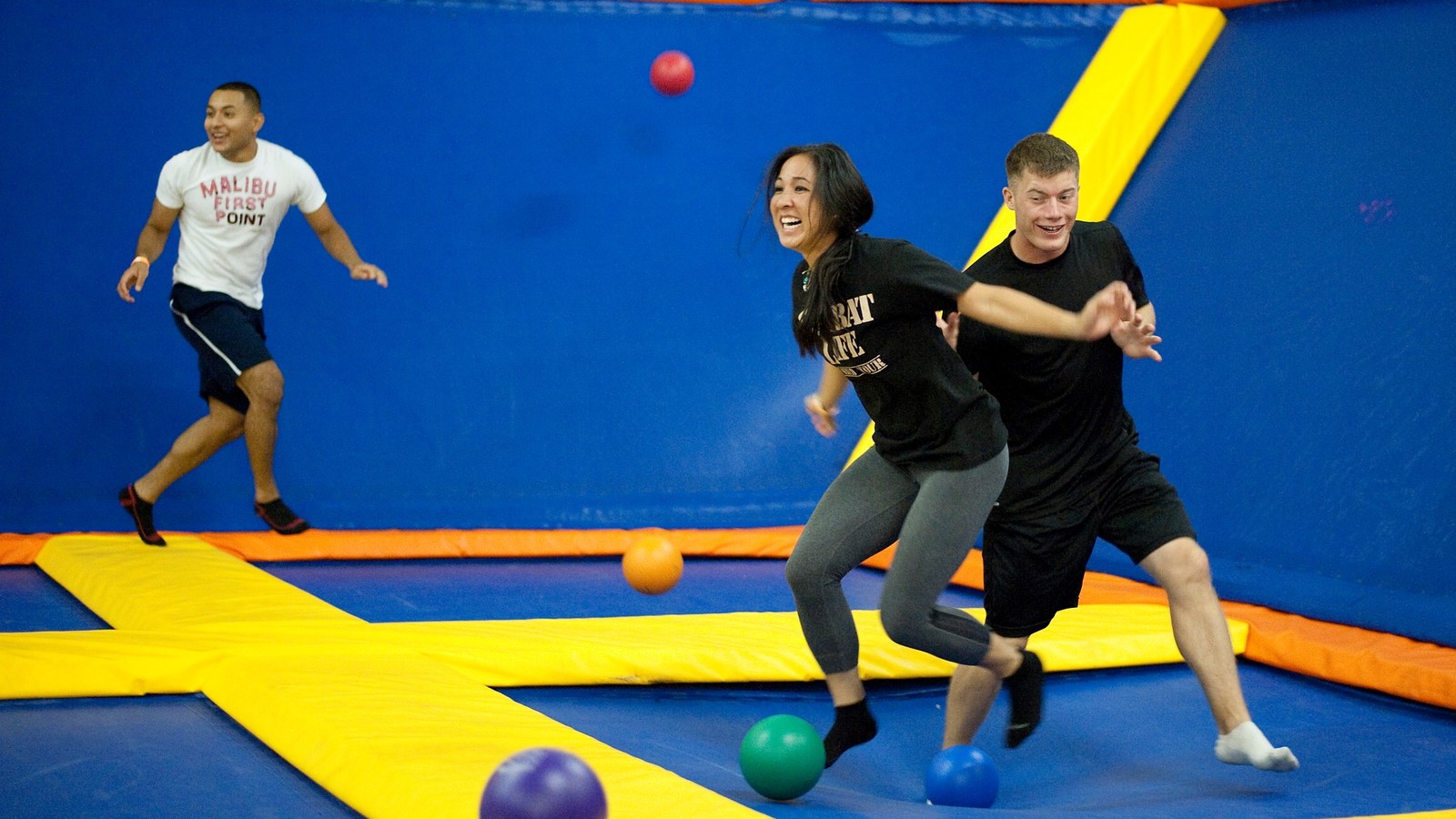
A Georgia trampoline park paid its liability insurer $47 for every $1,000 it took in trampoline admissions. The rate is not an estimate. It is printed on the park's own policy, which now sits in a federal court file as an exhibit, and it sits next to a second rate of $7 per $1,000 for concessions. On estimated sales of $1,000,000 in admissions and $620,000 in concessions, the advance premium for November 2017 to November 2018 came to $51,590.
That rate is not an outlier. Urban Air's 2026 franchise disclosure document, filed with the Minnesota Department of Commerce, estimates a new park's general liability premium with a formula: gross sales divided by 1,000, multiplied by 41. Launch's 2026 filing reports that ten franchised adventure and entertainment parks spent an average of 6 percent of gross revenue on insurance in fiscal 2025, with the lowest at 2 percent and the highest at 10 percent. Its 2025 filing put dollars on the same idea: across 14 franchised parks in fiscal 2024, insurance expense ran from $61,673 to $385,000 and averaged $166,129, against average revenue of $2,318,776.
So the first honest answer to how much trampoline park insurance costs is a percentage, not a price. The premium is a rate multiplied by what comes through your doors.
The second honest answer is on the same Georgia policy. It carried a $1,000,000 each occurrence limit. In February 2024, a Clayton County jury returned a $3,500,000 verdict against the park. The park moved for a new trial, so it is a verdict rather than a confirmed payout, but the gap between the limit and the verdict is the whole business in two numbers: a premium rated on revenue, and a single claim that can run past the policy. The rest of this guide covers what sits between them.
What trampoline park insurance costs, line by line
A trampoline park does not buy one policy. It buys a program, and the lines below are the ones that show up on a park's schedule. Foundation lines are the ones nearly every park carries, and several of them are mandatory in the franchise systems and state laws covered later in this guide. Situational lines follow the operation.
Specialty Insurance's 2026-2027 ranges for a single-location indoor trampoline park run $40,000 to $150,000 a year for General Liability Insurance, $20,000 to $60,000 for Participant Injury Insurance and $50,000 to $150,000 for Excess / Umbrella Insurance. Sexual Abuse and Molestation Insurance and Commercial Property Insurance each run $5,000 to $25,000, Workers' Compensation Insurance $1,000 to $25,000, and Liquor Liability Insurance $2,500 to $25,000 where the park serves alcohol.
Read the franchise figures above against this table with care, because they measure something different. A franchise insurance line covers every policy the franchise agreement requires, often bought through a mandatory program with its own fees. The table prices each line on its own.
2026-2027 premium benchmark
What trampoline park insurance costs, line by line
Typical annual premiums for a US indoor trampoline park, by coverage line.
- Priced for
- Single-location indoor trampoline park
- Basis
- Annual premium, United States
- Updated
- September 2026
| Coverage | Typical annual range | Monthly estimate | Typical limits |
|---|---|---|---|
| General Liability InsuranceFoundation Third-party bodily injury, property damage and legal defense, rated on gross sales and audited at expiration. | $40,000 to $150,000 | $3,335 to $12,500per month | $1,000,000 per occurrence / $2,000,000 aggregate |
| Participant Injury InsuranceFoundation Injuries to paying jumpers on courts, foam pits and attractions, the exposure a participant exclusion can remove from a liability form. | $20,000 to $60,000 | $1,670 to $5,000per month | $1,000,000 per occurrence |
| Excess / Umbrella InsuranceFoundation Limits above the primary policy for severe spinal and head injury claims that can exceed a $1,000,000 occurrence limit. | $50,000 to $150,000 | $4,170 to $12,500per month | $1,000,000 to $5,000,000 per occurrence |
| Sexual Abuse and Molestation InsuranceFoundation Claims alleging abuse of a minor in the park's care, which a standard abuse or molestation exclusion removes from the liability policy. | $5,000 to $25,000 | $420 to $2,085per month | $1,000,000 per occurrence |
| Commercial Property InsuranceFoundation Tenant improvements, courts, foam pits and attractions in leased space, with business income sized to the lease rather than the default. | $5,000 to $25,000 | $420 to $2,085per month | Based on total insurable value |
| Workers' Compensation InsuranceFoundation Employee injuries, including court monitors working on and around active courts. Required in most states, with employee-count thresholds that vary by state. | $1,000 to $25,000 | $85 to $2,085per month | Statutory state limits |
| Liquor Liability InsuranceSituational Dram shop and over-service claims where the park, its adult sessions or its party rooms serve alcohol. | $2,500 to $25,000 | $210 to $2,085per month | $1,000,000 per occurrence / $1,000,000 aggregate |
Most parks do not buy every line on one form. Liquor Liability Insurance follows alcohol sales. Adventure parks that add go-karts, ropes courses, zip lines or climbing walls should expect each attraction to be reviewed on its own, and parks with vehicles, stored payment data or a large staff should also ask about Commercial Auto Insurance, Cyber Liability Insurance and employment practices liability.
Specialty Insurance book. Updated . Ranges are an indication for budgeting, not a quote or a bindable offer.
Get a 24-hour quoteThe table prices each line separately, so it is not a program total, and it is not a quote. Two things move an individual park off these ranges faster than anything else: how much of your revenue the carrier counts as gross sales, and which attractions sit on the floor.
Your premium is a rate multiplied by your gross sales
Most small commercial buyers think of liability insurance as a price for a limit. A trampoline park's general liability is closer to a tax on revenue, and the Georgia policy shows the mechanics in plain language. Its premium payment endorsement rates two classes separately, trampoline admissions at $47 per $1,000 and concessions at $7 per $1,000, and then does something most operators never notice: it splits party revenue between them.
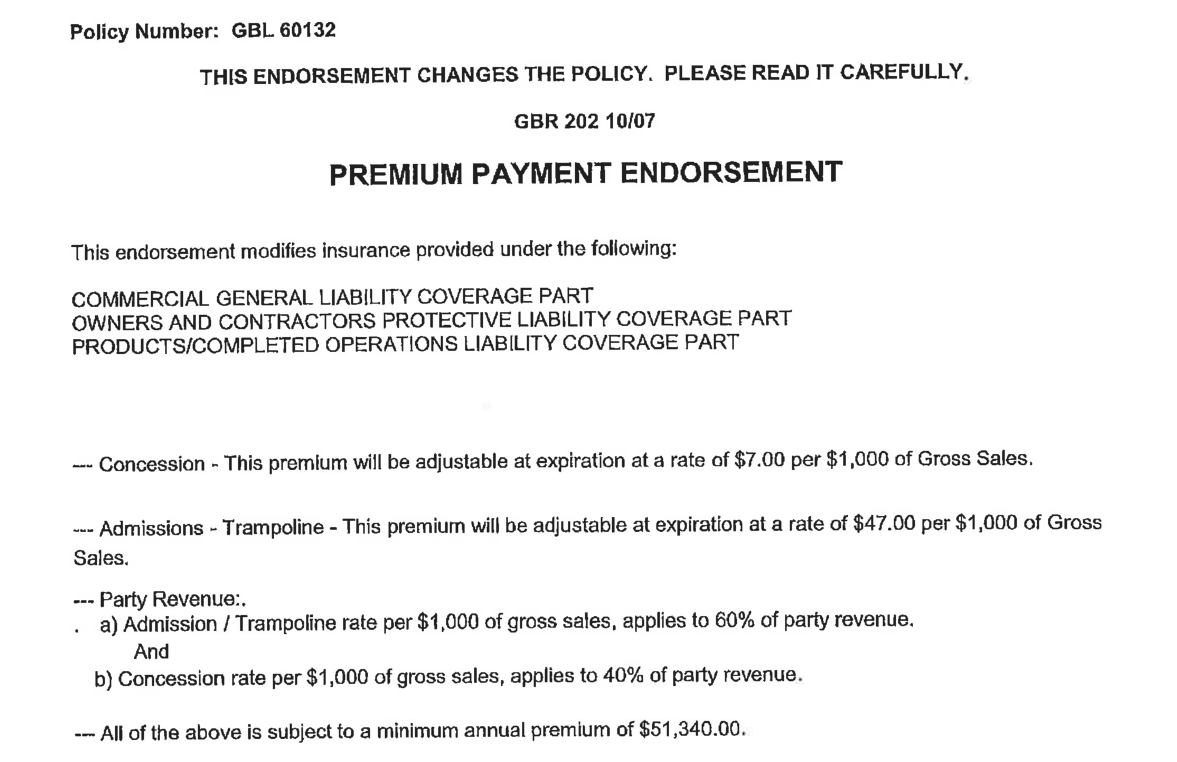
Source 1 of 4 · A liability premium written as a rate on sales
The premium payment endorsement from a Georgia trampoline park's 2017 to 2018 general liability policy, filed as an exhibit in federal court. Trampoline admissions are rated at $47.00 per $1,000 of gross sales, concessions at $7.00, party revenue is split 60 and 40 between the two, and the whole is subject to a minimum annual premium of $51,340.
Sixty percent of party revenue is rated at the trampoline admission rate and forty percent at the concession rate. A park that grows its party business is growing a revenue stream rated mostly at the higher of the two, and a park that cannot show which sales were parties, which were admissions and which were food leaves that question to the audit.
Then there is the audit. The same policy's premium audit endorsement states that the premium shown as "advance premium" is "a deposit premium only which shall be credited to the amount of the earned premium due at the end of the policy period." The number you pay at binding is an estimate. The number you owe is calculated at expiration against your real sales.
That clause is litigated. In a federal case in California brought by a trampoline center insurer against a group of operators and their franchisor, the court accepted as uncontroverted that the "Final premium due under each policy is derived by multiplying a rate into said Gross Sales figure," and found that each operator breached the audit provision by failing to give the insurer's auditors access to original financial records. A later ruling in the same litigation held that the franchisor's royalty income was properly counted as gross sales for premium under one of the policies. The insurer's audit claimed $777,372 and $350,376 in final premiums, and the court declined to adopt those amounts on summary judgment. The fight was over what counts as gross sales, and it went to federal court.
On a trampoline park I ask for the revenue split before I ask for the attraction list. Admissions, parties, concessions, retail and memberships can each carry a different rate, and the policy's own definition of gross sales decides which dollars count. A park that reports one blended number is asking to be rated at the highest rate on the schedule, and it finds out at audit, when the deposit premium turns out to be the smaller of two bills.
Bobby Sharp, Action Sports Practice Lead, Specialty Insurance
Three practical consequences follow. Report revenue by stream, the same way the policy rates it. Read the definition of gross sales before you bind, including whether it reaches retail, royalties, membership fees and party packages. And keep the records an auditor will ask for, because in the California case, failing to give auditors access to original records was itself held to be a breach of the policy.
What the franchise systems make every park buy
Franchise disclosure documents are the best public record of what a trampoline park is expected to insure, because franchisors write their insurance requirements into a filing that state regulators publish. They show requirements, not premiums, and the table below keeps them that way.
| Franchise system | Required liability limits | Abuse and molestation | How the insurance is bought |
|---|---|---|---|
| Urban Air Adventure Park (2026) | General liability of $1,000,000 per occurrence and $2,000,000 aggregate, with coverage for injury to participants; $1,000,000 excess; $1,000,000 liquor liability if selling alcohol; 12 months of business income | No sublimit on sexual abuse and molestation within the general liability policy | Workers' compensation, general liability, excess, property and employment practices through the franchisor's designated supplier |
| Sky Zone (as amended May 2026) | $2,000,000 per occurrence and $4,000,000 aggregate primary general liability, plus excess; the filing states "The total liability limit is $6 Million" | Sexual misconduct liability by endorsement, with annual criminal and sex offender registry checks for adult employees added in 2026 | Mandatory Master Insurance Program, with a $250,000 retention per claim and the park paying up to $10,000 of each claim |
| Altitude Trampoline Park (2026) | General liability of $1,000,000 per occurrence and $2,000,000 aggregate; $1,000,000 excess; statutory workers' compensation; business interruption | No abuse or molestation requirement appears anywhere in the filing | Franchisee buys from carriers rated A/VIII or better |
| Launch (2026) | General liability of $1,000,000 per occurrence and $2,000,000 aggregate; $1,000,000 umbrella; 12 months of business income; $1,000,000 liquor liability if serving alcohol; $1,000,000 auto | $100,000 sexual misconduct and molestation | Franchisee buys from carriers rated A minus or better by AM Best |
The pre-opening insurance rows in those same filings are easy to misread, because each covers a different period. Urban Air's Item 7 row of $13,087 to $77,437 is, in the filing's words, "only the first month's minimum, initial down payment." Sky Zone budgets $24,000 to $65,000 for the first fiscal quarter and separately estimates annual property premiums at $4,000 to $14,000 and annual workers' compensation at $2,000 to $25,000. Altitude budgets $35,000 to $50,000 for the first three months of a park of about 25,000 square feet. Launch budgets $22,277 to $48,373 for three months of start-up insurance, up from $9,000 to $15,000 in its 2025 filing. None of those rows can be multiplied out into an annual premium, and this guide does not do it.
What the filings do show clearly is direction. Sky Zone's mandatory program cost was disclosed as between 2.96 percent and 8.69 percent of gross sales in its 2024 filing, between 2.0 percent and 10.0 percent in 2025, and "currently between 2.4% and 13.0% of Gross Sales" as amended in May 2026. Its affiliate received $11,003,350 in fiscal 2025 from the program or other insurance related payments. Sky Zone's parent formed a Cayman Islands insurer, Loscann Insurance Company, in 2024 to provide general liability coverage to Sky Zone franchisees under the self-insured retention component of the brand's program. Rockin' Jump's 2022 filing disclosed that in 2021 its affiliate "ran a profit" on the mandatory liability program, receiving $2,667,483 from franchisees for premium and claims payments and paying $1,982,073 to carriers for premiums and deductibles.
Two details from those systems are worth copying even for an independent park. The requirement lists are a useful floor, because they were written by companies that see the claims across hundreds of locations. And the waivers are enforced with money: Big Air's 2026 filing lists a $2,500 waiver violation fee per violation if admission was granted without a valid signed waiver, and Sky Zone's filing gives the franchisor the right to charge the same amount.
The states that wrote trampoline parks into law
When Illinois brought trampoline courts under its amusement ride inspections in 2021, the state's Department of Labor announced that "Illinois joins eight states that regulate trampoline parks." Several of those states set an insurance minimum in statute, and the minimum is not the same everywhere.
| State | Insurance minimum | Other duties | Where it is written |
|---|---|---|---|
| Arizona | Not less than $1,000,000 for bodily injury | Registration with the state forester; annual inspection by the insurer or its inspector | A.R.S. 37-1423 and 37-1424 |
| Utah | $1,000,000 aggregate and $500,000 per incident | Notice within 24 hours of a lapse; staff monitoring every area of the court during all operating hours | Utah Code 11-63-304 and 11-63-501 |
| New York | $1,000,000 aggregate and $500,000 per incident | Annual inspection; contract clauses restricting the venue of a claim are void | General Business Law 225, 226 and 228 |
| Illinois | $1,000,000 per occurrence and $2,000,000 aggregate, shown at permit inspection | ASTM F2970-20; annual third-party inspection; no more than 32 participants per attendant or assistant | 430 ILCS 85/2-14; 56 Ill. Adm. Code 6000.353 |
| Colorado | Not less than $1,000,000 per occurrence | Trampoline courts and foam pits listed as amusement rides and devices | 7 CCR 1101-12 |
| Virginia | Not less than $1,000,000 per occurrence | Courts operated, maintained and inspected under ASTM F2970 | 13VAC5-31-75 and 13VAC5-31-300 |
| Tennessee | Not less than $1,000,000 per occurrence for an amusement device permit | Trampoline parks listed by the state's Amusement Device Unit | Tenn. Code Ann. 68-121-117 |
| Michigan | None in the statute | ASTM F2970-13; jumpers accept the obvious and necessary inherent dangers | MCL 691.1731 to 691.1738 |
Arizona's version is the most instructive for an insurance buyer, because it makes the insurer part of the safety regime. The park's liability insurance can come from an admitted insurer or from one on the state's list of qualified unauthorized insurers, which leaves the door open to the surplus lines market. The annual inspection is done "by an insurer or an inspector with whom the insurer has contracted." And the park must send its records of emergency responder calls to the state forester within ten days, where "The service call records are public records."
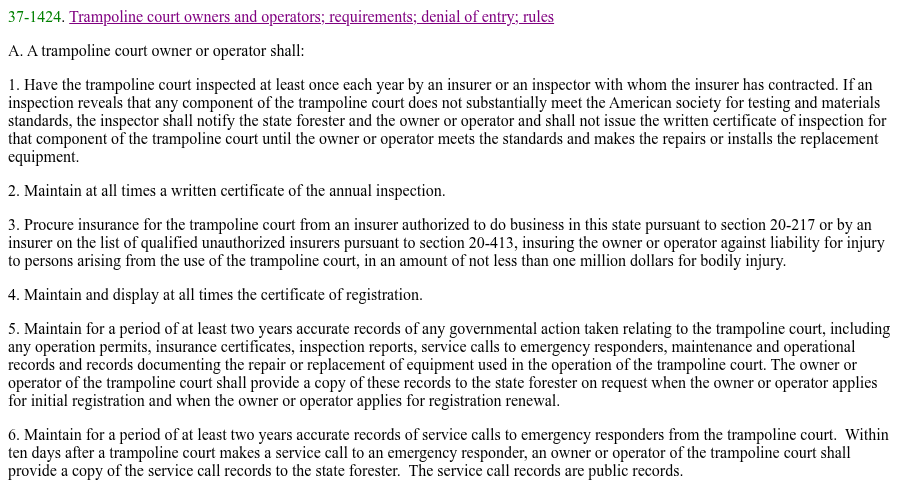
Source 2 of 4 · The state that made the insurer part of the inspection
Arizona Revised Statutes 37-1424. A trampoline court must be inspected every year by its insurer or the insurer's contracted inspector, must carry at least $1,000,000 of bodily injury liability from an admitted or qualified surplus lines insurer, and must send its emergency responder call records to the state forester, where they are public records.
Source: azleg.gov/ars/37/01424.htm
Utah gives something back for compliance: its statute lets an operator raise its compliance with the safety sections as a defense to a claim over inherent risks. New York takes something away: under General Business Law 228, any clause in a trampoline park contract that restricts the venue where a claim is adjudicated or arbitrated is void. And the regulators do enforce. In November 2024 the Illinois Department of Labor announced a settlement, with civil penalties, after inspectors found a park operating its main trampoline court in violation of a stop order.
Other states have gone the opposite way. North Carolina, Texas, Florida and Georgia exclude trampolines from their amusement ride laws, although Texas still issues ride stickers for individual attractions inside trampoline parks, such as battle beams, zip lines and harnessed climbing walls. Bills that would have set insurance minimums failed in Texas in 2025 and Wisconsin in 2026. A park operating in more than one state is working to more than one rulebook.
One more detail matters for the inspection certificate on file. The current trampoline court standard is ASTM F2970-25, but Michigan's statute still names the 2013 edition and Illinois' rule names the 2020 edition. ASTM F2374, which sometimes turns up in trampoline park paperwork, is the standard for inflatable amusement devices, not trampoline courts. And there is no approved ASTM standard for ninja or adventure challenge courses at all: the proposed practice covering warped walls, climbing walls and monkey bars has been a work item since 2022.
Why so few carriers want the class
At least one state regulator names trampoline parks outright as a class buyers struggle to place. Alaska's surplus lines placement list, which the Division of Insurance issues after hearings on the kinds of insurance buyers generally cannot get from admitted insurers, lists "Indoor trampoline parks" for general liability. The order carrying that list forward took effect on 5 January 2026.
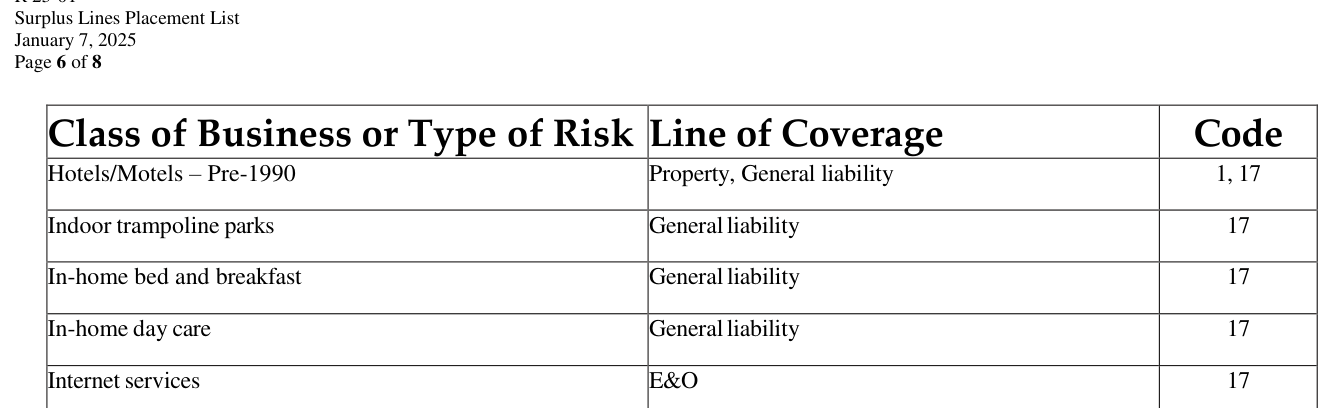
Source 3 of 4 · Named by a regulator as hard to place
Alaska's Surplus Lines Placement List, Order R 25-01, carried forward unchanged by Order R 26-01 effective 5 January 2026. Indoor trampoline parks appear for general liability among the kinds of insurance buyers generally cannot secure from admitted insurers.
New Mexico's insurance regulator put indoor trampoline parks on a similar list in 2015, before rescinding the whole list in 2023. New York, California and Maryland list amusement parks and amusement devices on theirs without naming trampoline parks. A placement list of this kind lets a broker go to the surplus lines market without first searching for an admitted carrier, which is the regulator's way of recording that admitted carriers generally will not take the risk.
The reason is visible in the policy forms. The standard sports or athletic participant endorsement, CG 21 01, reads: "With respect to any operations shown in the Schedule, this insurance does not apply to bodily injury to any person while practicing for or participating in any sports or athletic contest or exhibition that you sponsor." Whether it applies depends on the facts. A federal court in Pennsylvania held that the exclusion did not apply where the insurer could not show that its insured sponsored the event, which is why the wording of the schedule matters as much as the endorsement.
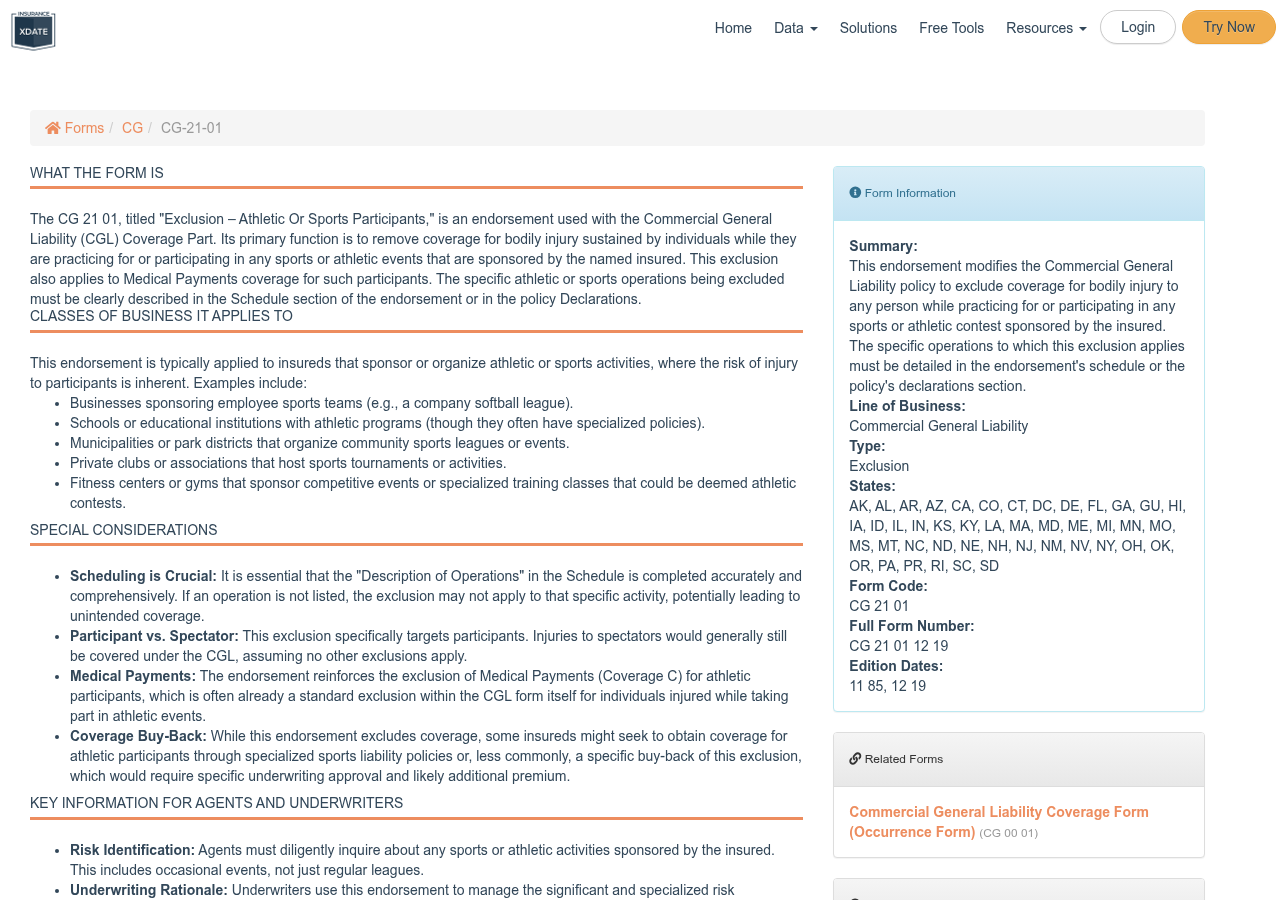
Source 4 of 4 · Standard ISO exclusion form
Endorsement CG 21 01, the sports or athletic participant exclusion. Attached to a trampoline park's liability policy with the park's operations in its schedule, it is the form that decides whether a paying jumper is inside or outside the coverage.
Some carriers do not rely on the standard form. In a 2020 decision, a federal court in New York enforced a liability policy exclusion for "any claims arising out of the use of any aerial equipment including but not limited to the use of a trapeze or trampoline." The insured's broker had told it the carrier "would no longer be providing coverage for anything involving equipment," and the defense was being paid from a separate policy with an eroding limit of $50,000 per person that also had to absorb claim expenses. In a 2023 petition against a tumbling and trampoline gym in Illinois, an insurer relied on its own sports and stunts exclusion for "Trampolines 55 inches or larger in diameter." A South Carolina municipal risk pool's 2026 coverage contract excludes trampolines and rebounding equipment outright. For the full comparison of what each coverage reaches, see our guide to participant injury against general liability.
Classification adds a second layer of friction. A search of the New York workers' compensation classification digest for the word trampoline returns one class out of 594, and it is awning and tent manufacturing, where trampoline jumping surfaces appear as an analogy. Pennsylvania's 630 classifications do not contain the word. California's plan is the only one found that assigns trampoline facilities to an operating class, placing facilities that offer trampolines for at-will use under Health Clubs or Gyms. The federal index is clearer: NAICS 713990 lists "Trampoline facilities, recreational," in a code that covered 25,454 private establishments of every kind at the end of 2025.
What that looks like at renewal is easiest to see from the operator side. The operator of a Brooklyn youth play space with a tumble track described general liability rising from about $8,000 to $31,000 a year after its carrier dropped it, with the replacement being the only carrier its broker could find.
Before I look at a trampoline park's limits, I read the schedule of forms. A participant exclusion, an aerial equipment exclusion or a size limit on trampolines can each leave a $1,000,000 policy covering the lobby, the party rooms and the parking lot, and nothing on the courts. It is one line on a form list, and nobody finds it until the first serious claim.
Bobby Sharp, Action Sports Practice Lead, Specialty Insurance
What the injury record shows
The federal injury surveillance system has no code for a trampoline park. The Consumer Product Safety Commission's NEISS query tool records every trampoline injury under product 1233, and estimates 118,369 emergency department visits involving trampolines in 2025, in a band of 111,212 to 123,014 across the five years from 2021.
The case narratives are where the parks appear. By our count of the federal microdata, records whose narrative names a trampoline or jump park represent a stable national estimate of 20,748 emergency department visits in 2025, about 17 to 19 percent of all trampoline visits in each year from 2021 to 2025. That is a floor, because many narratives never name the setting. Within those 2025 park records, our count estimates 6,086 fractures, 4,500 visits by adults and 1,295 patients admitted, transferred or held for observation. Park injuries also hide under other product codes, such as a 2025 record of a woman who "JUMPED OFF ZIPLINE AT TRAMPOINE PARK," and adding those brings the 2025 park estimate to 23,076.
Two individual records show the range. In January 2025: "50YOF SHE WAS JUMPING AT THE TRAMPOLINE PARK, AND INJURED HER RIGHT KNEE DX: CLOSED FRACTURE OF LATERAL PORTION OF RIGHT TIBIAL PLATEAU." In October 2022, an 18 year old was admitted after "DOING A DOUBLE BACK FLIP WHEN HE LANDED ONTO HIS HEAD," with fractures of multiple cervical vertebrae and a spinal cord injury.
The clinical literature explains why those claims are expensive. A 2016 study in Pediatrics estimated that emergency department visits for trampoline park injuries rose from 581 in 2010 to 6,932 in 2014, and found park injuries more likely than home injuries to warrant admission. A 2019 review of 439 injuries in a Tennessee university healthcare network found adults hurt at commercial jump parks had a 23 percent surgical rate against 10 percent on home trampolines, with fractures or dislocations making up 45 percent of adult park injuries against 17 percent at home. A 2022 meta-analysis of 11 studies found injuries at trampoline centres more likely than home trampoline injuries to need surgery.
The only published exposure-based rate comes from outside the United States. A 2024 Pediatrics study of 18 standard-compliant parks in Australia and the Middle East measured 1.14 injuries per 1,000 jumper hours, rising to 2.11 for high-performance jumping and 1.91 for foam pit or airbag jumping. The American Academy of Pediatrics, in a policy statement reaffirmed in March 2026, still says data on trampoline park safety are insufficient and warns that park jumpers may be at increased risk of an injury that is potentially catastrophic.
Adults and severity are the two findings an underwriter reads first. A park that runs adult nights, fitness classes or corporate events is not insuring a children's attraction, and a spinal injury is priced on a lifetime of care, not on the number of visits.
Zone by zone: where the claims start
A modern park is several attractions under one roof, and each one carries its own standard, its own rules and its own claim history. Urban Air's filing lists trampolines, foam pits, ninja courses, soft play, climbing walls, ropes courses, bumper cars, arcades, laser tag and virtual reality among its attractions, and requires its larger 2.5 Park format to include go-karts. The table below is how an underwriter walks that floor.
| Zone | Where the claims come from | What an underwriter asks for |
|---|---|---|
| Main trampoline courts | Collisions between jumpers of different sizes, double bounces and awkward landings on open courts. | Court monitor ratio, one-jumper-per-bed rule, the current ASTM F2970 inspection certificate. |
| Dodgeball court | Contact injuries and landings during games and tournaments, where another player's bounce changes the jump. | Referee staffing, age and size separation, whether tournaments are run or hosted. |
| Foam pit or airbag | Flips and head-first entries into a pit that is too shallow or poorly maintained, the source of the most severe spinal claims. | Measured pit depth and a maintenance log, written flip rules, an attendant at the pit whenever it is open. |
| Ninja or warrior course | Falls from height onto landing surfaces, on attractions with no approved ASTM standard of their own. | Drop heights, landing surface specifications, minimum height rules and manufacturer documentation. |
| Climbing walls and ropes courses | Harness, belay and fall-from-height incidents, governed by ASTM F2959 for harnessed courses. | Auto-belay and harness inspection records, staff certification, any state registration or ride sticker. |
| Toddler area and soft play | Small children injured by larger jumpers who enter the area, and falls in soft contained play. | Physical separation, age and height enforcement, staffing during open jump sessions. |
| Go-karts and bumper cars | Vehicle collisions and track incidents at adventure parks that add powered rides, under ASTM F2007 for go-karts. | Track design, maintenance logs, driver age and height limits, whether the attraction sits on the same policy. |
| Party rooms and birthday events | Groups of children whose waivers were signed by a host rather than a parent, and party revenue rated partly as admissions. | How every party guest's waiver is collected in advance, and how party revenue is reported. |
Foam pits carry the most catastrophic claims in the reported record. In a Texas suit over a boy who cracked his skull after flipping into a foam pit at a Lubbock park, the plaintiff settled with other defendants for $960,991.78 before trial against the rest. A Pennsylvania suit removed to federal court in 2026 alleges a foam pit was about two feet deep and did not meet ASTM F2970 depth requirements, and the court refused to dismiss the claim for punitive damages. Idaho's Supreme Court affirmed judgment for a park in a foam pit spinal case, for lack of evidence of causation. Published park rules show where the line is drawn: one guest per lane, no diving, no back flips, and no jumping without a team member present.
Dodgeball and open courts produce collision claims. A Tennessee appellate court refused to enforce a parent-signed release for a boy injured in a trampoline dodgeball tournament, where another player's "double bounce" allegedly contributed to his landing. In the Pennsylvania cases decided in 2025, a three year old was hurt when an adult entered a toddler area and jumped on her trampoline.
Ninja courses, climbing walls and go-karts bring standards from outside the trampoline world. There is still no approved ASTM standard for ninja courses. An Ohio appeals court revived a claim by a patron who alleged he dropped 12 to 13 feet from a park's ninja course onto an area with nothing to cushion his landing. Harnessed courses fall under ASTM F2959, go-karts under ASTM F2007 and soft play under ASTM F1918, and North Carolina requires challenge courses and zip lines to carry at least $1,000,000 per occurrence and $2,000,000 aggregate with no per person sublimits.
Your waiver is a document, not a policy
Every park has a waiver, and courts keep finding the gaps in them, most often where the jumper is a child.
- Pennsylvania, 2025. The state Supreme Court held in two consolidated trampoline park cases that "parents are without authority to bind a minor child to an agreement to arbitrate."
- Kentucky, 2019. The Supreme Court held a parent's pre-injury waiver for a child at a for-profit trampoline park unenforceable on the facts of that case, reasoning that "A commercial entity has the ability to purchase insurance and spread the cost between its customers."
- New Jersey, 2021. The Appellate Division held a park could not bind a guest's parent and child to its waiver and arbitration agreement on the signature of the birthday party host, and noted the park could send the waiver to parents to sign in advance.
- Louisiana, 2016. The Supreme Court held a trampoline park's arbitration clause adhesionary and unenforceable, in an agreement that also required patrons who sued to pay $5,000 in liquidated damages.
- Texas, 2025. The Supreme Court went the other way, compelling arbitration of a child's injury claim at an Urban Air park even though the mother had not signed a new release for that visit, because the agreement delegated questions of scope to the arbitrator.
Waivers can also become the claim. Altitude's 2026 filing discloses three consolidated New Jersey suits, over a fractured tibia, a fractured ankle and a fractured foot, in which the plaintiffs allege the park's participant waiver was intended to mislead and misrepresented that parks are ASTM and IATP certified, and ask the court to declare it void.
Insurers know all of this. The authors of a 2025 Minnesota Law Review article report from their interviews that insurers refine and encourage liability-limiting contract terms and may deny coverage without them, but rarely reduce premiums for them. A waiver is a condition of being insurable. It is not a substitute for the insurance, as we set out in what a waiver really holds against.
The limit decides whether a park survives the claim
Go back to the Georgia policy. It carried $1,000,000 each occurrence and $2,000,000 in the aggregate, excluded medical payments entirely, and carried a $2,500 deductible per claim that applied to investigation and legal expense as well as damages. Against that, the jury returned $3,500,000, and the injured plaintiff later filed a federal suit against the park's insurer over the $1,000,000 limit. In Harris County, Texas, a jury in 2016 reportedly returned an $11.485 million verdict against a trampoline park for a teenager's brain injury, according to local television reporting of a release from the plaintiff's law firm.
Sky Zone's own program answers the limits question for its parks with a total liability limit of $6,000,000 per location. An independent park carrying $1,000,000 is making a decision about the other $5,000,000, whether or not it knows it.
Notice is the second way a park loses a claim it paid premium for. A Virginia trampoline park injury in January 2018 was serious enough that an employee called an ambulance. The park did not notify its insurer until 572 days later. A federal court held the insurer owed no defense or indemnity on the two resulting state lawsuits, each seeking $3,000,000, because the delay materially breached the policy's notice condition. The discipline that prevents that outcome is covered in the first 24 hours after an injury.
And some parks are not insured at all. In a Louisiana case, a park owner testified in deposition that the park had no liability insurance in effect in July 2014, and that it recorded 88 documented injuries among roughly 90,000 patrons in its first nine months. The sub-limit version of the same failure, where a policy exists but pays a fraction of the claim, is the subject of the sub-limit trap.
Landlords, lenders, schools and scout troops
Almost every trampoline park is a tenant in a big box. Urban Air's filing describes a typical park as no less than 25,000 square feet with at least 18 feet of clear height over half of the space, and a go-kart location as likely needing at least 45,000 square feet. Those leases run long and are tracked by the landlord's lenders: a shopping center owner's 2022 credit agreement filed with the Securities and Exchange Commission lists a 33,938 square foot trampoline park lease running from December 2016 to December 2036.
A lease that long is why business income matters. Urban Air and Launch both require franchisees to carry 12 months of business income, and the lender on another shopping center, in a 2021 loan agreement also filed with the SEC, requires the landlord to insure 12 months of rental loss on a property whose leases include an Altitude Trampoline Park. Both sides of the lease are planning for a year of closure, not a month. A park that loses its courts to a fire or a roof failure still owes rent on 30,000 square feet it cannot open, and its own business income coverage should be sized to the same horizon.
The people who book groups have their own rules. Salt Lake City School District will not approve field trips to trampoline parks, citing risk management and liability concerns. Beaverton School District in Oregon lists trampoline parks among field trips that will not likely receive approval, and a Louisiana parish school board committee approved a policy revision in 2025 stating that field trips to trampoline parks "are not permitted due to the high risk of injury." A Girl Scout council in coastal Virginia requires "commercial general liability insurance in an amount not less than $1,000,000" on a certificate before a venue is approved, and lists one adventure park as not approved because it was unable to provide proof of insurance. Oregon State University requires $2,000,000 per occurrence for elevated-risk events such as amusement rides and inflatables, with separate sexual abuse and molestation coverage when minors are unaccompanied.
Every one of those decisions is made on paper. A park that can issue a certificate showing the right limits, with abuse and molestation coverage listed, is on the approved list. A park that cannot is not in the conversation.
What moves the number up, and what moves it down
Everything above collapses into a short list. These are the factors an underwriter weighs, in roughly the order they tend to matter.
What moves it up.
- Revenue reported as one blended figure, which invites the highest rate on the schedule to apply to all of it.
- Attractions beyond the court: foam pits, ninja courses, climbing walls and go-karts each add their own exposure.
- Flips, high-performance jumping and adult sessions, the patterns the injury studies tie to severity.
- A large party business, rated partly at the admissions rate and signed for by hosts rather than parents.
- Unaccompanied minors without sexual abuse and molestation coverage in the program.
- A late-reported or undocumented claim in the loss history.
- State or franchise limits above the carrier's standard offering, or an excess layer the lease requires.
What moves it down.
- A revenue report split the way the policy rates it, with the definition of gross sales agreed before binding.
- Documented court monitor ratios, with Illinois' 32 participants per attendant as a published benchmark.
- Written flip and foam pit rules, with measured pit depth recorded against ASTM F2970.
- A current annual inspection certificate that cites the correct standard.
- An advance waiver process for every child, including every party guest, signed by a parent or guardian.
- Same-day incident reports and prompt notice to the insurer, every time an ambulance is called.
- Age and height separation between toddler areas, open courts and dodgeball.
The trampoline parks I can place well at renewal hand me the same five documents every year: the annual inspection certificate, the court monitor schedule, the incident log with the date each claim was reported, the waiver process for birthday parties, and a revenue report that splits admissions from everything else. That file is what an underwriter prices, and it is the same file a defense lawyer asks for on the first day of a lawsuit.
Bobby Sharp, Action Sports Practice Lead, Specialty Insurance
None of those documents is expensive to produce. All of them are expensive to reconstruct after a claim, which is when most parks first try.
"Bobby Sharp and the team at Specialty Insurance had a fast turnaround, professional service, and answered every question I had as a brand-new operator. They wrote the policy I'd want defending me if a player ever filed a claim."
Grimnir Tactical LLC
Verified customer review
How to get a quote that matches your park
Bring five things and most of the difficulty in this guide disappears.
A revenue report by stream. Admissions, parties, concessions, retail, memberships and any alcohol sales, for the last twelve months and projected for the next, because the premium is a rate multiplied by those figures.
An attraction schedule. Every zone on the floor, with foam pit depths, ninja course drop heights, climbing wall and ropes course systems, and any go-karts or bumper cars, plus the age and height rules for each.
Your compliance file. The current inspection certificate, the standard it cites, any state registration or permit, and your court monitor staffing plan.
Your waiver and your claims history. The participation agreement, how party guests sign it, the incident log for the last three years, and the date each claim was reported to your insurer.
The insurance requirements you already owe. Your lease's insurance article, your franchise agreement's insurance section if you have one, and any school or group booking requirements you want to meet.
Specialty Insurance places action sports and entertainment venues that generalist markets decline, exclude or misclassify, in all 50 states, and reads the schedule of forms before it reads the price. If your current quote arrived without anyone asking how your revenue splits or what is in your foam pit, it was not written for your park. Our trampoline park insurance page sets out the program.
Frequently Asked Questions
How much does trampoline park insurance cost?
Specialty Insurance's 2026-2027 ranges for a single-location US indoor trampoline park run $40,000 to $150,000 a year for General Liability Insurance, $20,000 to $60,000 for Participant Injury Insurance and $50,000 to $150,000 for Excess / Umbrella Insurance. Sexual Abuse and Molestation Insurance and Commercial Property Insurance each run $5,000 to $25,000, Workers' Compensation Insurance $1,000 to $25,000, and Liquor Liability Insurance $2,500 to $25,000 where the park serves alcohol. Liability premium is commonly rated per $1,000 of gross sales: a Georgia park's filed policy rated trampoline admissions at $47 per $1,000, and Urban Air's 2026 franchise filing estimates general liability at $41 per $1,000. The ranges are line-by-line indications for budgeting, not a quote.
Which states require trampoline parks to carry liability insurance?
Arizona requires at least $1,000,000 for bodily injury, Utah and New York require $1,000,000 in the aggregate and $500,000 per incident, and Illinois requires $1,000,000 per occurrence and $2,000,000 aggregate for trampoline courts, with proof at permit inspection. Colorado, Virginia and Tennessee regulate trampoline courts or parks as amusement devices with minimums of $1,000,000 per occurrence. Michigan regulates trampoline courts without an insurance mandate, while North Carolina, Texas, Florida and Georgia exclude trampolines from their amusement ride laws.
Does general liability insurance cover injuries to jumpers?
Not automatically. The standard CG 21 01 endorsement removes bodily injury to anyone practicing for or participating in a sports or athletic contest or exhibition the insured sponsors, for the operations shown in its schedule. Some carriers go further: a federal court in New York enforced an exclusion for claims arising out of the use of aerial equipment including trampolines, and an insurer in Illinois relied on its own exclusion for trampolines 55 inches or larger in diameter. Read the schedule of forms before you bind, and confirm that injuries to paying jumpers are covered.
Do waivers protect a trampoline park from injury lawsuits?
Only partly, and least of all for children. Pennsylvania's Supreme Court held in 2025 that parents cannot bind a minor child to arbitration, Kentucky's Supreme Court held a parent's pre-injury waiver for a child at a for-profit trampoline park unenforceable on the facts of that case, and courts in Tennessee, New Jersey and Louisiana have refused to enforce trampoline park releases or arbitration clauses. The Texas Supreme Court compelled arbitration in a 2025 Urban Air case. A waiver supports a defense and is often a condition of coverage, but it does not replace the insurance.
Why is trampoline park insurance hard to find?
Because regulators, carriers and classification systems all treat the class as specialist business. Alaska's surplus lines placement list names indoor trampoline parks for general liability, among the kinds of insurance buyers generally cannot secure from admitted insurers. Carriers attach participant, aerial equipment and trampoline exclusions, no class in New York's workers' compensation digest names the operation of a trampoline park, and one play space owner reported general liability rising from about $8,000 to $31,000 a year after its carrier dropped it.
Sources
All sources retrieved and verified 16 September 2026.
- Knight v. Golden Bear Insurance Company, N.D. Ga. No. 1:24-cv-04199, Document 1-1: commercial general liability policy GBL 60132 for Get Air Suwanee Parks, LLC (policy period 10 November 2017 to 10 November 2018), Premium Payment Endorsement GBR 202, Premium Audit Endorsement GBR 203, and Judgment on Verdict, State Court of Clayton County No. 2018CV02012.
- UATP Management, LLC (Urban Air Adventure Park), 2026 Franchise Disclosure Document, Items 1, 7 and 8. Minnesota Department of Commerce, CARDS.
- Launch Franchising, LLC, 2026 Franchise Disclosure Document, Items 7, 8 and 19, and 2025 Franchise Disclosure Document, Item 19. Minnesota CARDS.
- Sky Zone Franchise Group, LLC, Franchise Disclosure Documents of April 2024 and April 2025, and as amended May 2026, Items 6, 7 and 8; Cloudbound Franchise Group, LLC, Franchise Disclosure Document, September 2025, Item 1. Minnesota CARDS.
- ATP Franchising, LLC (Altitude Trampoline Park), 2026 Franchise Disclosure Document, Items 3, 7 and 8; Rockin' Jump Franchise, LLC, 2022 Franchise Disclosure Document, Item 8; Big Air, 2026 Franchise Disclosure Document, Item 6. Minnesota CARDS.
- Kinsale Insurance Co. v. Sky High Sports LLC, E.D. Cal. No. 2:14-cv-02086, Order of 25 August 2015; Kinsale Insurance Co. v. Sky High Sports Concord LLC, 254 F. Supp. 3d 1234 (E.D. Cal. 2017).
- Arizona Revised Statutes 37-1423 and 37-1424; Utah Code 11-63-304, 11-63-501 and 11-63-502; New York General Business Law 225, 226 and 228; 430 ILCS 85/2-2 and 2-14 and 56 Ill. Adm. Code 6000.353; 7 CCR 1101-12; 13VAC5-31; Tenn. Code Ann. 68-121-117; Michigan Compiled Laws 691.1731 to 691.1738.
- N.C. Gen. Stat. 95-111.3 and 66-456; Texas Occupations Code 2151.002 and the Texas Department of Insurance amusement ride sticker list; Florida Statutes 616.242; Ga. Comp. R. and Regs. 120-3-27; Texas HB 3481 (89th Legislature); Wisconsin 2025 Senate Bill 1049.
- Illinois Department of Labor, "Trampoline Courts Subject to Inspection," 1 October 2021, and press release of 8 November 2024.
- ASTM International, F2970-25, F2374-24, F2959-26a, F2007-24 and F1918-21, and work item WK81308.
- Alaska Division of Insurance, Orders R 25-01, R 25-02 and R 26-01, Surplus Lines Placement List; New Mexico Office of Superintendent of Insurance, Bulletins 2015-007 and 2023-012; New York Insurance Regulation 41 export list; California Department of Insurance Bulletin 2025-16; COMAR 31.03.06.10.
- Sciolla v. West Bend Mutual Insurance Co., 987 F. Supp. 2d 594 (E.D. Pa. 2013).
- Philadelphia Indemnity Insurance Co. v. Streb, Inc., S.D.N.Y. No. 1:19-cv-00366-KPF, Opinion and Order of 16 September 2020; SECURA Insurance Co. v. Chatham Tumbling & Trampoline, Inc., C.D. Ill. No. 3:23-cv-03024, First Amended Petition for Declaratory Judgment; South Carolina Municipal Insurance and Risk Financing Fund, 2026 Coverage Contract.
- New York Compensation Insurance Rating Board, Classification Digest; Pennsylvania Compensation Rating Bureau, Workers Compensation Manual Section 2; WCIRB California, Uniform Statistical Reporting Plan effective 1 September 2026, Classification 9053(2); US Census Bureau, 2022 NAICS Index File; US Bureau of Labor Statistics, Quarterly Census of Employment and Wages, NAICS 713990.
- CPSC National Electronic Injury Surveillance System, Estimates Query Builder and 2021 to 2025 annual microdata, product 1233; NEISS Coding Manual, January 2025 (rev. 1); CPSC meeting log, Trampoline Park Safety, 2 June 2022.
- Kasmire KE, Rogers SC, Sturm JJ, "Trampoline Park and Home Trampoline Injuries," Pediatrics (2016); "Trampoline-Related Injuries: A Comparison of Injuries Sustained at Commercial Jump Parks and Home Trampolines," Journal of the American Academy of Orthopaedic Surgeons (2019); Nunez C, Eslick GD, Elliott EJ, "Trampoline centre injuries in children and adolescents," Injury Prevention (2022); Teague WJ et al., "Trampoline Park Injury Trends," Pediatrics (2024); American Academy of Pediatrics, "Trampoline Safety in Childhood and Adolescence," reaffirmed March 2026.
- Santiago v. Philly Trampoline Park, LLC and Shultz v. Sky Zone, LLC, Pa. Supreme Court Nos. 24 and 25 EAP 2023 (2025); Miller v. House of Boom Kentucky, LLC, 575 S.W.3d 656 (Ky. 2019); Blackwell v. Sky High Sports Nashville Operations, LLC, 523 S.W.3d 624 (Tenn. Ct. App. 2017); Gayles v. Sky Zone Trampoline Park, 468 N.J. Super. 17 (App. Div. 2021); Alicea v. Activelaf, LLC, 218 So. 3d 1001 (La. 2016); Cerna v. Pearland Urban Air, LLC, Supreme Court of Texas No. 24-0273 (2025).
- In re 3 Atoms, LLC and Fun Spot Manufacturing, LLC, Tex. App. Amarillo No. 07-19-00243-CV (2019); Taddy v. Get Air State College, LLC, M.D. Pa. No. 4:26-CV-00574 (2026); Griffith v. JumpTime Meridian, LLC, Idaho Supreme Court (2017); Edwards v. Adrenalin Trampoline Park, L.L.C., 2020-Ohio-280.
- HDI Global Specialty SE v. Hassan, E.D. Va. No. 3:19cv891, Memorandum Opinion of 14 September 2021; Perkins v. Air U Shreveport, LLC, 249 So. 3d 187 (La. Ct. App. 2018).
- Hoffman and Swedloff, "Insurers as Contract Influencers," 110 Minnesota Law Review 769 (2025).
- CBL and Associates credit agreement of 7 June 2022, Exhibit 4.1, and Medalist Diversified REIT loan agreement of 8 November 2021, both filed with the Securities and Exchange Commission
- Salt Lake City School District administrative memo, 29 April 2025; Beaverton School District Administrative Regulation IICA-AR; Tangipahoa Parish School Board Policy IFCB, first revision 2025; Girl Scout Council of Colonial Coast, Certificate of Insurance Approved Vendor List, updated 3 September 2026; Oregon State University Insurance and Risk Management, Events and Activities.
- The operator account quoted in prose is verbatim from a public r/Insurance post from 2024, retained on file with its permalink and date. It is not linked, in line with our outbound-link policy.