

A real paintball insurance program commonly runs $7,000 to $15,000 a year, a benchmark we document in our paintball insurance pricing guide. That range matters to GellyBall operators for one reason: it is the price of the box a generalist agent ticks when the application has no GellyBall class to put you in. Priced as the game you run, GellyBall is one of the most affordable classes in action sports to insure, and the distance between those two numbers is what this guide is about.
Here is what GellyBall and gel blaster business insurance really costs in 2026, the drivers that move the number in both directions, and how to keep your premium at the bottom of the class without leaving your players uncovered.
What GellyBall business insurance costs in 2026
For a full-time mobile GellyBall party business carrying a real program, General Liability with Participant Injury, Inland Marine on the traveling kit, and Hired and Non-Owned Auto once the equipment rides to bookings, plan on roughly $2,000 to $6,000 a year at one million per occurrence and two million aggregate limits. That is the band most established mobile operators in our book land in, and it is the number to sanity-check any quote against. If you are still building the operation, see how to start a GellyBall party business, and for the mobile-rental specifics, gel blaster party rental insurance.
The figure moves from there with the shape of your operation:
- Part-time and weekend-only mobile operators sit below the range, on lower booking volume and a smaller kit.
- Full-time mobile party businesses sit in the middle of it.
- Fixed soft-barrier arenas sit above it, on premises exposure, a property schedule, and open-play volume.
- Dual and multi-activity operations that run GellyBall beside paintball or other attractions price each activity on its own class, so the program grows with the lineup.
The distance below the paintball benchmark is earned, not promotional. The soft hydrogel gellet produces a milder injury profile than a paintball, and a carrier prices that difference, when the application lets it. The full cost and safety comparison sits in GellyBall vs paintball.
The class rate exists because the category earned it. Gel blaster play has grown from a backyard novelty into a recognized location-based-entertainment segment, with industry coverage reporting one gel-blaster experience passing 80,000 players and a pipeline of additional venue installations. That volume is what lets carriers rate the game on its own loss profile.

Source 1 of 3 · Industry growth record
Trade coverage documents gel blaster play scaling into a location-based-entertainment category of its own. That volume is why carriers can rate GellyBall on its own loss profile instead of borrowing paintball's, and why a correctly classified quote runs lower.
The two wrong numbers GellyBall operators get quoted
When a GellyBall premium misses the band, it misses in one of two directions, and each direction has its own fix.
The number that is too high is a classification problem. A generalist agent with no GellyBall box to tick describes the operation as paintball, and the premium prices impact severity your game does not carry. The quote is not high because the carrier is cautious. It is pricing a different sport. Why the misclassification happens, and what the correct class looks like on an application, is the subject of our deep dive on why GellyBall should not be priced like paintball. Whether a paintball policy even extends to GellyBall in the first place is answered in is GellyBall insurance the same as paintball coverage.
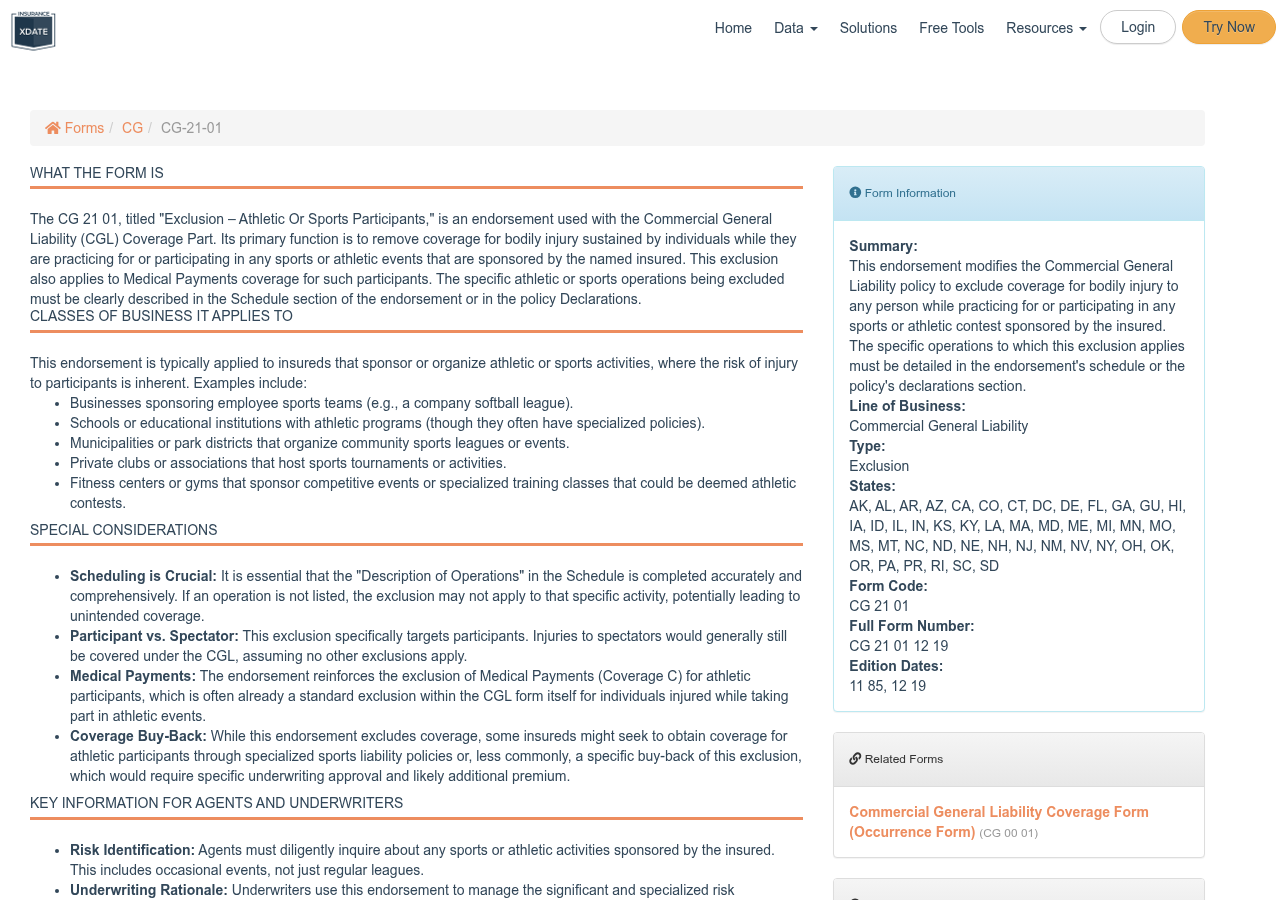
The number that is too low is a coverage problem. A bare Commercial General Liability quote at a few hundred dollars looks like a win for a small party business, but the standard General Liability form excludes injury to anyone "practicing for or participating in any sports or athletic contest or exhibition." At a GellyBall booking, every paying player is a participant. The bargain policy covers the parent watching from a lawn chair and excludes the eight-year-old holding the blaster, which is the claim a GellyBall business is most likely to see.
Source 2 of 3 · Standard ISO exclusion form
The standard ISO CG 21 01 endorsement removes coverage for athletic and sports participants. At a GellyBall party that is every player on the field, which is why the cheapest quote in your inbox is cheap: it leaves out the people the business exists to host.
A real GellyBall program prices four lines, not one. The table below is what the premium buys, and what the discount quote leaves out.
| Coverage | What it pays for | In the cheap quote? |
|---|---|---|
| General Liability | The spectator parent struck by a stray gellet, the guest who trips over an inflatable anchor, damage to a rented venue or gym floor | Usually yes, at minimum limits |
| Participant Injury | The paying player hurt during a game, the coverage the standard General Liability form excludes | Almost never |
| Inland Marine + Property | Blasters, inflatable bunkers, masks, and the rest of the kit, in the van, at the booking, and in storage | Rarely, and rarely at replacement cost |
| Hired & Non-Owned Auto / Workers' Comp | The vehicle exposure of a business that drives to its customers, and party hosts once you hire staff | No, these are separate lines |
Half the GellyBall quotes I am asked to review were priced for a game the operator does not run. The application said paintball because that was the closest box a generalist could find, and the premium followed the box. Correct the described operations and the number comes down on its own. That is not a discount. That is the first time the policy has described the actual risk.
Bobby Sharp, Action Sports Practice Lead, Specialty Insurance
What pushes a GellyBall premium up
Within the class, seven drivers move the number the most. The first two are paperwork, which is good news, because paperwork is fixable before renewal.
| Driver | Why underwriters charge more for it |
|---|---|
| Written on a paintball or airsoft classification | The premium prices impact severity the game does not carry; the most expensive paperwork error in the class |
| Hobby-grade, high-velocity blasters in the fleet | Published case data measured gel pellets at 200 to 300 feet per second; equipment at that level pulls the account toward airsoft-style underwriting |
| Loss history | A prior eye claim is the single biggest rate-up any projectile class carries |
| Open public play versus booked sessions | Walk-in volume raises claim frequency and thins out supervision documentation |
| No enforced eye-protection rule | Removes the control underwriters credit most in a projectile class |
| Bundled attractions on the same policy | Inflatables, obstacle courses, and axe lanes each bring their own class and their own claims |
| Mobile operation with unscheduled auto and equipment | Undisclosed vehicle and transit exposure surfaces at audit and reprices the account |
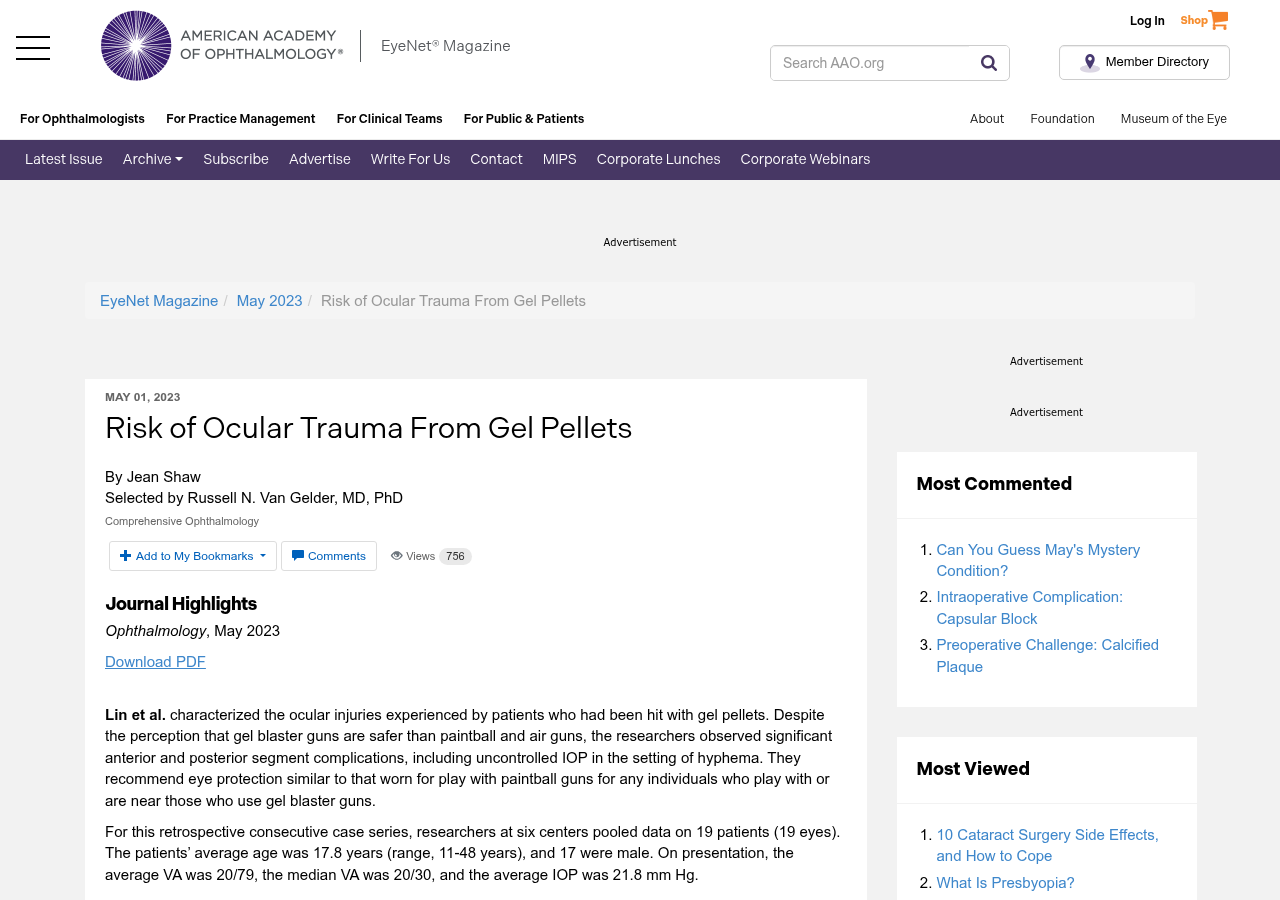
The velocity spread is the underwriting story most operators have not heard. Party-grade GellyBall equipment fires a light hydrogel bead at low speed for young children. The hobby end of the same category is harder than the toy shelf suggests: a multicenter case series in Ophthalmology, the journal of the American Academy of Ophthalmology, documented 19 patients with gel pellet eye injuries, including hyphema in 12 eyes and surgical procedures in 7, with pellets measured at no less than 200 to 300 feet per second (Lin et al., Ophthalmology, May 2023). Party-grade fleets sit nowhere near those speeds, which is why documentation matters: the carrier cannot tell a birthday fleet from a hobby-grade arsenal unless the application proves it.
Source 3 of 3 · Peer-reviewed clinical record
The American Academy of Ophthalmology summarizes a multicenter case series of gel pellet eye injuries, with pellets measured at 200 to 300 feet per second at the hobby end of the category. The spread inside the class is why your fleet list, not the word "gel," sets your rate.
Source: aao.org/eyenet/article/risk-of-ocular-trauma-from-gel-pellets
What brings a GellyBall premium down
Most of the levers that hold a GellyBall premium at the bottom of the class are documentation habits, not capital spending. An underwriter prices what you can prove.
| Tactic | What it does to your premium |
|---|---|
| Correct GellyBall classification named in the described operations | The single biggest mover; a requote on the right class regularly beats any discount on the wrong one |
| Manufacturer velocity specifications on file for every blaster model in the fleet | Proves the party-grade profile the class rate assumes |
| Mandatory eye protection for every player, every session | Removes the most expensive claim driver a projectile game has |
| A signed waiver for every participant, with a parent or guardian signature for minors | Cleaner claim defense, which the carrier sees in your loss runs over time |
| Clean three-year loss history | The strongest pricing signal once you are in the specialty market |
| Session rosters and staffing ratios kept on file | Documented supervision earns underwriting credit at renewal |
A GellyBall file that arrives with manufacturer velocity specs, a posted eye-protection rule, and a signed waiver for every booking prices at the bottom of the class. The identical operation with nothing on paper prices like a question mark. The cheapest insurance purchase an operator makes this year is the folder.
Bobby Sharp, Action Sports Practice Lead, Specialty Insurance
Mobile operators have one more lever, and it is the one most often skipped. The blasters, bunkers, and masks of a traveling business spend half their working life in a van, where a standard property policy quietly stops following them. Scheduling the kit on Inland Marine keeps it covered in transit and at the venue, a setup we walk through in our guide to Inland Marine for action sports.
Where your operation lands on premium
The headline band is the starting point, not the quote. The chart below maps roughly where each operation type sits, the same picture an underwriter builds before pricing your file.
Two operations with the same booking calendar can sit thousands of dollars apart at renewal on classification and documentation alone. That is why a real quote starts with your fleet list and your booking model, not a price list.
How to get an accurate GellyBall insurance quote in 24 hours
A generalist who has never written the class shops your application one carrier at a time, usually under the wrong classification, and the result is slow and high. A broker who writes GellyBall on purpose turns a tailored quote in 24 to 48 hours. Five things speed it up:
- A completed application that names GellyBall or gel blaster play in the described operations
- Your fleet list with manufacturer and model, so velocity is documented instead of assumed
- Loss runs from any prior carrier, or a note that you have never been insured
- Your waiver template, including the parent or guardian signature line for minors
- Your booking model: mobile, arena, or both, and where the equipment is stored between events
Operators feel the difference in the first conversation: the specialist asks about your fleet and your booking calendar, the generalist asks how close the game is to paintball. It is the difference customers describe once a program is built around the operation itself.
"Specialty Insurance has been an incredible foundation for our business. They are personal, professional, and easy to work with."
Talk to a GellyBall specialty broker before you compare quotes
The cheapest line on a comparison spreadsheet is rarely the cheapest policy after a claim. Before you bind, get a number from a broker who writes GellyBall insurance on purpose, builds Participant Injury into the program instead of leaving it excluded under a standard General Liability form, and schedules the traveling kit instead of hoping the van is never broken into. Then compare like for like. The right class, fully covered, is usually still the lowest number on the table.
Frequently Asked Questions
How much does GellyBall business insurance cost per year?
For a full-time mobile GellyBall party business with a real program, General Liability with Participant Injury, Inland Marine on the kit, and Hired and Non-Owned Auto, plan on roughly $2,000 to $6,000 a year at one million per occurrence and two million aggregate limits. Weekend-scale operators sit below that band, fixed arenas sit above it, and multi-activity venues price each activity on its own class.
Why is my GellyBall insurance quote as expensive as paintball insurance?
Almost always classification. If the application describes the operation as paintball, the premium prices paintball's impact severity, which GellyBall does not carry. Ask the broker to requote with GellyBall or gel blaster play named in the described operations. That correction regularly moves the premium more than any discount.
Is GellyBall insurance cheaper than paintball or airsoft insurance?
Yes, when it is classified correctly. A real paintball program commonly runs $7,000 to $15,000 a year, and airsoft typically prices higher than lower-impact classes because of its eye and dental severity profile. A correctly classified GellyBall operation sits below both, because the soft hydrogel gellet produces a milder injury profile.
Does a mobile GellyBall party business need insurance for every booking?
You carry one annual policy, not a policy per party. What each booking may require is a certificate of insurance naming the venue, park, or school as an additional insured. A broker who writes mobile operators issues those certificates per booking, and Inland Marine plus Hired and Non-Owned Auto keep the kit and the driving covered between stops.
How can I lower my GellyBall insurance cost?
Confirm the policy is classified as GellyBall, keep manufacturer velocity specifications for your fleet on file, enforce eye protection for every player, collect a signed waiver for every participant with a parent or guardian signature for minors, and protect a clean loss history. Underwriters price what you can document, so the operator with the organized file earns the bottom of the class.
Sources
- blooloop, gel-blaster industry coverage: trade record of gel blaster play scaling into a location-based-entertainment category, the volume that lets carriers rate GellyBall on its own loss profile.
- ISO Commercial General Liability form CG 21 01, Exclusion of Athletic or Sports Participants: the standard endorsement that removes participant coverage from a bare General Liability quote.
- Shaw J., "Risk of Ocular Trauma From Gel Pellets," EyeNet Magazine, American Academy of Ophthalmology, May 2023, summarizing Lin et al., Ophthalmology: the multicenter case series documenting gel pellet eye injuries at 200 to 300 feet per second at the hobby end of the category.
- Specialty Insurance, GellyBall Insurance: Why It Should Not Be Priced Like Paintball: the classification deep dive behind the requote fix.
- Specialty Insurance, How Much Does Paintball Insurance Cost? A 2026 Pricing Guide: the paintball benchmark band this guide compares against.
- Specialty Insurance, Inland Marine Insurance for Action Sports: how traveling equipment stays covered in transit and at the venue.