


The quick answer: it depends on which policy is behind the arena
Does nerf arena insurance cover foam dart eye injuries? Yes, when the policy was written for a foam-dart venue. A program with named Participant Injury and Participant Accident coverage treats an eye injury on the arena floor as exactly the claim it was priced for. The same injury under a generic general liability policy is often not covered at all, because the standard form carries a one-paragraph exclusion that removes the injured player from the policy. Which of those two documents sits behind your arena is the whole answer.
The reason operators get this wrong is understandable. The projectile is foam. It weighs about a gram, it leaves the blaster at a fraction of a paintball's energy, and the marketing photo on every brochure is a nine-year-old laughing behind an inflatable barrier. So the assumption forms early: nothing at a nerf arena, blaster tag venue, or foam combat park can hurt anyone badly enough to test an insurance policy. The eye is where that assumption fails. The American Academy of Ophthalmology puts it plainly: "Nerf darts are soft, but that doesn't mean they're safe" (AAO, 2024). A foam dart cannot break a bone, but it can put a child in an ophthalmology clinic, and the claim that follows lands on whichever policy you bought.
What a purpose-built nerf arena policy covers
A nerf arena program from a specialty carrier is built around one fact: the people most likely to be injured at your venue are the paying participants. Here is how the coverage lines divide the work when a foam dart finds an eye.
| Coverage line | What it does for a foam dart eye injury |
|---|---|
| General Liability | Covers third parties: the parent struck watching from the sideline, the visitor who slips in the lobby. Defends and pays negligence claims from people who are not playing. |
| Participant Injury | The liability answer for the players themselves. When the injured child's family alleges the arena was negligent (no eye protection offered, no safety briefing, worn darts with hardened tips), this coverage defends the business and pays what it owes. |
| Participant Accident | The no-fault layer. Pays medical bills for an injured player promptly, without waiting for anyone to prove negligence. Small dollars against an ophthalmology bill, large dollars against goodwill: the family whose emergency-room visit was paid rarely calls an attorney. |
| Property + Inland Marine | Not an injury line, but part of the same program: blasters, dart inventory, inflatable obstacles, and the buildout, on premises and in transit. Covered in the FAQ below. |
The pairing in the middle two rows is the part generalist quotes miss. Participant Injury answers the lawsuit; Participant Accident often prevents it. It is not an exotic structure: facility owners who host athletic activities already require it, and one university facility-rental policy asks renters to prove both that the general liability policy covers athletic participants and that Participant Accident insurance is in place (California State University, Long Beach, facility rental insurance requirements). We walk through the division of labor between the two lines across every action sport in Participant Injury vs General Liability.
Where a generic policy leaves the injured player
Most new arena owners do not buy that program. They buy a standard small-business General Liability policy, because it is fast and cheap and the agent who sold it writes restaurants the rest of the week. That policy has four places where a foam dart eye injury claim dies.
| The gap | Why it opens |
|---|---|
| The athletic participants exclusion | Standard ISO endorsement CG 21 01 excludes bodily injury to any person while practicing for or participating in a sports or athletic contest. Organized foam-dart matches are exactly that. The child hit during a game is not a covered claimant; the policy answers for the parking lot and the lobby, not the arena floor. |
| The description of operations | A policy written for a "party venue" or "entertainment center" that never names foam-dart battles describes a business the carrier never priced. At claim time, the description of operations is the first page the adjuster reads, and a mismatch turns a payment into an argument. |
| Medical payments has its own sports exclusion | Operators often assume the med-pay line will at least handle the emergency-room bill. It usually will not: the standard ISO general liability form's medical payments coverage carries its own athletics activities exclusion, barring payment for a person injured while participating in games, sports, or athletic contests. |
| Waiver reliance | The waiver signed at check-in is real protection, but it is not coverage, and at a venue whose customer base is children it is weaker than most operators assume: in many states a parent cannot sign away a minor's right to sue, a principle the New Jersey Supreme Court applied to a commercial recreation venue in Hojnowski v. Vans Skate Park (2006). A defense built on a waiver still has to be paid for, and on an excluded claim there is no carrier paying for it. |
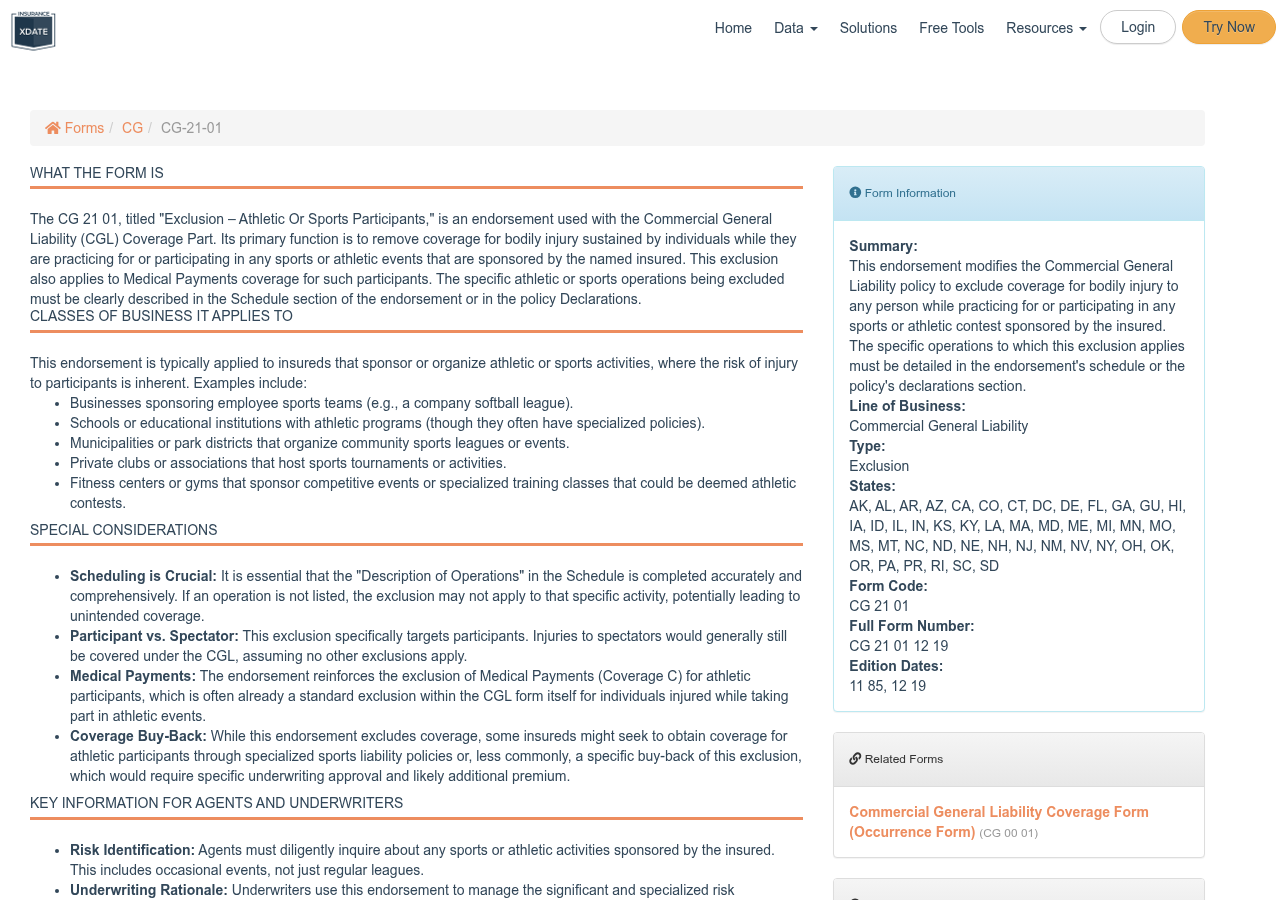
Source 1 of 3 · Standard ISO exclusion form
The one-paragraph endorsement that removes the injured player from a standard general liability policy. A nerf arena running organized matches on an unmodified generic form is holding coverage for everyone except the people playing.
The exclusion is not a technicality buried for lawyers. It is the first page a specialist reads on any foam-dart venue submission, because it decides who the policy is for.
The dart is foam. The lawsuit is not. When a nerf arena sends me the policy they bought online, I read the athletic participants exclusion first, because that one paragraph decides whether the child with the eye injury is a covered claim or the owner's personal legal bill.
Bobby Sharp, Action Sports Practice Lead, Specialty Insurance
We wrote the long version of this failure mode for paintball in why your field's GL policy probably has gaps; the form language there is the same language nerf arenas inherit when they buy generic coverage.
How a foam dart eye injury claim unfolds
Start with what the medical record says a foam dart does to an eye, because the clinical literature is what a plaintiff's attorney will read to your jury. In 2017, ophthalmologists at Moorfields Eye Hospital in London published a case series after three unrelated patients, two adults and an 11-year-old child, arrived within three months with eye injuries from Nerf-style blasters. All three had traumatic hyphema, bleeding inside the front chamber of the eye. The child, hit from about two meters, had the most extensive damage: corneal swelling, inflammation, angle recession, and bruising of the retina. The patients were shot from one, two, and eight meters, and the authors concluded that no safe shooting distance could be established (Bizrah and Verma, BMJ Case Reports, 2017).
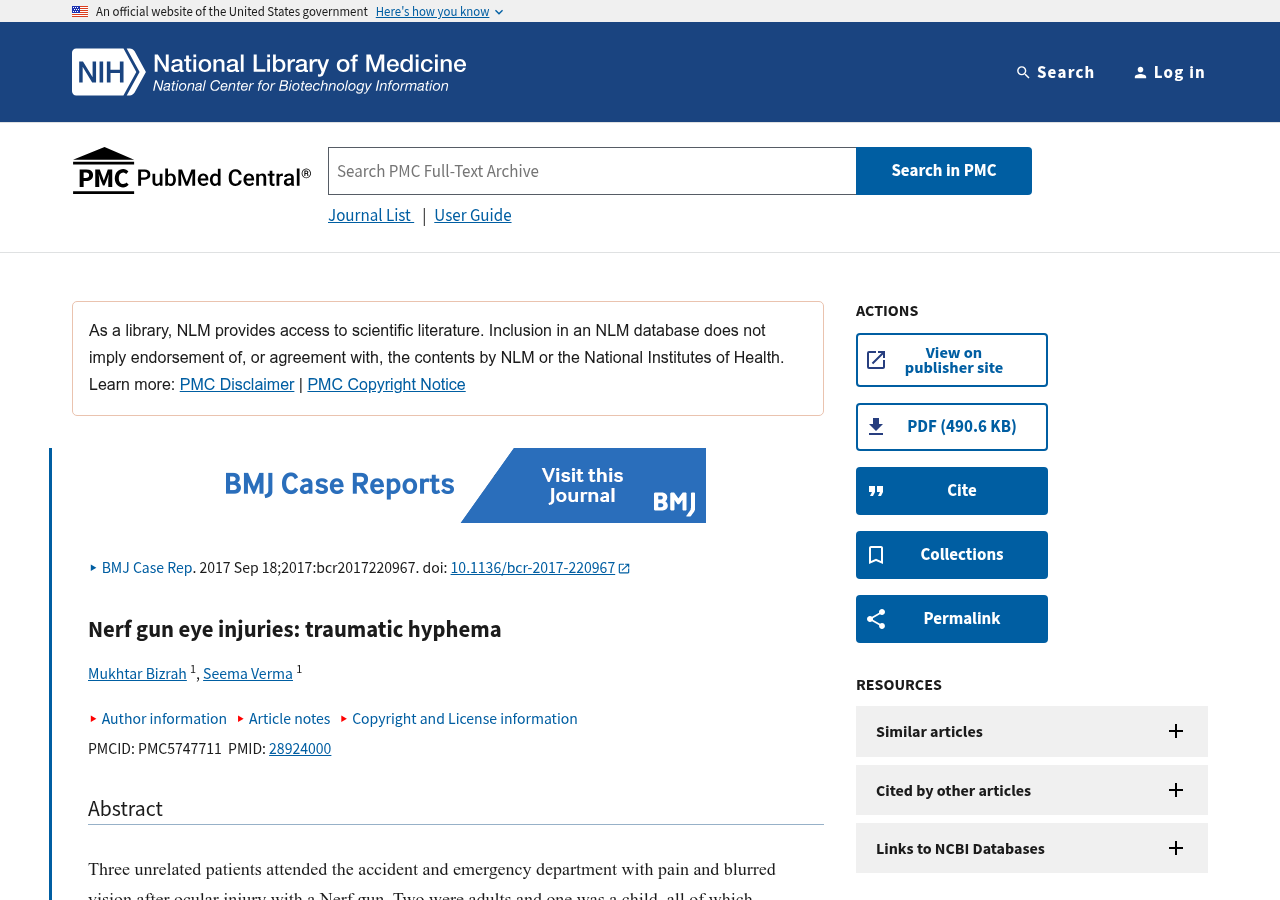
Source 2 of 3 · Peer-reviewed clinical record
The Moorfields Eye Hospital case series documenting traumatic hyphema from Nerf-style foam darts in three patients, including an 11-year-old child. This is the paper a plaintiff's attorney will quote back to your carrier.
The surveillance numbers point the same direction. A 12-year study of a pediatric eye emergency center in Paris, reported in JAMA Ophthalmology, found foam projectiles were the single most common toy-gun cause of eye trauma: 151 of 304 cases, half the total, ahead of BB and airsoft guns at 110 and paintball at 31. The injury list included 51 intraocular hemorrhages, 19 retinal injuries, and 2 open-globe injuries, and one boy under 10 permanently lost all light perception in one eye (Dentel et al., JAMA Ophthalmology, 2023). A separate 2023 case series in the European Journal of Pediatrics documented 11 pediatric foam-dart eye injuries with hyphema in 82 percent of patients and glaucoma-related complications in 36 percent, and concluded that foam dart blasters "can cause severe blunt ocular trauma and permanent visual loss" (Cohen et al., European Journal of Pediatrics, 2023). For scale, the Consumer Product Safety Commission estimates 267,100 toy-related injuries were treated in United States emergency departments in 2024, with 45 percent of them to the head and face, the body region that includes the eye (CPSC, Toy-Related Deaths and Injuries, Calendar Year 2024).
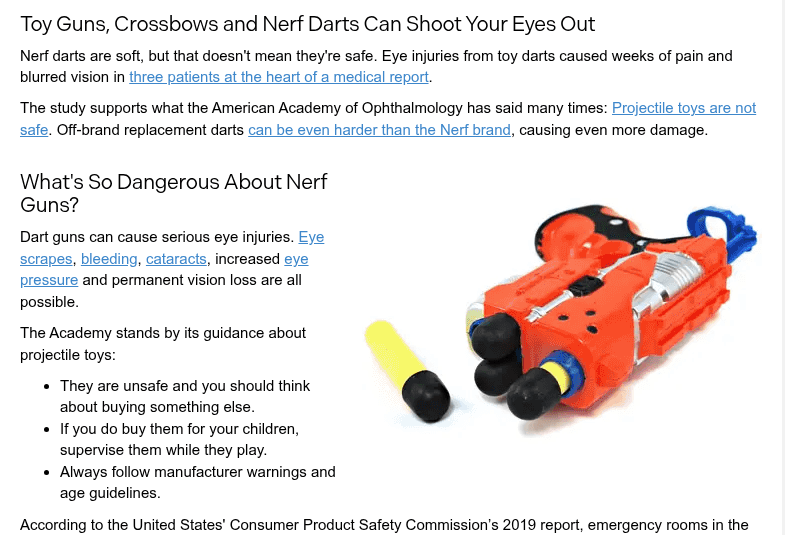
Source 3 of 3 · Clinical-authority warning
The American Academy of Ophthalmology's standing guidance that foam darts are not eye-safe, listing eye scrapes, bleeding, cataracts, increased eye pressure, and permanent vision loss as possible outcomes.
Source: aao.org/eye-health/anatomy/combating-eye-injuries-from-air-guns
None of this makes a nerf arena a dangerous business. It makes the eye the one concentrated exposure in an otherwise low-severity class, which is exactly how an underwriter prices it and exactly where a generic policy fails it. One operational detail from the Moorfields paper deserves its own sentence: the authors examined the off-brand replacement darts one patient was hit with, bought online at a fraction of the price of branded ammunition, and found the tips noticeably firmer. An arena that buys bulk third-party darts is quietly changing its own risk profile, and a documented eyewear policy is cheaper than discovering that in a claim file.
For the record, we could not locate a single published court decision or verdict against a foam-dart venue operator for a participant injury, and this article will not invent one. Two cautions before that comforts anyone. Settlements at the trial-court level are routinely confidential, so the absence of published verdicts is not proof that no claims have been paid. And the litigation that does exist sits one step away: in November 2025, a federal product-liability complaint alleged that a foam-dart blaster broke apart during play and left a child blind in his left eye (Karaoglu v. Hasbro, Eastern District of New York, filed November 2025 and voluntarily dismissed the following week). When the first venue claim of that severity lands, the operator's policy will be tested with no precedent to lean on, which is an argument for coverage certainty, not against it.
Now picture the booking, because this is a mechanics walk-through, not a war story. A Saturday birthday party, twelve children, two rounds in. A dart catches a seven-year-old flush in the eye and the crying does not stop. The parents leave for urgent care, and the follow-up letter arrives three weeks later. The adjuster on the other end opens the file in the same order every time: what does the description of operations say the business does, who is the claimant, and does an exclusion reach them. On a purpose-built arena program, those three questions produce a claim number, a defense, and a paid medical bill. On a generic policy, they produce a reservation of rights letter, and the owner discovers the difference between having a policy and having coverage while a plaintiff's attorney is already working.
How to close the gap before the next birthday party
The fix is a program built for the venue, and for a foam-dart arena it is one of the least expensive programs we write in action sports.
- Name the activity. The description of operations should say foam-dart battles, matches, and parties, so the carrier prices the business you run.
- Add named Participant Injury coverage so the players themselves are covered claimants, not excluded ones.
- Pair it with Participant Accident so a real eye injury becomes a paid medical bill in weeks instead of a negligence fight in year two.
- Put eye protection in the operations story. Offered eyewear, posted rules, staff briefings, and a documented incident log all move underwriting, and they shrink the negligence theory an attorney can build.
- Cover the gear and the buildout with Property on the arena and Inland Marine on anything that travels to mobile parties.
- Check the contract layer. If you operate under a franchise agreement or a landlord's lease, the required limits and additional-insured wording are obligations your policy has to match. The FAQ below covers the franchise specifics.
On price, a standalone nerf arena is one of the most affordable venues in our book. Most arenas Specialty Insurance quotes land between $1,000 and $2,000 a year for a program at standard limits, based on our own quoting across foam-dart venues. That band is the cost of doing it right: activity named, players covered, certificates that match the lease. Full details on what a foam-dart program includes are on our nerf arena insurance page.
Foam is a low-severity class with one concentrated exposure, the eye. Priced as what it is, a nerf arena runs $1,000 to $2,000 a year in our book. The operators paying more are usually holding a policy that was never written for foam darts, and the operators paying less are usually holding one that excludes their own players.
Bobby Sharp, Action Sports Practice Lead, Specialty Insurance
A specialist reads the franchise agreement, the lease, and the dec page in one pass, which is the difference operators describe after making the switch.
"Bobby Sharp and the team at Specialty Insurance had a fast turnaround, professional service, and answered every question I had as a brand-new operator. They wrote the policy I'd want defending me if a player ever filed a claim."
Grimnir Tactical LLC
Verified customer review
Frequently Asked Questions
Is nerf arena equipment stolen from a van covered by insurance?
Not by a premises property policy. Property coverage follows the schedule and usually the address, so blasters, dart inventory, and inflatable bunkers sitting in a van between mobile parties are off premises. Inland Marine coverage is the line built for business equipment in transit, and the Insurance Information Institute notes that collisions and cargo theft are the two most frequent causes of inland marine losses (III). For a mobile foam-dart operation, it is the difference between a theft and a shutdown.
What insurance does a nerf arena franchise agreement require?
Franchise agreements typically set minimum general liability limits, require the franchisor to be named as an additional insured, and require a certificate of insurance before opening and at each renewal. The obligation is standardized enough that the FTC Franchise Rule requires every Franchise Disclosure Document to list insurance among the franchisee's principal obligations in its Item 9 table (16 CFR Part 436). The specific numbers live in your franchise agreement and disclosure documents, and the policy has to be written to match them, because coverage that ignores the franchise agreement is a breach even before any claim exists.
Should a nerf arena buy an umbrella policy or an excess policy?
The Insurance Information Institute draws the line this way: umbrella policies sit over all of your underlying liability policies, while excess policies raise the limit of one particular policy (III). For most arenas the practical driver is the contract layer, because franchise agreements and landlord leases often require total limits above what a primary policy carries. One warning: an excess layer typically follows the terms of the policy beneath it, so stacking limits on a primary policy that excludes your players multiplies a limit that never applies to them. Fix the primary first.
Does a BOP cover a nerf arena franchise?
A Business Owners Policy bundles property, general liability, and business interruption coverage for eligible small businesses, typically those with around 100 employees or fewer and revenues up to roughly $5 million (III). The property side fits an arena well. The problem is the liability side: the general liability inside a standard BOP carries the same athletic participants exclusion problem as a standalone generic policy, so the players are still outside it. A BOP can be part of the program; it cannot be the program.
Do I need property insurance for nerf arena inflatable obstacles?
Yes, and they need to be scheduled. Inflatable bunkers and obstacle sets are high-value contents that a fire, a burst pipe, or a theft can remove overnight, and an unscheduled inflatable is an argument at claim time. On premises they belong on the property schedule at replacement cost; on the road they belong on the Inland Marine schedule.
What does it cost to add archery tag or a second activity?
Each added activity changes the classification, not just the price. In our book, a combined nerf and archery operation typically quotes between $2,000 and $3,000 a year, against $1,000 to $2,000 for foam darts alone, because arrows carry a different severity profile than foam. The expensive mistake is adding the activity without naming it on the policy, which recreates the description-of-operations gap that undoes coverage at claim time.
Sources
- Bizrah M, Verma S. "Nerf gun eye injuries: traumatic hyphema." BMJ Case Reports, 2017. pmc.ncbi.nlm.nih.gov/articles/PMC5747711
- Dentel A, et al. "Incidence of Eye Trauma in Children Associated With Foam Bullets or Foam Darts From Nonpowder Guns." JAMA Ophthalmology, 2023. pmc.ncbi.nlm.nih.gov/articles/PMC10176182
- Cohen S, et al. "Ocular injury from foam dart (Nerf) blasters: a case series." European Journal of Pediatrics, 2023. pubmed.ncbi.nlm.nih.gov/36575309
- American Academy of Ophthalmology. "Eye Injuries From Paintball Guns, Air Guns and Other Projectile Toys," 2024. aao.org
- U.S. Consumer Product Safety Commission. "Toy-Related Deaths and Injuries, Calendar Year 2024," April 2026. cpsc.gov
- ISO Form CG 21 01, "Exclusion: Athletic or Sports Participants." insurancexdate.com/insurance-forms/CG/CG-21-01
- Insurance Information Institute. "Specialty Lines" (excess casualty vs umbrella). iii.org
- Insurance Information Institute. "Understanding Business Owners Policies (BOPs)." iii.org
- Insurance Information Institute. "Understanding Inland Marine Insurance." iii.org
- Recreation Law (Moss JH). "States that allow a parent to sign away a minor's right to sue," 2024; Hojnowski v. Vans Skate Park, 187 N.J. 323 (2006). recreation-law.com
- Karaoglu v. Hasbro, Inc., No. 2:25-cv-06149 (E.D.N.Y. 2025), public docket. courtlistener.com
- California State University, Long Beach. "Facility Rental and Camps Insurance Requirements." housing.csulb.edu
- FTC Franchise Rule, 16 CFR Part 436, § 436.5(i) (Item 9: Franchisee's Obligations, insurance row). ecfr.gov