

Specialty Insurance Data Report
The most striking thing about commercial axe throwing is how little hard injury data exists for it. What the governing bodies and the public records do show points one way: the sport itself rates as a low-injury activity, and the real driver of an axe-throwing venue's insurance cost is the alcohol, not the axe. Every figure below is sourced.
Every statistic below is written out with a numbered footnote. Full citations are listed under Sources and methodology.
Get an axe-throwing-specific quote in 24 hours. 50 states. No obligation.
01A young sport with almost no injury record
Commercial axe throwing went from one Toronto backyard to a global sport in under 20 years, and the safety evidence has not caught up. That gap is the whole story for an underwriter, so start with the shape of it.
- Commercial urban axe throwing dates to 2006, when the first urban venue opened and put the activity on a storefront footing.5
- The sport's larger governing body reports 300 or more affiliated venues across 20 countries and more than 85,000 competitors equipped since it was founded in 2017.2
- The second governing body reports over 20,000 league members across more than 150 cities and 9 countries.3
- The US axe-throwing-center industry counts about 166 businesses generating roughly $329.2 million in annual revenue.6
- One leading operator alone has put nearly 5 million people in front of a target across 18 locations.5
- Against all of that activity, a systematic search of PubMed and Europe PMC in July 2026 returns zero peer-reviewed studies or injury datasets specific to recreational or commercial axe throwing.10
- The closest published safety statement comes from the sport itself. The official rulebook states that injuries are rare, and that the most common are minor splinters.1
So the honest headline is that the public record is nearly blank on venue injuries. That is not the same as saying the sport is dangerous and undocumented. As the rest of this report shows, the reason serious injuries stay rare is that the risk is engineered out of the lane before a single axe leaves a hand.
02The safety envelope the governing bodies build
Both governing bodies publish detailed venue standards, and those standards are why the injury record stays thin. The controls are physical, measurable, and easy for an underwriter to verify.
- The rulebook requires each hatchet lane to be a minimum of 12 feet wide, 15 feet long, and 12 feet in ceiling height, with a 12-foot fault line (15 feet for the heavier Big Axe).1
- It mandates at least one certified judge for every 16 competitors at league and local events, and one judge per lane at national tournaments.1
- The other federation requires a red foot-fault line painted 110 inches (about 279.5 cm) from the target, plus a yellow perimeter line that separates throwers from spectators at every member venue.4
| Published venue standard | World Axe Throwing League | International Axe Throwing Federation |
|---|---|---|
| Minimum lane width | 12 ft1 | Per member-venue rules4 |
| Minimum lane length | 15 ft (20 ft for Big Axe)1 | Per member-venue rules4 |
| Throwing / fault line | 12 ft hatchet, 15 ft Big Axe1 | 110 in (279.5 cm) red line4 |
| Spectator separation | Enclosed lane1 | Yellow perimeter line4 |
| Officiating ratio | 1 judge per 16 throwers1 | Per member-venue rules4 |
Reference · Governing body
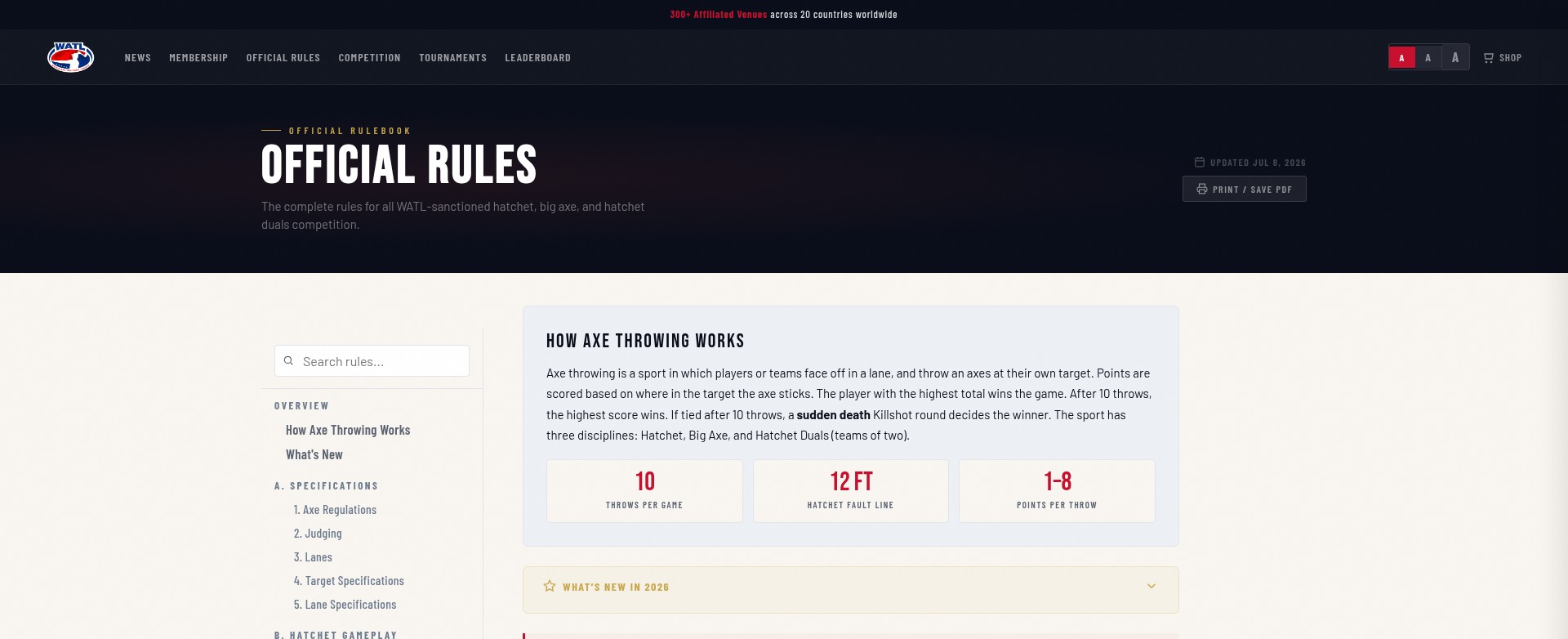
The World Axe Throwing League Official Rules, updated July 2026, set the lane dimensions, the 12-foot hatchet fault line, and the judging ratios that define a sanctioned venue's safety envelope.
Source 1
03The 12,000-a-year number that is not about venues
Search for axe injury statistics and you will hit a large federal number. It is real, and it is almost entirely about firewood, not throwing lanes. This is the figure most likely to be misread onto a venue's risk profile, so it is worth pinning down.
- The federal injury-surveillance system estimated 12,567 US emergency-department visits for hatchet and axe injuries in 2024, up from 12,110 in 2023 and 10,464 in 2022.8
- About 89 percent of the 2024 patients were male (11,223 of 12,567), and the category sits under Yard and Garden Equipment, alongside chain saws and lawn mowers.8
- A peer-reviewed analysis of a decade of this data found that roughly 65 percent of axe and hatchet injuries happened at home, and 95 percent involved men.9
Read that category label carefully. These are economy-wide hatchet and axe injuries, overwhelmingly wood-splitting, utility, and tool-handling cases. The surveillance system has no separate code for a commercial axe-throwing venue, so none of this 12,000-a-year figure is a measure of supervised target throwing. It is the number to know so you can explain why it does not apply to you.
04What an axe injury actually looks like
The medical literature that does exist describes utility axe use, not venue throwing. Treat it as the closest available proxy, because it tells you the injury pattern to plan for: a cut hand, not a catastrophe.
- In a decade of national data, there were 1,866 axe and hatchet ED visits, against 16,384 for power saws.9
- Lacerations were the most common diagnosis at 62.5 percent, and about half of all injuries involved the fingers and hand.9
- Axe injuries carried an amputation rate of about 2.6 percent, far below the 7.4 percent seen with power saws, because a hand tool rarely delivers the continuous cutting of a powered blade.9
- Axe users were much more likely than saw users to present with a strain or sprain (9.4 percent versus 1.6 percent), the signature of a swinging, momentum-driven motion.9
- The largest dedicated case series on axe hand injuries, 125 cases, concluded that axe injuries are rare and usually affect the thumb and index finger of the nondominant hand.11
Lacerations are the most common axe-injury diagnosis, and about half strike the fingers and hand.
Amputations are rare at 2.6 percent, a fraction of the power-saw rate. At a supervised venue the realistic worst case is a cut hand, not a lost limb.
Reference · Peer-reviewed
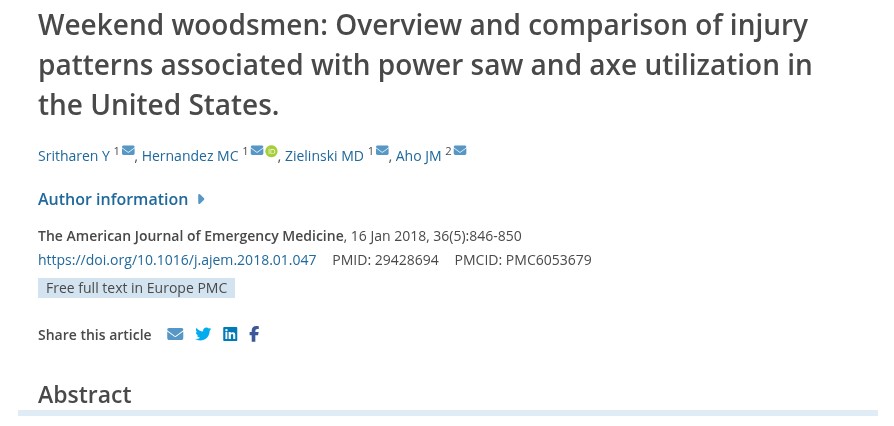
The one peer-reviewed dataset on axe injury patterns, published in The American Journal of Emergency Medicine in 2018, analyzed a decade of national surveillance data. It describes tool use, not venue throwing.
Source 9
05How axe throwing compares with other leisure activities
With no venue-specific rate to quote, the fair way to place axe throwing is against the leisure activities people already treat as safe. Measured per participant per year, the projectile sports sit near the bottom.
- Target archery, the closest projectile-sport analog to axe throwing, recorded about 60 injuries per 100,000 participants in 2018, or one for every 1,673 participants.13
- Bowling ran 50 per 100,000, billiards 17, and even gentle old golf 219.13
- Across sports generally, a systematic review put injury risk anywhere from 0.04 to 127.3 per 1,000 hours of exposure, with sedentary target sports near the low end and contact sports at the top.12
The governing bodies' "rare, minor splinters" self-report is consistent with axe throwing living at the archery end of that range, not the contact-sport end. For the same exercise across the projectile sports we underwrite, see our injury-rate comparison of paintball, airsoft, and GellyBall.
Send us your operation type and we will show you where the exposure actually sits.
06The real cost driver: the bar, not the blade
The axe is a supervised, low-energy risk, and the injury record backs that up. The alcohol is a different story, and it is where an axe-throwing premium is really made or broken.
- Alcohol can account for as much as 20 percent of an axe-throwing venue's profits, by operators' own estimates, which is why so many venues pair a throwing lane with a tap list.7
- Once a venue serves alcohol it enters the liquor-liability market, and in South Carolina that market is, in the industry's own words, in crisis.14
- South Carolina liquor-liability insurers lost about $1.77 for every $1.00 of premium earned from 2017 to 2022, and the combined ratio hit 290 percent in 2022 (about $2.90 paid per premium dollar) against 62 percent next door in North Carolina.15
- The newest state report, covering 2015 to 2024, is worse: insurers spent about $2.11 per $1.00 of premium, claim frequency ran 6.3 per $1 million of premium against 3.3 in neighboring states, and earned premiums tripled to $26.4 million as average rates doubled.16
- The base policy does not absorb this on its own. The standard general-liability form excludes liquor liability once a business is in the business of serving alcohol.17
One caveat matters: those South Carolina figures cover every alcohol-serving business in the state, not axe-throwing venues specifically. But a venue with a tap list is priced inside that same troubled market. There is a second, quieter exclusion too. A standard endorsement, ISO form CG 21 01, removes coverage for injury to anyone taking part in a sponsored sport or athletic activity, which is exactly what a paying thrower is.18 That is why participant injury coverage sits separate from general liability, a gap we cover in detail in participant injury versus general liability.
Reference · Insurance loss data
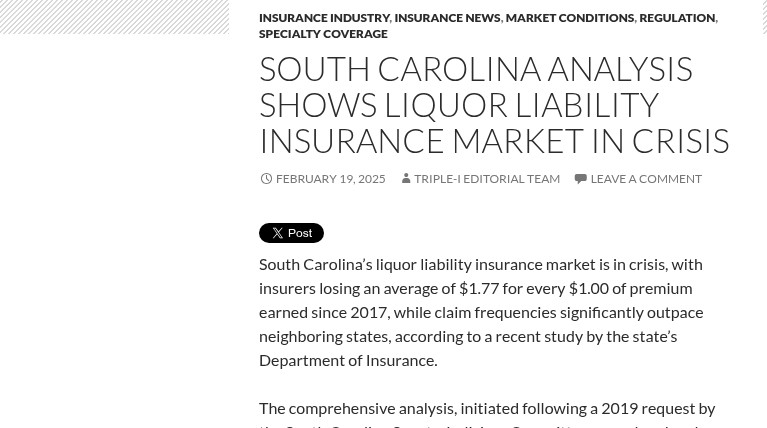
The Insurance Information Institute, drawing on a South Carolina Department of Insurance study, describes the state's liquor-liability market as in crisis, with insurers losing $1.77 for every $1.00 of premium.
Source 14
Operators expect us to obsess over the axe. We do not. The blade is a supervised, low-energy risk, and the injury record backs that up. What moves an axe-throwing premium is the tap list. The minute you serve alcohol, you are underwritten like a bar rather than a target range, and in a state like South Carolina that is the most expensive line on the page.
Bobby Sharp, Action Sports Practice Lead, Specialty Insurance
07What a new operator should expect on premium
There is no published axe-throwing rate table, and no mature loss history, so a carrier prices the drivers, not the sport name. Here is what that means in practice.
- The market backdrop is currently soft. In the first quarter of 2026, commercial premiums fell 1.2 percent on average, but small accounts, where most axe venues sit, still rose 1.1 percent, general liability rose 2.6 percent, and umbrella rose 4.8 percent.20
- Regulators note that venues frequently require their tenants to carry minimum liability limits and to name the venue as an additional insured, so a thin policy can cost you a booking, not just a claim.19
The coverage stack a venue actually needs runs well beyond general liability. This is the map most operators get wrong.
| Coverage | What it does at an axe-throwing venue |
|---|---|
| General Liability | Pays when a spectator slips, a vendor is hurt, or a third party is injured. It is the base, and it excludes the paying thrower. |
| Participant Injury | Covers the thrower who cuts a hand or turns an ankle. Excluded from base general liability by CG 21 01. |
| Liquor Liability | Covers claims tied to serving alcohol. Excluded from the standard general-liability form, and the single biggest cost driver. |
| Property | Covers the lanes, targets, building, and equipment. |
| Umbrella / Excess | Raises limits above the primary policies for the catastrophic-claim scenario a young vertical has not yet seen. |
Because the vertical is young, the levers that move your number are the ones you control: alcohol service and how you manage it, documented waivers, governing-body safety compliance, coaching and throw-line supervision, and a clean loss history. Axe-throwing venues are a family entertainment center risk at heart, and the sub-limit traps that catch those operators are the same ones worth reading about in how an entertainment policy pays $100K on a $425K claim.
08What the data says about your axe-throwing insurance risk
Put the evidence together and the ranking is clear. The order of risk is the reverse of what most people assume when they picture a room full of flying axes.
For an operator, that ranking is good news and a warning at once. The activity you worry about is the one the data clears, and the amenity you added for revenue is the one that sets your premium. Handle a claim well when it does come, starting with the first 24 hours after an injury, and the record you build is what keeps that premium honest.
50 states. Send your current dec page and we will show you the gaps for free.
Specialty Insurance writes axe throwing and family entertainment coverage in all 50 states with specialty underwriters who know participant-injury and liquor-liability exposure. Call (888) 673-7228.
09Frequently asked questions
How dangerous is commercial axe throwing?
By the available evidence, not very. The governing bodies report injuries are rare and usually minor, and measured against other leisure activities the sport rates closer to target archery than to a contact sport. Most axe injuries in the wider data are hand lacerations from utility use, not supervised venue throwing.
How many people get injured axe throwing?
There is no published injury dataset specific to commercial axe-throwing venues as of 2026. The roughly 12,000 US ER visits a year for hatchet and axe injuries are almost all home and utility cases filed under Yard and Garden Equipment, not venue throwing.
What is the biggest insurance risk at an axe-throwing venue?
The alcohol, not the axe. Venues that serve drinks enter the liquor-liability market, which in South Carolina ran a 290 percent combined ratio in 2022. The standard general-liability policy excludes liquor liability once a business serves alcohol, so it has to be covered separately.
Does general liability cover an injured axe thrower?
Often not by itself. ISO form CG 21 01 excludes injury to sports and athletic participants, and a paying thrower is a participant. That gap is filled by participant injury coverage, which sits separate from general liability.
Why is axe-throwing insurance hard to price?
The vertical is only about a decade old commercially, so there is no mature loss history for carriers to rate against. Underwriters price the controllable drivers instead: alcohol service, waivers, governing-body safety compliance, supervision, and loss history.
Do axe-throwing venues need liquor liability insurance?
If they serve or allow alcohol, yes. The standard general-liability form excludes liquor liability for businesses in the business of serving alcohol, so a separate liquor-liability policy is needed to close the gap.
Sources and methodology
- World Axe Throwing League, Official Rules, 2026: injuries rare and most commonly minor splinters; 12 ft lane width, 15 ft length, 12 ft ceiling, 12 ft hatchet fault line; one judge per 16 competitors.
- World Axe Throwing League, About: 300 or more affiliated venues across 20 countries, 85,000 or more competitors equipped, founded 2017.
- International Axe Throwing Federation: over 20,000 league members across more than 150 cities and 9 countries, established 2016.
- International Axe Throwing Federation, Rules 3.3, Lane Dimensions and Throwing Line Measurements: red foot-fault line 110 in (279.5 cm) from the target, yellow perimeter line separating throwers from spectators.
- Backyard Axe Throwing League (BATL), About: commercial urban axe throwing founded 2006, first urban venue, nearly 5 million people thrown across 18 locations.
- IBISWorld, Axe Throwing Centers in the US, January 2024: about 166 businesses, roughly $329.2 million in revenue, 2.6 percent CAGR 2019 to 2024.
- Cascade PBS, February 2021: operators estimate alcohol sales at as much as 20 percent of venue profits (operator estimate reported in news coverage).
- CPSC National Electronic Injury Surveillance System (NEISS) Data Highlights: 2024 (12,567 hatchet and axe ED visits, 11,223 male), 2023 (12,110), 2022 (10,464); category "Hatchets, Axes" under Yard and Garden Equipment.
- Sritharen Y, Hernandez MC, Zielinski MD, Aho JM. Weekend woodsmen: injury patterns associated with power saw and axe utilization in the United States. Am J Emerg Med, 2018 (NEISS-AIP 2006 to 2016): 1,866 axe and hatchet ED visits, 65 percent at home, 95 percent male, lacerations 62.5 percent, about half fingers and hand, amputation 2.6 percent versus 7.4 percent for power saws, strain or sprain 9.4 percent versus 1.6 percent.
- PubMed and Europe PMC literature search, July 2026: no peer-reviewed study, case series, or injury dataset specific to recreational or commercial axe-throwing venues.
- Muir L, Foucher G, Marian-Braun F. Ax injuries of the hand. J Trauma, 1997: 125-case series, axe injuries rare, usually affecting the thumb and index finger of the nondominant hand.
- Spinks AB, McClure RJ. Quantifying the risk of sports injury: a systematic review. Br J Sports Med, 2007: injury risk ranged from 0.04 to 127.3 per 1,000 hours of exposure.
- NSSF Industry Intelligence Report (sources: CDC, CPSC NEISS, NSGA 2018): injuries per 100,000 participants in 2018, billiards 17, bowling 50, target archery 60, golf 219.
- Insurance Information Institute (Triple-I), February 2025: South Carolina liquor-liability market described as in crisis; claim frequency 9 per $1 million in 2022 versus 5 or fewer in neighboring states; average incurred claim $281,071 in 2022.
- South Carolina Department of Insurance, Status Report on the South Carolina Commercial Liability Insurance Market, January 2024: liquor liability lost about $1.77 per $1.00 of premium 2017 to 2022; combined ratio 290 percent in 2022 versus 62 percent in North Carolina.
- South Carolina Department of Insurance, 2025 Commercial Liability Insurance Report (data 2015 to 2024): liquor liability spent about $2.11 per $1.00 of premium; claim frequency 6.3 per $1 million versus 3.3 in surrounding states; earned premiums tripled to $26.4 million as average rates doubled.
- IRMI, Raising the Bar: The Liquor Liability Exclusion in the CGL: the standard ISO commercial general liability policy excludes liquor liability for a business in the business of serving alcohol.
- ISO form CG 21 01, Exclusion, Athletic or Sports Participants: removes coverage for bodily injury to any person while practicing for or participating in a sponsored sports or athletic contest.
- National Association of Insurance Commissioners (NAIC), Event Insurance: venue and event coverage typically includes liability, personal injury, property damage, and liquor liability; venues often require minimum liability limits and additional-insured status.
- The Council of Insurance Agents and Brokers (CIAB), Q1 2026 P&C Market Survey: commercial premiums fell 1.2 percent on average, small accounts rose 1.1 percent, general liability rose 2.6 percent, umbrella rose 4.8 percent.