

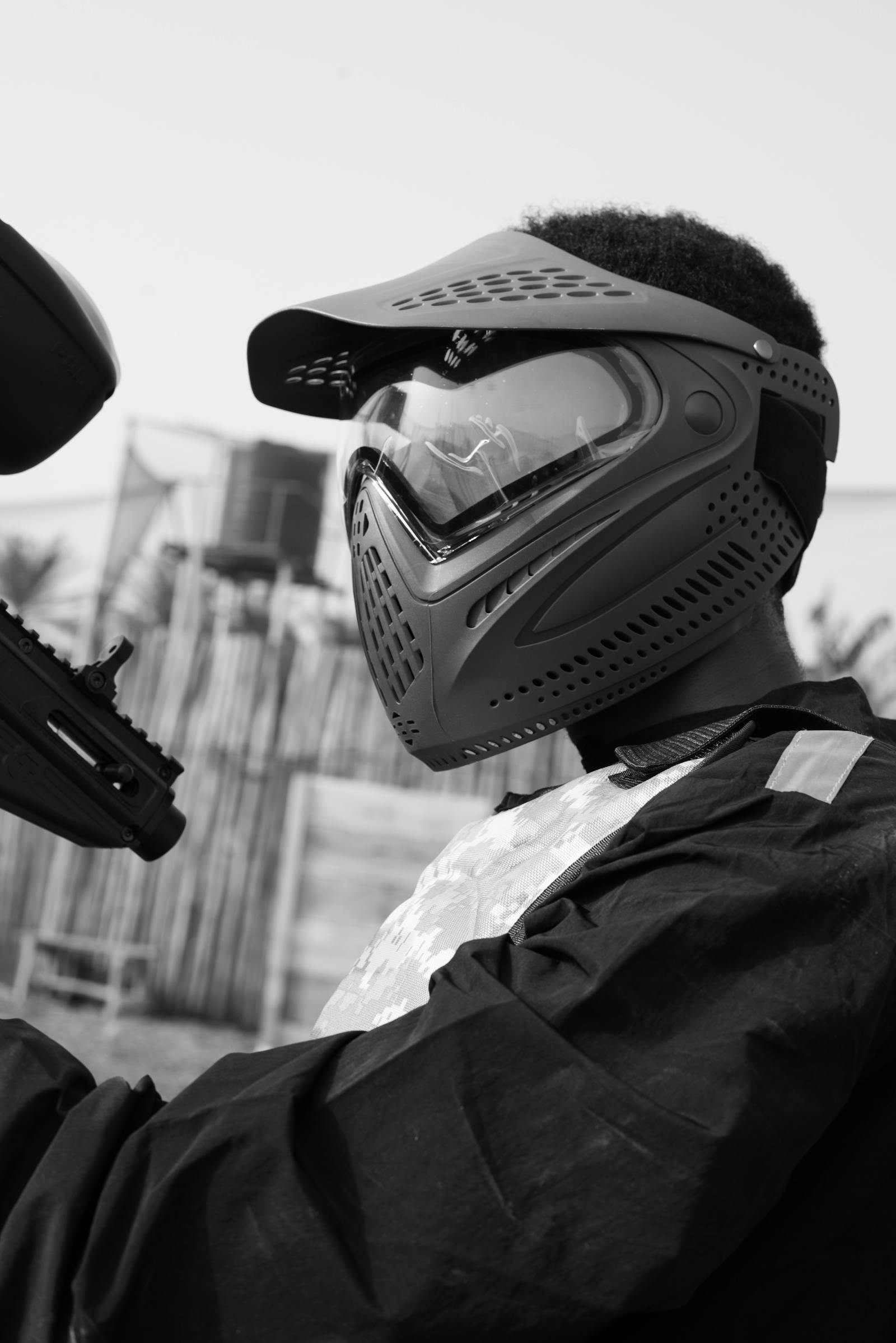
Seven practices move the premium. Most operators only do four.
When our underwriters score a paintball field at renewal, the score sheet is the same every time: seven safety practices, each worth a slice of the premium. The fields that hit all seven price out in the bottom quartile of our book. The fields that hit four or fewer get rate-up notices, sub-limit reductions, or non-renewal letters.
This guide walks through the seven, in the order our team rank-orders them by impact. None of them is exotic. Most of them are documentation, not capital. Every one of them is on the underwriting questionnaire we send to a paintball field at quote.
Practice 1: ASTM F1776-22 mask compliance, replacement cycle, mask-on enforcement
The current version of the standard is ASTM F1776-22. It governs eye-protective devices for paintball, specifying impact resistance, optical clarity, retention, and field-of-view requirements (ASTM F1776-22 catalog listing, ASTM International via iTeh standards). The standard is unambiguous: a paintball mask that does not meet F1776 is not paintball-rated eye protection. Shop safety glasses (ANSI Z87.1) and military goggles are not interchangeable.
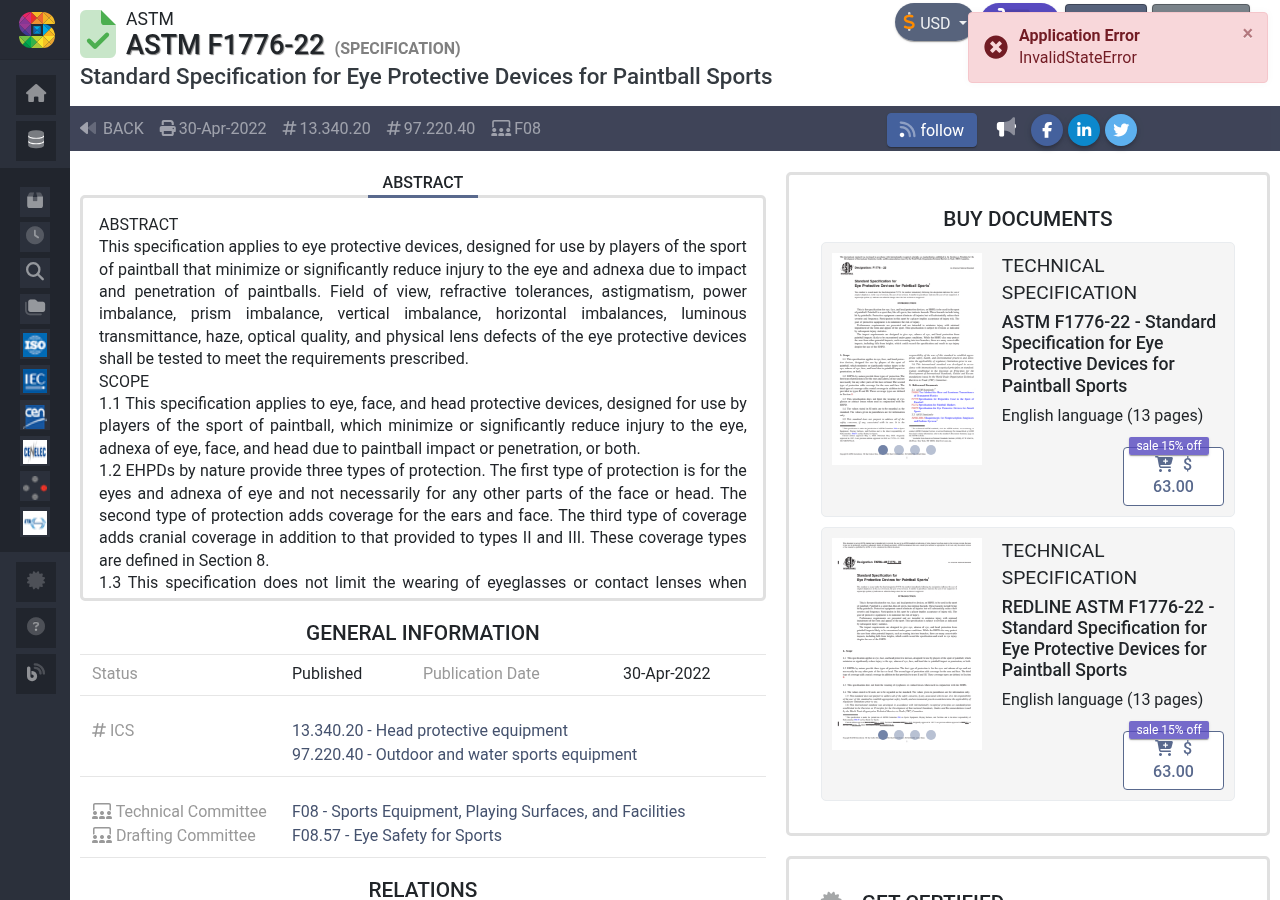
Source 1 of 1 · Current consensus standard
ASTM F1776-22, the current version of the paintball eye-protection standard. The "-22" denotes the 2022 revision. Carriers underwrite to the current version, so an older F1776-10 fleet is a flag at renewal.
Source: standards.iteh.ai/catalog/standards/astm/.../astm-f1776-22
What our underwriters look for: rental fleet replaced on a documented annual or biennial cycle, every mask tagged with its replacement date, photo evidence of the rental-fleet inspection at start of each season, and a written mask-on policy posted at every safe-zone exit and enforced by referees.
Practice 2: Chronograph every marker every play day, log it, cap at 280-285 fps
The industry-standard maximum is 300 feet per second for outdoor commercial paintball play, with a recommended operating ceiling of 285 fps to leave headroom for variance. Every paintball-class carrier underwrites to this velocity cap and expects field-rule documentation that matches it.
What our underwriters look for: a chronograph log dated to every play day, every marker tested at start of day and after any reported velocity change, each entry signed by the on-duty referee. The single biggest renewal lever after loss history is a clean chronograph log.
When we audit a paintball field, we score the same seven practices every time. The fields that hit all seven pay premiums in the bottom quartile of our book. The fields that hit four or fewer get rate-up notices at renewal.
Bobby Sharp, Paintball Practice Lead, Specialty Insurance
Practice 3: 20-ft netting within 300 ft of safe zones
The industry-standard netting spec is at least 20 feet of perimeter netting wherever spectators, parking, or non-player traffic come within 300 feet of an active field. The standard for paintball field netting itself is documented in ASTM F2278.
What our underwriters look for: photographic documentation of the perimeter netting at start of season, height measured against a known reference point, replacement-cycle log for damaged netting sections, evidence that netting was repaired within 24 hours of any documented damage.
Practice 4: Referee ratio + mandatory pregame safety briefing
The accepted industry ratio for organized commercial play is 2 referees per 15 players on active fields, with a mandatory pregame safety briefing delivered by a named referee before every game.
What our underwriters look for: staffing schedule showing the ratio across the play day, a written pregame safety-briefing script (so the briefing is consistent regardless of the referee), and a signed log confirming every group received the briefing.
Practice 5: Minimum age policy + minor's release + parent supervision
The Listman 2004 paper documented that more than 40% of paintball eye injuries were pediatric, and 43% of patients with follow-up vision testing had vision of 20/200 or worse (Listman, Pediatrics, January 2004). The underwriting implication is direct: a paintball field that runs minor play needs a separate-from-adult risk-control package.
What our underwriters look for: a written minimum-age policy (commonly 10 to 14 for low-impact, 18 for full play), a minor's release signed by parent or guardian and reviewed to state law, documented parent-supervision requirement during play, and full ASTM F3100 compliance if the field offers low-impact youth play. F3100 specifies the low-impact paintball-equivalent equipment, masks, and operational requirements.
Practice 6: Signage discipline at every gate, every safe zone, every parking lot
The fields with the cleanest claim histories all share a signage habit. Underwriters look for at least five signs:
- Mask-on perimeter sign at every safe-zone exit and gate.
- Velocity-limit sign at every chronograph station (280-285 fps, the field's specific cap).
- No-spectators-beyond-this-point sign at the netting perimeter.
- Pregame-safety-briefing-required sign at the check-in counter.
- Hours-of-operation and emergency contact sign at every entrance.
Photographic documentation of each sign, dated to the season, lowers the field's perceived risk profile at renewal.
Practice 7: ASTM F3100 low-impact field operation procedures
ASTM F3100 governs low-impact paintball-equivalent operations, including the equipment specifications (.50-cal markers, lower-velocity ammunition), mask requirements (often F1776 plus F3100-specific specifications), and operational procedures for youth and beginner play.
A paintball field that runs low-impact youth leagues and can show F3100 compliance on the equipment, masks, and procedures is underwriting as a separate risk class from a full-impact-only field, with substantially different rates.
"Brandon Johnson worked with my insurance agent (David and Justin) and gave the correct and specific coverages you need for the airsoft and paintball industries. There is no other source out there that does what they do, and Bobby Sharp wrote the policy I should have had from day one."
Gel Tag San Diego LLC
Verified customer review
What gets a renewal declined: the underwriter's DON'T list
| Don't | Why it kills the renewal |
|---|---|
| Allow players to bring non-F1776 masks from home | One injury claim with a non-rated mask voids most carriers' defense |
| Chronograph "by feel" without a written log | No defense at claim time |
| Drop netting on the parking-lot side of the field | Single highest-frequency spectator-strike vector |
| Run youth leagues without F3100 compliance | Risk classified higher; rate increases or non-renewal |
| Refer 1:15 instead of 2:15 | Standard slips, briefings get skipped, claims rise |
| Use a generic SMB GL waiver template | Voided at summary judgment in multiple states |
| Skip the pregame safety briefing for repeat players | Most defensible single document we ask for at claim time |
What changes at renewal when you document all seven
The premium curve we see at our renewal desk, holding revenue constant:
- 7 of 7 practices documented: premium typically in the bottom 20% of the book, full-appetite renewal.
- 5 to 6 of 7 documented: middle of the book, standard renewal with loss-control questions.
- 3 to 4 of 7 documented: top quartile of the book, rate-up + deductible-increase common.
- Fewer than 3 documented: non-renewal candidate.
The math is direct. A new field that puts the documentation infrastructure in place in year one pays year-two premiums that are 20% to 40% lower than a comparable field that doesn't. More on the patterns behind those claims in our writeup on common paintball field claims and where most paintball GL policies have gaps.
What the right paintball policy carrier asks at quote
A paintball-specific carrier's quote questionnaire asks specifically about the seven. A generalist's questionnaire asks "Do you have a waiver? Yes/No." The questions our team asks at quote:
- What is your mask replacement schedule, and is your rental fleet F1776-22 compliant?
- Is your chronograph logged, and what is your published velocity cap?
- Do you have perimeter netting per the 20-ft spec, photographed within the last 30 days?
- What is your referee-to-player ratio, and is the pregame briefing scripted?
- If you run youth play, are you F3100 compliant?
- Can you provide photographs of your signage discipline?
- Have you had any reported incidents in the last 24 months, claim filed or not?
If your current broker has never asked these, your policy was not underwritten as paintball.
Frequently Asked Questions
Is ASTM F1776 mask compliance required by law?
F1776 itself is a voluntary consensus standard, not a federal regulation. But most paintball-specific insurance policies require F1776 compliance as a condition of coverage, and most paintball fields' waivers cite F1776 as the operating standard.
What is the maximum fps for a paintball field?
Published industry guidance is 300 fps maximum with 285 fps recommended as the operating ceiling. Many indoor fields and youth leagues cap lower.
Do I need to offer low-impact F3100 paintball for youth play?
You don't have to offer it, but if you do offer youth play (commonly under 14 years old), F3100 is the operational standard most carriers will require for that segment.
Does my insurance require netting around every field?
Most paintball-specific policies require perimeter netting wherever spectators, parking, or non-player traffic come within 300 feet of an active field. The published spec is 20 feet of netting in those locations.
What documentation does my underwriter request at renewal?
A paintball-specific underwriter typically requests waiver template, chronograph logs (sample), rental-fleet inspection record, referee staffing schedule, pregame safety-briefing script, signage photographs, and any incident reports from the prior 12 months.
Sources
- ASTM International. F1776-22 Standard Specification for Eye Protective Devices for Paintball Sports. standards.iteh.ai
- Listman, David A. "Paintball Injuries in Children: More Than Meets the Eye." Pediatrics, January 2004. publications.aap.org
- ASTM International. F2278, F1979, F3100 standards (paintball netting, paintball performance, low-impact paintball operation).
- Specialty Insurance. Why Your Paintball Field's GL Policy Probably Has Gaps
- Specialty Insurance. Common Paintball Field Claims