


Is Axe Throwing Insurance More Expensive Than Gun Range?
Is axe throwing insurance more expensive than gun range insurance? Usually not, and it is not close. A dry axe throwing venue typically insures for a fraction of what a commercial gun range pays, because the two premiums are built from different raw materials: an axe house is priced on lanes, throwers, and whether there is a bar, while a range is priced on lead, ventilation, rentals, and a retail counter full of firearms.
There is one setup that changes the answer, and it is not the axes. Add alcohol to an axe throwing venue and the premium starts climbing toward range territory. Here is the side-by-side comparison, the real numbers behind it, and the point where the two lines cross.
The short answer, side by side
| Axe throwing venue | Gun range | |
|---|---|---|
| Typical annual premium | $2,500 to $7,500 for General Liability plus accident and health with participant coverage (dry venue) | $5,000 to $25,000 depending on lane count, retail, and rentals |
| What sets the base rate | Lane and target count, annual thrower volume, revenue | Lane count, plus everything attached to the lanes: ventilation, rentals, retail, instruction |
| The exclusion that bites | The participant exclusion on a bare General Liability form | The same participant exclusion, plus lead and pollution carve-outs |
| The biggest premium swing | Alcohol: a separate liquor liability policy on top | Rental and retail exposure: guns you hand to strangers and inventory you sell |
| Who will write it | Specialty and excess and surplus market | Specialty and excess and surplus market, with even fewer carriers at the table |
| The discount lever | League affiliation and standardized lanes (WATL, IATF) | Documented range management programs (NSSF Star Rating, certified range officers) |
Both verticals live outside the standard market, both get hurt by the same participant exclusion, and both earn credits for documented safety programs. The difference is how much operation the carrier has to underwrite around the activity itself.
Where the averages land
Across the Specialty Insurance book, an axe throwing venue running General Liability plus accident and health with participant coverage generally lands between $2,500 and $7,500 a year, with alcohol priced separately on top. A commercial gun range generally lands between $5,000 and $25,000 a year, moved by lane count, retail volume, and whether the counter rents firearms.
Put the midpoints next to each other and the answer to the headline question is plain. The average axe throwing premium in our book sits around $5,000 a year. The average gun range premium sits around $15,000 a year, roughly three times higher. The public record backs the shape of that gap: in a 2024 Delaware coverage case, the court file shows a single Dover shooting range with a retail firearms store paid $13,502.27 for one year of commercial General Liability alone (Noble Eagle Sales, LLC v. Mesa Underwriters Specialty Ins. Co.).
Those bands assume a real program. A bare General Liability quote for either business will come in far cheaper, and it will be cheap for the same reason in both buildings, which is where the comparison gets interesting.
Same skeleton, two different risk engines
Strip the signage off both operations and an underwriter builds the same program skeleton: General Liability as the base, participant coverage for the people doing the activity, Property on the build-out and equipment, and Workers' Compensation once there is staff. The skeleton is shared. The engine bolted to it is not.
The shared trap sits in the base layer. The standard General Liability form carries an exclusion for injury to anyone "practicing for or participating in any sports or athletic contest or exhibition." On an axe floor, that is the paying thrower. On a firing line, that is the paying shooter. A discount policy in either building covers the spectator by the snack counter and excludes the customer the business exists to serve. We walk through the mechanics in our breakdown of participant injury versus general liability.
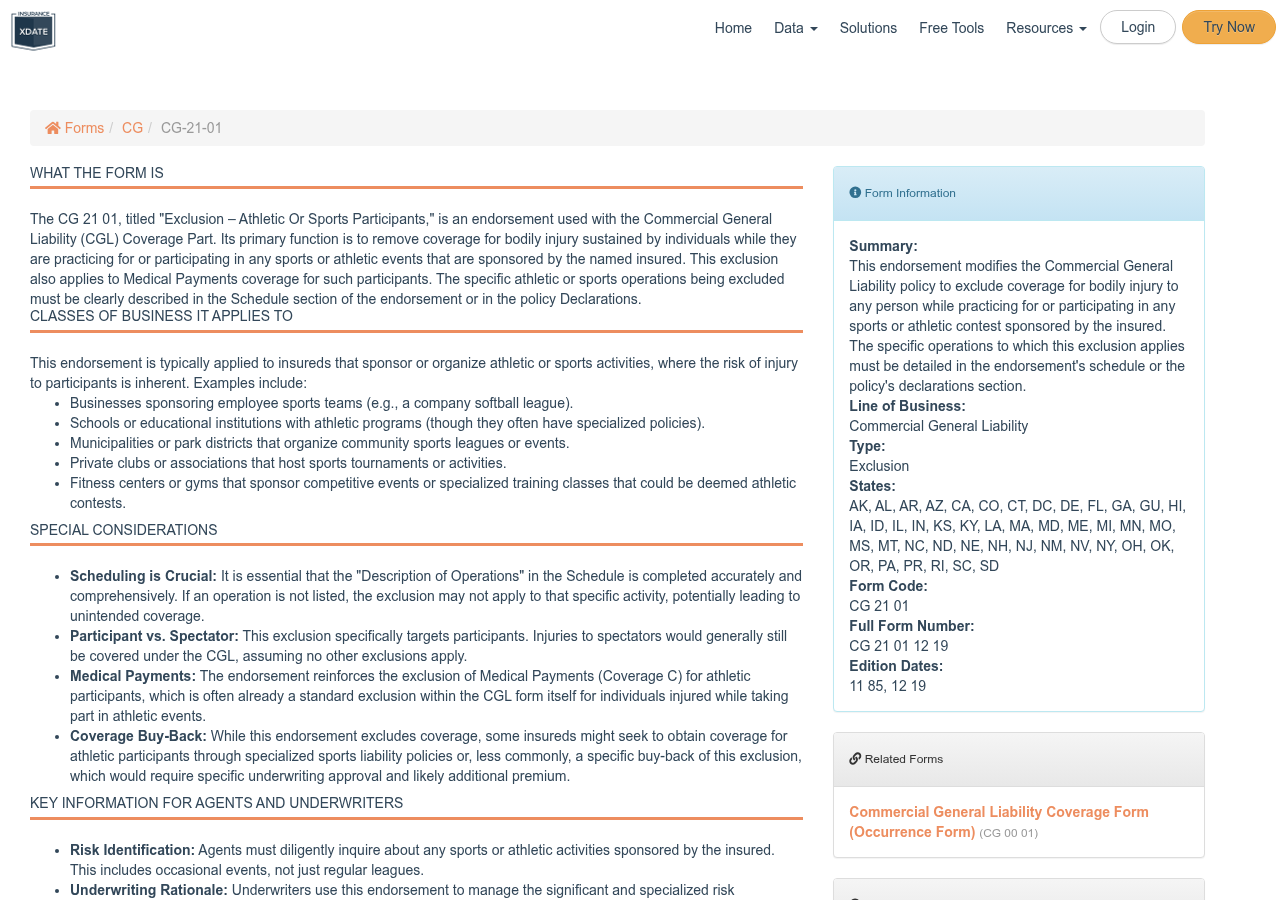
Source 1 of 3 · Standard ISO exclusion form
The standard ISO CG 21 01 endorsement removes coverage for athletic and sports participants. It bites both businesses in this comparison the same way: the thrower on the axe floor and the shooter on the firing line are both participants.
From that shared skeleton, the two files diverge fast.
When an axe venue and a gun range land on my desk in the same week, the axe file is thinner, and thinner is cheaper. The range file carries a ventilation report, a lead management program, rental counter procedures, and a firearms inventory schedule before I even reach the lanes. The premium difference is not about which sport sounds scarier. It is about how much of the operation the carrier has to underwrite.
Bobby Sharp, Action Sports Practice Lead, Specialty Insurance
Why a gun range usually costs more to insure
Three exposures sit in a range file that an axe file simply does not have.
Lead and ventilation. An indoor range is a regulated industrial-hygiene environment, and the federal occupational safety agencies treat it that way. OSHA applies its lead standard (29 CFR 1910.1025) to range employers, requiring exposure testing and, above set thresholds, medical surveillance, and its guidance calls for a dedicated push and pull ventilation system separate from the building's normal HVAC, inspected on a schedule (OSHA Fact Sheet 3772). NIOSH estimates 16,000 to 18,000 indoor firing ranges operate in the United States, with thousands of range employees, more than a million law enforcement officers who train at them, and some 20 million active target shooters potentially exposed to lead and noise. Outdoor ranges carry their own version of the exposure: the EPA publishes a 103-page manual on managing environmental lead at outdoor shooting ranges. None of that exists in an axe house, and every line of it shows up in a range's premium, engineering costs, and property rates.
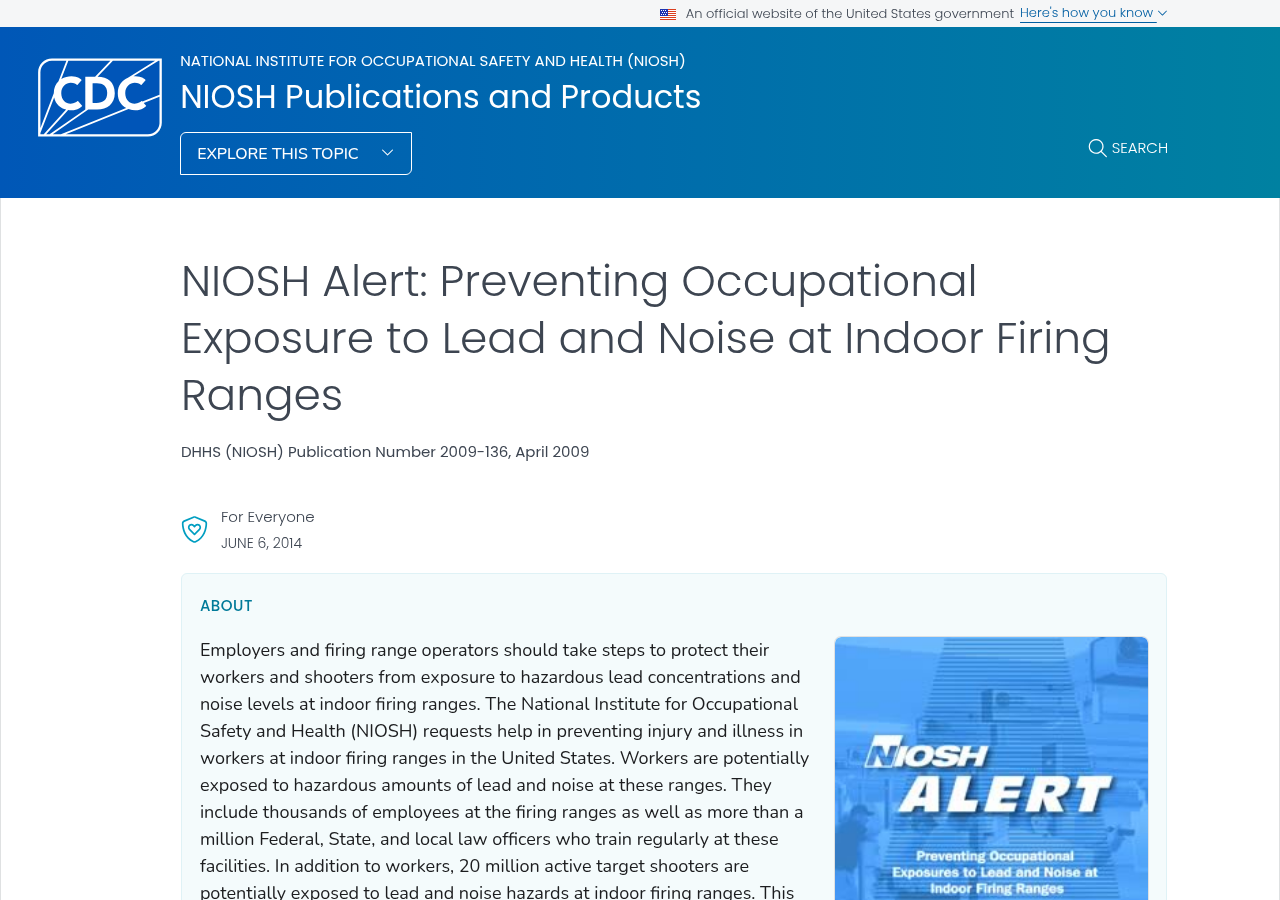
Source 2 of 3 · Federal occupational safety agency
NIOSH's alert on indoor firing ranges documents the lead and noise exposure that makes a range a regulated industrial-hygiene environment. This layer of the risk, and the ventilation engineering that answers it, has no equivalent in an axe throwing venue.
Rentals and retail. An axe venue hands a customer a hatchet that stays on the premises. A range with a rental counter hands a customer a firearm, and many ranges also run a retail store with an inventory of guns and ammunition. That is a products exposure, a theft exposure, and a negligent entrustment exposure stacked on top of the participant risk. The Delaware case above shows how heavy that stack can get: a patron used a rented range gun in a suicide, the estate sued the range for negligence and negligent entrustment, and the range then had to litigate whether its own policy's rental equipment exclusion applied. The court found the exclusion's wording ambiguous and ordered the insurer to defend the range, which is the rare good ending. The lesson for a range owner is that the rental counter is its own underwriting conversation.
A smaller table of carriers. Both of these verticals sit in the specialty and excess and surplus market, the part of the industry built for risks the standard admitted market will not write. Insurance regulators say so in writing: West Virginia's Insurance Commissioner lists firearms sales, distribution, and repair on its surplus lines export list, the state's register of coverages "generally unavailable in the authorized market" (WV export list, 2023), and New York's Regulation 41 export list places shooting ranges in the same category. Fewer carriers competing for a file means less downward pressure on price, and the range file has the shortest carrier list of all. Some specialty carriers underwrite axe throwing inside the same program as their shooting range book, which tells you how the industry sees the family resemblance, but the range version of the file always carries more pages.
When axe throwing closes the gap
The one decision that pushes an axe throwing premium toward gun range territory has nothing to do with sharp objects. It is the bar.
A dry axe venue is one of the friendlier files in the action sports book. Add alcohol service and the program grows a separate liquor liability policy, and for late-night venues an assault and battery layer on top. That layer is priced against a hard market: the Insurance Information Institute reported that South Carolina's liquor liability insurers lost $1.77 for every $1.00 of premium earned from 2017 to 2022, with the state's combined ratio reaching 290% in 2022. An axe bar with late hours and event crowds can carry a total premium well into five figures, which is range money.

Source 3 of 3 · Insurance research body
The Insurance Information Institute's report on South Carolina's liquor liability market crisis explains the mechanism that lets an axe bar's premium catch up to a gun range's: the alcohol layer is priced against a market losing money on every premium dollar.
Source: insuranceindustryblog.iii.org
South Carolina operators feel this one directly: it is Specialty Insurance's home state, and every alcohol layer placed there is priced against those numbers.
A dry axe house is a clean, thin file, and it prices like one. The day the bar goes in, that file starts reading like a range file: a second policy, a second set of controls, staff training the carrier wants documented, and a premium that has to earn both exposures. Owners ask me what moves an axe throwing quote the most, and the honest answer is the tap list, not the axes.
Bobby Sharp, Action Sports Practice Lead, Specialty Insurance
Both verticals also share a discount lever: documented standards a carrier can inspect. On the axe side, affiliation with the World Axe Throwing League or the International Axe Throwing Federation signals standardized lane geometry, containment barriers, and trained coaches. On the range side, the National Shooting Sports Foundation's Star Rating program plays the same role, crediting ranges that demonstrate documented excellence in management and operations. In both files, the operator who can produce the paperwork prices below the operator who only promises it.
The mistakes operators make when comparing the two
The comparison in this article only holds if the two quotes describe the same thing. Most bad comparisons fail on one of five points:
- Comparing a bare General Liability quote to a full program. The cheap number excludes the participant, in either building. Our piece on why a generalist General Liability policy has gaps shows the same failure across the action sports verticals.
- Assuming the scarier-sounding sport costs more. Underwriters do not price fear. They price ventilation reports, rental counters, tap lists, and loss runs.
- Leaving alcohol out of the axe quote. A dry-venue quote for a venue that plans a bar is not a quote. It is the first half of one.
- Leaving the rental counter out of the range quote. Rental firearms and retail inventory are their own exposures, and the Delaware case shows what happens when nobody reads that part of the form.
- Shopping both files through a generalist. Most standard agents can place neither class. Every week they spend discovering that is a week you operate on the wrong coverage.
Get both numbers from a desk that writes both
The honest answer to the headline question is a range, not a slogan: axe throwing insurance is usually the cheaper program by a factor of about three. A dry axe venue sits at the bottom of the comparison, a commercial range with rentals and retail sits at the top, and an axe bar with a busy tap list lands between them. Specialty Insurance writes axe throwing insurance and gun range insurance as dedicated classes, with participant coverage built into the program rather than left out of it.
"Bobby Sharp and the team at Specialty Insurance had a fast turnaround, professional service, and answered every question I had as a brand-new operator. They wrote the policy I'd want defending me if a player ever filed a claim."
Grimnir Tactical LLC
Verified customer review
That turnaround matters in this comparison for a practical reason: two quotes you can hold side by side in the same week are two quotes you can compare honestly.
Frequently Asked Questions
What is umbrella insurance for an axe throwing business?
Commercial umbrella coverage, also called excess liability, sits above your primary policies and starts paying when a covered loss exhausts the per-occurrence limit of an underlying policy such as General Liability (Insurance Information Institute). For an axe throwing venue it is the practical way to satisfy a landlord or event contract that demands higher limits than your primary policy carries, without rebuying the primary program.
Do I need a BOP if I already have general liability for my gun range?
Usually a Business Owners Policy is not the path for a range. A BOP packages property, liability, and business interruption coverage for small and medium businesses, but insurers exclude some business types because of the risks inherent in the operation (Insurance Information Institute), and firearms businesses generally sit in the specialty and surplus lines market instead. A range typically builds its program coverage by coverage with a specialty broker rather than through a standard package policy.
Do I need product liability insurance for my axe throwing venue?
If you sell or serve anything, it is worth confirming. Products and completed operations coverage responds to injury caused by products a business makes, sells, or serves, and it specifically extends to food and drink consumed on premises you own or rent (Insurance Information Institute). For an axe venue with a kitchen, a bar, or retail merchandise, the products piece of your General Liability program is doing real work, so confirm a cheap quote has not stripped it.
Do gun ranges need armored vehicle insurance?
No regulation requires one. ATF's rules for federal firearms licensees govern where business may be conducted and the acquisition and disposition records a dealer must keep, not the vehicles used to move inventory. Moving firearms or cash between a store and a range is an insurance decision rather than a legal mandate: commercial auto for the vehicle, inland marine for property in transit, and crime coverage for cash are the layers that answer it.
Does hosting a 3-gun competition change a gun range's insurance?
It can. A competition brings outside participants, spectators, and often vendors onto the property, and your policy needs to contemplate competitive events rather than routine lane rental. Sanctioning bodies do not do this for you: USPSA's published club affiliation requirements are organizational, and the NRA advises affiliated clubs and ranges to carry liability insurance and to use signed waivers whose enforceability varies by state. Tell your broker before the match date so event and spectator liability is confirmed in writing.
Sources
- ISO Commercial General Liability form CG 21 01, Exclusion of Athletic or Sports Participants (insurancexdate.com): the standard endorsement that removes participant coverage from a bare General Liability policy, in an axe house and on a firing line alike.
- NIOSH Alert, "Preventing Occupational Exposure to Lead and Noise at Indoor Firing Ranges," DHHS (NIOSH) Publication No. 2009-136, April 2009 (cdc.gov): the lead and noise exposure documentation behind indoor range underwriting.
- OSHA Fact Sheet 3772, "Protecting Workers from Lead Hazards at Indoor Firing Ranges" (osha.gov): the lead standard (29 CFR 1910.1025) applied to range employers, the 16,000 to 18,000 indoor range estimate, and the dedicated push and pull ventilation specification.
- U.S. EPA, "Best Management Practices for Lead at Outdoor Shooting Ranges," EPA-902-B-01-001 (epa.gov): environmental lead management obligations at outdoor ranges.
- Noble Eagle Sales, LLC v. Mesa Underwriters Specialty Insurance Co., C.A. No. K22C-03-022 RLG, Del. Super. Ct., June 4, 2024 (law.justia.com): the rental-gun coverage dispute, the ambiguous "sporting equipment" rental exclusion, and the range's $13,502.27 annual General Liability premium in the public record.
- West Virginia Offices of the Insurance Commissioner, Surplus Lines Export List, effective October 20, 2023 (wvinsurance.gov): firearms sales, distribution, and repair declared generally unavailable in the authorized market.
- New York State Department of Financial Services, Insurance Regulation 41 Current Export List (dfs.ny.gov): shooting ranges listed among classes placeable in the excess line market.
- Insurance Information Institute (Triple-I Blog), "South Carolina Analysis Shows Liquor Liability Insurance Market in Crisis," February 2025 (insuranceindustryblog.iii.org): the $1.77 lost per $1.00 earned figure and the 290% combined ratio behind liquor liability pricing.
- Insurance Information Institute, "Insuring Your Business: Liability Insurance" and "Understanding Business Owners Policies" (iii.org): umbrella and excess liability mechanics, BOP eligibility, and products-completed operations coverage including on-premises consumption.
- World Axe Throwing League, "Venue Target Specifications" (worldaxethrowingleague.com) and National Shooting Sports Foundation, "Range Star Rating" (nssf.org): the two verticals' inspectable-standards programs that earn underwriting credit.
- ATF, "Federal Firearms Licensee Quick Reference and Best Practices Guide" (atf.gov): licensing scope and recordkeeping requirements for moving firearms inventory.
- USPSA, "Club Affiliation Information" (uspsa.org) and NRA Explore, "Affiliated Clubs: The Importance of Incorporation" (explore.nra.org): what sanctioning bodies require of clubs and what they advise on liability insurance and waivers.
- Specialty Insurance, "Participant Injury vs General Liability" and "Why Your Paintball Field's GL Policy Probably Has Gaps" (internal): the participant exclusion mechanics and the generalist coverage-gap pattern.