

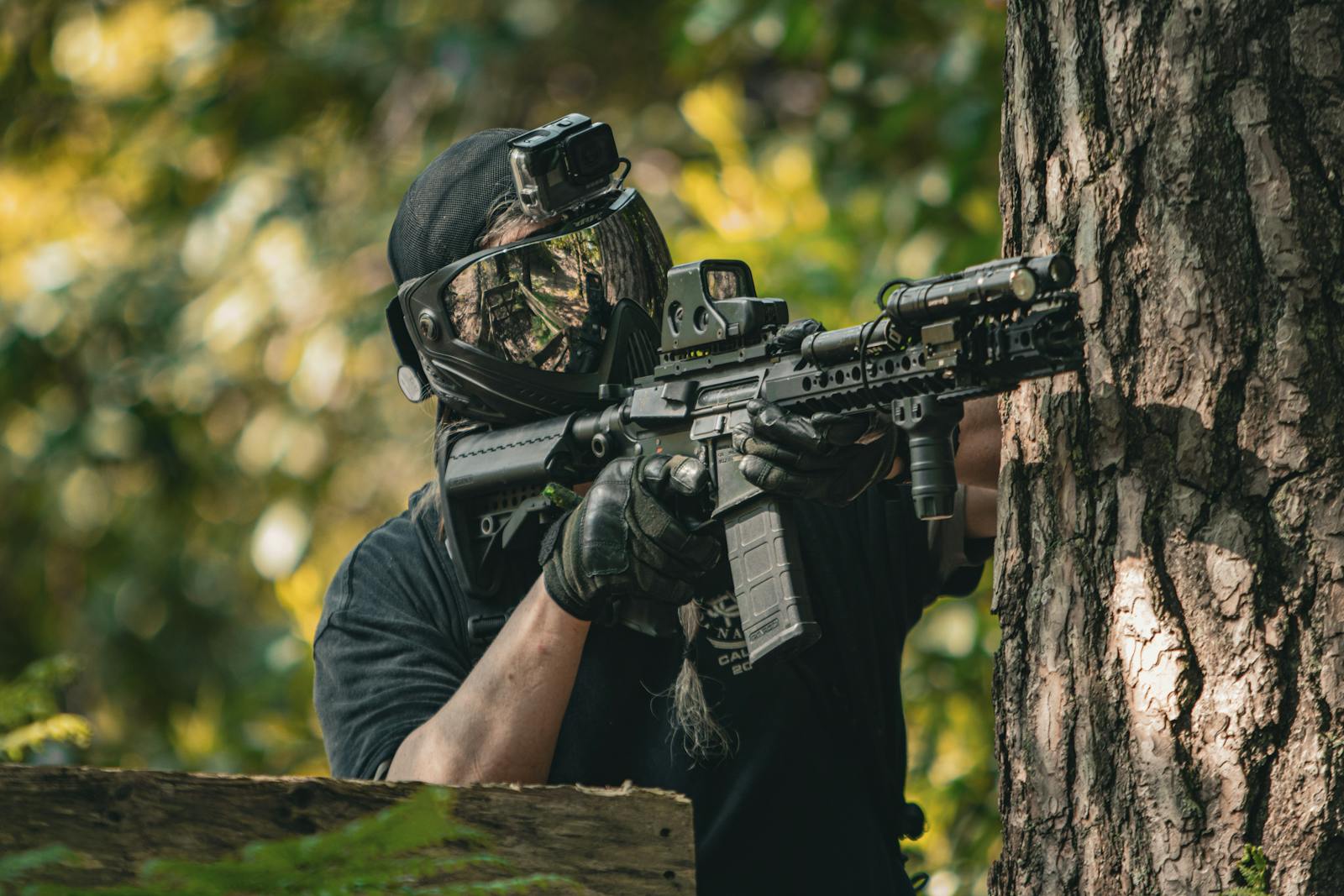
TL;DR: same category to a generalist, two risk classes to an underwriter
To a generalist agent, airsoft and paintball are one line on a quote: projectile combat sports. To an underwriter who prices the class, they are two different risk profiles, written by a partly different set of carriers, at a measurable premium gap. The short version: airsoft usually carries a 10% to 20% surcharge over paintball at the same revenue level, and the reason is the injury type, not the velocity number.
Here is the head-to-head.
| Factor | Paintball | Airsoft |
|---|---|---|
| Projectile | .68 caliber gelatin capsule | 6mm plastic BB |
| Typical velocity | Around 280 fps | 300 to 400 fps |
| Projectile behavior | Breaks on impact, marks the hit | Does not break, hits called on honor |
| Face protection | Full-face mask standard (ASTM F1776) | Eye protection required; some fields allow mesh lower-face |
| Dominant injury type | Welts, bruising, rare eye injury | Eye injury risk, dental chips |
| Rental equipment cost | $150 to $250 per marker | $200 to $400 per AEG |
| Carrier treatment | Standard action-sports class | Surcharged or declined by some carriers |
What each coverage does, head to head
Both sports need the same three coverages: General Liability for third parties, Participant Injury for the players, and Property for the equipment. Where they diverge is in the fine print.
For paintball, the full-face mask is the dominant risk control. The ASTM F1776 standard governs paintball eye protection, and a compliant mask covers the full face, which is why paintball dental claims are rare. Most paintball injury claims are welts, slips, and the occasional lifted-mask eye injury.
For airsoft, the protective picture is looser. Eye protection is mandatory, but many airsoft fields permit mesh lower-face protection instead of a full mask. A 6mm BB traveling at 300 to 400 fps that gets under a mesh guard can chip a tooth. That is the single biggest reason airsoft prices higher.
| Eye-protection requirement | Paintball | Airsoft |
|---|---|---|
| Governing standard | ASTM F1776 (paintball eye-protective devices) | No equivalent ASTM mask standard; field-rule based |
| Coverage required | Full-face mask, sealed lower face | Eye protection mandatory; lower-face protection often optional |
| Typical gear | Sealed thermal-lens paintball mask | Sealed goggles or shooting glasses, plus optional mesh half-face guard |
| Lower-face exposure | Built into the mask; teeth and mouth protected | Often unprotected or covered only by mesh; 6mm BB can pass through |
| Dental-injury claim frequency | Rare | Recurring claim type, especially with mesh lower-face gear |
| Insurance impact | Standard action-sports rate | 10% to 15% surcharge above a comparable paintball field |
The paintball standard is published as ASTM F1776 (current revision F1776-22, available through the ASTM form catalog). Airsoft has no equivalent mask standard, which is the structural reason the underwriting outcomes diverge.
The eye-injury data behind the airsoft surcharge
The clinical record on air-gun and airsoft eye injuries is what carriers underwrite against. The American Academy of Ophthalmology reports that eye injuries from non-powder toy guns (the category that includes airsoft, BB, and pellet guns) have risen 50%, that hospital admissions for air-gun eye injuries increased roughly 600% since 2010, and that the average age of the injured patient dropped from 16 to 9 (American Academy of Ophthalmology). The same source notes that in one study about 3 in 10 young air-gun-injury patients still had vision worse than 20/50 after treatment.
That is a severity story, and severity is what moves a premium. A carrier looking at airsoft sees a tail risk of a serious eye claim, and prices the surcharge accordingly. A field that mandates full-seal eye protection and enforces it removes most of that tail, and a specialty underwriter will credit the field that documents it.
The airsoft surcharge is not about the BB being faster than a paintball. It is about where the BB can get to. A mesh lower-face guard stops a welt and lets through a chipped tooth. The carrier prices that gap.
Bobby Sharp, Action Sports Practice Lead, Specialty Insurance
When to pick which coverage structure
The structure depends on what you operate.
Paintball only. A standard action-sports package: General Liability, Participant Injury, Property. Confirm the participant coverage is named and not excluded, and confirm dental is not specifically carved out (it rarely matters for paintball, but check).
Airsoft only. The same three coverages, but confirm in writing that dental injuries are covered and not sub-limited to a token amount. Airsoft-only fields commonly price 10% to 15% above a comparable paintball field.
Both, at one location. This is where the disclosure trap catches operators. If the policy says "paintball operations" and the field starts running airsoft events, an airsoft-game injury can be denied as an undisclosed exposure. The policy language must explicitly list both: "paintball and airsoft operations." Vague language like "recreational shooting sports" creates claim arguments.
The four mistakes operators make insuring two sports
These are the recurring errors a specialty broker catches on a dual-operation account.
- Hiding the second sport. Telling the carrier "paintball" and quietly adding airsoft events later. If the carrier learns of the undisclosed exposure at claim time, it has grounds to deny.
- Assuming dental is covered. Standard participant-injury wording does not always extend cleanly to dental. On an airsoft account, dental must be confirmed explicitly.
- Under-scheduling the equipment. Airsoft AEGs run $200 to $400 each. A field with 50 rental units owns $10,000 to $20,000 in markers alone, plus ammunition inventory. If the property limit was set for a small paintball fleet, the airsoft gear is underinsured.
- Letting the carrier blend the rate badly. Some carriers will quote a dual operation at the full airsoft surcharge across both sports. A specialty broker prices the blend on the actual revenue split.
The dual-operation account that pays the least is the one whose policy names both sports, schedules both fleets, and confirms dental in writing. The one that pays the most is the one that found out at a claim that "paintball operations" did not mean airsoft.
Bobby Sharp, Action Sports Practice Lead, Specialty Insurance
That is exactly the underwriting conversation new dual-sport operators need from a specialty broker, and it is the difference between a clean dual-sport policy and one whose scope only matches half the operation.
"Specialty Insurance works with you to make sure your business has all the correct and specific coverages you need for the airsoft and paintball industries. There is no other source out there that does what they do."
Gel Tag San Diego LLC
Verified customer review
What both sports cost to insure
A small field doing around $150,000 in annual revenue should budget roughly $4,000 to $7,000 a year for a real package: General Liability, Participant Injury, and Property. Airsoft-only fields commonly sit 10% to 15% above a comparable paintball-only field. Dual operations fall in between, weighted by the revenue split.
The premium moves on more than the sport. Documented safety briefings, enforced full-seal eye protection, a clean multi-year loss history, and quality rental gear all pull the number down. A field that can show those at renewal prices below a field that cannot, regardless of which sport it runs.
How to talk to your carrier about a dual operation
Tell the carrier exactly what you run, in writing, before the policy binds. The policy should explicitly list every activity by name. Schedule both equipment fleets at replacement cost. Ask the carrier to confirm, in writing, that dental injury is covered for the airsoft side. If you add the second sport mid-term, call before the first event, not after the first claim. We cover the broader version of this in our guide to the action-sports coverage gaps a generalist agent misses, and the property side in why your paintball field's GL policy probably has gaps.
Frequently Asked Questions
Is airsoft insurance more expensive than paintball insurance?
Often yes. Airsoft commonly carries a 10% to 20% surcharge over paintball at the same revenue level, driven by higher dental and eye-injury exposure. Some carriers decline airsoft entirely, which is why carrier selection matters.
Why does airsoft cost more to insure than paintball?
The dominant reason is injury type. Paintball's full-face mask makes dental claims rare. Airsoft fields often allow mesh lower-face protection, and a 6mm BB at 300 to 400 fps can chip a tooth, so carriers price the added severity.
Do I need separate policies for airsoft and paintball?
Usually not. Most carriers cover both under one policy, but the policy must explicitly name both activities. Some carriers require a separate endorsement or surcharge for the second sport.
Does participant injury coverage include dental injuries?
Not automatically. Standard participant-injury wording does not always extend cleanly to dental. On an airsoft account, confirm in writing that dental injury is covered and not sub-limited to a token amount.
What happens if I run airsoft on a paintball-only policy?
If an airsoft-game injury occurs and the policy only lists paintball operations, the carrier can treat airsoft as an undisclosed exposure and deny the claim. Always have every activity named in the policy.
Sources
- American Academy of Ophthalmology. "Eye Injuries From Paintball Guns, Air Guns and Other Projectile Toys." aao.org
- ASTM International. F1776-22 Standard Specification for Eye Protective Devices for Paintball Sports. standards.iteh.ai
- Specialty Insurance. The Action-Sports Coverage Gaps a Generalist Agent Will Miss
- Specialty Insurance. Why Your Paintball Field's GL Policy Probably Has Gaps