


The eleven-line form a generalist agent never reads
There is a single endorsement form, eleven lines of text, that decides whether your action-sports business is insured. It is ISO form CG 21 01, the Athletic or Sports Participants exclusion. A generalist insurance agent who writes commercial policies for restaurants, contractors, and retail stores has almost certainly never had a reason to read it. At a paintball field, a trampoline park, or an axe-throwing venue, that form is the difference between a covered claim and a $42,000 check out of your own pocket.
A generalist agent is not a bad agent. They are a wrong-specialty agent. Action-sports insurance is a different class of business, written by a different set of carriers, with a different set of exclusions to manage. Here are the five gaps a generalist will leave on your policy, and why each one matters.
Gap 1: The participant exclusion that quietly voids your coverage
The form CG 21 01 modifies a standard Commercial General Liability policy so it does not apply to bodily injury to any person "while practicing for or participating in any sports or athletic contest or exhibition" that you sponsor. Read literally at an action-sports venue, that exclusion removes coverage for the exact people your business exists to serve: the paying participants.
A generalist agent reads "General Liability, $1M per occurrence" on the quote and moves on. They do not flag that the policy form, with the participant exclusion attached, has been reduced to spectator-and-parking-lot coverage. The participant who took a close-range hit, twisted an ankle in a bunker, or fell on the course is outside the policy. That is not a pricing problem. It is a no-coverage problem, and the operator usually finds out the day a claim is denied.
Every action-sports policy I review, I read the exclusions before the coverages. The participant exclusion is the line a generalist agent skips. It is also the line that decides whether the operator is insured or just paying premiums.
Bobby Sharp, Action Sports Practice Lead, Specialty Insurance
The fix is participant injury coverage: Participant Accident and Participant Legal Liability. A specialty carrier writes both. A generalist's go-to carrier usually cannot.
Gap 2: A generalist's carriers will not write the class
Your agent's preferred carrier for restaurants and retail stores will, in most cases, decline a paintball field, an axe-throwing venue, or a trampoline park outright. Action sports are a high-hazard class. Only a limited set of carriers actively write participant injury coverage for it.
A generalist agent who gets one declination will often tell the operator the business is "uninsurable" or quote it at a punitive rate from a single reluctant market. A specialty broker who writes the class every day knows which carriers compete for it and markets the risk to several of them. The difference is not a rounding error on price; it is whether the operator gets a real policy at all.
Gap 3: Property coverage that excludes the property you own
A standard commercial property policy covers a building and its contents. At an action-sports venue, the most valuable property is often outdoors or in motion: paintball bunkers and netting, an air-fill station, a rental marker fleet, inflatables, axe-throwing lane targets, climbing-wall holds.
A generalist agent writes "Building $500K, Contents $50K" and considers the property covered. Outdoor structures are excluded by default on most forms unless specifically scheduled. A rental fleet can be miscoded as "stock" (inventory for resale) and capped at a $5,000 sub-limit when the operator owns $60,000 of it. We covered the property side of this in depth for paintball fields in why your paintball field's GL policy probably has gaps.
Gap 4: Mobile and off-premise operations with no coverage past the gate
Most commercial property and liability policies for a fixed venue are premises-only. The coverage stops at the property line. An operator who runs a mobile axe-throwing trailer, a traveling laser-tag setup, or a party-rental inflatable business, and is insured on a fixed-location policy, has no coverage at the birthday party, the corporate event, or the school fair.
Two coverages close this: Inland Marine, which covers equipment in transit and at temporary off-site locations, and an off-premise extension on the liability policy. A generalist agent rarely asks whether the equipment leaves the building. A specialty broker asks it first. More on the equipment side in our guide to Inland Marine for action-sports operators.
Gap 5: The assumption that a clean safety record removes the need for coverage
The best-run venues sometimes carry the thinnest policies, because the operator reasons that strong safety protocols, trained staff, and a low incident rate mean little can go wrong. Safety discipline lowers claim frequency and earns better pricing. It does not stop a lawsuit from being filed.
A participant can allege injury from ordinary gameplay after signing a waiver and breaking no rules. A parent can sue over a child's injury that followed the child ignoring instructions. The operator does not control whether a suit is filed. The operator controls whether there is a policy to defend it. Even an unsuccessful suit runs $20,000 to $50,000 in defense costs before a judge ever rules.
The three coverages a generalist policy usually leaves out
Here is the side-by-side a generalist quote rarely puts in front of an operator.
| Coverage | What it does | Who it pays | What a generalist policy usually does |
|---|---|---|---|
| General Liability | Third-party bodily injury and property damage | Spectators, vendors, parking-lot visitors | Included, but often with the CG 21 01 participant exclusion attached |
| Participant Injury | Injury to the paying participant during the activity | The customer who was playing | Missing, or excluded by CG 21 01 |
| Inland Marine | Equipment in transit and at off-site locations | The operator (own property) | Missing for any mobile or off-premise operation |
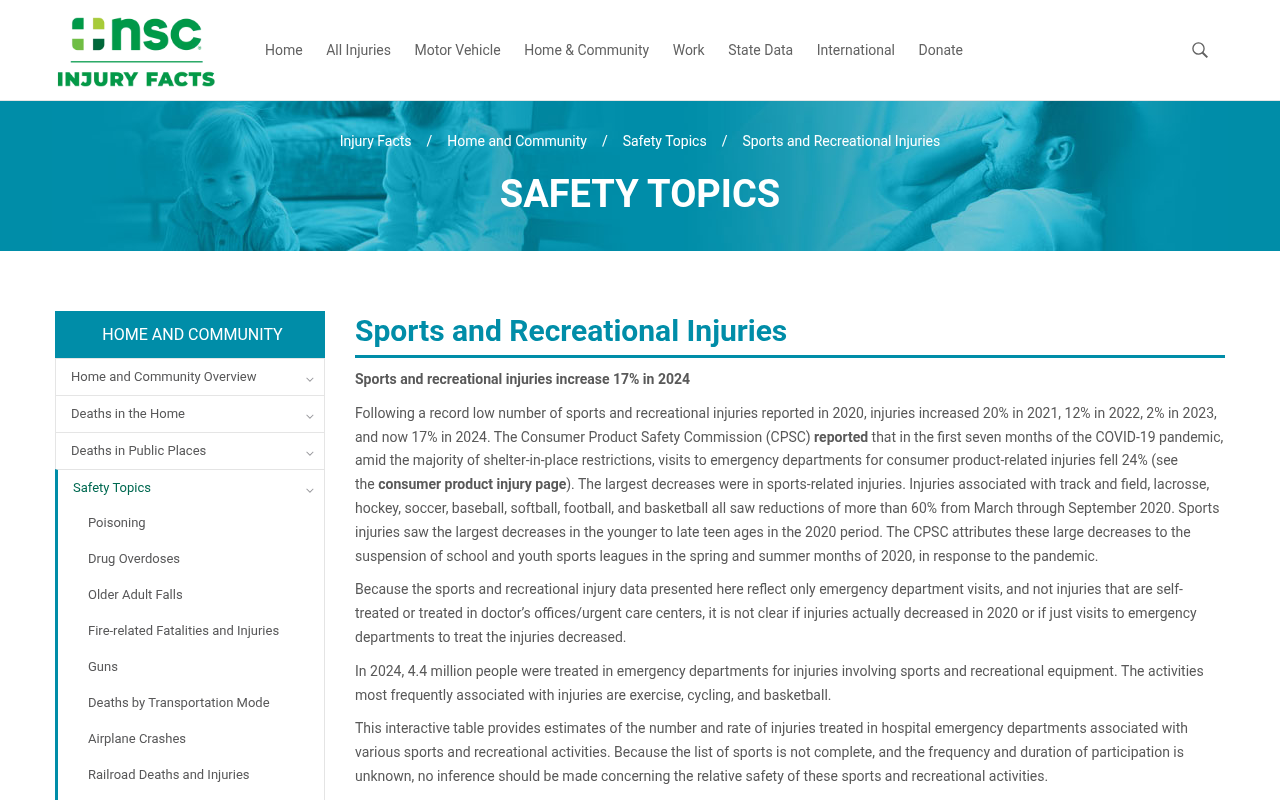
The injury frequency behind these coverages is not theoretical. In 2024, 4.4 million people were treated in U.S. emergency departments for sports and recreational equipment injuries, a 17% jump from 2023 and the fourth consecutive year of double-digit-plus growth (National Safety Council, Injury Facts, analyzing CPSC NEISS data). Recreation-activity categories run heavily on sprains, fractures, contusions, and lacerations. Those are participant injuries. A policy with the participant exclusion attached responds to none of them.
Reference source · National Safety Council Injury Facts (NEISS-based)
NSC Injury Facts page on sports and recreational injuries, 2024 update. Sports and recreational ED visits totaled 4.4 million in 2024 , a 17% rise from 2023, compounding the +20% (2021), +12% (2022), and +2% (2023) of the prior three years. These are precisely the claims a participant-exclusion-laden GL policy will not pay.
Source: injuryfacts.nsc.org/home-and-community/safety-topics/sports-and-recreational-injuries
A generalist agent is not learning your business on your renewal. They are learning it on your claim. By then the exclusion is already in the policy and the carrier is already gone.
Bobby Sharp, Action Sports Practice Lead, Specialty Insurance
That is the difference an operator hears about after a real policy read, not just in the underwriter's voice but in the customer's.
"Specialty Insurance diligently takes their time and works with you, making sure your business has all the correct and specific coverages you need. There is no other source out there that does what they do for the airsoft and paintball industries."
Gel Tag San Diego LLC
Verified customer review
How to tell if your agent is the wrong specialty
Ask your current agent four questions. The answers tell you whether your policy was written by a specialist or a generalist.
- Does my General Liability policy have the CG 21 01 athletic-participants exclusion attached? Send me the endorsement.
- Does my policy include Participant Accident and Participant Legal Liability coverage, named as such?
- Are my outdoor structures and rental fleet scheduled on the property section, at replacement cost?
- If my equipment leaves the building, what covers it?
If your agent cannot answer all four in plain language within 48 hours, the policy was written by a generalist, and the gaps above are probably on it.
What working with a specialist changes
A specialty broker does three things a generalist structurally cannot.
It markets the risk to the carriers that compete for it, not the one carrier that reluctantly tolerates it. That is the difference between three quotes and one declination.
It reads the exclusions before quoting. The participant exclusion, the outdoor-structure exclusion, the products sub-limit, the premises-only restriction: a specialty broker checks each one because each one has produced a denied claim on someone else's policy.
It stays in the class. When an operator adds airsoft to a paintball field, opens a second location, or starts a mobile arm, a specialty broker has placed that exact change before and endorses it correctly. A generalist improvises. Read more in our breakdown of participant injury versus general liability.
Frequently Asked Questions
What is the participant exclusion in a general liability policy?
It is an endorsement, commonly ISO form CG 21 01, that removes coverage for bodily injury to anyone practicing for or participating in a sport or athletic activity the business sponsors. At an action-sports venue it can eliminate coverage for the paying customers.
Can a generalist insurance agent write action-sports coverage?
Some can, but most generalist agents' carriers decline the class or quote it punitively, and generalist agents rarely manage the participant exclusion. Action-sports coverage is reliably placed by brokers who write the class regularly.
Does my general liability policy cover a player injured during the activity?
Often no. If the CG 21 01 athletic-participants exclusion is attached, injuries to participants during the activity are excluded. Participant Accident and Participant Legal Liability coverage close that gap.
Do I still need participant injury coverage if every customer signs a waiver?
Yes. A waiver can be challenged, voided for a minor, or defeated on a gross-negligence claim, and even a successful waiver defense costs money to litigate. Insurance pays defense costs and valid claims; a waiver does neither.
What coverage do I need for a mobile action-sports operation?
Inland Marine for equipment in transit and at off-site locations, plus an off-premise extension on your liability coverage. A premises-only policy provides no coverage once the equipment leaves your address.
Sources
- ISO Commercial General Liability form CG 21 01, "Exclusion: Athletic Or Sports Participants." insurancexdate.com
- US Consumer Product Safety Commission, National Electronic Injury Surveillance System (NEISS). cpsc.gov/cgibin/neissquery
- Specialty Insurance. Why Your Paintball Field's GL Policy Probably Has Gaps
- Specialty Insurance. Inland Marine Insurance for Action Sports
- Specialty Insurance. Participant Injury vs General Liability